Fujirumors is reporting which battery the upcoming Fujifilm X100VI will use: the old NP-W126S.
A lot of Fuji X Weekly readers frequently visit Fujirumors. There’s some crossover between the audience of both websites; however, I’m not a rumor site, and I don’t personally have inside information on upcoming gear. I can only comment about what other people report, and Fujirumors has a reputation of being correct a whole lot more than incorrect. If you want the inside scoop, that’s where you need to go. But I do get asked to comment on the things that Fujirumors reports. Just within the last couple of hours, three different people reached out to me for my opinion on the latest rumor.
I think a lot of photographers—myself included—speculated that, since the X100VI will have IBIS, it will also have the new WP-235 battery. Between the 40mp sensor and the in-body-image-stabilization, there’s a lot of potential battery drainage, so the old battery would be insufficient, and the new battery would be a requirement. In order to use the bigger battery, the camera would need to be larger, at least a little. Plus, the new battery is a tad heavier. The assumption was that the new camera would be a hair bigger and a little heavier to accommodate IBIS and the WP-235 battery.
The X100VI will indeed be a hair bigger—but literally just a hair—as apparently the lens needs to extend just 1mm further out to make room for the IBIS, but otherwise it will be basically identical to its predecessor. I’m sure the camera will be just a smidge heavier, too, but not much at all. By using the old battery—the same battery that the X100V takes—Fujifilm prioritized size and weight on the new model. It seems as though more will be the same than different between the X100V and X100VI, and that’s not bad whatsoever. If it ain’t broke, don’t fix it.
But it definitely raises some questions regarding battery consumption. The expected battery life on the X100F was 390 pictures, and it increased to 420 on the X100V. Those numbers are decent enough, but not necessarily impressive; plenty of battery life most of the time, yet occasionally insufficient. Of course, battery life depends on a whole host of factors, so your mileage might vary. I used to own a Sigma DP Merrill camera that got between 35 and 40 exposures on a battery—about as many frames as a roll of 36 exp film. So it’s nowhere near that; however, it’s also not particularly close to the 580 shots that the X-T5 is rated at. The X-S20, with the old sensor and new battery, can apparently get 750 exposures, which illustrates that the new sensor drains the battery significantly more than the old sensor. So what kind of battery life are we looking at? I’m sure that the Fujifilm programmers worked some magic to maximize efficiency, but it would be pretty shocking if the X100VI can get more than 350 shots… it might even be less than 300. I have no idea, this is mere speculation, and I could certainly be wrong. I’ve been wrong plenty of times before, so definitely take all of this with a grain of salt.
There are, of course, some things that one can do to mitigate battery drainage. For example, on my X-T5, if I know I’ll be shooting all day and need the batteries to last, I’ll turn Image Stabilization Off, and only use it when I need it (most of the time I don’t need it). On my X100V, I like to keep the rear LCD off and use the Optical Viewfinder, which not only gives a film-like shooting experience, but also saves battery. It’s possible to make the battery last quite awhile if you need it to. And, as always, you can keep a spare or two nearby. If you are in a studio, you could always use a tethered faux battery that plugs into the wall.
I think it’s clear that the X100VI—much like the X100V—is a photographer’s camera more than a cinematography tool. With the heat issues and battery drainage—sure, it’s possible to use it for video with much success, but it is far from ideal for that purpose. I don’t use my X100V for video, and don’t anticipate using the X100VI for video, either, even with IBIS. Can you? Absolutely. Is it the best option? Absolutely not.
I’m actually a little glad that the X100VI will take the old NP-W126S, and that Fujifilm prioritized size and weight over battery life. The way I use the camera, I get significantly more than 420 exposures on a fully-charged battery. I can turn IBIS off, and only activate it when I need to, which I’m sure won’t be very often. It’s good to have IBIS as an option, but the reality is that it’s not all that important on a camera like the X100. Size and weight matter more to me. I don’t think Fujifilm’s battery choice will be a big deal for most people (it won’t be for me), but for some it might make the X100V an intriguing choice over the X100VI, just depending on how long the battery will last on the upcoming camera.
I hope to organize a Fuji X Weekly meet-and-greet type event in the Phoenix, Arizona, area sometime later this year. While I’ve been to a few photography gatherings before, I’ve never hosted one. What I’d like to know is what you’d expect or hope for from a Fuji X Weekly meet-and-greet.
Obviously, it could be really simple. Come say hi, as I’d love to meet you. Let’s shake hands and talk gear informally. This would be the most simple to put together, but maybe the least exciting to attend?
It could be more convention-like, with booths from local camera stores and photography-related businesses. There could be presentations or workshops, and perhaps even guest speakers. A small expo would be a heck-of-a-lot more complex to organize, and would likely require an entrance fee to offset the costs. I doubt there would be enough interest to justify anything like this, but maybe this is what people would most want?
A third option is a group photowalk. Let’s not just talk gear, but use our gear. Let’s meet up somewhere and take pictures, perhaps in an urban setting, or some place that’s especially good for photography. If the location is ideal, it could be all in one place, and no need to drive around (other than to the event).
I’m sure there are many other ideas, and I’d love to hear them. Even if you would never come to Phoenix because it is too far away, I’d still greatly appreciate your feedback. I want to make this event special for those who can attend (and, who knows, maybe it will be the first of many?), but I’m unsure what direction it should go. Perhaps one of these ideas resonates with you, or none of them, or some aspect about one is intriguing but another aspect is not. Leave me a comment with your ideas and opinions!
Also, how likely would you attend this event, for those who live near the area? Let me know that, too, with a comment. I really look forward to hearing your input!
I don’t know yet when this meet-and-greet will happen (or even for certain that it will, although I really hope it will). Most likely it will be either in the spring or fall, but preferably in the spring. As soon as I have more concrete answers, I’ll let you know. In the meantime, your input is much needed, and will help me out tremendously. Thank you!
Hasselblad XPan III mockup — Photo by Tony Andersen
Tony Andersen loves XPan cameras. He is from Finland, and has admired Hasselblad for a long time. Tony has the original Hasselblad XPan film camera, and the idea of a digital version excites him. So much so, in fact, that he made a pretty cool mockup of what it could look like—using a Fujifilm X-Pro1. Let’s talk about what makes XPan special, discuss some considerations for a digital model, plus look at Tony’s mockup. We’ll conclude with some current options for XPan photography.
For those that don’t know, XPan cameras were a joint venture between Hasselblad and Fujifilm in the late-1990’s through the mid-2000’s, right at the pinnacle of film. XPan models were interchangeable-lens rangefinder cameras that used approximately two frames of 35mm film to capture panoramic pictures in a 65:24 aspect ratio. These cameras were quite niche and only sold moderately well when they were new, but today they are highly desirable among landscape photographers who still shoot film, and interest in XPan has been seemingly growing recently. Hasselblad and Fujifilm made two models; Hasselblad called theirs XPan and XPan II, while Fujifilm named theirs TX-1 and TX-2. Interestingly, Fujifilm’s X-Pro, X-E, and (especially) X100 series cameras all share some design elements with XPan, and, in a way, can trace their lineage to those models.
The original Hasselblad XPan camera — Photo by Tony Andersen
While it is certainly possible to crop any photograph to the 65:24 aspect ratio, the problem is that you are tossing approximately half of the resolution in the trash. The XPan cameras didn’t utilize a narrow section of 35mm film to create a panorama, but instead used nearly two frame’s worth of real estate. This allowed photographers to achieve high-quality, detail-rich images in a wide format, yet in a camera that was still relatively compact. If one wanted just a regular 3:2 frame, the XPan cameras were capable of that, too. To digitally recreate this, one would need to have a wide sensor with a good deal of resolution. Ideally, a digital XPan camera should have around 50-megapixels (or more), and produce a minimum of 24mp when cropped to 3:2.
Tony’s mockup of a digital XPan camera began with a used X-Pro1. He chose the camera because it has a similar look to XPan, and has essential features: solid build-quality, hybrid-viewfinder, manual retro controls. It has the original X-Trans I sensor, which Tony appreciates. Plus, “it has a nice shutter click sound, which makes the analogue experience better.”
“I used an angle grinder to remove the edge of the lens side viewfinder frame,” he told me, “so that I could continue to make a seemingly wider viewfinder out of it. Then I measured the original XPan and used filler and plastics to model a wider version of the X-Pro1. I didn’t even know I could do sculpturing. I wanted a camera that looks and feels like the XPan. I’ve been working on the X-Pro1 for over a year.”
“I was able to replicate the XPan color with three different layers of spray paint,” Tony continued. “I made from wood a new grip for the X-Pro1 and put leather around it. I found that the original grip on the XPan was uncomfortable and too small.”
Modified X-Pro1 with a coat of spray paint — Photo by Tony Andersen
Modified X-Pro1 on the workbench — Photo by Tony Andersen
Tony used a Fujinon 16mm f/2.8 lens to replicate a Hasselblad 45mm f/4 XPan lens (both have a full-frame-equivalent 24mm focal length). He used a 3D-printer to create a lens hood that disguises the Fujifilm lens to more closely resemble the Hasselblad. He also has an adapter to use the XPan lenses on the X-Pro1. There were only three lenses made for XPan cameras: 30mm f/5.6, 45mm f/4, and 90mm f/4. An 11mm lens for the X-Pro1 would be necessary to replicate the 30mm, but there is no such lens: you can choose either 10mm or 12mm. For the 90mm, the Fujinon 33mm f/1.4 would be the best bet.
Just recently, Tony added a film advance lever from an old Kiev 6C camera to his X-Pro1. The lever is only for looks, and doesn’t actually do anything; however, Tony envisions that if a digital XPan camera were ever manufactured, a film advance lever could be included, and could serve any number of functions. It could be utilized to cock the shutter like on the Epson R-D1, or it could be a programmable lever that activates various features, such as flash, or built-in ND filter, or something like that.
Hasselblad XPan (left) and faux Hasselblad XPan III (right) — Photo by Tony Andersen
XPan Crop — Fujifilm X-Pro1 — Photo by Tony Andersen
While Tony’s “XPan III” has a 16mp Trans I CMOS sensor, he believes that most ideally such a camera should have a 50mp XPan-shaped CCD sensor. The reason why he would prefer a CCD sensor over CMOS is because CCD sensors inherently behave more like film, and can produce images that appear more similar to analog. Theoretically it is possible to program such a sensor to produce “digital film emulsions” where the aesthetic is partially created at the hardware level, and not just from the camera’s firmware or software on a computer. There are advantages and disadvantages to both CCD and CMOS; however, the camera industry has committed to advancing CMOS technology and has put very little into CCD development. It would be intriguing to explore CCD, but almost certainly any digital XPan camera manufactured today would have a CMOS sensor.
To simulate what CCD XPan photographs might look like, Tony captured some images with his Phase One P65+ (which as a 60mp CCD sensor), cropped them to the 65:24 aspect ratio, and edited the files in Lightroom to resemble Velvia 50 and Kodak Panatomic-X film scans. He believes that it should be possible to achieve similar results straight-out-of-camera from a digital XPan III camera.
XPan crop — “Fujifilm Velvia ISO 50” — Phase One P65+ — Photo by Tony Andersen
XPan crop — “Kodak Panatomic-X ISO 32” — Phase One P65+ — Photo by Tony Andersen
Tony hopes that his X-Pro1 project will bring an increased awareness and interest to XPan cameras, both the film models and especially a potential digital version. “Maybe even catch the eye of Fujifilm or Hasselblad.”
“Fujifilm might be the most logical choice for a digital XPan,” Tony stated, “as it would be better placed in their product line. The GFX 50R could be a nice base to build the new camera on. The GFXPan camera could use the current sensor—the 102mp—modify it to 44x17mm by removing the upper and lower rows to achieve a 65×24 aspect ratio. Then redevelop the firmware to use only this aspect in the viewfinder, maybe redesign the optic for 2.7:1 wide like the XPan.”
It was with Fujifilm’s partnership that the XPan film cameras were made, and it was with a Fujifilm X-Pro1 that Tony made an XPan III mockup. I find the idea of Fujifilm creating a digital XPan camera—called TX-3 or GFXPan—highly intriguing. It could be with a slightly stretched sensor inside an X-Pro body (similar to Tony’s mockup). Much more likely, it would be something in the GFX realm; however, it would need to have the retro controls and styling like the GFX 50R, and not be a PASM model like most GFX cameras. Obviously, either way, it would be a niche product, but it seems like there is enough interest—and a growing interest—that such a camera would sell well enough to be profitable. It would certainly make headlines! People would be talking about Fujifilm, which would be good for Fujifilm.
For some unknown reason, Fujifilm X-series cameras inexplicably don’t have the XPan aspect ratio as an in-camera option (GFX cameras do, though). I would strongly encourage Fujifilm to include the 65:24 aspect ratio on their X-series cameras with the 40mp X-Trans V sensor. It would be simple for them to do, and it seems like an obvious no-brainer. It would be amazingly cool if they ever produced a digital XPan, but at the very least Fujifilm should offer the XPan aspect ratio as an option in the X-series. Yes, you can do it with post-editing software, but I much prefer to do things in-camera whenever possible.
XPan Ratio — iPhone 14 Pro — RitchieCam App — Slide Film Filter — Photo by Ritchie Roesch
XPan Ratio — iPhone 14 Pro — RitchieCam App — Slide Film Filter — Photo by Ritchie Roesch
I don’t know if a digital XPan III will ever come to fruition, but there are currently a few cameras to consider if you are looking for an alternative. Fujifilm GFX models have the XPan aspect ratio as an in-camera option, and they also have plenty of resolution and film-like results; however, only the GFX 50R has the retro-styling and controls similar to the film cameras, which means that the GFX 50R is your best bet. Most Fujifilm X-series cameras have the retro design and controls plus film simulations and Film Simulation Recipes; the X-T5 and X-H2 have enough resolution, but you have to crop to XPan post-capture. The Panasonic S1R has sufficient resolution and the XPan aspect ratio as an in-camera option, but it doesn’t deliver the retro experience or film-like straight-out-of-camera results. My RitchieCam iPhone App also has the XPan aspect ratio; when used with the 48mp 1x camera on the iPhone 14/15 Pro/Pro Max, it has enough resolution, and is an in-your-pocket option that produces film-inspired results straight-out-of-camera. None of these are fully ideal. Hopefully someday Fujifilm and/or Hasselblad will release an XPan III camera with a 65:24 sensor shape. As it stands now, these are your best alternatives to a camera that does not yet—and may never—exist, but should.
I want to give Tony Andersen a big “thank you” for sharing his XPan III mockup and photographs. Hopefully Tony’s enthusiasm for the XPan format will some day result in an XPan III type camera from one of the camera manufacturers. It definitely deserves to happen someday, and Fujifilm seems like the perfect camera maker to do it.
I don’t know about you, but I received several Amazon gift cards for Christmas. You might want to use those gift cards to purchase some photography gear, but perhaps you are not sure what to buy. So—if you are stuck—let me offer you some ideas. Since this is a Fujifilm blog, these items are mostly geared towards Fujifilm photographers.
This post contains affiliate links, and if you make a purchase using my links I’ll be compensated a small amount for it.
$25
If your Amazon gift card is $25, here are some camera things you can buy:
Yesterday, MPB (“an online platform for used photography and videography equipment”) published an article entitled How to Install and Use Fujifilm Recipes, which was largely written by Michael Schulz. I knew that this story was in the works because MPB had reached out to me several weeks ago just to make sure that it was ok to mention Fuji X Weekly in an upcoming piece; however, I only found out that it was published because I noticed a number of clicks to this website from theirs within today’s daily stats. What I love about the MPB article are the lovely photographs by Michael captured with his Fujifilm X100V, using mostly the Pacific Blues, Kodak Gold 200 (or is it this one?), and Kodak Portra 400 v2 (maybe Vibrant Arizona, too…) Film Simulation Recipes. It’s a real testament to what can be done straight-out-of-camera with Fujifilm models.
I was thinking today: why are camera stores talking about Fuji X Weekly and Film Simulation Recipes? It would be more obviously understood if I had merchandise for sale in their stores or on their websites, but I don’t. What’s in it for them? I think the answer is pretty simple: Fuji X Weekly Recipes sell Fujifilm cameras.
Golden Light in Abandoned House – North Salt Lake, UT – Fujifilm X100V – Fujicolor Reala 100 Recipe
Recipes are one of the reasons why the X100V has been so hard to find for over a year now. Social media influencers began saying that the X100V’s pictures “mimic film” and require “zero editing”—next thing you know they’re out of stock everywhere. With a little research I found out that these influencers were using my Film Simulation Recipes.
If you have a camera store and want to move your Fujifilm inventory, the best way is to point out to customers that the straight-out-of-camera pictures look so darn good, and post-editing isn’t necessary. Specifically, Film Simulation Recipes make it easy to get great-looking pictures without fuss, which can make photography more accessible and enjoyable, saving tons of time and frustration. There’s even an app! I think Fujifilm themselves have overall done a fairly poor job of communicating this; it’s been influencers and camera stores and really just word-of-mouth by Fujifilm photographers that has spread the message to the community at large. Outside of Fujifilm circles, this whole concept is fairly unknown or misunderstood, so there’s still a lot of work to go. MPB’s article will help; hopefully there will be more like it in the near future.
Since Fujifilm has discontinued what was their entry-level models (such as the X-T200 pictured above), it’s a little more expensive nowadays to get into the X system. If you are on a tight budget, your options are limited, but you still have some good cameras to choose from. Note: this article is based on current pricing as of the time of publication. Let’s dig into this!
This post contains affiliate links, and if you make a purchase using my links I’ll be compensated a small amount for it.
If your budget is $1,000 and you want something brand-new:
That is your only option, but it is a good one; however, if you think outside the box, there’s another way to approach this:
Choose one of the cameras below: Fujifilm X-T30 II — Amazon — B&H — Moment Fujifilm X-S10 — Amazon — B&H — Moment Add one of these lenses: 7Artisans 25mm f/1.8 — Amazon Meike 25mm f/1.8 — Amazon Meike 35mm f/1.7 — Amazon Meike 35mm f/1.4 — Amazon 7Artisans 35mm f/1.4 — Amazon TTArtisan 35mm f/1.4 — Amazon TTArtisan 50mm f/2 — Amazon Meike 50mm f/1.7 — Amazon
If your budget is under $1,000:
You’ll have to go the second-hand route. Some places to look are B&H’s used department, KEH, MPB, and eBay. I’m sure there are other websites, too. Some used camera models to consider are:
If you shop around, it’s possible to find a good deal, and even get a Fujifilm camera and lens for less than $400. Almost no matter your budget, there are options, but the less you have to spend, the more difficult it will be and the fewer choices you’ll have; however, don’t fret! Just keep an eye out for good deals, and with some patience you are bound to find something that you can afford. My introduction to Fujifilm, which was on a tight budget, was via a used X-E1. I know first-hand that it is possible.
With Christmas just 10 days away, you might be looking for some last-minute camera deals as a gift to yourself or a photographer (or budding photographer) in your family. This website is all about Fujifilm, and for the most part there haven’t been a lot of Fujifilm deals. There hasn’t been a lot for me to recommend to you. You can always pay full price for gear, but you don’t need me to point that out—the service that I’d rather offer is showing where you can save some money. So let’s get into that.
This post contains affiliate links, and if you make a purchase using my links I’ll be compensated a small amount for it.
It’s a really good time to get into GFX if you’ve been thinking about it, as that’s where the best discounts are. The 50mm f/1 lens is $300 off, and that’s the most intriguing bargain to me, personally. The 90mm f/2 is one of my favorite lenses; while the discount is only $100, it is on sale, and it’s an easy one for me to recommend. If you’ve thought about doing some serious cinematography with Fujifilm, the X-H2s bundled with the cinema lenses are significantly discounted. Otherwise, the deals are pretty pedestrian right now.
A Fujifilm X100V captured with a Fujifilm X-T5 + Fujinon 90mm + Reala Ace Recipe
Fujifilm has never asked me what I’d like for Christmas, nor do I expect them to ever ask that question. I do believe there is a chance that they read this website occasionally, so I thought I would take a moment to share with them—on the off-chance that they find this article—some gear that they could “give” to me that would really make my holiday special. To be clear, I’m not suggesting that Fujifilm should send me free products (although, if they ever did, I wouldn’t say no…); instead, this is simply a list of gear that I’d love to see Fujifilm release, which would be the perfect Christmas gift for me, and probably a lot of you, too.
I don’t want to take up too much of your time, so let’s dive right into my Fujifilm Christmas Wish List! The order is least-to-most desired, but really I’d be happy with any of them.
#10 — Fujinon 135mm f/2.8
The longest prime lens that Fujifilm offers—aside from the really huge and extremely expensive 200mm f/2—is the Fujinon 90mm f/2, which is one of my absolute favorite lenses. I feel like there’s a massive gap that should be filled to some extent, and a 135mm option seems quite logical—after all, it used to be a very common focal length.
This theoretical 135mm Fujinon lens, which would be 202mm full-frame-equivalent, shouldn’t be too large or expensive. For example, I have a vintage Vivitar 135mm f/2.8 lens that is surprisingly compact. So the design team goals should be to keep it a similar size and weight to the Fujinon 90mm f/2, and with an MSRP no more than $1,200 (under $1,000 would be even better). Of course some compromises might be necessary, and one that I’m ok with is the maximum aperture; I’d prefer f/2.8, but f/3.5 would be fine if something’s got to give (the price should be a little less if it is f/3.5). I think such a lens would be appreciated by those who find the 90mm not-quite-long-enough sometimes, which would likely be a fairly sizable group. I could see it being used by some sports, wildlife, portrait and landscape photographers. Yes, there are several zooms that cover the longer focal lengths, but some of us (myself included) much prefer primes over zooms.
#9 — Fujifilm GFX100R
I’m not in the GFX system, but if Fujifilm ever made a GFX100R, I’d buy it. I cannot afford GFX gear, but I’d still buy it. Why? XPan. Such a camera would be the closest one could get to an XPan III, the digital version of the XPan II. The GFX100R would produce 50mp 65:24 aspect ratio images. A GFX50R II would be alright, too, but a GFX100R would be even more spectacular.
Yes, I know the GFX100 and the GFX100S and the GFX100 II (and even the upcoming GFX100S II) are capable of 50mp XPan-crop pictures, but none of them will provide an XPan-like experience. The only camera that’s close is the GFX50R, but that model is five years old now and missing the latest film sims and JPEG settings and such. Ideally, whether it is a GFX50R II or GFX100R, the body should be X-Pro like in design. One other option that Fujifilm could consider is a GFXPan, where the sensor is shaped in the 65:24 aspect ratio instead of 4:3 (basically, the current 100mp sensor, but half as tall). That would be incredible!
#8 — Fujifilm X-Pro4
This one is near the bottom of the list because 1) I suspect that it’s already well in the works and 2) I don’t know how they’ll make it better than the X-Pro3, aside from some things that could just be a firmware update. So what do I think Fujifilm could do to make the X-Pro4 different-enough from the X-Pro3 to justify it? One idea is an APS-H sized sensor with maybe 50-ish megapixels. That would not only garnish a lot of attention, but it would (more importantly) allow for an XPan crop with over 20mp, and perhaps as much as 25mp. Whether they do this or use the 40mp APS-C sensor of the X-H2 and X-T5, they should still include the XPan aspect ratio as an in-camera option. Another idea is IBIS. A lot of people would welcome that, and it’s probably expected from a camera of this price point, but Fujifilm needs to be careful with how it affects the size, weight, and cost. Most likely, aside from a bump in pixel-count, the biggest change will be a different rear screen. I don’t have any idea how they’ll change it, but I’m certain that they will do so in some way. I think the OVF should be made to be more like the one in the X-Pro2.
#7 — Fujifilm X-Pro3 Acros Edition
While we wait for the X-Pro4, Fujifilm could release a monochrome-only version of the X-Pro3. This camera would make some big headlines, and get a ton of attention. While such a model would surely be niche, Pentax proved that it could still be successful, and I think there’s been enough interest in the Fujifilm world for such a camera that it will sell out, however many copies Fujifilm decides to make. I’d certainly buy one if Fujifilm ever decided to produce it. Heck, I’d buy one almost no matter what body they decided to do it with, but the X-Pro makes the most sense to me, followed closely by the X100.
#6 — Fujifilm X100Z Variants
We’ve known for awhile now that the next Fujifilm camera will be the X100V successor. I don’t know what they’ll name it, but my guess is X100Z. The X100V successor is not in this list because we already know that it’s coming, and it will probably be announced next month, or early-February at the latest. What I would like to put on this wish-list are variants of the camera. For example, Sigma made three versions of the DP Merrill models, and four of the DP Quattro. They were all basically the same, except for the lens permanently attached to the front. I could see Fujifilm doing something similar, with maybe a 30mm-ish “standard” lens, another with a 50mm-ish portrait lens, and maybe a wide-angle version with a 14mm or 16mm lens, to go along with the main 23mm option. Fujifilm could sell multiple versions of the X100Z (or whatever they name it), just with different focal-length lenses. Not only would people be able to buy their preferred focal length option, but you’ll have some people buy all of them.
#5 — Another Fujinon Pancake Lens
A big advantage to APS-C over full-frame is the size and weight of the gear, so it is shocking to me that Fujifilm has only two pancake lenses: the 27mm f/2.8 and 18mm f/2. The 18mm model is only kind-of a pancake, and is in desperate need of an update. Fujifilm should have a series of pancake offerings. Maybe a 16mm f/3.5, the 18mm f/2 (but updated, please!), a 23mm f/2.8, the 27mm f/2.8, and maybe a 40mm-ish f/2.8. It would make my day if Fujifilm were to announce even one more pancake lens, and it would make so much sense if they did.
#4 — Fujifilm X-E5
I had to include this—and put it fairly high on this list—because Fujifilm has indicated that the X-E line might be finished. It would be a huge shame if that’s true. I love the X-E line, and the X-E4 is one of my favorite models. This line is especially great for travel, and is the perfect body to pair pancake lenses with. I don’t need a new X-E camera, but I don’t want this line to end, so I would consider buying an X-E5 just to show support for its continuation in the lineup. Hopefully this will encourage Fujifilm to produce an X-E5, perhaps in time for Christmas 2024.
#3 — Fujifilm Minimalist Model
I would love a rangefinder-styled camera without all the bells and whistles. Just the basic controls that you need. It should have a shutter knob with an ISO ring, a C1-C7 knob, and exposure compensation knob on the top. It must have an M/C/S switch somewhere. Otherwise, it should be kept clean and simple. No rear screen, only a box-top screen like on the X-Pro3, but it should have a hybrid viewfinder. No video mode or even the Advanced Filters and such. It should be a “pure photography” concept that delivers the most film-like experience of all the models. I don’t think Fujifilm would ever consider such a camera, but they absolutely should have a “digital-film” model. This concept would seem to fit Fujifilm’s profile perfectly! Maybe call it simply the X1.
#2 — Fujifilm X200
A lot of people have basically demanded that Fujifilm should jump into the full-frame market, but they’re not going to, and in my opinion it is a smart move. They’d go from being a big fish in a decent sized pond to a small fish in a large and overcrowded pond. One big problem is that they’d have to develop a whole new line of lenses, which, if they weren’t successful, could bankrupt the division. One way that Fujifilm could dip their toes into the full-frame market in a way that’s pretty much guaranteed to be successful and won’t require the new-lens-lineup investment—in other words, somewhat small risk and big reward—is to make a full-frame version of the X100-series. Call it the X200. Perhaps differentiate it from the X100 by giving it a 30mm (going slightly more wide-angle) or 40mm (slightly more telephoto) lens, and increase the maximum aperture to f/1.8. If full-frame is simply out of the question, perhaps go the fuller-than-full-frame route, and make a GFX200, which would be a GFX version of the X100. Personally, I would have a hard time saying no to such a camera.
#1 — Fujifilm X80
The Fujifilm X70 was such a great little camera! It had a much-too-short production run thanks to Sony’s sudden discontinuation of the sensor inside that model, and it’s a real shame that Fujifilm never made a successor. Especially considering how well the Ricoh GR III is selling right now, it would make a lot of sense for Fujifilm to produce a successor to the X70. From what I can tell, the demand for such a camera has been increasing. So many people have told me that they’d buy one. I know that I would be first in line! Come on, Fujifilm! Make an X80 already! Consider it your Christmas gift to me and all of your customers who have been dreaming of it for years.
The cost of a second-hand Fujifilm X-E4 is completely out of hand!
Before we get to that, let’s rewind this all a bit. Fujifilm released the X-E4 in late-February 2021. I preordered my copy, which arrived in early March. The X-E4 was the fifth in the X-E line, which began in 2012 with the X-E1, Fujifilm’s second interchangeable-lens X-series model (the X-Pro1 was the first). The X-E2 came out only one year later, and the nearly identical X-E2s was released three years after that. The X-E3 was released in 2017, and rumors floated around that it might be the last X-E camera.
The X-E line is much beloved by those who own them. It’s a combination of beautiful rangefinder styling, diminutive size, simplicity, and affordability, while producing images that are equally as good as the bigger and more expensive models. But sales have always been so-so. The X-E3, in particular, was a slow-mover, and it was possible to buy a brand-new copy for less than MSRP as recently as last year. Two years ago the X-E3 was on sale for $560. This is to say that the X-E line is niche, even within Fujifilm, which is itself sort of a niche brand; however, it’s a much loved series by many who have had the pleasure to use them. The X-E1 was my gateway into Fujifilm; today the X-E4 is my second-favorite camera, only behind the X100V.
With the X-E3 not moving particularly quickly, Fujifilm seriously considered discontinuing the X-E line. But with the discontinuation of the low-budget X-A and X-T000 cameras, plus a vocal outcry from their customers, I believe Fujifilm had a change of heart, so the X-E4, with its minimalistic design, was born. However, between the global parts shortage and the expected so-so sales, Fujifilm didn’t produce as many copies as other cameras. My guess is that they were concerned that unsold boxes of the X-E4 would be sitting around for years like with the X-E3 (and, to an extent, the X-E2s before that, and the X-E2 before that, and the X-E1 before that), so Fujifilm made the decision to discontinue the X-E4, and divert manufacturing resources to other cameras, like the X100V, X-T5, and X-S20.
What Fujifilm did not anticipate is that the sudden success of the X100V—thanks to social media and Film Simulation Recipes (to a degree)—would spill over to the X-E4. Since it became so hard to get a copy of the X100V, and new orders were being placed faster than Fujifilm could manufacture the camera—with backorder lists six months long—people began to look for alternatives. The X-E4, especially paired with the 27mm pancake, was a top alternative suggested for those who wanted an X100V but couldn’t get one. The X-E4, which was already hit-or-miss to find, was now sold out everywhere, and Fujifilm couldn’t manufacture new copies nearly fast enough.
Even though the X-E4 was suddenly super successful, Fujifilm inexplicably discontinued it back in March of this year, just two years after it was initially released. I believe that Fujifilm had already decided to discontinue it, and cease manufacturing at a certain point—not secure the necessary parts to make more copies—and they followed through with their plan despite the increased demand. In my opinion, this was a big mistake. Apparently, Fujifilm may have also planned to quietly discontinue the X-E line with the X-E4. My hope is that they change their minds and create an X-E5, but I’m not holding my breath, because it probably won’t happen. Maybe articles like this will convince them otherwise.
Working – Salt Lake City, UT – Fujifilm X-E4 & Fujinon 27mm f/2.8 – Kodak Vision3 250D
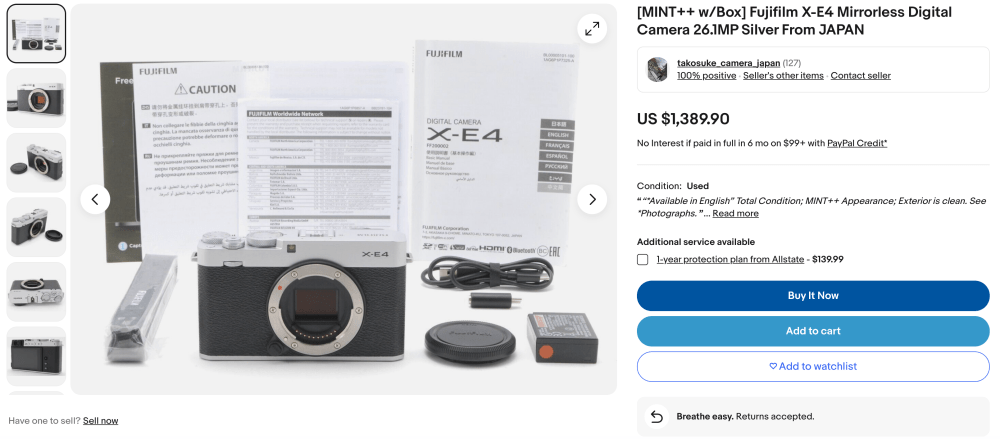
Since the X-E4 was discontinued while demand was high, the prices of used copies has skyrocketed, as reported by Fujirumors. I began this article prior to Patrick publishing his, but got busy with other things before finishing it, then I saw his post on the subject. I questioned if it was even worth publishing, but, after thinking about it, I decided to finish this article. I believe that I have a divergent-enough take on this topic that it’s worthwhile to publish anyway.
Used copies of the X-E4 are being listed for sale for 50% to 100% more (and sometimes higher!) than the camera cost when brand new. Crazy! It’s simple supply and demand. There’s a lot of demand, and Fujifilm didn’t manufacture nearly enough supply. So now, if you want an X-E4 you’re going to pay through the teeth. Even the X-E3 is selling for more than it was, although it still seems pretty affordable—if you can’t find an X-E4, buy an X-E3 instead. I love my X-E4, but I wouldn’t recommend buying one for these prices. What it really shows is that Fujifilm should make an X-E5, or start manufacturing more X-E4 bodies. It’s a wasted opportunity.
Below are some screenshot examples I found of the insanely inflated X-E4 prices. If you are trying to buy one, I sincerely wish you the best of luck finding one for a reasonable cost.
When people discuss their camera gear, they mostly talk about their camera bodies and lenses. Photography accessories are sometimes overlooked, but they can be just as important. While I’m most commonly asked about cameras and lenses, occasionally someone inquires about my “other” gear, wanting to know what I use and why, and what I recommend. In this article I’ll briefly discuss each camera accessory that I use and why I use it.
The way that I’m going to do this article is I’ll talk about which accessories I currently use with various camera bodies. I’ll begin with the Fujifilm X100V and continue on until I’ve covered all of the different accessories.
This post contains affiliate links, and if you make a purchase using my links I’ll be compensated a small amount for it.
Fujifilm X100V Accessories
I don’t have a lot of accessories for my Fujifilm X100V, but the ones I do have are very important. First, I have a Hoagle filter adapter (Amazon). Using a filter adapter on the X100V (in conjunction with a filter) makes the camera weather-sealed, as the only part that isn’t weather-sealed is the front lens element—simply screwing on a filter fixes this, but it requires an adapter. There are a number of brands who sell one, including Fujifilm themselves (Amazon), but I use Hoagle because it’s cheap and it works. I always use a filter, either a Fotasy 49mm UV filter (Amazon), or one of several diffusion filters: Tiffen 1/4 Black Pro Mist (Amazon), which I used in conjunction with the KodaNeg Film Simulation Recipes, 5% CineBloom (Amazon), 10% CineBloom (B&H), or 20% CineBloom (Amazon). Of these filters, the 5% CineBloom and Fotasy UV are the two most commonly used, and the 20% CineBloom is the least used. Shooting with diffusion filters is the third suggestion in my 7 Tips to Get the Film Look From Your Digital Photos article. You can also stack them to achieve a dreamy look.
What else? I found the camera strap used on eBay. I have a Monfrotto Compact Action Aluminum Tripod (B&H), which I do use occasionally with this camera (and my other cameras). Otherwise, that’s it.
Fujifilm X-E4 Accessories
I don’t really have any accessories for my Fujifilm X-E4, but I thought I’d take a moment to talk about lens adaptors. Fujifilm cameras are especially great when paired with vintage lenses, which typically have more character than modern glass. This is the fourth suggestion in my 7 Tips to Get the Film Look From Your Digital Photos article. To use vintage lenses, you’ll need an adapter, and I currently have three: M42-to-Fuji-X, M39-to-Fuji-X, and Pentax-110-to-Fuji-X. The M42 and M39 adapters are nondescript ones I purchased on eBay for cheap six years ago, but the Fotasy M42 (Amazon) and M39 (Amazon) would work just fine, and are inexpensive. My Pentax-110 adapter is made by Fotasy (Amazon).
Another thing worth noting is that, because of the compact size of the X-E4 and X100V, the National Geographic NG 2344 Earth Explorer Mall Shoulder Bag (Amazon) works really well for me, better than any other camera bag I’ve ever owned—I don’t travel without it.
Fujifilm X-T30 Accessories
I don’t have a lot to add with my Fujifilm X-T30, so I’ll take the opportunity to bring up SD cards and batteries. Because I’ve been shooting for awhile, I have tons of memory cards lying around, but the one I use the most is SanDisk Extreme Pro 128GB (Amazon), which I own several of. I have a number of spare Fujifilm NP-W126S batteries (Amazon); I do own a couple third-party batteries, but I don’t like using them, and only do so in a pinch, which is very infrequently. I love the Nitecore USB Camera Battery Charger (Amazon), which just so happens to fit really well in one of the pockets in my camera bag.
Fujifilm X70 Accessories
My Fujifilm X70 came with an official Fujifilm leather half-case (Amazon), which I absolutely love! If mine hadn’t come with this, I probably wouldn’t have purchased the case because I wouldn’t have realized what I was missing. Definitely “worth it” in my opinion; however, I’m sure some of the cheaper third-party options are nearly as good for a fraction of the cost.
Fujifilm X-H1 Accessories
The final accessory that I want to bring up for my Fujifilm gear is my studio lighting: Phottix Nuada R3 II two-light kit (Amazon). I don’t use artificial lights very often, but occasionally I do (like here and when I do the SOOC broadcasts), and the Phottix Nuada R3 II is absolutely great. Best lights I’ve ever owned—bright, versatile, compact, lightweight. I’m sure they’re not for everyone, but if you’re thinking about buying some studio lights and are unsure what to get, I do recommend this kit.
iPhone 11 Accessories
Since I created my very own iPhone camera app—RitchieCam—it should come as no surprise that I have a couple of iPhone accessories: Moment Tele 58mm lens (Amazon) and Moment MagSafe Tripod Mount (Amazon), which require a Moment cellphone case (Amazon). Completely worthwhile, in my opinion.
I own a shelf-full of different accessories that I’ve collected over the last nearly 25 years, but the ones mentioned in this article are the ones that I actually use. There are a number of items that I have used before, but have parted ways with or sit collecting dust, so I didn’t mention them. I’m sure I could list a number of accessories that I wish I had, but this article is about what I currently use. For some of you, this list might seem surprisingly short. For some of you, this list might appear to have unnecessary or redundant items. A lot of times I think that less is more, particularly with camera gear, but if there’s something you’ll actually use, it’s likely worth having around.
Amazon invited me to be an “Influencer” on their website. I never thought I’d be called an influencer, but I suppose to an extent I am (hey, I now have over 18K followers on Instagram! Thank you!). I certainly didn’t set out to be one. I’m just trying to be helpful as we journey together photographing with Fujifilm gear.
What does being an Amazon Influencer mean? Not much. I have a “Shop” on Amazon.com. Basically, I recommend products, and write a little blurb with a photo. It’s an affiliate program, and if you make a purchase, I get compensated a small amount. I have affiliate links already on this site, and every once in awhile you might see them. I try not to be pushy with the affiliate links, but they do generate a very small amount of money that helps pay the bills and such, so I include them (hopefully unobtrusively) when I can. It doesn’t cost you anything, and it helps to support this website. I appreciate those who do use them!
I didn’t realize at first, but there’s another way to view and interact with what I publish on Amazon (click here). It’s set up more like a social media feed, and I see potential to publish meaningful content through this view. I hope to make it meaningful, anyway, so that it’s worth your time if you should visit. I just started it, so there’s not much currently there, but more will be added in the coming days, weeks, and months.
Feel free to follow me on Amazon. Or feel free not to. Either way. I promise I won’t be pushy with it, and I hope this is a positive thing somehow for the Fuji X Weekly community.
There are some really great deals on certain Fujifilm cameras right now. These aren’t necessarily “Black Friday” deals, but they are certainly great for holiday shopping or if you’ve been eyeing one of these for awhile. I want to bring special attention to the Graphite X-Pro2 with the Fujinon 23mm f/2 lens, which has been deeply discounted, and you’re not likely going to find it for cheaper. Need a second camera body? The X-T20 and X-E3 are dirt cheap right now. The X-T100 is at a rock-bottom price. It’s what I would gift to a family member who has been asking for a camera. Heck, for the price, I might pick one up for myself!
This post contains an affiliate link, and I will be compensated if you make a purchase after clicking through my link.
The new Fujifilm X-Pro3 will be released on November 29, and there’s a lot of buzz around it, but what about the X-Pro2? Is it still relevant? Is it a camera that you should consider? Is it a good option even though it has the old sensor and processor? I hope to answer those questions in this review.
The X-Pro2 was released way back in March of 2016. It replaced the X-Pro1, which was the very first X-Trans sensor camera by Fujifilm. The X-Pro2 was the first camera to have the 24-megapixel X-Trans III sensor. The X-H1, X-T2, X-T20, X-E3 and X100F would later share this same sensor and processor. The 26-megapixel X-Trans IV sensor, which is the same sensor found in the upcoming X-Pro3, was introduced with the X-T3 in September of 2018. The X-Trans III sensor inside the X-Pro2 is almost four-years-old, and perhaps a year out-of-date, but is it still good?
The main advantage of the fourth generation sensor over the third generation is heat. The new sensor runs cooler, which means it can be pushed further. It’s quicker, and the processor can be asked to do more. There’s very little image-quality difference between the two sensors. Pictures captured with the X-Pro3 won’t look much different than those captured with the X-Pro2. But the older camera won’t be as quick, especially regarding auto-focus, and it has fewer features. The X-Pro3 is loaded with new tools, which may or may not be useful to you. Even though the X-Pro2 isn’t as quick or feature-rich, it’s still sufficiently quick and feature-rich for most photographers.
The X-Pro line isn’t about quickness anyway. It’s about having a solid quality camera that’s a joy to use. It feels good to have in your hand and to hold to your eye. It’s something to take to the city and wait for just the right light and moment. It’s a photographer’s tool. And what a great tool it is!
Something that I appreciate about the X-Pro2 is that it’s weather-sealed. Pair it with a weather-sealed lens, and you can use it in situations that you wouldn’t dare take another camera. For me that was the Great Sand Dunes National Park in Colorado, where the winds were whipping the sand, which pelted my skin. The X-Pro2 handled it like a champ, and I was able to “get the shot” that I was after.
Another thing that I really appreciate about the camera is the viewfinder. The X-Pro2 has a unique hybrid viewfinder that can be used electronically or optically. It’s a part of the experience of the camera. The X-Pro line isn’t about test charts or stat sheets, it’s about the user experience. Fujifilm calls it “pursuing pure photography” with “a body design that maximizes practicality.” While the X-Pro2 offers identical image quality and similar features to the X-T2 (and, really, the X-T20), what sets it apart is the experience of it, and the great viewfinder is a big part of that.
Even though the X-Trans III sensor is almost four-years-old now, it doesn’t come across as “old” in practical use. It offers more than enough resolution, dynamic range and high-ISO capabilities for most people and situations. The X-Pro2 is plenty quick and feature-rich to warrant consideration. It wasn’t designed to be your typical “throw-away” digital camera, which you own for perhaps two years, and then unload on eBay at a bargain basement price when the latest model is released. The X-Pro2 was intended as a camera that you keep for years. It’s a camera that you’ll still want to have around when it’s ten years old, and if it still has some clicks left in the shutter, perhaps longer.
The X-Pro2 is a beautiful camera! I think the only camera that’s better-looking in the Fujifilm lineup is the X100F, and only by a little. Fujifilm got the design right, and it’s cameras like this that have given Fujifilm a great reputation. Strangers will ask you about the camera around your neck, and fellow photographers will comment to you about the beautiful design. There’s a certain pride in owning one.
I don’t want to dive deeply into the technical aspects of this camera. I’m not going to share stat sheets or show massive crops comparing the image quality to other cameras. You can readily find that information on the web. What I want to offer is my opinion of the X-Pro2. Is it a good camera to buy?
If you are in the market for a camera and are considering the X-Pro2, but you are unsure because it’s not the latest-and-greatest, I want to help you. You will love it! But with the caveat that the X-Pro series isn’t for everyone. If you are the type of person who has to have the newest, fastest and greatest, this might not be the best camera for you. If you find yourself constantly searching the internet for side-by-side crops to compare the tiny differences between cameras, this one might not be for you. If you are the person who buys a new camera every year, you might want to consider something else. If you’re the kind of person who likes to capture pictures at your own pace and in your own way, and you appreciate the way Fujifilm cameras render images, then the X-Pro2 might very well be a good choice. If you are after an experience that’s different from your typical digital camera, something with an analogue soul perhaps, the X-Pro2 is something you should strongly consider. It’s a great camera, even in 2019, and I’m sure still in 2026, and while it’s not for everyone, I do believe that most people would appreciate it.
These are affiliate links, which, when you purchase something using them, I get a small kickback. It doesn’t cost you anything, yet it helps to financially support this website. I would never ask you to purchase something that you don’t want, but if you found this article helpful and are planning to buy this camera, using my links to do so helps me tremendously. Thank you for your support!
Example photographs, all camera-made JPEGs from my Fujifilm X-Pro2:
Twisted Tree – Keystone, SD – Fujifilm X-Pro2
Jacob’s Ladder – Taos, NM – Fujifilm X-Pro2
Passerby – Great Sand Dunes NP, CO – Fujifilm X-Pro2
Storm Over San Luis Valley – Alamosa, CO – Fujifilm X-Pro2
Old Truck & Mt. Lindsey – Fort Garland, CO – Fujifilm X-Pro2
Clouds Around Timpanogos – Heber City, UT – Fujifilm X-Pro2
Bells & Crosses – Taos, NM – Fujifilm X-Pro2
Needle’s Eye Night – Custer SP, SD – Fujifilm X-Pro2
Night Sky Over Needles Highway – Hill City, SD – Fujifilm X-Pro2
Securely In Father’s Arms – Mount Rushmore NM, SD – Fujifilm X-Pro2
From Dust To Dust – Great Sand Dunes NP, CO – Fujifilm X-Pro2
Drummond Ranch – Pawhuska, OK – Fujifilm X-Pro2
Red Leaves In The Forest – Wasatch Mountain SP, UT – Fujifilm X-Pro2
Green & Blue Mountain – South Weber, UT – Fujifilm X-Pro2
Nobody pays me to write the content found on fujixweekly.com. There's a real cost to operating and maintaining this site, not to mention all the time that I pour into it. If you appreciated this article, please consider making a one-time gift contribution. Thank you!
For those looking for great deals on Fujifilm gear, X-Trans III sensor cameras have the best bargains currently. Cameras like the X-T2, X-T20 and X-E3 are priced pretty darn low, and they’re still excellent and worth owning. I know that the X-Pro3 has received much attention lately, but don’t overlook what’s available right now, and at such cheap prices, too!
Below are my affiliate links, and if you make a purchase using the links I will be compensated a small amount for it.
Have you visited my Fujifilm Gear page? The intention of this new page is to make it more convenient to find camera and lens reviews, recommendations, and links to buy. Up until recently it has been difficult to find that information because you had to dig for it. The articles were on this blog, but you might have missed them when they were new and perhaps were unaware of their existence, or didn’t know how to locate them. Now it’s all in one easy-to-find place, which should improve the Fuji X Weekly experience, at least a little.
As I write more articles, I will expand the page, adding relevant material. As best as I can I will keep the links accurate so that you can see what gear is available and what’s on sale, which will hopefully make gear shopping a tad easier for you. I’m hoping that this will be a good resource, and it will be a page that you’ll return to often. I’ve made a few additions and changes since the page went live three weeks ago, and I plan to keep working on it over the coming weeks to improve it even more.
To get to Fujifilm Gear, simply click on the three bars (the “hamburger menu”) at the top-left of this page, and then click on Fujifilm Gear. Once there, I recommend bookmarking the page so that you can easily find it whenever you might want to access it. I also invite you to follow Fuji X Weekly, if you haven’t already done so. When you are at the top of this page, click “follow” on the bottom-right. Oh, and don’t forget to look me up on Instragram: @fujixweekly.
There’s a new page that I created on Fuji X Weekly called Fujifilm Gear. The intention of this new page is to make it more convenient to find camera and lens reviews, recommendations, and links to buy. Up until this point it has been difficult to find that information because you had to dig for it. The articles were on this blog, but you might have been unaware of their existence, or missed them when they were new, or didn’t know how to locate them. Now it’s all in one easy-to-find place, which should improve the Fuji X Weekly experience, at least a little.
I hope to expand the page, adding more articles as I write them. As best as I can I will keep the links accurate so that you can see what gear is on sale, which will hopefully make bargain hunting a tad easier for you. I’m hoping that this will be a good resource, and it will be a page that you’ll return to often.
To get to Fujifilm Gear, simply click on the three bars (the “hamburger menu”) at the top-left of this page. Once there, I recommend bookmarking the page so that you can easily find it whenever you might want to access it. You can also follow Fuji X Weekly, if you haven’t already done so. When you are at the top of this page, click “follow” on the bottom-right. Oh, and don’t forget to look me up on Instragram: @fujixweekly.