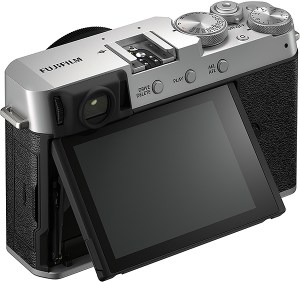
Last night Fujifilm announced the brand-new X-T30 III camera and Fujinon XC 13-33mm f/3.5-6.3 lens. That’s a lot of threes! I’m not going to spend much time talking about either of these products, but I did want to briefly mention their existence.
The X-T30 III is almost identical to the X-T30 II, which was pretty much identical to the X-T30, launched in early 2019. The big changes for the third iteration are: X-Processor 5 and Film Dial. All of the other changes are directly related to those two.
X-Processor 5 brings with it more computing power and more efficient processing, which allows for autofocus and video improvements (including 6K Open Gate), as well as the Nostalgic Neg. and Reala Ace Film Simulations. Probably better battery life, too. The Film Dial replaces the Drive Dial, which has now been relocated to a button on the back, similar to the Fujifilm X-E5, X100VI, and X-Pro3. Some people are greatly offended by this, but the Drive button has worked quite sufficiently on those popular models and has been a complete nonissue, so there’s no reason to believe it won’t be the same for the X-T30 III. Some people like to complain for the sake of complaining. The benefit of the Film Dial is that it can store up to three Film Simulation Recipes, bringing the total possible Recipes that can be programmed into the camera at any one time up to 11 (certainly Nigel Tufnel would buy this camera just for this). As of right now, the X-T30 III and X-E5 are the only two cameras capable of 11 Recipes; however, I hope that Fujifilm brings the FS1/FS2/FS3 Recipe option to the X-T50 and X-M5, and any future models with the Film Dial.
The one negative with the Film Dial on the X-T30 III is that—like the X-E5—it’s limited to only six hard-set Film Simulations. Unfortunately, Classic Negative and Nostalgic Neg. were both excluded. For Classic Negative, that’s inexplicable, as it’s one of the most popular and iconic options. I think if Fujifilm had used the same Film Dial found on the X-T50 and X-M5, that would have been better. While the Film Dial isn’t perfect and certainly can be improved, it’s still a feature that I love, and I’m happy to see it on this camera.
The lens? I personally don’t use zooms very often. I’m more of a prime guy myself. It seems like a budget-friendly alternative to the 10-24mm f/4. I’m sure it’s sufficiently good, and a decent starter kit lens. I have no intentions of owning it, personally. Sold with the X-T30 III, I’m sure it’s worthwhile for $150; I definitely wouldn’t spend $400 on one.
There are two (very annoying) complaints that I’ve seen regarding this announcement: Fujifilm should not release any camera until they have Sony-like AF, and where’s the X-Pro4? Let’s discuss both.
I’ve talked about autofocus at great lengths (just type “autofocus” in the search bar), so I won’t spend much energy on it. My basic argument, though, is that Fujifilm’s AF is pretty good, better than what’s existed for the vast majority of photography, and if you can’t make it work for you, it’s largely user error. Yes, your fault. People are offended by that, but sometimes the truth hurts. Once you accept that truth, it reveals a path forward so that you can move beyond your AF obstacles. It might take learning some new skills and/or learning some new things about your camera that you didn’t realize. Fujifilm’s AF is more than sufficient for 99%+ photographers and situations if you know what you’re doing. Those who constantly complain about it have 1) unrealistic expectations (Canikony brands have been making AF for much, much longer, have larger R&D budgets, and larger teams, so it stands to reason that theirs is and always will be better), 2) an unwillingness to accept that they are a part of the problem (more so than the gear), and 3) no motivation for self-improvement.
Can and will Fujifilm improve their AF? Absolutely. I have zero doubts that they’re working hard on that right now and have been for years. Will those improvements have a practical benefit for most of their customers? Probably not, because we’re nearing the peak of an inverted U curve, which means that each improvement will have a smaller and smaller and smaller impact (this is true for every brand, especially Sony and Canon, who might actually be nearing the back side of the curve). Also, realize that any obstacle—including AF woes—can be overcome if you are willing to self-reflect and put in the work. Those who constantly complain about this topic are unwilling on both accounts.
As for the X-Pro4, which I’m predicting will be called X-Pro5, I’m somewhat confident that it will arrive within the next six months, probably announced in January or February. It will likely kick off X-Trans VI, and the X-T30 III will mark the end of the fifth-generation. In other words, the next X-Pro is coming, just have a little more patience.
Anyway, the Fujifilm X-T30 III will hold the important role of budget-friendly non-PASM model with an EVF. The X-T30 II and the X-T30 before it served this purpose very well, and, despite less fanfare, sold a heck-of-a-lot of copies. The X-T30 III will quietly be a major success, too. At only $999, it’s probably the best value camera in the lineup. Yes, some models are cheaper. Yes, some are better. But none quite offer the bang-for-the-buck that the X-T30 III does.
This post contains affiliate links, and if you make a purchase using my links I’ll be compensated a small amount for it.
Fujifilm is about to announce the X-T30 III, the true successor to the X-T30 II. A lot of people assumed that the Fujifilm X-T50 was the X-T30 II’s successor, but it wasn’t—if you a Fuji X Weekly regular, you’ve known that for about a year-and-a-half now. Tomorrow at 10:00 PM Pacific Time, Fujifilm will unveil the new camera.
I don’t have any inside information, but I expect that the Fujifilm X-T30 III will be 95% the same as the X-T30 II, which was 98% the same as the X-T30. Fujifilm announced the original X-T30 in February of 2019. I remember it well because I preordered it, and later created many Film Simulation Recipes with that camera. The X-T30 II, which was basically a firmware update with a few minor changes, came in October of 2021. The ability to save WB Shift with each C1-C7 Custom Settings preset, as well as Classic Negative and other JPEG tools like Clarity, are the major improvements found on the Mark II version. Now, four years later, Fujifilm is about to release the latest iteration.
From all accounts, the X-T30 III will be the same as the X-T30 II, except with X-Processor 5 (which includes Nostalgic Neg. and Reala Ace), a Film Dial like what’s on the X-T50 and X-M5, and a Drive Button instead of a Drive Dial. Aside from that, it will be pretty much the same thing as the X-T30 II. I don’t expect any major changes. Overall, it will be a mild refresh.
Why, then, do I think this camera is genius? Because Fujifilm will quietly sell a whole lot of these. It’s not going to go viral like the X100VI. It’s not going to make major headlines. It’s not going to be a hot topic on Reddit or Facebook groups. But Fujifilm will sell a bunch of X-T30 III cameras, more than most other models offered by the brand.
Just four days ago, New York Magazine published in The Strategist section This Fujifilm Camera Gives Me Film Photos Without the Processing by Katherine Gillespie. It’s essentially a review of the Fujifilm X-T30 II. In that article, Katherine states, “Even just using the cheapest 15-45mm kit lens, the camera creates beautiful JPEG photos that require little to no editing to make the colors pop and can be wirelessly transferred to my phone via Fujifilm’s XApp. For me, this is a big sell. While some people seem to enjoy playing around with presets on Lightroom, as a procrastinator who also sort of hates computers, I can’t think of anything worse than shooting in RAW then having to go through and edit hundreds of photos after every social event or vacation. Especially as doing so would also require purchasing a pricey Adobe subscription.”
The article included a small and subtle shoutout to Fuji X Weekly, which was mind-blowing. This follows the New York Times mention in July. I never imagined getting noticed by such large and prestigious publications. But I digress; however, it is a good read, should you want to.
Statements like Katherine’s are why the X-T30 and X-T30 II sold so well, and why soon the X-T30 III will, too. It’s easy to get great-looking photos without the fuss. The cameras are small, lightweight, inexpensive, and straightforward-enough that they’re accessible to anyone and everyone. Even a child can use it and get great results. Robust enough that professionals can use it for serious work, but not so much that first-time hobbyists are in over their heads. That’s indeed a big sell.
No other Fujifilm camera has been given a Mark III iteration. The X-E2 had a second version called X-E2s. There’s the X-H2 and X-H2s, but that’s a slightly different story. There was an X-T3 WW, which was an X-T3 without an external battery charger included in the box. The X-T4 ES is an infrared version of the X-T4. Most models have their time, followed by a successor; the few with a second variation were not given a third. The X-T30 is unique, with a third iteration about to crest the horizon. That elevates the camera to legendary status in my books. There is no doubt in my mind that the X-T30 III will be a great success for Fujifilm, albeit without the fanfare that other models in the X-series often get.
Fujirumors posted an article today entitled BREAKING: This Totally Unexpected Fujifilm Camera is Coming in 2025 – And I Know You Won’t Believe Me. I believe it and even expected it, because I’ve been saying it for over a year. If you regularly read Fuji X Weekly, you probably believe it, too, and might even have expected it yourself. I can’t tell you how many times I’ve predicted it over the last 14 months—probably a good handful. For some (including myself), this is not a surprise in the least.
In the third paragraph of my Fujifilm X-T50 review (published on May 16, 2024), I stated, “The X-T50 is not the successor to the X-T30 II, but a whole new (yet highly similar) line. Fujifilm plans to sell the X-T30 II alongside the X-T50, similarly to what they did with the X-T3 and X-T4 a few years back. This also means that there is a potential future successor to the X-T30 II, perhaps called the X-T30 III or X-T40; I don’t know that for sure, but I think it is a fair assumption. The main thing for you to know is that the X-T50 is not a replacement for any previous model, but a whole new camera.”
Just two months ago, in my article entitled My Hopes for the Fujifilm X-E5 (published on May 21st), I concluded with this: “My prediction, which is merely a guess and nothing more, is that an X-T30 III (an X-T30 II but with X-Processor 5) will be announced in the fall….” It looks like that guess was pretty much correct.
For those still scratching their heads, Fujirumors just leaked that the X-T30 II’s successor (which isn’t the X-T50) is coming sometime in 2025. And this is taking the Fujifilm community by surprise. Many people apparently assumed that the X-T50 was the X-T30 II’s successor, even though Fujifilm said from the get-go that it wasn’t. Fuji X Weekly might have been the only website that predicted the X-T30 III (or maybe they’ll call it X-T40, but I doubt it). I don’t have any inside information, I only took Fujifilm at their word, and followed the sequence of past releases to predict this outcome. It just made sense to me.
So what will the Fujifilm X-T30 III look like? I think it will be exactly the same as the X-T30 and X-T30 II (which was mostly just a firmware update to the X-T30), except with the X-Processor 5. In other words, it will have Nostalgic Neg. and Reala Ace, but otherwise will be pretty much identical to the X-T30 II. Some are predicting an X-T50 but with the 26mp sensor instead of 40mp, but I don’t think so, personally. There will be a price increase, because of inflation (and, in America, the tariffs). The X-T30 II was $900 in 2021, which is $1,070 today, so don’t be surprised if the X-T30 III is about $1,050-$1,100 USD for the body-only outside of America, and $1,300-$1,400 in the US due to tariffs. That’s just the new normal, I think.
The question that some will certainly ask is why does this camera need to exist. The X-M5 is the new entry-level model. The X-S20 is the hybrid PASM model underneath the X-H2/X-H2s. The X-E5 has been upgraded to a mid-tier camera. The X-T50 is also a mid-tier model. Where does the X-T30 III fit into that? I believe that it will be the lowest-tier non-PASM camera, underneath the X-T50 and X-T5. This line has been historically successful for Fujifilm. It offers a more affordable option for those who want an EVF. But… I think it will also be an indication of what’s to come very soon with the other models (aside from the X-E5 and X half): price increases (at least in America, maybe not worldwide). Other brands have already announced higher prices, and Fujifilm will be doing so soon, too, in my opinion.
Of course, I’ve been wrong about plenty of things before. For every one thing that I’ve predicted correct, I’ve predicted two or three completely incorrect. That’s the trouble with guessing the future (ask Robert Zemeckis). I cannot say with any level of certainty what the X-T30 II’s successor will be like, so my predictions should be taken with a large grain of salt. But the fact is that the X-T30 II’s successor is coming soon, and I’m not surprised by it.
I’m hesitant to write this review, because the Fujifilm X half is paradoxical. There’s a lot about it that’s conflicting. You can say this aspect of it is great for a certain group of people, but this aspect of it is not. This might be the most unique digital camera ever made, so it’s going to get a lot of attention, but also a lot of criticism. Trying to figure out who will most appreciate the X half (also called X-HF1) has been an intriguing endeavor.
To be completely transparent, it’s important for me to tell you upfront that Fujifilm sent me an X half to keep. Yea! Thank you, Fujifilm. I didn’t pay a dime for the camera. But I did have an X half preordered, so I was planning to spend money on one. I’m doing my best to not let my impressions be colored by Fujifilm’s kind generosity.
There are a few things that are unique about X-HF1. The headline is the vertically-mounted 1″ sensor. As far as I know, this is the very first camera to have a vertical sensor, all others are horizontal—that is, aside from cellphones. A lot of people—younger people especially—tend to photograph vertically on their cellphones, so it was just a matter of time before a camera would have a tall sensor. The X half is revolutionary because it’s the very first. I suspect there will be more in the future, and Fujifilm won’t be the only brand. Speaking of 1″ sensors, the name is a bit misleading. The surface area of a so-called 1″ sensor is the same as old 1″ Vidicon vacuum tube television cameras. So the name (“one inch”) has to do with the tube size of TV cameras from the ’50’s, ’60’s and ’70’s, and not the dimensions of the sensor.
The inspiration for the X half—and where the name comes from—are half-frame film cameras, like the Fujica Half, Olympus Pen, Kodak H35N, and Pentax 17. These cameras use half of a 35mm frame for each picture, orientated tall. Some medium-format cameras also are natively portrait orientated. Cameras that capture vertical photos are not new, but they are new in the digital age. Of course it has to be said that the X-HF1’s sensor isn’t half the size of a full-frame sensor, or even half the size of APS-C; no, the X half‘s “half” is not a mathematical term, but simply a nod to analog half-frame cameras. The 3:4 aspect ratio is also the same as half-frame cameras.
Like a half-frame film camera, the X half is capable of creating diptychs, which are two frames side-by-side combined into one image. You can do this easily in-camera using the Frame Advance Lever, or after-the-fact using the new X half app. It’s a heck-of-a-lot of fun, but I imagine that the novelty will wear off after awhile. While it will put a (customizable) bar in-between the two frames, I wish it had the option for a boarder around the whole image like in the examples above, which was done using a third-party app. Maybe Fujifilm will add this feature to the X half app in the future.
The X-HF1 is as minimalistic as it gets in the X-series. The menu has been simplified and streamlined, and a lot of settings have been left out. You cannot use Film Simulation Recipes with this camera, only the stock Film Simulations and Filters. Not all of the Film Sims made the cut, but most of them are there: Provia, Velvia, Astia, Classic Chrome, Reala Ace, Classic Negative, Nostalgic Negative, Eterna, Acros (include +Ye, +R & +G), and Sepia. I would rather have Eterna Bleach Bypass over Sepia, but it’s a good group overall. There are a whole bunch of Filters (called Advanced Filters on other X-series cameras), some of which are borrowed from the Instax Evo cameras. My favorites are Pop Color, Light Leak, Expired Film, and Retro. These cannot be used in addition to Film Simulations—it’s one or the other, and not both. The list of Filters is quite long, and I don’t have an interest in most of them, so I wish that you could customize which ones are available, to make it easier to find and select the ones you actually want to use.
Above: Pop Color Filter
Above: Light Leak Filter
Above: Expired Film Filter
Above: Retro Filter
Pop Color is reminiscent of Fujichrome Fortia. I’d actually like to see it graduate to Film Simulation status. Light Leak, as well as filters like Halation and Vignette, should become JPEG options on other X-series cameras, that can be added to any Film Simulation. Expired Film and Retro should be added as Advanced Filters. Of the three Expired Film options, Green and Neutral are my favorites.
The only customizations that are available are Grain, Portrait Enhancer (which I believe is just Smooth Skin Effect renamed), White Balance (but no WB Shift), and Long Exposure NR. One cool thing is that these are also applied to the Filters, and not just the Film Simulations—I’d love for that to make its way to other X-series cameras. Beyond that, the Film Simulations and Filters cannot be customized to achieve various looks, which is a real bummer for someone like me who uses Recipes extensively.
Top left: Weak / Small Grain. Top right: Strong / Large Grain. Bottom: Actual Ilford Delta P3200 film
I enjoy a little grain in my photos. It adds texture that’s been common in photography for much of its existence. The X-HF1 has faux grain, with four options: Weak/Small, Weak/Large, Strong/Small, and Strong/Large. Grain set to Weak/Small on the X half is a little more pronounced than Strong/Large is on (for example) the X100VI. I wish that there was a less strong option than Weak/Small, because it’s borderline too much; however, since there’s not, I used it almost exclusively. Strong/Large is a bit ridiculous, and is reminiscent of the grain of ultra-high ISO films like Ilford Delta P3200. If you want to achieve an Ilford Delta P3200 look, the X half isn’t far off at all when Grain is set to its maximum parameters.
Another word about Grain is that it slows the camera down, much like Clarity on other X-series cameras. I found this to be odd, and my theory is that when Grain is applied, so is Clarity (maybe -2). I tried to prove this, but couldn’t, so I might be completely wrong. I have another theory that—for Film Simulations, at least, and maybe for Filters—Color is increased as exposure is increased, and is reduced as the exposure is reduced. I also tried to prove this, but got mixed results, so I’m not certain if this is how the camera is programmed, or just a natural effect of over and under exposure.
Above: Classic Negative
The camera seems to apply a heavy-handed noise reduction, and then a heavy-handed sharpening to compensate. I would love to have some control over this, as it’s not my favorite approach. It might be necessary, though, since the X-HF1 has a Bayer sensor instead of X-Trans. One benefit of X-Trans that doesn’t get discussed enough is that it allows noise to be more easily identified and controlled; Fujifilm uses this to make it more film-grain-like, and less of a nuisance. Since this is a Bayer camera, it might require a little stronger noise reduction.
Another benefit of X-Trans is that it has more green pixels (55%, compared to 50% on Bayer), which allows for more luminosity information. This provides a little more dynamic range and high-ISO capabilities. On the X half, dynamic range is quite limited. I would say it’s roughly comparable to DR100 with Highlight and Shadow set to +0.5 on other X-series cameras. It’s fairly easy to clip highlights and/or block up shadows, and is a little like slide film in this regard. Since this camera is JPEG-only (no RAW), you have to be very careful about the exposure.
Above left: ISO 1600. Above right: ISO 4000
I found that I prefer ISO 400 and below on the X half, reminiscent of Sigma Merrill cameras, which has a similar limitation. In a pinch you can go higher, especially if the picture will only be shared to social media, but I tried my best to keep the ISO at or below ISO 400 whenever possible. Because the maximum aperture of the lens is “only” f/2.8, when the sun goes down it can be very challenging to use the camera.
The X-HF1 does have a built-in flash, albeit not a great one. It doesn’t have a hotshoe, only a coldshoe. Flash photography is, unfortunately, not ideal on this camera, which is too bad, since it has a leaf shutter. If Fujifilm someday makes a second version, I hope that it either has a proper flash or a hotshoe (or both), as this current setup is mediocre at best. I kept the flash off most of the time.
Above: Flash photography on the X half
One really cool feature is called Film Camera Mode. You select either 36, 54, or 72 shots, and you are dedicated to that mode until you’ve completed your “roll of film”—which is whatever Film Simulation you chose. I do wish that 24 was an option, as it takes awhile to finish a roll. You cannot review the photos until they’ve been “developed” in the X half app. In this mode, the X-HF1 functions similarly to point-and-shoot film cameras from the 1990’s. You have to use the Frame Advance Lever in-between shots. It’s a ton of fun, but also challenging, because you have no idea if you correctly exposed, focused, or even if you framed it well. I kept forgetting to take the lens cap off, too. My daughter coined the 72 shot roll as the 72 exposure challenge. I’d love for that to become a community-driven trend, where people post their best frames from their 72 exposure “roll” on social media, with the hashtag #72exposurechallenge.
It would be nice if you could use the various Filters in this mode, and not just the Film Simulations. ***Edit: I was on a pre-production firmware; however, after updating to the latest version, I can now use Filters in the Film Camera Mode. Yea! Sorry for the confusion.*** Another thing I’d appreciate is that whatever ISO you have selected is carried over to the Film Camera Mode. Unfortunately, you only get Auto ISO up to ISO 12800, which is totally unusable whenever it goes that high. Fortunately, your Grain and White Balance settings are carried over, so be sure to set those before starting.
Above: X half contact sheet and various frames
Once you develop your “roll” in the app, you get a contact sheet. It would be great if you could long-press on a frame, and it would give you the option of saving that frame with the sprockets, or that frame plus the one next to it (on either side, unless it’s the end of the strip), or the whole strip. Instead, you have to crop the contact sheet in order to accomplish that. But I’m a huge fan of the contact sheet in-general, it’s a really cool idea.
Overall, I enjoyed using the Film Camera Mode, but I found myself not using it as much as the regular shooting mode because you have to be in the mood for it. One of the challenges that I appreciate about the X-HF1 is finding the “right” Film Simulation or Filter, combined with the “best” White Balance, to convey the mood of the scene most appropriately. The X half is so simple that a three-year-old could use it, but to get the most out of it requires thinking a little more deeply about things that are easily taken for granted. It’s been one of the most simple yet most challenging cameras I’ve ever used—the paradox I mentioned in the opening sentence.
Fujifilm X half – Acros Film Simulation
The X half is capable of recording video, but it’s very mediocre. Someone will use it creatively just to prove the point that it can be done, but I think Fujifilm probably should have just left off video, which would have made an interesting statement. Or else, maybe do a faux 8mm thing with sprockets and light leaks and such—that would have been really cool. Food for thought for the next iteration, if there is one someday.
Who should consider buying this camera? I think there are a few obvious answers. First, the X-HF1 has a foot in both the X-series and the Instax world. For those unaware, Instax is bigger than X and GFX combined. I talked to a bunch of people—probably close to ten—who own an Instax camera yet don’t own any X-series model, and they were all highly interested in the X half. Six different people told me that it’s the only Fujifilm camera they want, aside from Instax. The X half is an obvious bridge into the X-series for these folks. Also, some people who shoot point-and-shoot film cameras but are tired of the cost of film will find this to be an intriguing option. At $25 to $50+ per roll (including development and scanning), it won’t take long for the X half to pay for itself. The X-HF1 is sort of like a digital 110 camera, and almost lomography-esque, so it’s not difficult to see the appeal. Third, digicams are all the rage right now among younger people, and this camera can be considered in that category, too.
Above: Various pictures captured with the Fujifilm X half
What about current X-series photographers? What about someone like me? The camera is a blast. It’s so much fun. But it’s a toy. It’s not a serious camera for serious photography (I’m sure someone will use it in a serious way just to prove the point that it can be). It’s great for casual snapshots. I used it extensively during nearly three weeks of travel, and it was my most-used camera during that time, even more than my Fujifilm X100VI. I have so many more pictures that I could share, this is only a small sampling. It’s so easy to always have on you, and I would rather use the X half than my iPhone, if only for the tactile experience and Fujifilm colors. If you think you’d enjoy it, it’s probably worthwhile to get. If you wonder why anyone would buy it, it’s probably not for you, and it’s easy to move on.
The biggest criticism is going to be the price. In America, the X half is a steep $850. Across the rest of the world, it’s roughly equivalent to $700 USD. Unfortunately, this was the first camera to include the new tariffs in the price (although Canon and Nikon have just implemented some price increases, and Sony will soon, too), so it’s a bit shocking. Some people will say it should be $200 or $300, and that’s highly unrealistic—just absurd and not even close to any level of reality. Some will say it should be $500, and I’d agree with that if it were pre-Covid; however, there’s been a lot of inflation since then. I believe that $650 to $700 is a fair price. $850 is a little much, but that’s largely not Fujifilm’s fault; hopefully the tariff situation will get resolved soon, and Fujifilm can drop the price to where it should be. I don’t know if that will happen, though, and if the camera sells really well at its current price, there may not be a reason to reduce it.
Above: Various diptych pictures captured with the Fujifilm X half
The last thing that I want to address is the inability to use Film Simulation Recipes with this camera. Recipes are a pretty big thing in the Fujifilm world—the brand-new X-E5 actually uses the word “Recipe” in the camera menu. I appreciate excellent straight-out-of-camera results. While I would love to be able to customize the looks more in the X half, you can still get good picture aesthetics with the limited tools available in the camera. The photography continuum has been leaning towards less editing for a few years now, and this camera is just a natural and seemingly inevitable expression of that.
There’s a lot to like about the Fujifilm X half, and a lot that can be questioned. You have to accept the camera for what it is and forgive it for not being what it’s not; otherwise, it might grind on your nerves. But, for certain, the camera is very enjoyable, and it offers a unique shooting experience not found anywhere else. If you want the X half experience, you have to have an X half. But that unique experience will not appeal to everyone, and maybe not even to most X-series photographers. I do believe this camera will be quite successful, and will bring many people into the X-series fold, mainly from groups that the camera industry has largely ignored. This will be the first X-series camera for a number of people, and someday some of those people will upgrade to a more premium model, perhaps an X-M5, X-E5, or X100VI. I think all of that is very good. It’s quite obvious to me that the Fujifilm X-HF1 will be a trendy camera, especially among younger photographers, and you’re soon going to see X half pictures all over TikTok and Instagram.
This post contains affiliate links, and if you make a purchase using my links I’ll be compensated a small amount for it.
One thing that might have been missed with the Fujifilm X half announcement is that the next X Summit will be in Shanghai on June 12th, which is less than three weeks away. I’m not sure what time, but most likely it will be in the early morning hours in the United States, or maybe late PM on the 11th for those on the west coast.
What gear will be announced? I don’t have any inside information—I find out the same way that you all do. I’m guessing a camera and lens, but that’s only a guess. Fujifilm will unveil it soon enough, though, so we won’t have to speculate for much longer.
It’s a bit unusual for Fujifilm to release two cameras so close together. It’s exciting times, even if one or both models are not all that interesting to you, personally. I’ve been saving up for a GFX100RF (still have a ways to go), but I might just divert those funds to what Fujifilm just released and is about to release.
Not very long after this X Summit is the B&H BILD Expo at the Javits Center in Manhattan on June 17th and 18th. Fujifilm invited me to come out to be a part of it, although I’m not sure yet what my role will be. This is a big event that you won’t want to miss! Peter McKinnon is one of the headline speakers, but there are many others, too. David Geffin, Kyler Steele, and Jasmine Quiñones are three that I personally recommend. It’s a free event (but you have to register), so if you are in the NYC area, be sure to attend—come say “hi” and chat a little.
I’m sure that Fujifilm will have on display a GFX100RF, X half, and whatever gear is upcoming. You can probably hold them, and it’s an opportunity to ask any questions you might have about these items from people who have personally used them and know them inside and out. Even if you don’t have any interest in that, be sure to stop by anyway—this is going to be a great time, and well worth the effort to get to.
Fujifilm announced a new camera last night called X half. It also goes by the name X-HF1, apparently. This is a 32mm (full-frame-equivalent) f/2.8 fixed-lens compact camera with a vertically mounted 1″ sensor, and is probably the most unique digital camera ever made—or, at the least, it offers the most unique photographic experience in all of digital photography. This isn’t a review, but I did want to give my thoughts on the release.
I haven’t used the camera, or even seen it in-person. I was up late last night watching the announcement and various review videos that were published, trying to figure out what this camera is. Now I’m awake typing this article after less than five hours of sleep, so if there are any typos, please excuse me. I’ve barely started my first cup of coffee. Anyway, Fujifilm released two videos, which I’ve included below.
In the weeks leading up to the release, I published two article about the X-HF1, speculating what it might be. The first was Why the Upcoming Fujifilm Half-Frame Camera is Genius, and I guessed that this was going to be an amazing camera, specifically designed for both a film-like photographic experience and recording vertical videos for TikToks and Reels. The second was What if the upcoming Fujifilm Xhalf is something different?, where I second-guessed my prior article, and wondered if the camera was going to be stripped down, less video-centric, and more Instax than X-series. Well, the X half seems to fall right in-between (maybe closer to the second take), and both articles had some things right and some wrong.
The new camera is intended to produce a film-like experience, and is capable of doing so in a unique way. In Film Camera Mode, you choose your “film” (Film Simulation) and how many frames (36, 54, or 72), and then you shoot through the Optical Viewfinder until the roll is fully exposed, using the frame advance lever in-between shots. You cannot see your pictures until after the roll is finished and “developed” in their new app that is just for this camera. I think this is super cool, and I hope this mode comes to some future camera, maybe the upcoming X-E5. There is a missed opportunity: Fujifilm offers photo printing services, so you should be able to order 4″x6″ prints of your roll of “film” from the new app. It would be so much fun to order prints, then wait until they arrive in the mail before reviewing the pictures. It would encourage people to print their photos, which isn’t done nearly enough nowadays. And it would be a way for Fujifilm to make some extra money on a service they already offer. Maybe they’ll update the app to include this in the future, as it seems like an obvious oversight.
The X half has a 20mp 1″ Bayer sensor, but only uses 18mp because it crops out 2mp to accommodate the 3:4 aspect ratio (the sensor is 2:3). If you want to crop your pictures to 2:3, you’ll lose a little more resolution, but it is still plenty for social media and web use, as well as prints smaller than 16″x24″. It would have been nice if one could choose to use the full sensor and the 2:3 aspect ratio, but with the X-HF1, Fujifilm significantly stripped down the menu and customizations. They made the camera about simplicity, but in doing so you lose out on some of what makes Fujifilm cameras special; namely, you cannot use Film Simulation Recipes with this camera, since you cannot control the various parameters like you can on any other X-series model.
Instead of 20 Film Simulations, this camera only has 13: Provia, Velvia, Astia, Classic Chrome, Reala Ace, Classic Negative, Nostalgic Negative, Eterna, Acros, Acros+Y/+R/+G, an Sepia. It’s too bad Sepia made the cut over PRO Neg. Hi, PRO Neg. Std, and Eterna Bleach Bypass. While you cannot use Recipes, the Film Simulations seem to produce a slightly divergent look than the standard Film Sims, almost as if Fujifilm programmed each with its own Recipe, for what that’s worth. There are also so-called Advanced Filters, including a few new ones borrowed from the Instax Evo cameras.
While the X half does shoot vertical video, the quality seems suspect. I’m sure there are some who will appreciate this and will create some interesting content with it, but it’s a big miss in my opinion. They should have allowed 1080p in the 9:16 aspect ratio so it would have been more useful for social media video creation. The X-HF1 could have been a trendy camera for TikToks, Reels, and Shorts, but I just don’t see that happening with the video implementation. The capability of video-video and still-video diptychs are a bit intriguing, but I don’t think that will catch on as anything more than a passing curiosity. Or don’t included video capabilities at all—I think that would have made a bigger statement (and would have been viewed more positively) than how it was implemented.
So what do I make of the X half? It looks nice. It’s very compact, which is perfect for everyday carry or travel. It’s minimalistic, which can be good. It offers a very unique shooting experience that looks like a lot of fun. It seems like a bridge between Instax and the X-series, and I think it’s fair to consider it more like a very-high-end Instax Evo camera without a printer than a bottom-end X-series model (it’s basically both). It will certainly be a very controversial camera (maybe the most), with perhaps the biggest controversy being the price: an MSRP of $850, which seems high for what it is. Some people are going to love it, and some are going to hate it. I think it will be especially popular with Gen Z and Gen Alpha, who are currently fascinated with classic digicams and film cameras, including half-frame models like the Pentax 17. Me? I applaud Fujifilm for daring to be different, and going way outside the box. I did preorder one last night, but I’m a bit unsure if I’m actually going to like it or not. Now excuse me while I pour that second cup of coffee….
This post contains affiliate links, and if you make a purchase using my links I’ll be compensated a small amount for it.
Fujifilm teased a new upcoming camera on their social media accounts. Not much is known about it. The biggest clue is the title: Half the Size, Twice the Story. The camera appears to be quite small, perhaps similar to the Fujifilm X30, but maybe smaller than that—it could be even smaller than the X70. It’s hard to say from the teaser.
Interestingly, there appears to be a small film simulation screen (kind of like the X-Pro3, but shaped differently, and maybe with less information) on the rear. Looks pretty cool, from the little that can be seen.
There’s been talk for awhile now of a “half frame” model that’s essentially a digital version of the Pentax 17 half-frame 35mm film camera. I don’t know if this is that, or even what that means exactly, but it could be. And if it is, it will be a lot of fun. I don’t think anyone will use it as a professional camera (of course it could be, and someone will do so just to prove the point, I’m sure), but as an enjoyable carry-everywhere model, or as a first camera for your kids, it could be quite tempting. This is just speculation, obviously—not much is known, not even when it might be released.
And there’s also the question of availability in the United States. Word on the street is that Fujifilm is pausing shipments into America until the tariff stuff settles—I don’t know if that’s true or not, just something I’ve heard more than once, so it could be true. If it is true, I’m not certain if it will be for all gear or only some, or for how long, or if prices will be raised once resumed. This isn’t a political comment, so please, no political talk in the comments section (they will be removed). Availability of some Fujifilm products has been scarce over the last couple of years (ever since the X100V went viral roughly 30 months ago), and this will likely compound the issue in the USA, but maybe have the opposite effect elsewhere in the world. Whatever the new camera is, I’m highly interested, and I’m keeping my fingers crossed that it will be available in America whenever it is announced.
Fujifilm just announced this morning the brand-new GFX100RF, the first ever fixed-lens compact digital medium-format camera. This new camera uses the same 100mp sensor found in the GFX100 II and GFX100S II, and has a built-in 35mm (28mm full-frame-equivalent, or 18mm APS-C-equivalent) f/4 lens. All for only $4,899! There are several things that make this new camera special—plus a couple that don’t—so let’s dive right in.
The Fujifilm GFX100RF is the most portable digital medium-format camera ever made. It’s the most lightweight digital medium-format camera/lens combination, and it’s the smallest GFX. It’s probably the smallest medium-format, but it depends on how exactly you define smallest. The Hasselblad 907X (plus CFV 100C back) with the 28mm f/4 lens was previously considered the smallest and lightest, and while it might arguably be the “smallest” (it is less wide, but deeper), it is no longer the lightest. For portability, the GFX100RF is the best option in medium-format, making it a compelling camera for travel or even everyday carry.
A few months ago I purchased my first GFX camera, the GFX100S II, with the specific purpose of creating XPan panoramic images that I want to print large. One problem with GFX in general is the size and heft of the gear, which do not lend themselves well for lugging all over the place. Of course, Ansel Adams and the great photographers of the past would laugh at that. While I much prefer smaller gear for travel, I “need” to bring my GFX100S II for the XPan pictures. The 40mp sensor in my X-series cameras produces plenty of resolution for the XPan crop, but it is not quite enough for how large I hope to print. The GFX100RF would be perfect for this, except that I just dropped a ton of money on a GFX camera and a couple lenses back in December.
Which brings me to point number two: the GFX100RF is the cheapest way to get into digital medium-format photography, aside from buying used. If you’ve wanted to get into digital medium-format but have been priced out, this new camera might be for you. It wasn’t even a decade ago that it would cost you at least $10,000 for just the camera body, and thousands more for a lens. Now the entry fee is only $5,000, and that includes the lens! Most people, though, don’t need so much resolution, and medium-format is far more of a luxury than a need.
Another unfortunate aspect of the GFX system is the lack of retro-styled cameras with the traditional tactile controls that Fujifilm is known for. This not only makes the cameras stylish, but also fun, and (IMHO) more functional. The long-discontinued GFX50R is the only other option, so this type of design is long-overdue. Thankfully, Fujifilm is bringing it back to GFX! I bet if this camera does well, there will be more retro-styled models in the future—perhaps a GFX100R.
The GFX100RF has a couple of unique features. One is an aspect ratio knob, which also includes a couple of new aspect ratios not typical found on Fujifilm cameras. Now you can choose between 4:3, 5:4, 1:1, 3:2, 7:6, 65:24, 17:6, and 16:9, and you can switch between those without digging through the menu. Another is a digital teleconverter, with a wheel that shuffles through the options: 45mm, 63mm, and 80mm (I’m not sure if those crops are GFX focal-length measurements or full-frame). Also, interestingly, the GFX100RF uses the same 49mm filter thread size as the X100-series. I can’t say this with 100% confidence, but I’m pretty sure the WCL-X100 and TCL-X100 will work on the new camera (this is mere speculation), which is absolutely amazing if they do; however, I doubt that they are officially supported, and they may not cover the entire frame. Oh, and the GFX100RF is the first GFX model with a leaf shutter, which is especially useful for high speed flash sync.
Now onto a couple of negatives. I’ve covered these before (here and here), so I’ll try to make this quick. I think the camera will be well-received and well-loved, and these two issues will prove to be relatively minor in the long run.
First is the lack of IBIS. An expensive camera lacking IBIS in 2025 is a shocker for some. There are photographers who consider it an essential feature, and won’t buy a camera without it. I’m not in that camp personally. This isn’t a video-centric model, and it has a wide-angle lens, so it doesn’t really need IBIS. Sure, it would be nice to have, but it would have made the camera larger, heavier, and more expensive (at least a little). Two of the biggest selling points (portability and price) would have taken a bit of a hit. I’m sure Fujifilm debated extensively internally if it should have it or not, and ultimately they chose to exclude IBIS for the reasons I just stated. I would have been happy with or without stabilization, as it’s just not a big deal on a camera like this; however, those who do believe it is an essentially feature will likely pass.
Second is the maximum aperture of only f/4, which is not particularly impressive. While f/4 is common on medium-format, it’s not especially bright, which will make the camera less practical after the sun goes down or in dimly lit indoor situations. Generally speaking, shallow depth-of-field isn’t a major focus of wide-angle lens photography, but for those wondering, f/4 on GFX has a similar depth-of-field as f/2 on the X-series. The GFX100RF is more of an “f/8 and be there” camera, so I don’t think the small maximum aperture will be a problem for most people and situations.
That’s my analysis of the new camera. I think many will order it for its portability, price, and style. It’s not a camera that most people need, but I bet it will be highly desired. I want one! I kind of wish I had waited to jump into GFX, because if I hadn’t purchased a GFX100S II a few months ago I would have ordered the GFX100RF today. Instead, I will have to save up and wait. Oh, well. Whenever the opportunity comes to buy the camera, I’m certain that I will be thrilled with it. I’m sure those who have already preordered the camera will love it when it arrives next month.
You can preorder the Fujifilm GFX100RF today. I’ve heard there has already been a lot of preorders, so don’t be surprised if there is a bit of a wait before your order ships. The camera will officially be released and ship on April 24th.
This post contains affiliate links, and if you make a purchase using my links I’ll be compensated a small amount for it.
Fujifilm GFX100RF in black: Amazon, B&H Fujifilm GFX100RF in silver: Amazon, B&H
The brand-new Fujifilm X-T50 was just announced! It’s both surprising and intriguing. This might be Fujifilm’s most contentious model since the X-Pro3, but it shouldn’t be controversial at all. What exactly is the X-T50? Is it the right camera for you? I’ll try to answer those questions in this article.
The double-digit X-T line has traditionally been Fujifilm’s mid-level, enthusiast-grade, interchangeable-lens, SLR-styled models (that’s a mouthful!). It’s the little brother of the single-digit X-T cameras, like the X-T2 and X-T3. With the discontinuation of the low-end triple-digit X-T series, the double-digit X-T cameras have become Fujifilm’s de facto entry-level option. The Fujifilm X-T30 II, which was released in November of 2021, is the current base model, although it’s neither cheap in quality or price—it’s still a mid-tier APS-C camera.
The X-T50 is not the successor to the X-T30 II, but a whole new (yet highly similar) line. Fujifilm plans to sell the X-T30 II alongside the X-T50, similarly to what they did with the X-T3 and X-T4 a few years back. This also means that there is a potential future successor to the X-T30 II, perhaps called the X-T30 III or X-T40; I don’t know that for sure, but I think it is a fair assumption. The main thing for you to know is that the X-T50 is not a replacement for any previous model, but a whole new camera.
There are some key things that set the X-T50 apart from the X-T30 II. First is the 40mp X-Trans V sensor, the same sensor found in the X-H2, X-T5, and X100VI; the X-T30 II has the 26mp X-Trans IV sensor. Second, like the other 40mp cameras, the X-T50 has IBIS; the X-T30 II doesn’t. Perhaps the biggest difference—and the one that is most contentious—is the Film Dial. The X-T30 II has a Drive Dial on top, but in its place on the X-T50 is a brand new knob for switching between the film simulations (Drive is a button on the X-T50, like on the X100VI and X-E4). Aside from that, the X-T50 is a tad bigger than the X-T30 II, has a more rounded design, and costs quite a bit more ($1,400 for the body-only). The X-T50 is more premium than the X-T30 II, but, unsurprisingly, it’s not at the same level as the X-T5. I’d call it an upper-mid-tier model, higher than the X-T30 II but lower than the X-T5.
The Film Dial is a brilliant move by Fujifilm. I know that some may not “get it” and that’s ok; not every camera is for every person. Film simulations are such an intrinsic part of the Fujifilm experience for many users. Placing it on top of the camera in a position of importance makes film simulations a more immersive experience, one that invites exploration. The Film Dial alone will sell the X-T50; 40mp, IBIS, 6K video, etc., are merely bonuses. By simply taking an already existing and loved feature, and moving it from an Fn button or Menu position to the top plate, Fujifilm reinvented the functionality of their camera.
It’s not that the X-T50 does something that the X-T5 (or any other Fujifilm camera) doesn’t, it’s only how it is presented to the photographer. You can use the exact same Film Simulation Recipes on the X-T50 that you can on the X-T5, X100VI, and X-H2, and the analog-like output is identical between each of those models. What is unique about the X-T50 is that a turn of the Film Dial will instantly change the film-like aesthetic. That experience differentiates this cameras from all the others—not just other Fujifilm models, but from every brand. The Film Dial makes the X-T50 a “digital film” camera.
I don’t want to get too deeply into what the Film Dial is and how to get the most out of it, because I have a whole article that explains it in detail (click here). What’s important to know is that the knob only changes the film simulation and nothing else. On the dial, there are eight (out of the 20) hard-set film sims (Provia, Velvia, Astia, Classic Chrome, Reala Ace, Classic Negative, Nostalgic Neg., and Acros), plus three customizable positions for your favorites that were left out. The “C” position simply disables the Film Dial.
If Fujifilm had asked for my input, I would have suggested a couple of changes. First, a C1-C7 Dial (or, better yet, a C1-C11 Dial, since there are 12 positions) would have been most ideal for those who use Film Simulation Recipes. That would’ve been less contentious, and I think a lot of current Fujifilm users would be excited for that; however, I understand why Fujifilm didn’t choose that route: a Film Dial is more inviting and less intimidating to the uninitiated. My advice to Fujifilm is to release an X-T55, which would be the exact same camera, but with a C1-C7 (or C1-C11) Dial in lieu of the Film Dial. Second, since they didn’t do that, I think it would have been really cool if each film simulation on the Film Dial could be customized into a Recipe. If Highlight, Shadow, Color, Dynamic Range, Grain, etc., etc., etc., could be custom set to each film sim on the Film Dial, that would be awesome. While Fujifilm could make that change with a Kaizen firmware update (and I very much hope they do), it would be surprising if they did. But, no worries, because I’ve figured out a good strategy for how to use the Film Dial as-is, and it’s highly enjoyable.
There are probably a number of people who are concerned that the X-T50 uses the “old” NP-W126 battery, and not the new NP-W235. I took this camera with me on multiple trips, and shot with it literally all day several times, and only once did I actually have to use a spare battery. So as long as you have two NP-W126 batteries, you should be good-to-go. Perhaps a second spare is a good idea if you record a lot of video footage.
So who is the Fujifilm X-T50 for? Is it worth buying? Should a different camera be considered instead? There are a few groups that the X-T50 makes a lot of sense for, and a couple of groups that I think it could potentially be a good option for.
First, the Fujifilm X-T50 is great for those who shoot film, but want to get into digital photography. With film prices so high right now, there are a number of analog photographers who are seriously considering their first digital camera. Or perhaps they haven’t picked up a digital camera in a long time because they didn’t appreciate the experience of it, and are searching for something that is more reminiscent of film photography. I can relate to this, personally. I have no doubts that it will be highly appealing to this group of people—after all, the X-T50 is Fujifilm’s “digital film” camera.
Next up are those who succumbed to the Fujifilm X100VI hype but cannot secure a camera due to the unprecedented demand. Specifically, I’m talking about those who are not current Fujifilm users—those who have a different brand of camera or perhaps no “real” camera at all currently. They will see the X-T50 as an alternative that they have a better chance at actually getting their hands on. Since most of the specs are exactly the same, it won’t take much to convince someone in this group to buy it instead of the X100VI. Obviously, there are some significant differences between the two models, but there are enough similarities that the X100VI’s demand (and Fujifilm’s inability to fulfill it) will notably fuel X-T50 sales. The X100VI’s hype is real, and, in my opinion, well deserved; the X-T50 is not an X100VI, but certainly close enough for many people.
Third, the X-T50 will be appealing to video content creators who desire streamlined color grading. The Film Dial works in video mode, and film simulations can reduce or even eliminate some editing steps. This is an underrated and underutilized aspect of Fujifilm cameras that I think will be employed more on the X-T50 simply because of the Film Dial.
Then there are Fujifilm X-T5 owners who want a smaller and lighter option—but with an identical output—to be a companion camera. Some might appreciate the divergent shooting experience, while others might not. I think, for this group, the X-T50 is contentions, and either you’re intrigued by it or put off, and your opinion has likely already been made.
The last group are those who have an older double-digit X-T camera, or perhaps even a triple-digit model, and are eager to upgrade to something brand-new. The X-T5 is a little too big, heavy, and/or expensive for you, while the X-T30 II doesn’t have the latest two film simulations or features like 6K video and IBIS. If you appreciate the Film Dial, the X-T50 could be perfect; otherwise, this might not be the double-digital X-T camera that you were wishing for.
I really like the Fujifilm X-T50, personally. It’s fun, and offers a divergent experience from the other retro-inspired models. But, no camera is perfect, and none are for everyone. Each person has their own preferences. I think the X-T50 will, generally speaking, appeal more to non-Fujifilm photographers than current Fujifilm owners. On one hand, that’s really good. The X-T50 will be a lot of people’s gateway into Fujifilm. On the other hand, there are plenty of people who will complain that Fujifilm should have designed it another way. I do wish that the new knob had been implemented just a little differently, but I completely understand why they did it. Just because this camera might be more well-received by those buying their first Fujifilm model, doesn’t mean that current Fujifilm enthusiasts can’t or won’t like it, too, because I think many will (I enjoyed it); however, there are some who definitely won’t.
The Fujifilm X-T50 is brilliant, as it blurs the line a little between digital and analog, and gives users a unique photography experience. I have no doubts that the Fujifilm X-T50 will be a huge success, and the new Film Dial will be a big reason for it.
This post contains affiliate links, and if you make a purchase using my links I’ll be compensated a small amount for it.
Find these Film Simulation Recipes and over 300 more on the Fuji X Weekly App! Consider becoming a Patron subscriber to unlock the best App experience and to support Fuji X Weekly.
My Fujifilm X100VI preorder was completed six minutes after the camera went live at the the top of the hour during the X Summit. It didn’t ship today. The store that I ordered from is not saying when it might ship, only that it could be weeks or months. I’m not worried or upset, though.
I’m guessing that many of you might be in the same boat as me. I’m sure some reading this didn’t preorder the new camera, but, with record-demand (not just for a Fujifilm model… the X100VI apparently had more preorders than any other camera by any brand ever), it’s a safe bet that many of you did order it. If you weren’t super quick (I thought I was, but obviously wasn’t quick enough), your order likely didn’t ship today. I’m sure that some of you did, in fact, receive a notice today that yours has shipped, and even a few of you might already have it in your possession. That’s awesome! Enjoy your new camera. For the rest of us, it’s easy to feel empty or even envious. If you preordered the X100VI but your copy wasn’t in the first batch, let me give you some reasons not to be dismayed.
First, in time, you’ll get your new camera. Just be patient. The hype will subside, new copies will be made, and it will get to you before you know it. Waiting a few weeks or months is not a big deal. Yes, we’re used to everything being instant. But a little delay won’t hurt you. Just take a deep breath in and out, and let the FOMO go. Know that it’s going to work out alright, and before you know it you’ll be shooting with the new model.
Second, the X100VI won’t be a night-and-day difference from your other Fujifilm gear. It likely is an upgrade, but it’s not going to be a massive upgrade, unless you’re coming from an early X-series model. Keeping expectations in check will not only help limit disappointments, but also help with patience.
Third, whatever camera you do have already, it’s plenty good enough. It’s a positive exercise to go back to the old reviews of your gear and read the glowing praise, which serves as a reminder that the cameras we own are actually pretty darn good. New gear won’t make you a better photographer. A camera like the X100VI can be a lot of fun, and sometimes that enjoyment can motivate us to use our gear more; however, there are plenty of ways to find renewed enjoyment from our old gear, such as trying different Film Simulation Recipes, using vintage lenses, or simply taking it on adventures.
So if you’re feeling disappointed that you’ll have to wait a bit longer for your new camera, I hope that this helps you feel a little better. A little patience will help ease your anxiousness, and a little fresh air is good for the spirit. So grab your current camera, whatever it is, and go out right now and shoot with it.
If you didn’t order the new Fujifilm X100VI but would like to, you’ll likely have a significant wait, but eventually it will be in stock.
This post contains affiliate links, and if you make a purchase using my links I’ll be compensated a small amount for it.
One benefit of having your own website is that you get to say whatever you want. It’s your platform, and nobody can tell you what you can or cannot state. They’re your opinions; if someone doesn’t like them, they’re free to leave and never come back. As the saying goes, everyone has opinions….
I don’t typically like to comment on the opinions of others, because they’re free to express their own, just as I’m free to express my own. I don’t have to like what they say, just as nobody who visits this website has to agree with everything that I say. We can disagree on things and still be friends (at least it should be that way, and it used to be). Arguments on the internet tend to be pointless endeavors that don’t do much good.
There’s an article I read on a photography website that I’m just really baffled by. I wasn’t going to say anything, though. Is it even my place? After all, they’re allowed to write whatever they want on their own page. If I don’t like it, I’m free to not return. Their article, though, has been bothering me for a few days now, so I thought maybe I should address it. Perhaps you read it, too, and are equally puzzled.
Initially I wasn’t even going to link the article in this post, because maybe I shouldn’t drive traffic to their website. Sometimes when people post outrageous things it is for attention, so maybe I’m doing just what they hoped people would do, and I’m falling for it hook, line and sinker. It’s a fairly popular and well-known page, so you could easily find it if you wanted to. But, for the sake of transparency, the website is The Phoblographer, and the article is their Fujifilm X100VI review by Chris Gampat, the founder and chief-editor of the site.
Here’s an interesting fact about The Phoblographer that I didn’t know until I was researching for this: they don’t have much more traffic than Fuji X Weekly. According to data available on the internet (which might not be 100% accurate), they get roughly about 10% more visitors than I do. They’re way more established, having been founded in 2009 (Fuji X Weekly dates back to 2017). At the current rate of growth, it’s probable that this website will exceed their’s by the end of the year, or possible sooner. I must be doing something very wrong, though, because they’re somehow able to support five employees off of that traffic.
Anyway, Fujifilm gave The Phoblographer a preproduction copy of the X100VI to try out, and Chris Gampat wrote about it. And he gave it a scathing review. Interestingly, Chris gave the X100V a five-star review, saying that it was “the closest they’ve come to a perfect camera.” Somehow, in a little less than four years, with some updates and improvements, it’s gone from nearly perfect to one-star, the lowest Chris could give. If you are Fujifilm and reading this, in the future perhaps you should consider sending your preproduction copies to someone else instead.
Now Chris is entitled to his opinions. He doesn’t have to be all-positive, and I don’t think anyone expects him or anyone else to be overtly optimistic about any gear. Being genuine is valuable. Authenticity is what people want. Overly positive reviews can seem dishonest, but so can overly negative reviews. Especially when the nearly-identical predecessor camera was “close to perfect”; somehow the barely different but definitely improved successor is “the embodiment of the word ‘meh.'” It just doesn’t make any sense. It doesn’t pass the smell test.
On one hand, Chris’ review reads like a toddler-tantrum after not getting his way. I guess he thought the “nearly perfect” camera was somehow due for a major overhaul (ignoring “if it ain’t broke don’t fix it” I suppose); since he didn’t get his way, it’s now garbage (or, as he puts it: a TikTok fashion accessory that’s actually a toy camera; Fujifilm betrayed him with this model). Many of the things that he liked about the X100V he now dislikes about the X100VI, despite them being the same. Stomping and kicking and screaming will surely get Fujifilm’s attention, no? Maybe he’s simply upset that this model is so popular, and soon there will be too many Star-Bellied Sneetches with it for his liking (time to get that star removed, eh?). Perhaps their partnerships with other brands is driving the over-the-top negativity? As they say, follow the money and you’ll find the truth. I don’t know what the answer is, but whatever the case, it’s baffling. And dishonest, even though he self-proclaims that he’s being “very honest” in the opening paragraph, and not to believe others. If you have to state that up front, that’s a big red-flag.
ISO 25600 — Expired Eterna Recipe — Fujifilm X-T5
What I found humorous is that he doesn’t like anything above ISO 800 for color photography, apparently. I guess he wouldn’t appreciate my GAF 500 Film Simulation Recipe, which uses ISO 12800 on purpose for the aesthetic of it. Or my Expired Eterna Recipe, which can be used as high as ISO 51200!
I’ve not touched or seen in real life a Fujifilm X100VI, but I have a Fujifilm X100V and a Fujifilm X-T5 (which collectively provide for me the experience of the outside and inside of the X100VI), and I disagree completely with many of his complaints. It’s perfectly ok to have some complaints, and I’m not saying Chris doesn’t have some valid criticisms; however, the one-star rating and excessive scathing complaints seem way unfair. Instead, say: I wish they had done this or that, and since they didn’t, it’s four-stars (or three-stars; something that seems remotely fair, unlike one-star). That would be honest and authentic.
In any event, The Phoblographer (faux-blographer?) has lost a lot of credibility with me, personally. I give them a one-star review. It’s clear—when it comes to X-series cameras, anyway—that they’re not a trustworthy source whatsoever. It’s a real shame, too, because I’m sure that they could bring some unique point-of-views to the table that could be valuable to somebody, if only they could get out of their own way (but they couldn’t and so didn’t). They’re missing the boat on what is sure to be the most-desired camera of 2024, and maybe of all time; however, that’s their choice. This was a curios decision that I don’t understand, but it’s important to not take any of it personal. I’m sure that Chris and everyone else at The Phoblographer are very nice people in real life.
Maybe their article will provide them with a much-needed traffic boost. Maybe it will prove to be the beginning of the end for them—the moment that they jumped the shark, so to speak. I have no idea if there will be any positive or negative consequences to their review. I’m just really baffled by it all, and I wonder if Fujifilm—or even the other camera brands—have taken notice. How will they respond? I don’t think the one-star review is having any impact on sales.
I did order the Fujifilm X100VI, approximately six minutes after it was available for preorders. I don’t expect to be in the first batch that’ll be shipped on February 28th, but if mine arrives before the end of March I’ll count myself as lucky. It’s easy to have FOMO (fear of missing out) when this camera is all that everyone seems to be talking about, but just know that whatever camera you have is pretty good. It’s a positive exercise to go back to the old reviews of your gear and read the glowing praise, which serves as a reminder that the cameras we own are plenty good enough. New gear won’t make you a better photographer. A camera like the X100VI can be a lot of fun, and sometimes that enjoyment can motivate us to use our gear more. There are plenty of ways to find renewed enjoyment from our old gear, such as trying different Film Simulation Recipes, using vintage lenses, or simply taking it on adventures. Experiences are often better investments than new gear.
This post contains affiliate links, and if you make a purchase using my links I’ll be compensated a small amount for it.
Fuji X Weekly is intrinsically connected to the brand-new Fujifilm X100VI.
Let me explain.
This goes back about a year-and-a-half ago, when the Fujifilm X100V famously and suddenly became an instant hit, two-and-a-half years after its release. I later discovered that I played a significant role in that. You see, social media influencers on TikTok and Instagram began using the X100V, and when they shared their pictures, it caused a spike in interest in the camera, which led to an explosion in demand. As it turns out, those social media influencers were using my Film Simulation Recipes, and it was the film-like straight-out-of-camera pictures that ultimately caused the buzz.
Autumn in a Mountain Meadow – Flagstaff, AZ – Fujifilm X100V – Fujicolor Superia 100
Last Christmas Eve I pointed out that a number of camera stores mentioned Fuji X Weekly and my Recipes. I concluded that they were doing so because Film Simulation Recipes sell Fujifilm cameras. Many camera retailers recognize this, and so they encourage new and potential customers to check out this website.
Yesterday evening I finally had a chance to view most of the articles and videos about the upcoming Fujifilm X100VI. I caught the X Summit when it was live at 10:30 PM my time, then in the morning did a live broadcast with Fujifilm X-Photographer Nathalie Boucry discussing the event and the new camera. Then I had all sorts of things going on, and finally found some time in the late afternoon to write an article about the new camera. It wasn’t until later that I could finally take a look at what others were saying, particularly those who had early-access to the camera.
A lot of people are surprised that Fujifilm doesn’t send me their new models. This website is one of the most popular for Fujifilm (2.4 million visitors in 2023), and (as I already said) Film Simulation Recipes do more to sell Fujifilm cameras—directly or indirectly—than probably almost anyone. I pay for my gear myself, except for a few inexpensive third-party lenses that were sent to me free of charge. Fujifilm gifted me a coffee mug three or four years ago, which I still use occasionally. If I’m being completely honest, it is a little disheartening when I see others who seemingly do less for Fujifilm get the goodies; however, I never imagined that all of this would go anywhere near as far as it has (and it seems to be still growing!), so I’m just thankful to be on this ride, whatever it does or doesn’t have in store for me. If that means not getting early-access to the latest models like others did, that’s perfectly ok with me. It’s better to be grateful for what you do have than be envious of what you don’t.
Golden Light in Abandoned House – North Salt Lake, UT – Fujifilm X100V – Fujicolor Reala 100
As I was going through the content posted about the new camera, something caught my attention. In a number of videos, there were mentions of—or even a focus on—the JPEGs produced by the X100VI. They talked about film simulations, no need for editing (or maybe only lightly editing), and even film-like results. I didn’t catch any specific mentions of Fuji X Weekly or Film Simulation Recipes, but many hints towards it. But, in the articles, there were indeed some direct mentions, and even links to this website. The Verge said, “Ask any Fujifilm shooter, and they’ll tell you one of the company’s core strengths is JPEG processing: there are entire websites devoted to tweaking these film sims and getting the best possible straight-out-of-camera results.” They included a link to Fuji X Weekly. That’s huge!Moment stated, “If you’re interested in creating custom film recipes using film simulations, you can easily do so with the Fuji X Weekly App or by visiting the Fuji X Weekly website.” Jonas Rask wrote, “…the community that revolves around making your own custom looks from Film Simulations has exploded in popularity, largely due to the popularity of sites such as FujiXweekly.com.”
There’s a seemingly universal understanding that many of those who have already ordered (or who plan to order) the Fujifilm X100VI will be shooting straight-out-of-camera JPEGs with it. Film Simulation Recipes will be such a big part of the experience of the new camera. Even those who aren’t all that familiar with Recipes (yet) are well aware of film simulations and Fujifilm’s out-of-camera output. It’s this ability to get film-like results without the need to edit that is a big driver of all the preorders that apparently are greatly exceeding Fujifilm’s expectations. If you wanted to buy the X100VI, I hope that you ordered it quickly after preorders opened, otherwise you might have to wait a little while. I’m “sorry, not-sorry” for any role that I may have played in that. Joking aside, I hope you enjoy your new camera, for all of those who took the plunge. For those who didn’t, let’s not forget how awesome our cameras are.
I’m pretty sure I’m last to the party today, but in case you haven’t yet heard the news, Fujifilm announced the new X100VI, the much-anticipated successor to the much-desired-but-hard-to-find X100V. There are a lot more similarities than differences between the two models, so I’ll jump right into what has changed.
For me, the big headliner is the Reala Ace film simulation. The X100VI will be the first X-series camera to get it. Apparently, Fujifilm is planning to bring Reala Ace to the other X-Trans V models—the X-H2s, X-H2, X-T5, and X-S20—via a Kaizen firmware update sometime in late-spring or summer (hurray, Kaizen!). If you have one of those cameras, with a little patience, you’ll get the new film sim. If you don’t have patience, try my Reala Ace Film Simulation Recipe.
For others, the big headlines are probably the 40mp sensor and IBIS. I like the 40mp X-Trans V sensor, but I actually like the 26mp X-Trans IV sensor just a tad more. More resolution can be great sometimes, but for most people, 26mp is already overkill for most purposes. The Digital Teleconverter benefits the most from the megapixel bump. IBIS is cool and all, but it does add a little weight, and for the most part is not a huge benefit for still photography on a camera like the X100VI; however, for video it can make a big difference. Speaking of video, the new camera has a nice jump in specs, but it will likely have heat dispersion issues similar to the X100V, which will limit its usefulness for cinema. In my opinion, these will help sell the camera, but for practical use, they’re somewhat minor upgrades that come with tradeoffs.
I will say this: the engineers and programers who worked on the X100VI project pulled off a small miracle of sorts. The size is “essentially” the same… the lens does protrude 2mm further out than on the X100V to accommodate IBIS. The new camera weighs only 0.1 pounds more. Most incredibly, Fujifilm claims that the X100VI gets a little bit better battery life than the X100V, even though it uses the same battery. I’m not sure if they measured with IBIS on or off, but if it is indeed with it on, that’s a significant feat that’s probably not getting enough press for how impressive it is.
Fujifilm is calling the new camera “X106” (ex-one-hundred-six). I think it’s a bit strange, but perhaps rolls off the tongue a tad easier than X100VI (ex-one-hundred-vee-eye). Fujifilm didn’t call the X100S “X102”, the X100T “X103”, the X100F “X104”, or the X100V “X105”. It was ex-one-hundred-es, ex-one-hundred-tee, ex-one-hundred-ef, and ex-one-hundred-vee. So why X106? And if you’re going to say “six” shouldn’t it be ex-one-thousand-six, as in X1006? I’m just going to say vee-eye, personally, as X106 doesn’t sound right to me. I’m sure Fujifilm put a lot of thought into it, but if there’s one area that (in my opinion) they messed up (what I’m sure will be an iconic camera), it’s the name. But it is what it is, and it’s not a big deal in the grand scheme of things.
The price of the X100VI is a little higher than the X100V, but that’s to be expected with inflation and the added resolution and IBIS. All things considered, $1,600 isn’t bad, especially since the X100V has been selling second-hand for that much or more. For a little higher price tag, you could get the limited-edition 90th Anniversary model. Hopefully, with the introduction of the X100VI, the price-gouging on the older versions will subside, and some normalcy will return to the used camera market. However, I suspect that the new camera will sell out rather quickly—if it’s not already—and will also be difficult to buy for awhile. The camera will begin shipping within the next couple of weeks, possibly before the end of the month.
This post contains affiliate links, and if you make a purchase using my links I’ll be compensated a small amount for it.
Wow! It’s been crazy the last several days. Fujifilm released the X-T5 on the 17th. Not everyone got their orders.
Let’s back this up. Amazon apparently listed the X-T5 too early on announcement day. By contract, everyone is supposed to go live no earlier than a certain time, but Amazon jumped the gun. I preordered an X-T5 on Amazon because I had reward points that I wanted to use. When the 17th came around, some people received their preorders that day. For others it shipped that day, and arrived in the next day or two. For me? Nothing. Those who ordered on Amazon were left in the dark. What I didn’t know is that Fujifilm decided to punish Amazon for their sins and not give them any cameras to sell; sadly, only Fujifilm photographers who ordered through Amazon were actually punished. Is it Amazon’s fault? Yes. Is it Fujifilm’s fault? Sure—they could have done something else to teach Amazon a lesson, while still allowing people to receive the cameras they ordered. Is it my fault? No. Is it your fault? No. But you and I didn’t get our gear when others did. I know this is a first-world problem, and in the grand scheme of things it doesn’t matter, but it is something that many people have experienced.
Amazon is a huge company, and Fujifilm sales are a tiny drop in a massive bucket. If Fujifilm stopped selling to Amazon altogether, it wouldn’t hurt Amazon in any way, shape, or form. I get that Fujifilm has to hold them accountable. I get that it wasn’t fair to their other retail customers. But let’s be real: crap rolls down hill. Who ended up with the crap? Me. You, if you, too, ordered through Amazon. Fujifilm’s customers are who got punished, not Amazon. I’m sure Amazon gave two seconds to this situation, and hasn’t cared one iota since. When they get their cameras, they’ll sell every single copy, and it will have such a small impact on the bottom line that you need a powerful magnifying glass just to see it. Those trying to be patient with their Amazon preorders might have to be extremely patient—I’ve heard that it might be sometime in January before orders are shipped. I don’t know that for a fact, but it’s what I have heard, and it may or may not be true—I hope it isn’t true.
So how did I get my X-T5? I called around to local camera stores, and I found one in stock. Luckily, Foto Forum in Phoenix had a body-only copy, plus one bundled with the 18-55mm f/2.8-f/4 kit zoom. I purchased the one with the lens. If you are still waiting for yours to ship, maybe call around to local camera stores to see if they still have an X-T5 in stock, and if so purchase from them instead.
That’s my story. What about you? Did you buy a Fujifilm X-T5? Did it arrive or are you still waiting?
People have already begun asking me for my impressions on this camera. I think a number of you are waiting to learn a little more about it before spending so much money. It’s way too soon to provide you with anything valuable. I’ll tell you my way-too-soon initial impressions, but please take them with a large grain of salt. I’ve only barely begun to use the camera and really haven’t had a chance to properly test it. I’ll give a full review later.
First, let’s talk about megapixels. Do you need 40? If you crop deeply, print posters, or just love to pixel-peep, then maybe. But if you don’t crop deeply, don’t print posters, or don’t pixel-peep, then you definitely don’t need 40mp—it’s way overkill. Fortunately, it doesn’t seem to negatively affect the speed of the camera or even the file transfer speed when using the Fujifilm Cam Remote app. Unfortunately, it does take up more space on the SD Card, phone/computer, and storage, and uploads to my cloud storage are noticeably slower. There’s pluses and minuses to 40mp; I don’t anticipate the pluses coming in handy for me very often. For some of you, though, it is an important upgrade.
I haven’t put the autofocus improvements to the test whatsoever, but through three days of shooting, I haven’t noticed it being any more snappy than my X-E4. The only thing I noticed is that face detection locked onto a face that was far away, which I wouldn’t expect to happen on my X-E4. Since I wasn’t trying to photograph the person, it actually wasn’t a positive thing, but I can see this being an improvement. I haven’t even attempted continuous tracking or anything like that yet, so I can’t speak of it.
I was really excited for HEIF, but discovered that it disables Clarity. That’s disappointing. No HEIF for me, since I use Clarity a lot. Speaking of Clarity, I was also very disappointed that it isn’t any faster on the X-T5, and the Storing pause is identical to X-Trans IV. Fujifilm should have spent some time speeding this up, in my opinion. Oh, and somehow I keep bumping the drive switch, and accidentally switching to CL or HDR, both of which disable Clarity—I’ll have to figure out how to not bump that switch.
While the X-T5 is smaller than the X-T4, and just a little bigger than the X-T1 and X-T30, it is definitely heavy. Seems like a similar weight to the X-T4—not sure if it is or isn’t, but it’s hefty. I personally prefer the weight of the X-T1 or X-T30, but if you use large lenses a lot, you might appreciate the solid base of the X-T5.
The reason that I purchased the Fujifilm X-T5 is because this camera has the new Nostalgic Neg. film simulation. What do I think of it so far? If Eterna and Classic Chrome had a baby, it would be Nostalgic Negative. It has some similarities to both of those film simulations, with soft gradations in the shadows similar to Eterna and with some Eterna-like colors (particularly the warm colors), and with contrast, saturation, and an overall palette more similar to Classic Chrome. I’m not a huge fan of default straight-out-of-the-box Nostalgic Neg.—I was actually initially disappointed—but with some adjustments it can become magical. I love it! Nostalgic Neg. is another analog-esque film sim from Fujifilm that’s sure to become a classic. Expect some recipes soon!
I don’t have any other observations yet. I hope to do some more serious experimentations soon, and when I do I’ll share those impressions with you. In the meantime, here are some straight-out-of-camera Nostalgic Neg. pictures that I captured with my Fujifilm X-T5:
Two Ducks – Lynx Lake, AZ – Fujifilm X-T5
311 – Lynx Lake, AZ – Fujifilm X-T5
Caution: Nature – Lynx Lake, AZ – Fujifilm X-T5
Believer – Lynx Lake, AZ – Fujifilm X-T5
Cat Clock – Prescott, AZ – Fujifilm X-T5
Dusk Blazer – Buckeye, AZ – Fujifilm X-T5
Spiderweb Rocks – Buckeye, AZ – Fujifilm X-T5
Don’t Shoot – Buckeye, AZ – Fujifilm X-T5
Warning – Buckeye, AZ – Fujifilm X-T5
Golden Light Chair – Buckeye, AZ – Fujifilm X-T5
Red & Gold – Prescott, AZ – Fujifilm X-T5
Going Out of Business – Prescott, AZ – Fujifilm X-T5
Hyundai – Prescott, AZ – Fujifilm X-T5
Short Train – Buckeye, AZ – Fujifilm X-T5
Around the Bend – Arlington, AZ – Fujifilm X-T5
Lakeview – Lynx Lake, AZ – Fujifilm X-T5
Log on the Lake – Lynx Lake, AZ – Fujifilm X-T5
Private Dock – Lynx Lake, AZ – Fujifilm X-T5
Can’t See the Forest – Lynx Lake, AZ – Fujifilm X-T5
Irrigation Mist – Buckeye, AZ – Fujifilm X-T5
This post contains affiliate links, and if you make a purchase using my links I’ll be compensated a small amount for it.
Just yesterday Fujifilm announced the brand-new X-T5, and I’ve been inundated with questions of whether I’ve preordered it or not. Before I give my answer to that, I want to share my opinion (and it’s just an opinion) on who should buy the X-T5 and why, and who should pass on it. I’m sure many of you are considering purchasing it and are on the fence, so hopefully this helps you.
I think it’s important to have some perspective. New cameras come out all of the time, and each time there’s a lot of hype, which causes FOMO (fear of missing out) and GAS (gear acquisition syndrome), neither of which are good things. I’ve often said that it’s better to invest in experiences than gear—what kind of epic journey could you embark on with $1,700?—and the gear you already have is more than good enough. “Better” gear will never make you a better photographer, but using your gear more often will, especially if you can make an honest evaluation of your photographs and really consider what lessons they have to offer—each exposure, whether failed or successful, is a learning opportunity if you are open to it. It’s always a good idea to take the new-camera hype with a large grain of salt by keeping a healthy perspective.
The Fujifilm X-T5 looks like and seems like a very wonderful camera. Fujifilm listened to those who complained about the X-T4, and made the X-T5 more like the X-T3. That’s good, unless you like the X-T4 more than the X-T3 (there are some who do), then you might not appreciate the X-T5; otherwise, you’re likely to consider the X-T5 to be a nice improvement. Are those nice improvements enough that you should consider purchasing it?
If you print your pictures poster-sized, the X-T5 is for you, because it has all that extra resolution. If you crop extensively, the X-T5 is for you, because—you know—40mp and all. If you find the autofocus on your current model to be insufficient, then the X-T5 is for you, because they improved that. Need to shoot 6K video? The X-T5 is for you. Need IBIS? The X-T5 has it. If your camera is too big and you’d prefer something smaller, depending on the camera you have and how small you want to go, the X-T5 might be for you. Just got to have Nostalgic Negative and “improved” Auto White Balance? Well, the X-T5 has it. None of those things apply to you? Then I would suggest passing on the X-T5.
A lot of times when a new camera is released, it takes two steps forward and one step backwards. I think this is so some future iteration of it can add it back in and call it a new feature or improvement. For the X-T5 it is the optional vertical battery grip, which isn’t an option for the new camera. For most people this is no big deal, but for some this is a dealbreaker, so it is worth pointing out. I have a feeling that once the X-T5 is released, we’re going to start getting reports of overheating issues, so keep that in mind, too.
Hummingbird Feeder Along a Wall – Buckeye, AZ – Fujifilm X-T1 – “Classic Kodak Chrome” – I captured this picture today
I started a new short-term project: I’m photographing exclusively with my Fujifilm X-T1 from the announcement date of the X-T5 (yesterday) until the release date (the 17th). The X-T1 started the X-T line and is such an important camera in Fujifilm’s X-series heritage. It’s eight-years-old now (almost nine), so it can’t be any good, right? Well, no surprise to me, it’s still a highly capable camera worthy of use in 2022. In fact, the X-T1 has one advantage over all other X-T cameras, including the X-T5: the file sizes are smaller. That means I can capture more pictures on an SD card, it takes less time to transfer the pictures from the camera to my phone, the pictures take up less space on my phone, the pictures upload more quickly to my cloud storage, the pictures use less cloud data, and the pictures download from cloud storage more quickly. Less is more sometimes. Even though the X-T5 is capable of saving in HEIF, which saves space, the files will still be significantly bigger than those from the X-T1. Certainly, though, the pictures from the X-T1 aren’t good enough for printing, though, right? Nonsense! Some of my favorite pictures that I’ve ever printed were captured on a Fujifilm X-E1, which is even older than the X-T1.
Now I’ll answer the opening question: did I preorder the Fujifilm X-T5? Yes, I did. The silver one. Why? One reason, and one reason alone: Nostalgic Negative. I don’t think this new film simulation is going to be my favorite. I don’t think I’ll like it as much as Classic Negative, Classic Chrome, Eterna, or Acros. But I really want to try it and see what Film Simulation Recipes I can create with it. I think it will be fun to do that. Which brings me to another point: if some new gear will bring you joy, even if it isn’t meeting any other need, then it might be worth it. Maybe. It could be short term joy, and later you’re asking yourself why you didn’t use the money to visit a National Park or something instead, so you better be sure that you’ll really enjoy it for some time to come. The X-T5 doesn’t meet any other need for me. I don’t need the extra resolution, and, in fact, I’m not looking forward to that aspect of it. I don’t need the improved autofocus, as I find the autofocus of the X-T1 to be good enough for me, and the X-H1, X-T30, X100V, and X-E4 that I own are even better. I don’t shoot video (my wife does on her X-T4), and I have no need for 6K. I don’t consider IBIS to be important for any of my photography, but if for some reason I do need it (such as a long telephoto lens in dim light), I use my X-H1, which has IBIS. I have a lot of smaller camera bodies already, so I don’t need another—in fact, I suspect that bigger and heavier lenses will balance better on the X-T3 and (especially) X-T4 than the X-T5. The new and improved Auto White Balance is intriguing, and I’m curious how that affects recipes, but that’s definitely not a selling point for me. The only thing about the X-T5 that makes me want to buy it is Nostalgic Negative, which I’m really uncertain if that’s a good reason to spend so much money (my brain says no, my heart says yes), but I really look forward to using Nostalgic Negative and experimenting with it—I’m quite excited for that!
Should you buy the X-T5? That’s a question only you can answer. I can offer my best advice, but you should take it with a grain of salt, because everyone’s wants and needs are different. I can offer my perspective, but I would recommend getting advice from others, and go with whichever one makes the most sense to you.
This post contains affiliate links, and if you make a purchase using my links I’ll be compensated a small amount for it.
Preorder your Fujifilm X-T5 in black: AmazonB&H Preorder your Fujifilm X-T5 in silver: AmazonB&H
What makes this camera special? Who should buy it?
To understand the X-T5, one has to go back in time a few years. The X-H1 was Fujifilm’s original flagship, but due to poor timing on its release and an overly aggressive initial MSRP, it didn’t sell well. Fujifilm thought this camera was going to be a huge hit, but instead it flopped… at least until it was heavily discounted. Those who own an X-H1 love the camera, and regard it as one of Fujifilm’s best, a true workhorse. The X-T3, which was announced just months after the X-H1 was released, more or less killed the X-H1, just because it was the first X-Trans IV camera while the X-H1 was the last X-Trans III model. The X-T3 would become Fujifilm’s top selling camera of all time, and was only recently discontinued. The X-T4 came out when the X-T3 was just over a year old, and Fujifilm sold them both at the same time because the X-T4 wasn’t really the X-T3’s successor, but instead was another attempt at a flagship model, kind of a cross between the X-H1 and X-T3 (but with compromises that both X-T and X-H users weren’t thrilled about). Now that Fujifilm has released the X-H2 and X-H2s cameras, there isn’t a “need” for the X-T4, and it’s being discontinued. That brings us to the X-T5, which is the successor to both the X-T3 and X-T4, but is more like the X-T3 than the X-T4, yet sharing a legacy with both models. Make sense?
What makes the X-T5 special is that it walks back some of the unwanted “improvements” of the X-T4—yet improves upon the appreciated features of the X-T4—while in a package more similar to the X-T3, and with the new sensor and processor of the X-H2. So is it better than the X-T3? In many regards yes, in some regards it is a wash (not better or worse), and in a couple of regards no. Is it better than the X-T4? This depends on your definition of better, because the X-T4 was actually a more premium model, but with curious design choices that some don’t appreciate—if that’s you, then, yes, the X-T5 is better, but if you really like the X-T4, the X-T5 might be seen as a step backwards in some ways. I will say this: my wife has an X-T4 that she really loves, but she would prefer the screen of the X-T3/X-T5, so that makes it potentially a better camera for her. I say “potentially” because the screen is just one factor. If the X-T4 handles heat better—say, if the X-T5 has overheating issues when recording video—then that wouldn’t work out well, because she uses it more for for video than stills. “Better” is a subjective term, anyway, that’s perceived much differently depending on the person and how they use their gear. What’s “better” for one person might not be “better” for another—at all depends on your point-of-view.
But isn’t X-Trans V better than X-Trans IV? X-Trans IV was such an outdated sensor and overall technology, while X-Trans V is the pinnacle of APS-C camera technology advancements—doesn’t that mean it’s unquestionably better? That’s tough to say. I’m reminded of when Syndrome, in the movie The Incredibles, describes his new-and-improved superhero-destroying robot. “It’s bigger, it’s badder, ladies and gentleman,” Syndrome announces, “and it’s too much for Mr. Incredible!” Similarly, there’s no doubt that the X-T5 is metaphorically “bigger and badder” than the X-T3 and X-T4 (physically, it’s smaller than the X-T4), but perhaps “it’s too much for” most photographers. While some have decried the X-T3 and X-T4 as disappointments or not “good enough” for some reason, for the vast majority of photographers, both of those models are well above and beyond anything that they actually need. And, of course, with more megapixels come additional challenges—sometimes less is more. The point of this paragraph is that, yes, the technology of X-Trans V is surely an improvement, but, at a point of diminishing returns, do you really need those improvements? Some of you do, many of you don’t—and for those who don’t, the improvements of the X-T5 are really paper improvements and not something that will likely affect your photography in any practical way.
What I just stated is important because some of you right now are trying to decide if you should upgrade, and everyone’s telling you that you should. There’s a whole lot of hype—some FOMO and GAS even—and you’re not sure what to do. I will give you my advice as someone who has never touched or seen in-person an X-T5. Take it for what it’s worth, which is probably not a lot.
If you have an X-T2 and have been thinking of upgrading for awhile, but the X-T3 was too similar to the X-T2 (not enough of an upgrade), and the X-T4 had that darn flippy screen you didn’t like, then you’ll likely really appreciate the X-T5. If you have the money and desire, just do it and get it—I feel like this is the group that the X-T5 makes the most sense for. Those with an X-T3? I have a hard time with this one, because it might be a big difference for you, or it might be pretty much the same thing that you already have, depending on how you use the camera. Those who shoot JPEGs will likely find it significantly different with the new film simulations and JPEG options (although it doesn’t appear to be a whole lot different than the X-T4 in this regard). If you print your pictures poster-sized, those extra megapixels will come in handy. If you somehow find the autofocus lacking, that’s been improved. Use it for video? There’s some improvements there, too. Need IBIS? It has it. But if those things don’t matter that much to you, the X-T5 isn’t all that much different than the X-T3, and won’t necessarily be an improvement for you. So my suggestion to those considering upgrading from the X-T3 to the X-T5 is to think long and hard about how you use your camera and where you find it lacking, if you find it lacking at all. Those with an X-T4, the X-T5 is only an upgrade for you if you hate the flippy screen, if you somehow find the autofocus lacking, print posters, or need a slightly smaller body (apparently the X-T5 is just larger than an X-T1); otherwise, the X-T5 isn’t really an upgrade for you, and I don’t recommend getting the new camera. Still using an X-T1? Buy a used X-T2 or X-T3—there’s about to be a whole bunch of them. So to summarize, the X-T5 makes the most sense as an upgrade for those who currently have an X-T2; it’s 50-50 for those with an X-T3, depending on how you use your camera; many of those with an X-T4 will likely not trade in for the new model, although some will, obviously.
We’ve talked about upgrading from a like-model, but what about those who have some other camera? If you’ve been using an X-T20 or X-T30 and wanting a more premium model, the X-T5 might be just that for you. I don’t think it should be underestimated how many will be moving up from one of those models to an X-T5, or perhaps a used X-T3 or X-T4. I suspect that a used X-T3 will be pretty easily found for $700-$800 in the coming months—they’re still exceptional cameras, and that will be very tempting for those who don’t have $1,700 to drop on an X-T5. For those with an X-H1, I think the X-T4 is just as much (if not more so) of an “upgrade” as the X-T5 (for those who don’t consider the X-H2 and X-H2s to be the “real” successors), and obviously neither are really upgrades, so I don’t see the X-T5 as particularly appealing to the X-H1 owners, although I’m sure some will take the bait. I do believe that those who own an X100V as their only Fujifilm camera (and that’s a significant group… it really is a gateway into the Fujifilm system) will take a long look at the X-T5, as they should, and some will buy.
You might think, reading all of this, that I’m not especially excited for this camera, but you couldn’t be more wrong. I believe that Fujifilm is trying to do the right thing with the X-T5. Fujifilm walked back a lot of the changes that they made to the line with the X-T4, because those changes weren’t appreciated by the majority of X-T users. They did what they should have done (and what I previously suggested that they should do) and make the X-T5 more like the X-T3 and less like the X-T4. Bravo! I think the X-T5 is an important camera for Fujifilm, and a lot hinges on its success. I truly hope it’s a smashing success for Fujifilm, and I think it will be. With that said, I don’t work for Fujifilm, and I want to give good advice—honest advice—to my community, and the best advice I have is this: you shouldn’t upgrade with every new model release, experiences are more valuable than gear, and new gear will not make you a better photographer. On the flip side, if you have the money, and the X-T5 will help your photography in some way or make it more fun, then it definitely might be worth the expense. Only you can decide that for yourself. Trust your gut, and either go for it or pass, and feel good about that decision, whatever it is.
This post contains affiliate links, and if you make a purchase using my links I’ll be compensated a small amount for it.
Preorder your Fujifilm X-T5 in black: AmazonB&H Preorder your Fujifilm X-T5 in silver: AmazonB&H
Fujifilm officially announced the X-T30 II today. This “new” camera is just like the “old” camera (including the X-T30 nameplate on the front… it says “X-T30” and not “X-T30 II”), except for a few key things. The rear screen is higher resolution. The camera has some additional built-in memory. It has (basically) the same firmware as the X-T4, X-S10, and X-E4. Otherwise, the two models are identical.
In my article Thoughts on the Upcoming Fujifilm X-T30 III basically blasted Fujifilm for not offering a firmware update to the X-T30, but selling that firmware update as a “new” camera. I also stated:
It is possible that the X-T30 doesn’t have the internal memory, processing power, or heat dispersion capacity to receive this firmware update. It is possible that there is a hardware limitation that prevents it.
It seems that “internal memory” was indeed an issue, although I believe that the memory issue has more to do with the video side of things than still pictures. That’s just my opinion, not anything I have any evidence for. So the X-T30 II firmware can’t just be uploaded onto the X-T30, but a scaled down version, perhaps without the improved video features, certain could, and definitely should! It’s long, long overdue.
Fujifilm, if you happen to read this, please visit the comments section of my previous article. These are your customers, and those are their opinions.
The X-T30 II will be available on October 21, and if you have been thinking about getting an X-T30, you are better off waiting until October and buying the X-T30 II. I assume that the “original” X-T30 will be discontinued and discounted around that time, so perhaps a good deal on that model will be coming soon.
Also announced was the X-T3 WW, which is an X-T3 without a battery charger, and a $100 cheaper price-tag. The X-T3 and X-T3 WW are 100% identical. If you don’t need a battery charger, this might be a good option to save a little money.
I told you a couple weeks ago that Fujifilm was going to release one more X-series camera before the end of the year, and I speculated what it might be. Fujirumors has let the cat out of the bag, and now we know it will be the X-T30 II, which will be an X-T30 but with “firmware on steroids.” I have a lot of thoughts (and emotions) on this, which I’ll share below.
First, I do not think this is the smartest move by Fujifilm. Last year I said, “If Fujifilm were to update the firmware on the X-T3 and X-T30 to breathe new excitement into these models, these cameras could still be sold for another two years easily.” Some people are looking for an excuse to upgrade from the X-T10 or X-T20 (and maybe a few other models), and whether the camera is the X-T30 II or an X-T30 with a major firmware update doesn’t matter to them. They’ll buy either. Those with an X-T30 aren’t likely to upgrade to the X-T30 II (I know I won’t).
All this does to X-T30 owners is make unhappy customers. I know that Fujifilm has no obligation to offer firmware updates. I was very happy with the my X-T30 when I bought it almost two-and-a-half years ago, and I’m still happy with it. But when a company does a certain practice (such as Kaizen firmware updates) for so long, it becomes expected. It’s not only expected that Fujifilm would do this, it makes sense for them to do so, as it creates happy customers, which means they’re more likely to be repeat customers and even unofficial brand ambassadors. Offering a major Kaizen firmware update to the X-T30 would thrill X-T30 owners and make them very happy customers (a.k.a. repeat customers who tell their friends how awesome Fujifilm cameras are), and it would breathe new life of excitement into the X-T30, increasing sales from those looking to upgrade from older models. It’s a win-win!
Instead, X-T30 owners will have to shell out $900 (or whatever the X-T30 II will cost) to get the firmware update that they’ve been hoping for. They won’t—I won’t, anyway. It seems like a greedy move. Fujifilm painted themselves with a seemingly negative light. They did it to themselves, I’m just pointing out the obvious that everyone sees.
That is, if indeed the X-T30 II is an X-T30 with nothing more than a firmware update. It is possible that the X-T30 doesn’t have the internal memory, processing power, or heat dispersion capacity to receive this firmware update. It is possible that there is a hardware limitation that prevents it. Maybe Fujifilm was attempting to do this firmware update when they realized they couldn’t, and thus the X-T30 II was born. I have no idea if this is the case or not. Emotionally I hope it is (because it means that Fujifilm isn’t driven by mere greed). Logically I hope it is not (because it means that a firmware update is still possible for the X-T30, although that seems unlikely at this point). Internally the X-T30 II might not be 100% identical to the X-T30—it’s impossible to know right now, but either way there’s a negative aspect to it for Fujifilm customers.
The X-T30 II is actually a much-needed camera in the Fujifilm lineup. Really, the X-T30 with a Kaizen firmware update is what was needed, but since that’s apparently not happening, X-T30 II will serve as a stop-gap between the X-T30 and future X-T40. You see, there are people who don’t want the X-S10 because of the PASM dial and non-retro design, who don’t want the X-E4 because it doesn’t have enough dials, switches and knobs, who don’t want an X-T4 because it is too big and expensive, and who don’t want the X-T30 because it doesn’t have all of the JPEG options that those newer cameras have. The X-T30 II will be the camera of choice for those people.
There’s also an implication here for the X-T3. Those who have an X-T3, like those with an X-T30, have been hoping for a Kaizen update for nearly two years. Since the X-T30 isn’t getting one, the X-T3 isn’t likely to get one, either. Want a firmware update for the X-T30? Buy an X-T30 II! Want a firmware update for the X-T3? Buy an X-T4! That’s the message, unfortunately.
The Fujifilm X-T30 II will be announced on September 2, the same day that the Fujinon 33mm f/1.4 will be announced.
I don’t think that Fujifilm regularly reads this website. I don’t think they were even aware of Fuji X Weekly until a little over a year ago. I do believe that they have mixed feelings about this blog, because I often use a competitor’s brand name (Kodak, Kodachrome, Portra, etc.), which seems silly to me as Kodak hasn’t been a major player in photography in awhile, yet I bring them a lot of new customers due to the film simulation recipes. They also don’t like articles where I mention yet-to-be-announced products (such as this one). I don’t have a voice at the company, but I wish that I did because I do believe I have a pretty good pulse of their customers—thanks to you, the greatest community in all of photography! In the off chance that Fujifilm reads this article, I would like your opinions to be included. If you’d like Fujifilm to release a firmware update for the X-T30 and X-T3, let them know by commenting. They might not ever read your thoughts and ideas, but they might, so please let them know, and maybe—just maybe—it will make a difference.
I wasn’t intending to write this article. I had other things that I wanted to talk about. There are a couple new film simulation recipes I’ve created that I plan to share. I want to give my thoughts on the new GFX100S. I want to talk more about the GFX-50S that Fujifilm sent me to use. There are a couple of lens reviews that I’ve been procrastinating on. The Android version of the Fuji X Weekly App is edging closer to being finished. But, the upcoming Fujifilm X-E4 has been turning inside my brain all day, so that’s why I’m writing about it instead.
I think a lot of people had high hopes and expectations for the Fujifilm X-E4, and nobody really predicted what it ended up being. It’s like when the X-Pro3 was announced, and everyone was scratching their heads. With the X-Pro3, even though so many didn’t understand it, I think there was a pretty large curiosity towards it, and a lot of people came around to it after awhile. The X-E4 has a similar lack of understanding surrounding it, but it doesn’t carry that same curiosity, so it will likely be fairly ignored. It’s already been overshadowed by other gear announcements.
There was a post I published back in July called Shrinking Camera Market: What Fujifilm Should Do in 2021 & Beyond. I suggested that Fujifilm should make a less-expensive 100MP GFX camera. Guess what? They did! Another thing I suggested is that Fujifilm should do more to differentiate the X-E4 from the X-T30 (and the eventual X-T40) because the X-E3 and the X-T20 were so very similar (aside from camera shape). Well, it looks like they did that, too. My apologies.
The question is: what was Fujifilm thinking when they designed the X-E4? What was their vision? That’s tough to know until the tell us, if they tell us, as they might not. Until then, we’re left guessing, and most of the guesses seems to be along the lines of, “They cheapened the X-E line.” I really don’t believe that was their intention.
As I’ve thought about this, I believe the X-E4 is intended to be a minimalist’s “just shoot” camera. Looking at all of the aspects of an X-E3, the designers asked themselves, “Is this necessary?” If the answer was yes, it stayed, perhaps repositioned or redesigned. If the answer was no, to the chopping block it went! I question if the rear wheel and focus-type-selector were really unnecessary, because I think they’re both quite handy. But someone obviously didn’t think so. An ISO dial on the shutter knob (like the X100V) would have been a great addition, but that didn’t happen, unfortunately. I do believe the design of the X-E4 was very intentional, and there was a purpose to the decisions, even if I don’t fully understand them myself.
Besides being a “just shoot” camera, I think the X-E4 was intended to be a smaller pocketable-ish camera, like the X100V or the X70. Remember the X70? It was the short-lived baby-brother to the X100T, with an 18.5mm fixed-lens. Sony suddenly stopped production of the X-Trans II sensor, which the X70 used, and that killed the camera. The X-Trans III sensor was too hot to place inside the small X70 body, so an X80 never happened. Is the X-E4 actually an interchangeable-lens X80? Maybe. Attach one of Fujifilm’s pancake lenses—the 18mm f/2 or 27mm f/2.8—to the X-E4 and it could pass as an X70 successor. It wasn’t very long ago that Fujifilm said there would be no X-E4, that the X-E3 was the end of the line, so maybe the initial vision of this camera wasn’t X-E at all. Just a thought.
Where I think the Fujifilm X-E4 makes the most sense is as a lightweight, compact, carry-everywhere camera. It could nicely complement the X100V. It might be a good option to replace an aging X70. Or, if you never purchased an X70 but always wanted to, this might be a solid alternative. Maybe the XF10 never interested you because of its sluggish performance, Bayer sensor, and PASM dial, but you’d love a compact X-Trans option. Well, now you have one.
My opinion is that if you can make peace with the minimalistic redesign, and you get yourself the 18mm f/2 and/or the 27mm f/2.8—maybe even use a wrist strap instead of a neck strap—this camera could be a very nice travel/street/have-with-you-wherever-you-go option. Is it perfect? No, but what camera is?
Like a lot of you, I’m disappointed that the Fujifilm X-E4 isn’t the camera that many of us thought it could or should be, but as I’ve pondered what it is exactly that Fujifilm created, I can see its place and it does make some sort of sense. If you embrace it for what it is, and perhaps think of it more as an interchangeable-lens X80 than an X-E camera, than I think the X-E4 could actually be a wonderful and fun option.
I say all of this, but I’ve never used or even held an X-E4, so this rant should be taken with a grain of salt. I was initially bummed by the camera because my expectations were off, but now that I’ve had time to dwell on it I’m actually beginning to warm up to it. I think the X-E4, like many of the X-E cameras that came before, will go under the radar and will be under appreciated, but for those who own one, it will be a joy to use.
This post contains affiliate links, and if you make a purchase using my links I’ll be compensated a small amount for it.
Fujifilm just announced the brand-new X-E4. This will be the smallest interchangeable-lens camera in the X series, and comes in at a modest $849 (body only) price tag. Plenty has been said about it, and I wanted to add my own quick opinions.
The X-E4 is a camera that I am excited for. Why? Because my Fujifilm journey began with the X-E1, and I love the X-E line. I appreciate the size and design. The X-E4 is the X-Pro3’s and X100V’s little brother; sometimes little brothers get overlooked. I could be wrong, but I bet this will be last camera with the X-Trans IV sensor, and the next Fujifilm X camera will feature a new X-Trans V sensor.
This latest version of the X-E camera, which will be released on March 11, is the smallest. It’s also the first with a tilting screen. There are some curious design choices. I’m not surprised that the D-Pad was removed, but I am surprised that the back wheel and some other buttons have been taken away. Fujifilm really embraced a minimalist camera back, which I suppose fits a philosophy that helps to separate this camera from the X-T30 and X-S10, but I wonder if that was actually a good idea. I’m personally disappointed the shutter speed knob doesn’t have an ISO dial like the X100V. It’s still such a beautiful camera body!
The GFX100S, which was announced the same day and really has received most of the attention online, and perhaps deservedly so, was given a new film simulation, called Nostalgic Negative. Strangely, the X-E4 won’t have this new film simulation (but it will have Classic Negative and Eterna Bleach Bypass). This puzzles me because 1) my assumption is that the majority of GFX users shoot RAW and not JPEG (although there are certainly many who do) and 2) this could have been a selling point for the X-E4 and would have generated more excitement for the camera. It would have made more sense to me to have included this film simulation on both cameras, or if it was going to be on only one it should have been the X-E4. My guess is that we’ll start seeing Nostalgic Negative on whatever X series camera comes after the X-E4.
I haven’t preordered the X-E4, but I’m considering selling my X-T30 and replacing it with the X-E4. I don’t think that’s necessarily an upgrade (maybe arguably in some sense, and maybe arguably a downgrade in some other sense, but mostly roughly a lateral move overall), but I just love the X-E line. I haven’t decided yet what I’ll do.
The X-E4 is a compact, lightweight Fujifilm X camera that embraces minimalism, simplicity and retro goodness. It seems like such a fun camera that’s especially great for travel or street photography. Introduced at the same time is the new 27mm f/2.8 pancake. This one is weather sealed (the X-E4 isn’t) and has an aperture ring (both are great upgrades!) yet with the same great image quality, so it’s a lens that I hope to add to my collection someday. You can buy the X-E4 bundled with the Fujinon 27mm pancake lens for $1,050.
If you’d like to preorder the camera, you can use the links below: