Red & Green Bush – Buckeye, AZ – Fujifilm X-T5 – “Superia Xtra 400”
This is a simple update to the Superia Xtra 400 Film Simulation Recipe, which was originally made for X-Trans IV cameras. I discovered that a slight tweak is needed for X-Trans V models, because the new sensor renders blues just a little deeper on some film simulations, including Classic Negative. For this recipe, simply setting Color Chrome FX Blue from Strong to Weak makes it compatible with (as of this writing) the Fujifilm X-T5, X-H2, and X-H2S.
Thomas Schwab created the Superia Xtra 400 recipe by capturing a roll of actual Superia Xtra 400 film while also capturing identical exposures with his Fujifilm cameras, then, using X RAW Studio, he worked on the settings until he found a match. As you can imagine, he put a lot of time and effort into creating it! He shared with me some of his side-by-side pictures—comparing the film with his recipe—and it was tough to figure out which was which—they looked so close! Also, just recently another photographer shot a roll of Superia Xtra 400 film and used the Superia Xtra 400 recipe on his Fujifilm camera, and he shared with me the similar results he got between the two. Amazing! Of course, with film, so much depends on how it’s shot, developed, and scanned or printed, and the aesthetic of one emulsion can vary significantly.
Fujifilm introduced Superia Xtra 400, a consumer-grade color negative film, in 1998, replacing Super G Plus 400. This film has been updated a couple of times, first in 2003 and again in 2006. It’s been widely used, thanks to its low cost and versatility. I’ve shot several rolls of this film over the years. This recipe is for Fujifilm X-Trans V cameras. Those with newer GFX models can use it, too, although it will likely render slightly differently.
Film Simulation: Classic Negative Grain Effect: Strong, Small Color Chrome Effect: Off Color Chrome FX Blue: Weak White Balance: Auto, +3 Red & -5 Blue Dynamic Range: DR400 Highlight: 0 Shadow: -1 Color: +4 Sharpness: -1 High ISO NR: -4 Clarity: -2 ISO: Auto, up to ISO 6400 Exposure Compensation: 0 to +1 (typically)
Example photographs, all camera-made JPEGs using this “Superia Xtra 400” Film Simulation Recipe on my Fujifilm X-T5:
Forwards or Backwards – Buckeye, AZ – Fujifilm X-T5
Nobody pays me to write the content found on fujixweekly.com. There’s a real cost to operating and maintaining this site, not to mention all the time that I pour into it. If you appreciated this article, please consider making a one-time gift contribution. Thank you!
Up or Down – Buckeye, AZ – Fujifilm X-T5 – “Pacific Blues”
I published the Pacific Blues Film Simulation Recipe just four months ago, and it has already become one of the most popular on Fuji X Weekly. The aesthetic is intended to emulate Lucy Laucht‘s Spirit of Summer series, particularly the Positano Bluesphotographs. While it is intended for a summer day at the beach, the recipe works great for many different subjects and situations. Foggy mornings? Yes! Dreary overcast? Yep! Desert landscapes? Sure! Garden flowers? Autumn leaves? Dramatic portraits? Absolutely. And lots, lots more. I’ve even seen some really interesting night photographs with it. Try this recipe for many different light scenarios and different subjects—you’re bound to love it!
Pacific Blues was made for X-Trans IV cameras, and I discovered that a slight tweak is needed for X-Trans V models, because the new sensor renders blues just a little deeper on some film simulations. For X-Trans IV recipes that use Classic Negative, Classic Chrome, Eterna, or Eterna Bleach Bypass and calls for Color Chrome FX Blue Strong, you’ll need to adjust it to Weak on X-Trans V; if it calls for Color Chrome FX Blue Weak, you need to adjust it to Off. If it calls for Color Chrome FX Blue Off, well, you just have to know it will render differently on X-Trans V and there’s nothing you can do about it. For Pacific Blues, setting it to Weak instead of Strong makes it compatible with X-Trans V.
If you have an X-Pro3, X100V, X-T4, X-S10, X-E4, or X-T30 II, you’ll want to use the original Pacific Blues Film Simulation Recipe. For those with an X-T3 or X-T30, unfortunately Fujifilm never gave your camera the Classic Negative film simulation, so you cannot use Pacific Blues. For those with GFX, if it’s an older model, I think the X-Trans IV version is likely most compatible, and for newer models, this version is likely most compatible; however, I have not tested either version on any GFX model to know for sure. If you have an X-H2, X-H2S, or X-T5 (or any other X-Trans V camera that is released after publication), this is the Pacific Blues recipe that you want to use.
Film Simulation: Classic Negative Grain Effect: Strong, Large Color Chrome Effect: Strong Color Chrome FX Blue: Weak White Balance: 5800K, +1 Red & -3 Blue Dynamic Range: DR400 Highlight: -2 Shadow: +3 Color: +4 Sharpness: -2 High ISO NR: -4 Clarity: -3 ISO: Auto, up to ISO 6400 Exposure Compensation: +2/3 to +1 (typically)
Example photographs, all camera-made JPEGs using this “Pacific Blues” Film Simulation Recipe on my Fujifilm X-T5:
Minolta Garden – Buckeye, AZ – Fujifilm X-T5
Ground Leaves – Buckeye, AZ – Fujifilm X-T5
Wet Lightbulb – Buckeye, AZ – Fujifilm X-T5
Flower in the Rain – Buckeye, AZ – Fujifilm X-T5
Wet Red Rosebud – Buckeye, AZ – Fujifilm X-T5
Wet Red Bougainvillea – Buckeye, AZ – Fujifilm X-T5
Afternoon Bougainvillea – Bcukeye, AZ – Fujifilm X-T5
Illuminated Branch – Buckeye, AZ Fujifilm X-T5
Spiderwebs – Buckeye, AZ – Fujifilm X-T5
Desert Cactus – Buckeye, AZ – Fujifilm X-T5
Misty Morning Desert – Buckeye, AZ – Fujifilm X-T5
Foggy Tree – Buckeye, AZ – Fujifilm X-T5
Neighborhood Fog – Buckeye, AZ – Fujifilm X-T5
Autumn Walkway – Buckeye, AZ – Fujifilm X-T5
Lifting Clouds Over Veiled Ridge – Buckeye, AZ – Fujifilm X-T5
Nobody pays me to write the content found on fujixweekly.com. There’s a real cost to operating and maintaining this site, not to mention all the time that I pour into it. If you appreciated this article, please consider making a one-time gift contribution. Thank you!
I bet you’ve figured out which is which, but if you haven’t, in the train picture at top the left is Nostalgic Neg. and the right is Eterna. For the set above, the Eterna picture is left and the Nostalgic Neg. is right.
What’s different between the two? There’s quite a bit different between out-of-the-box default Nostalgic Neg. and Eterna, but Eterna can be made to look quite similar to Nostalgic Neg.—this was just a quick experiment, and with some more time and work, I could probably get it even closer. Nostalgic Neg. has a little more contrast, a lot more vibrant colors, and is slightly warmer than Eterna. With some modifications to make the two appear similar, though, it seems that the biggest difference is that Nostalgic Neg. is slightly warmer and more vibrant in the shadows, and yellow is rendered a little more deeply; otherwise, you can almost match them identically.
So what does it take to create faux Nostalgic Neg. with Eterna? I’m still fine-tuning it, but I believe that, using Eterna, reducing Highlight by -1, increasing Shadow by +1.5, reducing Dynamic Range by one or maybe two spots, adjusting White Balance Shift by +2 Red and -1 (or maybe -2) Blue, increasing Color by +6… this obviously means that Color has to be a negative value (at least -2) on Nostalgic Neg. in order to match it. This is all still a work-in-progress, but it does mean that a fairly close faux Nostalgic Neg. recipe for X-Trans IV is possible, and in the process of being created. If you feel as though you’re missing out on Nostalgic Neg.—don’t fret!—if your camera has Eterna, it can, to an extent, mimic it—stay tuned for a Film Simulation Recipe!
Soft Rose – Buckeye, AZ – Fujifilm X-T5 – “Timeless Negative”
On February 3, 2021, Fujifilm shared the very first Nostalgic Neg. Film Simulation Recipe. As part of their promotion for the GFX100S, which was the first camera to have the new Nostalgic Neg. film sim, Fujifilm Japan shared a YouTube video, and hidden within was a recipe put together by the creators of Nostalgic Neg. “Nostalgic Negative is tuned for the best allrounder settings, but if you want to tweak it to get that classic American New Color look from the ’70’s, there are some adjustments you should make.” Fujifilm recommended, when using the Nostalgic Neg. film simulation, to set everything to 0, Off, or Auto, except for three things: shift Auto White Balance to +2 Red & -3 Blue, adjust Shadow to -2, and reduce Color to -2. Additional to that, I recommend using -4 High ISO NR.
I’m not a huge fan of Nostalgic Neg. set to factory defaults. It’s not bad, but it’s not what it purports to be, which is a vintage 1970’s aesthetic inspired by Eggleston, Shore, Sternfeld, and Misrach. I think Fujifilm should have had the courage to make their recipe the default, and not worry so much that it wasn’t the “best allrounder” film simulation. Fujifilm’s suggested adjustments do improve Nostalgic Neg. and bring it closer to a ’70’s vibe, but I felt I could improve it just a little more. Of course, that’s all subjective, and you might prefer factory default Nostalgic Neg., or Fujifilm’s recommended recipe, or something different altogether—in other words, when I say that this is “improved” it’s perfectly alright to disagree with that assessment, but hopefully many of you will agree that this is indeed better—at least a little, as my adjustments to Fujifilm’s recipe are pretty subtle. This particular recipe seems to be especially versatile, and can be used for many different genres of photography and in various light conditions—it looks good most anytime of the day or night.
This Timeless Negative Film Simulation Recipe is only compatible with (as of this writing) the Fujifilm X-T5, X-H2, and X-H2S. I assume that the GFX100S and GFX50S II can also use this recipe, but that it will render slightly different—I don’t have either of those cameras to test it to know for certain. Unless Fujifilm gives X-Trans IV cameras the Nostalgic Neg. film simulation, which I doubt they will do, this recipe is only for X-Trans V cameras, and maybe the latest GFX, too; however, Nostalgic Neg. isn’t too dissimilar from Eterna, so perhaps consider the Arizona Analog, SantaColor, Eterna V2, and Polaroid recipes as potential alternatives for those with X-Trans IV models.
Film Simulation: Nostalgic Neg. Grain Effect: Weak, Small Color Chrome Effect: Strong Color Chrome FX Blue: Off White Balance: Auto, +2 Red & -3 Blue Dynamic Range: DR400 Highlight: +2 Shadow: -2 Color: -3 Sharpness: 0 High ISO NR: -4 Clarity: -2 ISO: Auto, up to ISO 6400 Exposure Compensation: -2/3 to +1/3 (typically)
Example photographs, all camera-made JPEGs using this “Timeless Negative” Film Simulation Recipe on my Fujifilm X-T5:
Dark Coffee – Buckeye, AZ – Fujifilm X-T5
Night Train – Williams, AZ – Fujifilm X-T5
Color Behind Frosted Glass – Williams, AZ – Fujifilm X-T5
Hot Hot Hot – Williams, AZ – Fujifilm X-T5
Sleigh Bell – Williams, AZ – Fujifilm X-T5
Round Trip Ticket – Williams, AZ – Fujifilm X-T5
Dusk Train – Williams, AZ – Fujifilm X-T5
Keep Off – Williams, AZ – Fujifilm X-T5
Please… Use RitchieCam – Williams, AZ – Fujifilm X-T5
Barricades – Williams, AZ – Fujifilm X-T5
ATSF Caboose – Williams, AZ – Fujifilm X-T5
Route 66 Gift Shop – Williams, AZ – Fujifilm X-T5
Car Above, Coke Below – Williams, AZ – Fujifilm X-T5
UnAmerican Experience – Williams, AZ – Fujifilm X-T5
Stop Route 66 – Williams, AZ – Fujifilm X-T5
Los Angeles, 1978 – Buckeye, AZ – Fujifilm X-T5
Looney Tune – Buckeye, AZ – Fujifilm X-T5
Backyard Trumpet Blossoms – Buckeye, AZ – Fujifilm X-T5
Comparison
Factory default Nostalgic Neg., except High ISO NR set to -4.
Nostalgic Neg. with Fujifilm’s suggested adjustments.
This new Timeless Negative Film Simulation Recipe.
Nobody pays me to write the content found on fujixweekly.com. There’s a real cost to operating and maintaining this site, not to mention all the time that I pour into it. If you appreciated this article, please consider making a one-time gift contribution. Thank you!
Lights from a Frosted Window – Williams, AZ – Fujifilm X-T5 – “Kodachrome 64” – ISO 6400
A lot of people have asked me if the Fujifilm X-T5, with the new 40-megapixel X-Trans V sensor and processor, is better or worse than the 26-megapixel X-Trans IV cameras when it comes to high-ISO noise. Conventional wisdom would suggest that the lower-resolution sensor would be superior. Is it? Or did Fujifilm pull a rabbit out of a magic hat and somehow make X-Trans V better at high-ISO despite more megapixels?
I’ve spent some time pixel-peeping, comparing X-Trans V to X-Trans IV. Right off the bat I can tell you that both are pretty similar to each other. You’ll have a very hard time noticing the differences without pixel-peeping, and with pixel-peeping, they’re still quite similar. Below I’ve included a massive crop from an X-Trans V camera and an X-Trans IV camera. If these crops were sections of the whole pictures printed, I don’t know how large the prints would be, but they would be very large, so keep that in mind. The picture on the left (revealed by moving the bar to the right) is X-Trans IV, and the picture on the right (revealed by moving the bar to the left) is X-Trans V. Take a look at these two images.
You likely notice that the X-Trans V image is a little more detailed with noticeably finer digital noise, while the X-Trans IV picture is a tad fuzzier with chunkier digital noise. This is a result of the higher resolution sensor of the 40mp X-Trans V camera. What might be less obvious is that there seems to be just a bit more color blotchiness in the X-Trans V image. Perhaps even less obvious, I believe the X-Trans V camera is applying a slightly heavier-handed noise reduction to the picture than X-Trans IV, despite both set to -4 High ISO NR. However, please take all of this with a grain of salt, because we’re seriously pixel-peeping here. In real world photography, both cameras are pretty darn good at high-ISO, and neither are significantly better or worse than the other, and there’s no practical variance between the two. Unless you print posters or crop deeply, you’re not going to even notice a difference—even if you did print large or crop massively, the differences are pretty minor, but I guess you can feel confident that ultra-high ISO pictures will look slightly better (for the most part) on X-Trans V than X-Trans IV. That’s the takeaway, I think: high-ISO on X-Trans V cameras are just a hair better than X-Trans IV, but not enough to make a practical difference for most people. What I will add, though, is that it’s pretty amazing that they could do this while also increasing the resolution. I do wonder, though, if Fujifilm could make—say—a 20mp X-Trans camera with significantly increased dynamic range and high-ISO performance—that’s something I would be highly interested in.
Below are a few more high-ISO examples from my Fujifilm X-T5 camera.
Polar – Williams, AZ – Fujifilm X-T5 – “GAF 500” – ISO 12800
Train Wheels – Williams, AZ – Fujifilm X-T5 – “GAF 500” – ISO 12800
Tracks – Williams, AZ – Fujifilm X-T5 – “Kodachrome 64” – ISO 6400
Polar Express Passengers – Williams, AZ – Fujifilm X-T5 – “Kodak Tri-X 400” – ISO 12800
Tree Lights – Williams, AZ – Fujifilm X-T5 – “Kodachrome 64” – ISO 6400
This post contains affiliate links, and if you make a purchase using my links I’ll be compensated a small amount for it.
Pilot – Cordes Lakes, AZ – Fujifilm X-T5 – “Kodachrome 64”
This isn’t a new Film Simulation Recipe; it’s simply a slight modification of my Kodachrome 64 recipe for X-Trans IV cameras to make it compatible with X-Trans V models. The adjustments are pretty simple: set Color Chrome FX Blue to Off and Shadow to +0.5. Why the Color Chrome FX Blue adjustment? I discovered that with Classic Chrome (and some other film simulations), X-Trans V cameras render blue deeper. Why the change to Shadow? I stated in the X-Trans IV version, “I would set Shadow to +0.5 if I were using these settings on [a] camera [with that option].” With those two modifications, the Kodachrome 64 recipe is ready for your Fujifilm X-Trans V camera!
Kodachrome was a brand-name of color reversal film made by Kodak between 1935 and 2009. There were three eras of Kodachrome: 1935-1960, 1961-1973, and 1974-2009. Each era produced a slightly different look, and the third era is the one you’re probably most familiar with. This recipe is intended to mimic the aesthetic of the third era of Kodachrome, specifically the ISO 64 emulsion.
This Kodachrome 64 Film Simulation Recipe is intended for Fujifilm X-Trans V models, which (as of this writing) include the X-H2, X-H2S, and X-T5 cameras. It’s compatible with newer GFX models too, but will likely render slightly different on those cameras. Those with an X-Pro3, X100V, X-T4, X-S10, X-E4, or X-T30 II, try the Kodachrome 64 recipe for those models (click here). Those with an X-T3 or X-T30, try the Kodachrome 64 recipe for those cameras (click here). For those with an X-Trans II model, there’s a Kodachrome 64 recipe for you, too (click here).
Film Simulation: Classic Chrome Grain Effect: Weak, Small Color Chrome Effect: Strong Color Chrome FX Blue: Off White Balance: Daylight, +2 Red & -5 Blue Dynamic Range: DR200 Highlight: 0 Shadow: +0.5 Color: +2 Sharpness: +1 High ISO NR: -4 Clarity: +3 ISO: Auto, up to ISO 6400 Exposure Compensation: 0 to +2/3 (typically)
Example photographs, all camera-made JPEGs using this “Kodachrome 64” Film Simulation Recipe on my Fujifilm X-T5:
Palm Tree Closeup – Palo Verde, AZ – Fujifilm X-T5
Abandoned Mobile Home – Arlington, AZ – Fujifilm X-T5
Store & Bar – Hassayampi, AZ – Fujifilm X-T5
Narrow Bridge – Arlington, AZ – Fujifilm X-T5
Concrete Railroad Ties & Steel Bridge – Arlington, AZ – Fujifilm X-T5
Gillespie Dam – Arlington, AZ – Fujifilm X-T5
Gila River Reeds – Arlington, AZ – Fujifilm X-T5
Flag, Bell, Cross – Arlington, AZ – Fujifilm X-T5
Princess Garden – Buckeye, AZ – Fujifilm X-T5
Secret Garden – Buckeye, AZ – Fujifilm X-T5
Blossomed Garden Rose – Buckeye, AZ – Fujifilm X-T5
Farm Truck – Buckeye, AZ – Fujifilm X-T5
Wall Shadow & Empty Pot – Buckeye, AZ – Fujifilm X-T5
Dusk Lamp – Buckeye, AZ – Fujifilm X-T5
Girl on Swing – Buckeye, AZ – Fujifilm X-T5
Desert Sunset – Buckeye, AZ – Fujifilm X-T5
This post contains affiliate links, and if you make a purchase using my links I’ll be compensated a small amount for it.
Nobody pays me to write the content found on fujixweekly.com. There’s a real cost to operating and maintaining this site, not to mention all the time that I pour into it. If you appreciated this article, please consider making a one-time gift contribution. Thank you!
Short Train – Buckeye, AZ – Fujifilm X-T5 – “1970’s Summer”
This Film Simulation Recipe is the aesthetic that I hoped to achieve with the new Nostalgic Neg. film simulation. What does it resemble? It very much has a nostalgic Kodak “memory color” (as Fujifilm likes to say) that is reminiscent of old color photographs from the 1970’s. You might notice some similarities to William Eggleston’s Election Eve and 2 1/4 series and some of his other work from the late-1960’s through the mid-1970’s—not every picture, but certainly several. You might spot some similarities between this look and some of Stephen Shore’s photographs from the early-to-mid 1970’s. I think there are some similarities to a few of Joel Sternfeld’s American Prospects pictures. There’s a noticeable likeness to several of Richard Misrach’s desert photographs. In other words, this recipe produces a distinct 1970’s American New Color aesthetic.
It shouldn’t surprise you that the Nostalgic Neg. film simulation produces this look because Fujifilm stated that the American New Color movement was the inspiration. Specifically, they looked at the photographs of Eggleston, Shore, Sternfeld, and Misrach, but out-of-the-box default Nostalgic Neg. doesn’t seem to resemble their work all that closely. After examining many of their photographs, and identifying a few from each with a similar aesthetic, I set out to create a Film Simulation Recipe that better mimics some of their pictures. I feel like a got pretty close, and this recipe produces a distinct 1970’s vibe—especially the warmth of summertime—and so I named it 1970’s Summer. This recipe works best in sunny daylight, and is excellent for midday photography.
Going Out of Business – Prescott, AZ – Fujifilm X-T5 – “1970’s Summer”
This 1970’s Summer Film Simulation Recipe is only compatible with (as of this writing) the Fujifilm X-T5, X-H2, and X-H2S. I assume that the GFX100S and GFX50S II can also use this recipe, but that it will render slightly different—I don’t have either of those cameras to test it to know for certain. Unless Fujifilm gives X-Trans IV cameras the Nostalgic Neg. film simulation, which I doubt they will do, this recipe is only for X-Trans V cameras, and maybe the latest GFX, too; however, if you are looking for something somewhat similar, try my Vintage Color recipe, or even Kodak Portra 400 Warm.
Film Simulation: Nostalgic Neg. Grain Effect: Strong, Large Color Chrome Effect: Strong Color Chrome FX Blue: Strong White Balance: 6500K, -1 Red & -4 Blue Dynamic Range: DR400 Highlight: -2 Shadow: -0.5 Color: -2 Sharpness: -2 High ISO NR: -4 Clarity: -3 ISO: Auto, up to ISO 6400 Exposure Compensation: +1/3 to +1 (typically)
Example photographs, all camera-made JPEGs using this “1970’s Summer” Film Simulation Recipe on my Fujifilm X-T5:
Red & Gold – Prescott, AZ – Fujifilm X-T5
Adventure’s First Stop – Prescott Valley, AZ – Fujifilm X-T5
Hyundai – Prescott, AZ – Fujifilm X-T5
Cat Clock – Prescott, AZ – Fujifilm X-T5
Propane – Hassayampa, AZ – Fujifilm X-T5
Security Light – Palo Verde, AZ – Fujifilm X-T5
Hay, Detour – – Arlington, AZ – Fujifilm X-T5
Gila River Bridge – Arlington, AZ – Fujifilm X-T5
13 FT 6 IN – Arlington, AZ – Fujifilm X-T5
Around the Bend – Arlington, AZ – Fujifilm X-T5
Gillespie Dam Bridge – Arlington, AZ – Fujifilm X-T5
Desert Dam – Arlington, AZ – Fujifilm X-T5
Julio Suarez – Arlington, AZ – Fujifilm X-T5
Dam Reflection – Arlington, AZ – Fujifilm X-T5
Broken Dam – Arlington, AZ – Fujifilm X-T5
Lakeview – Lynx Lake, AZ – Fujifilm X-T5
Attention Anglers – Lynx Lake, AZ – Fujifilm X-T5
Can’t See the Forest – Lynx Lake, AZ – Fujifilm X-T5
Rural Tree – Arlington, AZ – Fujifilm X-T5
Green Field – Buckeye, AZ – Fujifilm X-T5
Abandoned Rural Home – Palo Verde, AZ – Fujifilm X-T5
More Than Double Wide – Arlington, AZ – Fujifilm X-T5
Hole in the Wall – Arlington, AZ – Fujifilm X-T5
PRA – Arlington, AZ – Fujifilm X-T5
Abandoned & Leaning – Arlington, AZ – Fujifilm X-T5
Desert Basketball – Arlington, AZ – Fujifilm X-T5
Double Cross – Arlington, AZ – Fujifilm X-T5
Palm Trunk & Blocks – Arlington, AZ – Fujifilm X-T5
Fake Fall Flowers – Arlington, AZ – Fujifilm X-T5
Arlington Baptist Church – Arlington, AZ – Fujifilm X-T5
Gate 8 – Arlington, AZ – Fujifilm X-T5
Flowing Water & Broken Footbridge – Arlington, AZ – Fujifilm X-T5
Irrigation Mist – Buckeye, AZ – Fujifilm X-T5
This post contains affiliate links, and if you make a purchase using my links I’ll be compensated a small amount for it.
Nobody pays me to write the content found on fujixweekly.com. There’s a real cost to operating and maintaining this site, not to mention all the time that I pour into it. If you appreciated this article, please consider making a one-time gift contribution. Thank you!
I’ve been busy the last few days trying to see what is similar and what’s different about the JPEG output from my new Fujifilm X-T5 camera. How does X-Trans V compare with X-Trans IV? Are my X-Trans IV Film Simulation Recipes really compatible with the new Fujifilm cameras? Technically they are because the options are the same (except that X-Trans V has the new Nostalgic Neg. film simulation), but do they render the same, or at least similar enough?
I was surprised by something that I discovered. While many of the colors are extremely close in rendering, blues are not. Take a look at the comparison below. Both images were captured with identical settings and even the same lens—one with an X-Trans IV camera, and the other on X-Trans V—but the blue sky is not the same. If you study close enough you might notice some other extremely subtle differences, but the rendering of blue is a clearly not the same between the two sensor generations.
I looked very closely at all of the different film simulations, and I noticed that this difference in blue is film simulation dependent. Not all film sims render blue differently, and some vary more than others. Here are my discoveries:
Eterna Bleach Bypass on X-Trans V renders blue a little darker than on X-Trans IV with Color Chrome FX Blue set to Weak. Classic Negative on X-Trans V renders blue identically to X-Trans IV with Color Chrome FX Blue set to Weak. Classic Chrome and Eterna on X-Trans V renders blue just barely lighter than on X-Trans IV with Color Chrome FX Blue set to Weak. Velvia, PRO Neg. Hi, and PRO Neg. Std on X-Trans V renders blue halfway in-between Color Chrome FX Blue set to Weak and Off on X-Trans IV. Provia and Astia on X-Trans V renders blue identically to X-Trans IV with Color Chrome FX Blue set to Off.
In other words, with the exception of Provia and Astia, blue is different on X-Trans V than X-Trans IV. With Classic Negative, if an X-Trans IV Film Simulation Recipe calls for Color Chrome FX Blue set to Weak, if you set it to Off instead, it will render the same; if it call for Color Chrome FX Blue set to Strong, if you set it to Weak instead, it will render the same. You can also do that with Eterna Bleach Bypass, Eterna, and Classic Chrome, and it will be pretty close, but it won’t be identical. With Velvia, PRO Neg. Hi, and PRO Neg. Std, you can go either way (adjusting Color Chrome FX Blue or not), and it really doesn’t matter because it will be wrong by about the same amount, either too light or too dark.
Does it matter? it’s not a huge difference, but it is a difference. You might prefer the rendering of X-Trans IV or you might prefer the rendering of X-Trans V. I think, personally, I’m leaning towards preferring the X-Trans V rendering—many of my recipes use Color Chrome FX Blue set to Weak or sometimes Strong, and with X-Trans V that’s already built-in now on some of the film simulations. But it also means that many X-Trans IV recipes will render differently, and, while technically compatible, aren’t truly compatible with X-Trans V cameras.
I captured with picture on my Fujifilm X-T5 using the new Nostalgic Neg. film simulation.
Why did Fujifilm do this? I don’t think this is anything new. For example, Fujifilm has tweaked Velvia film, because the original Velvia emulsion was a “mistake” (although many photographers didn’t think so—if it was an accident, it was a very happy one). I remember reading once that Fujifilm, with each sensor generation, reevaluates each film simulation to see if it’s possible to get them closer to the intended aesthetic. Fujifilm likely decided that the blue of previous generations wasn’t quite “right” for many of the film simulations and so they fixed it. You might not thought that it was “broke” so you’re wondering why they felt the need to “fix” it; however, the folks at Fujifilm must have thought something wasn’t quite right, so they adjusted it.
What else is different? I’m still looking closely, so I don’t have all the answers yet. I think the rendering of cool colors is slightly different, but blue is by far the biggest change—even with a close side-by-side comparison it’s difficult to spot the differences of the greens and purples, but blue is obvious. Shadows and luminance in general seem to be just a hair dissimilar, but it’s close. Warm colors seem to be pretty much identical; if they’re different it’s tough to spot—maybe yellow is the most dissimilar of the warm colors, but it is still very similar, and I think it might have more to do with general luminance than a color difference. Really, blue rendering is the only significant difference I’ve found so far between X-Trans IV and X-Trans V.
With the Fuji X Weekly App, I don’t have X-Trans IV recipes currently listed as compatible with X-Trans V cameras. There are some—those that use Provia or Astia—that could be listed as compatible because they’ll render the same. For others, a Color Chrome FX Blue adjustment will make them compatible. For others, they won’t ever look the same but will still look pretty similar. I’m still deciding how I’ll handle this. The easy route would be to just say they’re all compatible—that they’re close enough—but I don’t think that’s the right path. I ask for patience as I wade through these waters—the rendering of that blue water on X-Trans V—and how to best present it to you in the form of Film Simulation Recipes.
Lynx Lake Overlook – Lynx Lake, AZ – Fujifilm X-T5 – “Nostalgia Negative”
I spent $1,700 to get the Nostalgic Neg. film simulation. When I tried out-of-the-box default Nostalgic Neg., I was initially disappointed. It didn’t seem like anything special, or even particularly nostalgic. After a closer look, I saw the potential. The Nostalgic Neg. film simulation is like a cross between Eterna and Classic Chrome. It has soft tonalities in the shadows like Eterna, and warm colors are similar to Eterna, but with contrast and an overall palette more similar to Classic Chrome. There are some aspects that aren’t necessarily like either Eterna or Classic Chrome, but, for the most part, if Eterna and Classic Chrome had a baby, it would be Nostalgic Neg.
For this first Fujifilm X-Trans V Film Simulation Recipe, I wasn’t trying to emulate any specific film or process. I just wanted something that looked good. I simply attempted to create a better Nostalgic Neg., something that I would like shooting with. I hoped that perhaps it would even evoke feelings of nostalgia—that’s why I call this recipe Nostalgia Negative—and it would produce a vintage analog-like aesthetic. I think it does.
I really like this recipe for daylight situations. It does quite well in both midday and golden hour light. It’s pretty decent in shade, too. It’s not particularly well suited for indoor artificial light or nighttime photography, so I would avoid it for that. Otherwise, use it for landscapes, portraits, urban—it will look good for pretty much any genre of photography. I think this will be an instant favorite recipe for those with the latest cameras. Because this recipe uses Clarity, you cannot use the HEIF format, because HEIF disables Clarity. Also, for those who aren’t aware, Clarity causes the camera to pause briefly after each shot, similar to the amount of time it takes to advance to the next frame of film on an analog camera. I have Smooth Skin Effect Off, but I’m sure it’s fine if you enable it, either Weak or Strong, if you prefer.
Two Ducks – Lynx Lake, AZ – Fujifilm X-T5 – “Nostalgia Negative”
This Nostalgia Negative Film Simulation Recipe is only compatible with (as of this writing) the Fujifilm X-T5, X-H2, and X-H2S. I assume that the GFX100S and GFX50S II can also use this recipe, but that it will render slightly different—I don’t have either of those cameras to test it to know for certain. Unless Fujifilm gives X-Trans IV cameras this film simulation, which I highly doubt that they will, this recipe is only for X-Trans V, and maybe the latest GFX, too; however, my Nostalgic Negative recipe for X-Trans IV cameras is actually not too far off from the Nostalgic Neg. film simulation, so you might appreciate using that recipe while you wait to get a camera with the new film simulation.
Film Simulation: Nostalgic Neg. Grain Effect: Strong, Small Color Chrome Effect: Strong Color Chrome FX Blue: Weak White Balance: Daylight, +3 Red & -3 Blue Dynamic Range: DR400 Highlight: -1 Shadow: +1 Color: +4 Sharpness: -1 High ISO NR: -4 Clarity: -3 ISO: Auto, up to ISO 6400 Exposure Compensation: 0 to +2/3 (typically)
Example photographs, all camera-made JPEGs using this new “Nostalgia Negative” Film Simulation Recipe on my Fujifilm X-T5:
Blue Tree – Lynx Lake, AZ – Fujifilm X-T5
Lake Log – Lynx Lake, AZ – Fujifilm X-T5
311 – Lynx Lake, AZ – Fujifilm X-T5
Caution: Nature – Lynx Lake, AZ – Fujifilm X-T5
To – Buckeye, AZ – Fujifilm X-T5
Believer – Lynx Lake, AZ – Fujifilm X-T5
CVS Obscured – Buckeye, AZ – Fujifilm X-T5
Golden Tower – Buckeye, AZ – Fujifilm X-T5
The Burmister – Prescott, AZ – Fujifilm X-T5
Dusk Blazer – Buckeye, AZ – Fujifilm X-T5
Spiderweb Rocks – Buckeye, AZ – Fujifilm X-T5
Don’t Shoot – Buckeye, AZ – Fujifilm X-T5
Warning – Buckeye, AZ – Fujifilm X-T5
Triumph – Buckeye, AZ – Fujifilm X-T5
Golden Light Chair – Buckeye, AZ – Fujifilm X-T5
Lake Rocks – Lynx Lake, AZ – Fujifilm X-T5
Log on the Lake – Lynx Lake, AZ – Fujifilm X-T5
Brush Above the Water – Lynx Lake, AZ – Fujifilm X-T5
Private Dock – Lynx Lake, AZ – Fujifilm X-T5
PFG Boy – Lynx Lake, AZ – Fujifilm X-T5
Amanda – Lynx Lake, AZ – Fujifilm X-T5
Forest Abstract – Lynx Lake, AZ – Fujifilm X-T5
Last Light on the Desert Mountain Ridge – Buckeye, AZ – Fujifilm X-T5
This post contains affiliate links, and if you make a purchase using my links I’ll be compensated a small amount for it.
Wow! It’s been crazy the last several days. Fujifilm released the X-T5 on the 17th. Not everyone got their orders.
Let’s back this up. Amazon apparently listed the X-T5 too early on announcement day. By contract, everyone is supposed to go live no earlier than a certain time, but Amazon jumped the gun. I preordered an X-T5 on Amazon because I had reward points that I wanted to use. When the 17th came around, some people received their preorders that day. For others it shipped that day, and arrived in the next day or two. For me? Nothing. Those who ordered on Amazon were left in the dark. What I didn’t know is that Fujifilm decided to punish Amazon for their sins and not give them any cameras to sell; sadly, only Fujifilm photographers who ordered through Amazon were actually punished. Is it Amazon’s fault? Yes. Is it Fujifilm’s fault? Sure—they could have done something else to teach Amazon a lesson, while still allowing people to receive the cameras they ordered. Is it my fault? No. Is it your fault? No. But you and I didn’t get our gear when others did. I know this is a first-world problem, and in the grand scheme of things it doesn’t matter, but it is something that many people have experienced.
Amazon is a huge company, and Fujifilm sales are a tiny drop in a massive bucket. If Fujifilm stopped selling to Amazon altogether, it wouldn’t hurt Amazon in any way, shape, or form. I get that Fujifilm has to hold them accountable. I get that it wasn’t fair to their other retail customers. But let’s be real: crap rolls down hill. Who ended up with the crap? Me. You, if you, too, ordered through Amazon. Fujifilm’s customers are who got punished, not Amazon. I’m sure Amazon gave two seconds to this situation, and hasn’t cared one iota since. When they get their cameras, they’ll sell every single copy, and it will have such a small impact on the bottom line that you need a powerful magnifying glass just to see it. Those trying to be patient with their Amazon preorders might have to be extremely patient—I’ve heard that it might be sometime in January before orders are shipped. I don’t know that for a fact, but it’s what I have heard, and it may or may not be true—I hope it isn’t true.
So how did I get my X-T5? I called around to local camera stores, and I found one in stock. Luckily, Foto Forum in Phoenix had a body-only copy, plus one bundled with the 18-55mm f/2.8-f/4 kit zoom. I purchased the one with the lens. If you are still waiting for yours to ship, maybe call around to local camera stores to see if they still have an X-T5 in stock, and if so purchase from them instead.
That’s my story. What about you? Did you buy a Fujifilm X-T5? Did it arrive or are you still waiting?
People have already begun asking me for my impressions on this camera. I think a number of you are waiting to learn a little more about it before spending so much money. It’s way too soon to provide you with anything valuable. I’ll tell you my way-too-soon initial impressions, but please take them with a large grain of salt. I’ve only barely begun to use the camera and really haven’t had a chance to properly test it. I’ll give a full review later.
First, let’s talk about megapixels. Do you need 40? If you crop deeply, print posters, or just love to pixel-peep, then maybe. But if you don’t crop deeply, don’t print posters, or don’t pixel-peep, then you definitely don’t need 40mp—it’s way overkill. Fortunately, it doesn’t seem to negatively affect the speed of the camera or even the file transfer speed when using the Fujifilm Cam Remote app. Unfortunately, it does take up more space on the SD Card, phone/computer, and storage, and uploads to my cloud storage are noticeably slower. There’s pluses and minuses to 40mp; I don’t anticipate the pluses coming in handy for me very often. For some of you, though, it is an important upgrade.
I haven’t put the autofocus improvements to the test whatsoever, but through three days of shooting, I haven’t noticed it being any more snappy than my X-E4. The only thing I noticed is that face detection locked onto a face that was far away, which I wouldn’t expect to happen on my X-E4. Since I wasn’t trying to photograph the person, it actually wasn’t a positive thing, but I can see this being an improvement. I haven’t even attempted continuous tracking or anything like that yet, so I can’t speak of it.
I was really excited for HEIF, but discovered that it disables Clarity. That’s disappointing. No HEIF for me, since I use Clarity a lot. Speaking of Clarity, I was also very disappointed that it isn’t any faster on the X-T5, and the Storing pause is identical to X-Trans IV. Fujifilm should have spent some time speeding this up, in my opinion. Oh, and somehow I keep bumping the drive switch, and accidentally switching to CL or HDR, both of which disable Clarity—I’ll have to figure out how to not bump that switch.
While the X-T5 is smaller than the X-T4, and just a little bigger than the X-T1 and X-T30, it is definitely heavy. Seems like a similar weight to the X-T4—not sure if it is or isn’t, but it’s hefty. I personally prefer the weight of the X-T1 or X-T30, but if you use large lenses a lot, you might appreciate the solid base of the X-T5.
The reason that I purchased the Fujifilm X-T5 is because this camera has the new Nostalgic Neg. film simulation. What do I think of it so far? If Eterna and Classic Chrome had a baby, it would be Nostalgic Negative. It has some similarities to both of those film simulations, with soft gradations in the shadows similar to Eterna and with some Eterna-like colors (particularly the warm colors), and with contrast, saturation, and an overall palette more similar to Classic Chrome. I’m not a huge fan of default straight-out-of-the-box Nostalgic Neg.—I was actually initially disappointed—but with some adjustments it can become magical. I love it! Nostalgic Neg. is another analog-esque film sim from Fujifilm that’s sure to become a classic. Expect some recipes soon!
I don’t have any other observations yet. I hope to do some more serious experimentations soon, and when I do I’ll share those impressions with you. In the meantime, here are some straight-out-of-camera Nostalgic Neg. pictures that I captured with my Fujifilm X-T5:
Two Ducks – Lynx Lake, AZ – Fujifilm X-T5
311 – Lynx Lake, AZ – Fujifilm X-T5
Caution: Nature – Lynx Lake, AZ – Fujifilm X-T5
Believer – Lynx Lake, AZ – Fujifilm X-T5
Cat Clock – Prescott, AZ – Fujifilm X-T5
Dusk Blazer – Buckeye, AZ – Fujifilm X-T5
Spiderweb Rocks – Buckeye, AZ – Fujifilm X-T5
Don’t Shoot – Buckeye, AZ – Fujifilm X-T5
Warning – Buckeye, AZ – Fujifilm X-T5
Golden Light Chair – Buckeye, AZ – Fujifilm X-T5
Red & Gold – Prescott, AZ – Fujifilm X-T5
Going Out of Business – Prescott, AZ – Fujifilm X-T5
Hyundai – Prescott, AZ – Fujifilm X-T5
Short Train – Buckeye, AZ – Fujifilm X-T5
Around the Bend – Arlington, AZ – Fujifilm X-T5
Lakeview – Lynx Lake, AZ – Fujifilm X-T5
Log on the Lake – Lynx Lake, AZ – Fujifilm X-T5
Private Dock – Lynx Lake, AZ – Fujifilm X-T5
Can’t See the Forest – Lynx Lake, AZ – Fujifilm X-T5
Irrigation Mist – Buckeye, AZ – Fujifilm X-T5
This post contains affiliate links, and if you make a purchase using my links I’ll be compensated a small amount for it.
The Nostalgic Negative film simulation hasn’t received the fanfare of Classic Chrome or especially Classic Negative. Not even as much as Acros or Eterna. Maybe about as much as Eterna Bleach Bypass. Maybe. I think it’s because of poor marketing strategies by Fujifilm.
Nostalgic Negative was introduced by Fujifilm about a year-and-a-half ago on the GFX100S. I know that some people use film simulations and shoot straight-out-of-camera on GFX, but it is a much smaller percentage, I think, than the X system. I don’t know the numbers, but (just throwing something out there) if 20% of Fujifilm X owners use Film Simulation Recipes, the number of GFX owners is maybe 5%. So Nostalgic Negative is something that, for the most part, GFX owners don’t even care about. Besides, I’m pretty sure that GFX models sell a lot fewer copies than X series cameras, so the number of people actually using this film simulation on a GFX100S is pretty small. The next camera to get Nostalgic Negative was the GFX 50S II—kind of the same story. The first X camera to get Nostalgic Negative was the X-H2S, followed very quickly by the X-H2. Interestingly, this film simulation isn’t found anywhere in the promotional material for those two cameras. Yes, they have Nostalgic Negative, but it’s clear that Fujifilm didn’t think it would be a selling point for those two models. That makes sense, since these two “flagship” cameras aren’t intended for or marketed to long-time Fujifilm photographers, but for those with other camera systems (Canikony) looking to make a change. I suspect that many of those buying the X-H2S and X-H2 are generally less aware of, and less open to using, film simulations and recipes and such.
That brings us to the Fujifilm X-T5, the first X series camera where Fujifilm is actually promoting the Nostalgic Negative film simulation… barely. It’s mentioned in the promotional material, but without much fanfare, and not stated as a new feature, or with a good explanation of what it’s intended to resemble and what makes it special.
According to Fujifilm, the Nostalgic Negative film simulation is based on “American New Color” photography of the 1970’s. They studied photographs by William Eggleston, Stephen Shore, Joel Sternfeld and Richard Misrach in order to create it. Eggleston and Sternfeld largely shot on Kodachrome—II and X in the early 1970’s, 25 and 64 in the late ’70’s—while Shore shot mostly Kodacolor, and Misrach shot a lot of Vericolor. All of those are Kodak emulsions, but with different aesthetics. These four photographers had different styles and different darkroom processes, and they each had a unique look; the commonality that Fujifilm found was an “overall atmosphere based on amber.” That’s a basic explanation of what Nostalgic Negative is. While not mentioned by Fujifilm, I think this film simulation might be closer to aesthetic of Saul Leiter than the ones Fujifilm stated they studied. Saul Leiter used a whole bunch of different films over the years, including Kodachrome and Anscochrome, but apparently he didn’t mind using generic drug store brands, either. Nostalgic Negative is a divergent approach for Fujifilm, I think, in that it isn’t intended to mimic a certain emulsion (or the “memory color” of a specific film stock), but instead tries to mimic the “memory color” of a certain decade (the 1970’s), or perhaps elicit a nostalgic emotional response.
The Fujifilm X-T5 is the cheapest camera with Nostalgic Negative. It’s the 5th camera to get it, and at $1,700, it’s somehow the cheapest! I don’t think this film simulation will really “catch on” until it’s available on a more affordable body. And this is where I think Fujifilm goofed. If they had introduced Nostalgic Negative on the X-T5, and followed it up with an X-T40, X-S20, X100VI (or whatever it will be called), X-Pro4, and X-E5 in the coming couple of years, it would be a selling point. People would be super-excited about it right now. But because Fujifilm first put it on four models that are expensive and where the users aren’t as eager about film simulations, it lost a lot of its luster. Nobody’s really talking about Nostalgic Negative anymore. While I don’t think I’ll appreciate this film simulation as much as Classic Negative, Classic Chrome, Eterna, or Acros, I do believe it has the potential for some very interesting recipes. I look forward to trying it. Heck, I’m spending $1,700 just for Nostalgic Negative—that’s crazy! Or dumb. It could go either way.
What about you? Are you excited for Nostalgic Negative? How much would you spend for it? If Fujifilm offered it as a paid firmware update for your X-Trans IV camera, would you buy it? Let me know in the comments!
This post contains affiliate links, and if you make a purchase using my links I’ll be compensated a small amount for it.
Preorder your Fujifilm X-T5 in black: AmazonB&H Preorder your Fujifilm X-T5 in silver: AmazonB&H
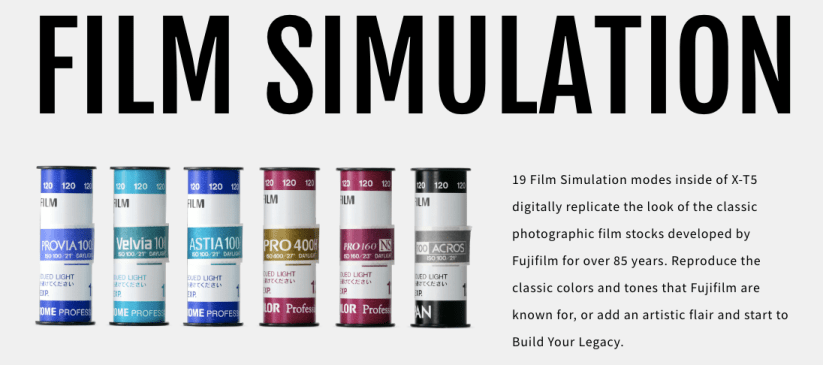
Interestingly, as a side note, if you look closely at the promotional statement by Fujifilm about film simulations on the X-T5, you’ll see this statement: “Reproduce the classic colors and tones that Fujifilm are known for, or add an artistic flair and start to Build Your Legacy.” First, I could be wrong, but I’m pretty sure it should be “is” and not “are”—after all, Fujifilm is known for reproducing classic colors and tones; for “are” to be correct, you’d need a conjunction, such as, “Reproduce the classic colors and tones that Fujifilm and Fuji X Weekly are known for….” Maybe they initially penciled that “and Fuji X Weekly” part in there, and erased it at the last minute, forgetting to change the “are” to “is” by accident. Second, Build Your Legacy seems to be Fujifilm’s new catchphrase for Film Simulation Recipes. It’s been a Fujifilm trademark for a few years, but I hadn’t seen it used in conjunction with film simulations. I wonder if Fujifilm has something up their sleeves that they’ll announce later. Perhaps it is even related to their upcoming app? I’m not sure, but it is definitely something to keep an eye on.
I had big plans for this project for these days, but life had other plans. Specifically, Covid. I know what you’re thinking: didn’t you just have the flu a few weeks ago? Yes, I did. Now I have Covid. Well, I’m almost recovered now, but I was very sick during the days that I captured these pictures, and I was limited to what I could capture in and around the house. Most of these photographs were taken in the backyard.
If you’re not sure what this short-term project is, the concept is simple: I’m photographing only with my Fujifilm X-T1 from the announcement day of the Fujifilm X-T5 (November 2) until the release date (November 17). Why? First, even though the Fujifilm X-T1 is eight-years-old (and approaching nine), it is still such a great little camera. It took three years for Fujifilm to bring this model to the market because they wanted to get it right, and it was one of their most important cameras ever released. The Fujifilm X-T1 was one of the first, if not the first, Fujifilm cameras that widely appealed to professional photographers. It was Fujifilm’s most successful model at the time—outselling all the previous cameras—and launched the extremely successful X-T line. The X-T5 is the latest iteration. This project will give me a better understanding of how the X-T5 has evolved from the original model. It also allows me to demonstrate that previous models, including the original X-T1, are still really good.
Hopefully, now that I’m not nearly so sick and my quarantine period has ended, I can do some of the photography that I was intending to do. I want to really see what the X-T1 is capable of, and with some luck I’ll be able to do that before this project comes to a close in the coming days. Once my X-T5 arrives in the mail, the X-T1 will be going back on the shelf, at least for a little while. I don’t expect the new camera to be wildly better than the first iteration, but soon enough I’ll know for sure just how much improved it is. And, of course, I’ll write all about it, so stay tuned!
Just yesterday Fujifilm announced the brand-new X-T5, and I’ve been inundated with questions of whether I’ve preordered it or not. Before I give my answer to that, I want to share my opinion (and it’s just an opinion) on who should buy the X-T5 and why, and who should pass on it. I’m sure many of you are considering purchasing it and are on the fence, so hopefully this helps you.
I think it’s important to have some perspective. New cameras come out all of the time, and each time there’s a lot of hype, which causes FOMO (fear of missing out) and GAS (gear acquisition syndrome), neither of which are good things. I’ve often said that it’s better to invest in experiences than gear—what kind of epic journey could you embark on with $1,700?—and the gear you already have is more than good enough. “Better” gear will never make you a better photographer, but using your gear more often will, especially if you can make an honest evaluation of your photographs and really consider what lessons they have to offer—each exposure, whether failed or successful, is a learning opportunity if you are open to it. It’s always a good idea to take the new-camera hype with a large grain of salt by keeping a healthy perspective.
The Fujifilm X-T5 looks like and seems like a very wonderful camera. Fujifilm listened to those who complained about the X-T4, and made the X-T5 more like the X-T3. That’s good, unless you like the X-T4 more than the X-T3 (there are some who do), then you might not appreciate the X-T5; otherwise, you’re likely to consider the X-T5 to be a nice improvement. Are those nice improvements enough that you should consider purchasing it?
If you print your pictures poster-sized, the X-T5 is for you, because it has all that extra resolution. If you crop extensively, the X-T5 is for you, because—you know—40mp and all. If you find the autofocus on your current model to be insufficient, then the X-T5 is for you, because they improved that. Need to shoot 6K video? The X-T5 is for you. Need IBIS? The X-T5 has it. If your camera is too big and you’d prefer something smaller, depending on the camera you have and how small you want to go, the X-T5 might be for you. Just got to have Nostalgic Negative and “improved” Auto White Balance? Well, the X-T5 has it. None of those things apply to you? Then I would suggest passing on the X-T5.
A lot of times when a new camera is released, it takes two steps forward and one step backwards. I think this is so some future iteration of it can add it back in and call it a new feature or improvement. For the X-T5 it is the optional vertical battery grip, which isn’t an option for the new camera. For most people this is no big deal, but for some this is a dealbreaker, so it is worth pointing out. I have a feeling that once the X-T5 is released, we’re going to start getting reports of overheating issues, so keep that in mind, too.
Hummingbird Feeder Along a Wall – Buckeye, AZ – Fujifilm X-T1 – “Classic Kodak Chrome” – I captured this picture today
I started a new short-term project: I’m photographing exclusively with my Fujifilm X-T1 from the announcement date of the X-T5 (yesterday) until the release date (the 17th). The X-T1 started the X-T line and is such an important camera in Fujifilm’s X-series heritage. It’s eight-years-old now (almost nine), so it can’t be any good, right? Well, no surprise to me, it’s still a highly capable camera worthy of use in 2022. In fact, the X-T1 has one advantage over all other X-T cameras, including the X-T5: the file sizes are smaller. That means I can capture more pictures on an SD card, it takes less time to transfer the pictures from the camera to my phone, the pictures take up less space on my phone, the pictures upload more quickly to my cloud storage, the pictures use less cloud data, and the pictures download from cloud storage more quickly. Less is more sometimes. Even though the X-T5 is capable of saving in HEIF, which saves space, the files will still be significantly bigger than those from the X-T1. Certainly, though, the pictures from the X-T1 aren’t good enough for printing, though, right? Nonsense! Some of my favorite pictures that I’ve ever printed were captured on a Fujifilm X-E1, which is even older than the X-T1.
Now I’ll answer the opening question: did I preorder the Fujifilm X-T5? Yes, I did. The silver one. Why? One reason, and one reason alone: Nostalgic Negative. I don’t think this new film simulation is going to be my favorite. I don’t think I’ll like it as much as Classic Negative, Classic Chrome, Eterna, or Acros. But I really want to try it and see what Film Simulation Recipes I can create with it. I think it will be fun to do that. Which brings me to another point: if some new gear will bring you joy, even if it isn’t meeting any other need, then it might be worth it. Maybe. It could be short term joy, and later you’re asking yourself why you didn’t use the money to visit a National Park or something instead, so you better be sure that you’ll really enjoy it for some time to come. The X-T5 doesn’t meet any other need for me. I don’t need the extra resolution, and, in fact, I’m not looking forward to that aspect of it. I don’t need the improved autofocus, as I find the autofocus of the X-T1 to be good enough for me, and the X-H1, X-T30, X100V, and X-E4 that I own are even better. I don’t shoot video (my wife does on her X-T4), and I have no need for 6K. I don’t consider IBIS to be important for any of my photography, but if for some reason I do need it (such as a long telephoto lens in dim light), I use my X-H1, which has IBIS. I have a lot of smaller camera bodies already, so I don’t need another—in fact, I suspect that bigger and heavier lenses will balance better on the X-T3 and (especially) X-T4 than the X-T5. The new and improved Auto White Balance is intriguing, and I’m curious how that affects recipes, but that’s definitely not a selling point for me. The only thing about the X-T5 that makes me want to buy it is Nostalgic Negative, which I’m really uncertain if that’s a good reason to spend so much money (my brain says no, my heart says yes), but I really look forward to using Nostalgic Negative and experimenting with it—I’m quite excited for that!
Should you buy the X-T5? That’s a question only you can answer. I can offer my best advice, but you should take it with a grain of salt, because everyone’s wants and needs are different. I can offer my perspective, but I would recommend getting advice from others, and go with whichever one makes the most sense to you.
This post contains affiliate links, and if you make a purchase using my links I’ll be compensated a small amount for it.
Preorder your Fujifilm X-T5 in black: AmazonB&H Preorder your Fujifilm X-T5 in silver: AmazonB&H
What makes this camera special? Who should buy it?
To understand the X-T5, one has to go back in time a few years. The X-H1 was Fujifilm’s original flagship, but due to poor timing on its release and an overly aggressive initial MSRP, it didn’t sell well. Fujifilm thought this camera was going to be a huge hit, but instead it flopped… at least until it was heavily discounted. Those who own an X-H1 love the camera, and regard it as one of Fujifilm’s best, a true workhorse. The X-T3, which was announced just months after the X-H1 was released, more or less killed the X-H1, just because it was the first X-Trans IV camera while the X-H1 was the last X-Trans III model. The X-T3 would become Fujifilm’s top selling camera of all time, and was only recently discontinued. The X-T4 came out when the X-T3 was just over a year old, and Fujifilm sold them both at the same time because the X-T4 wasn’t really the X-T3’s successor, but instead was another attempt at a flagship model, kind of a cross between the X-H1 and X-T3 (but with compromises that both X-T and X-H users weren’t thrilled about). Now that Fujifilm has released the X-H2 and X-H2s cameras, there isn’t a “need” for the X-T4, and it’s being discontinued. That brings us to the X-T5, which is the successor to both the X-T3 and X-T4, but is more like the X-T3 than the X-T4, yet sharing a legacy with both models. Make sense?
What makes the X-T5 special is that it walks back some of the unwanted “improvements” of the X-T4—yet improves upon the appreciated features of the X-T4—while in a package more similar to the X-T3, and with the new sensor and processor of the X-H2. So is it better than the X-T3? In many regards yes, in some regards it is a wash (not better or worse), and in a couple of regards no. Is it better than the X-T4? This depends on your definition of better, because the X-T4 was actually a more premium model, but with curious design choices that some don’t appreciate—if that’s you, then, yes, the X-T5 is better, but if you really like the X-T4, the X-T5 might be seen as a step backwards in some ways. I will say this: my wife has an X-T4 that she really loves, but she would prefer the screen of the X-T3/X-T5, so that makes it potentially a better camera for her. I say “potentially” because the screen is just one factor. If the X-T4 handles heat better—say, if the X-T5 has overheating issues when recording video—then that wouldn’t work out well, because she uses it more for for video than stills. “Better” is a subjective term, anyway, that’s perceived much differently depending on the person and how they use their gear. What’s “better” for one person might not be “better” for another—at all depends on your point-of-view.
But isn’t X-Trans V better than X-Trans IV? X-Trans IV was such an outdated sensor and overall technology, while X-Trans V is the pinnacle of APS-C camera technology advancements—doesn’t that mean it’s unquestionably better? That’s tough to say. I’m reminded of when Syndrome, in the movie The Incredibles, describes his new-and-improved superhero-destroying robot. “It’s bigger, it’s badder, ladies and gentleman,” Syndrome announces, “and it’s too much for Mr. Incredible!” Similarly, there’s no doubt that the X-T5 is metaphorically “bigger and badder” than the X-T3 and X-T4 (physically, it’s smaller than the X-T4), but perhaps “it’s too much for” most photographers. While some have decried the X-T3 and X-T4 as disappointments or not “good enough” for some reason, for the vast majority of photographers, both of those models are well above and beyond anything that they actually need. And, of course, with more megapixels come additional challenges—sometimes less is more. The point of this paragraph is that, yes, the technology of X-Trans V is surely an improvement, but, at a point of diminishing returns, do you really need those improvements? Some of you do, many of you don’t—and for those who don’t, the improvements of the X-T5 are really paper improvements and not something that will likely affect your photography in any practical way.
What I just stated is important because some of you right now are trying to decide if you should upgrade, and everyone’s telling you that you should. There’s a whole lot of hype—some FOMO and GAS even—and you’re not sure what to do. I will give you my advice as someone who has never touched or seen in-person an X-T5. Take it for what it’s worth, which is probably not a lot.
If you have an X-T2 and have been thinking of upgrading for awhile, but the X-T3 was too similar to the X-T2 (not enough of an upgrade), and the X-T4 had that darn flippy screen you didn’t like, then you’ll likely really appreciate the X-T5. If you have the money and desire, just do it and get it—I feel like this is the group that the X-T5 makes the most sense for. Those with an X-T3? I have a hard time with this one, because it might be a big difference for you, or it might be pretty much the same thing that you already have, depending on how you use the camera. Those who shoot JPEGs will likely find it significantly different with the new film simulations and JPEG options (although it doesn’t appear to be a whole lot different than the X-T4 in this regard). If you print your pictures poster-sized, those extra megapixels will come in handy. If you somehow find the autofocus lacking, that’s been improved. Use it for video? There’s some improvements there, too. Need IBIS? It has it. But if those things don’t matter that much to you, the X-T5 isn’t all that much different than the X-T3, and won’t necessarily be an improvement for you. So my suggestion to those considering upgrading from the X-T3 to the X-T5 is to think long and hard about how you use your camera and where you find it lacking, if you find it lacking at all. Those with an X-T4, the X-T5 is only an upgrade for you if you hate the flippy screen, if you somehow find the autofocus lacking, print posters, or need a slightly smaller body (apparently the X-T5 is just larger than an X-T1); otherwise, the X-T5 isn’t really an upgrade for you, and I don’t recommend getting the new camera. Still using an X-T1? Buy a used X-T2 or X-T3—there’s about to be a whole bunch of them. So to summarize, the X-T5 makes the most sense as an upgrade for those who currently have an X-T2; it’s 50-50 for those with an X-T3, depending on how you use your camera; many of those with an X-T4 will likely not trade in for the new model, although some will, obviously.
We’ve talked about upgrading from a like-model, but what about those who have some other camera? If you’ve been using an X-T20 or X-T30 and wanting a more premium model, the X-T5 might be just that for you. I don’t think it should be underestimated how many will be moving up from one of those models to an X-T5, or perhaps a used X-T3 or X-T4. I suspect that a used X-T3 will be pretty easily found for $700-$800 in the coming months—they’re still exceptional cameras, and that will be very tempting for those who don’t have $1,700 to drop on an X-T5. For those with an X-H1, I think the X-T4 is just as much (if not more so) of an “upgrade” as the X-T5 (for those who don’t consider the X-H2 and X-H2s to be the “real” successors), and obviously neither are really upgrades, so I don’t see the X-T5 as particularly appealing to the X-H1 owners, although I’m sure some will take the bait. I do believe that those who own an X100V as their only Fujifilm camera (and that’s a significant group… it really is a gateway into the Fujifilm system) will take a long look at the X-T5, as they should, and some will buy.
You might think, reading all of this, that I’m not especially excited for this camera, but you couldn’t be more wrong. I believe that Fujifilm is trying to do the right thing with the X-T5. Fujifilm walked back a lot of the changes that they made to the line with the X-T4, because those changes weren’t appreciated by the majority of X-T users. They did what they should have done (and what I previously suggested that they should do) and make the X-T5 more like the X-T3 and less like the X-T4. Bravo! I think the X-T5 is an important camera for Fujifilm, and a lot hinges on its success. I truly hope it’s a smashing success for Fujifilm, and I think it will be. With that said, I don’t work for Fujifilm, and I want to give good advice—honest advice—to my community, and the best advice I have is this: you shouldn’t upgrade with every new model release, experiences are more valuable than gear, and new gear will not make you a better photographer. On the flip side, if you have the money, and the X-T5 will help your photography in some way or make it more fun, then it definitely might be worth the expense. Only you can decide that for yourself. Trust your gut, and either go for it or pass, and feel good about that decision, whatever it is.
This post contains affiliate links, and if you make a purchase using my links I’ll be compensated a small amount for it.
Preorder your Fujifilm X-T5 in black: AmazonB&H Preorder your Fujifilm X-T5 in silver: AmazonB&H
If you didn’t know, Fujifilm is on the cusp of announcing the X-T5 (you can find all of the latest details at Fujirumors). I’ve been asked by a number of people to give my opinions on this upcoming camera. I hadn’t yet commented about it because a camera retailer reached out to me about the possibility of testing a preproduction X-T5, which comes with a promise not to talk about it until after it’s been officially announced; however, it didn’t work out, so I am free to say whatever I want. And just to be clear, I have no inside information on anything—I find out about things the same exact way that you do.
The X-T5 will be a pivotal camera, in my opinion. The X-H2 and X-H2S are pivotal cameras, too. I’m getting a little ahead of myself here—let’s back this bus up a little bit, and start over from the beginning.
Fujifilm launched the X-A7 in September of 2019, and the X-T200 in January of 2020. These were Fujifilm’s budget entry-level models. The X-A line had always been a good seller, especially in the Asian markets, and the X-T100 had done quite well; however, the X-A7 and X-T200 flopped pretty hard—not because they weren’t good cameras, but because that budget entry-level segment of the market suddenly dried up. Those who would normally purchase those cameras were using their cellphones instead. I think this is the origins of a big shift at Fujifilm, and what we’re seeing today is a result of that shift.
One big change is that Fujifilm pulled back on Kaizen (updating the firmware of older models to improve the cameras for no reason other than to have happy customers that will hopefully be repeat customers). This is something that they were renown for. Some at Fujifilm seem to believe that improving older models hinders the sales of newer models, which is likely true to an extent, but it also builds a very loyal customer base who are less likely to jump ship on the brand, which is good for long-term sales. Fujifilm stated recently that Kaizen isn’t necessary anymore, and to expect even less of it. This is a shame, and I believe a big misstep.
Hidden Church – North Salt Lake, UT – Fujifilm X-T200 – “Golden Negative“
Another change is the models that one might think of as mid-range are now the new entry-level. The X-T30 II, X-S10, and X-E4 are the current options. I don’t see Fujifilm continuing with three entry-level models, and I think the X-T00 or X-E line will become defunct. The X-E line might seem most logical, as it’s discontinuation is often discussed, but the X-T00 and X-S lines are basically competing against each other, so it could be that the X-T00 line is first to go. It will be interesting to see how this plays out over the next two or three years.
Fujifilm finds themselves as, more-or-less, the top dog in the APS-C market. Canon and Sony are only half-heartedly in it, as it’s clear they’re primarily focused on full-frame. Nikon is in a similar boat, but with perhaps slightly more heart. Pentax… they’ve got the GR line, but beyond that, they’re only half-heartedly making cameras anymore, period. Fujifilm is not only setting themselves up as the king of APS-C, they’re making it known that they’re the most premium APS-C brand in the market.
Which brings me to the X-H2 and X-H2S. These two cameras—the flagship models—are intended to compete against full-frame Canikony cameras—maybe not high-end full-frame, but certainly bottom-end and mid-range. These cameras are a statement that APS-C is still relevant, and is just as good as, or perhaps in some ways better than, many full-frame options. The X-H2 and X-H2S are made/marketed for three groups of people: 1) those with full-frame Canikony cameras who aren’t completely satisfied with their system and are considering a change, 2) those with a GFX model who otherwise don’t own a Fujifilm X camera (but, because of their GFX, think they might want to try it), and 3) those who came into the Fujifilm system via the X-S10 and want to upgrade to a higher-end model but want PASM and not the traditional dials found on most Fujifilm cameras. Those people are who these two cameras are for.
It should come as no surprise that those who have been in the system for a long time aren’t thrilled about this. Maybe they started with the original X100, later purchased an X-Pro1, upgraded to the X100T, upgraded to the X-Pro2, purchased an X-H1, purchased an X-T3, and upgraded to an X100V. They’ve faithfully been with Fujifilm for a decade, purchasing a number of cameras and lenses. They’re eager to upgrade to the best that Fujifilm has to offer, and yet the new top-of-the-line flagship models aren’t for them, but for someone else. They’ll have to settle for second best (or is it third best?). I’ve had a dozen or more people tell me that the above is essentially their story, and how they feel. That shouldn’t be so easily brushed off as a “get off my lawn” mentality, because their feelings are valid whether you agree with it or not—just as valid as your feelings. In fact, I would suggest that the long-time loyal customers’ feelings should be more valuable than anyone else’s. Should is the keyword, because obviously that’s not the case here—Fujifilm has made that clear, and that’s another misstep, in my opinion.
Suburb Home – Farmington, UT – Fujifilm X-E4 – “Positive Film“
Fujifilm took a significant risk with the X-H2 and X-H2S. They placed a pretty big bet on their decisions and design. If the bet pays off—and early indications are that it is—I have no doubts that Fujifilm will double-down on it. Why wouldn’t they? If you find gold, you don’t stop panning. The direction of the brand, which has been altering course due to fluctuating philosophies, will be determined, in part, by the success of these two cameras. That’s why I said that they are pivotal models.
The X-T5 will also be a pivotal model because it, too, could have a significant effect on the trajectory of the brand. If it does very well, Fujifilm will likely continue to produce this model (and others) that appeal to the long-time base, spending lots of R&D time and money on these types of cameras. If it doesn’t sell well, Fujifilm might pivot away from it, and it will be the beginning of the end of the X-T0 line. I think a lot more is at stake than many realize, and I’m sure that I will receive plenty of criticism for stating this.
The question is: will the X-T5 sell well or not? Will it convince people to upgrade from their X-T3 or X-T4. The X-T3 is Fujifilm’s all-time best selling model. I think the X-T4, while it did in fact sell well, wasn’t quite as big of a success as Fujifilm hoped it would be. I think they wanted it to be the flagship model that the X-H2 and X-H2S are now, but it didn’t work out because it wasn’t Goldilocks for either the X-T0 camp or the X-H camp—the compromises weren’t appreciated by either group. Will those who purchased an X-T3 or X-T4 be ready to upgrade to a new model? That’s the million dollar question.
Overall, I believe that the X-T5 will be better appreciated than the X-T4 because Fujifilm (apparently) walked back some of the changes introduced on the X-T4, and the X-T5 will be more similar to the X-T3 (except with IBIS and the new sensor and processor). I think this is very good. Bravo! However, the issue that I think could potentially derail the success of the X-T5 is that we’ve reached a point of diminishing returns. Does it matter that the X-T5 has 40-megapixels when the 26-megapixels of the X-T3 and X-T4 are more than enough for 99% of photographers? More megapixels can also mean more required memory, and you’ll have to upgrade your SD cards and external hard drives and/or cloud storage… sometimes less is more. Does it matter that the X-T5 has faster autofocus when the autofocus speed of the X-T3 and X-T4 is already fast enough for 99% of photographers? Sure, there are those who actually do need more resolution or faster autofocus (it’s a small group, and they know who they are), and there are those who think they need it but in reality don’t (better to learn the gear you’ve already got…), and that will generate some sales, too. But otherwise, is there enough to convince those who spent over a grand—maybe nearly two—on a camera body within the last two years—a camera that’s been working quite well for them—to drop $1,700 on a new body that they don’t really need? Time will tell.
I think the two new cameras that Fujifilm just introduced could potentially be a problem for the X-T5. You see, there were eager photographers who had money burning a hole in their pockets (a nice problem to have, I suppose) who wanted to get their hands on the latest-and-greatest and got caught up in the hype. They weren’t thrilled that it was a PASM camera, but they didn’t let that stop them, and they dropped $2,000 or more just recently. If they had known that the X-T5 was right around the corner, they would have waited and purchased that instead because they would have preferred it; however, they cannot justify owning both an X-H2 model and an X-T5, so they won’t buy the X-T5, at least not right away.
The other thing, which is a result of Fujifilm’s Kaizen retreat, is that new JPEG features introduced on later models won’t trickle to earlier models. The X-T3 doesn’t have Classic Negative, Eterna Bleach Bypass, Clarity, Color Chrome FX Blue, Grain size, half-step Highlight/Shadow adjustments, or the ability to save White Balance Shifts in the C1-C7 presets. The X-Pro3 doesn’t have Eterna Bleach Bypass or half-step Highlight/Shadow adjustments. The X-S10, X-E4, and X-T30 II have all of it, despite not being premium models, because they were introduced later. Whatever new features Fujifilm has up their sleeves that they will introduce on some later model won’t likely make it onto the X-T5, so if you want it, it’s better to wait towards the end of the X-Trans V lifecycle. The early bird gets …hosed, while the patient bird is rewarded.
Will I buy an X-T5? Maybe. Probably not, simply because I don’t need it. There’s no void in my camera lineup that the X-T5 would fill. All of my current Fujifilm models fulfill my photographic needs, so dropping so much money on something that I don’t need doesn’t make a whole lot of sense. Still, I’m intrigued by it, so I won’t say absolutely not; maybe I’ll put in a preorder on November 2—I’d definitely have to part ways with some other gear to fund it, and I have no ideas what that would be right now.
I could be very wrong, and I’ve been wrong in the past and I freely admit it, so take all of this with a grain of salt. I do think the X-T5 will sell well. Those who purchased an X-T3 maybe two or more years ago will take a very long look at the X-T5. Those who purchased an X-T4 but weren’t thrilled with the flippy screen will also consider upgrading to an X-T5. But I’m not convinced it will sell well enough (in Fujifilm’s eyes), which (if so) will result in some deep discussions at Fujifilm’s headquarters over the direction of the digital camera division. Again, time will tell if that happens, and, if so, what it even means.
This has been a whole lot of rambling about nothing. I have no real insights to offer. I’ve not seen or touched a Fujifilm X-T5. I’ve never spoken with anyone within the Japan office of Fujifilm about anything. I have talked with a number of Fujifilm photographers—I get nearly 50 messages a day—and I think I have a pretty good pulse on the community… at least those who primarily shoot JPEGs. I think the X-T5 will be a wonderful camera that many of you will purchase and love. I truly hope it far exceeds Fujifilm’s wildest sales expectations, because I believe this camera is a pivotal model. Will it? I have no idea—it’s as much my guess as anyone else’s.
There’s some exciting news that I want to pass along to you. I don’t want Fuji X Weekly to be completely centered on gear, but I also want to keep you in the know, and so I try to keep things balanced. Anyway, according to Fujirumors.com, there are three new Fujifilm cameras coming this spring. One is the X100V, which will replace the excellent X100F. Another, which might be called X-T3s or X-T5 (in Japan, the number four is bad luck), will replace the not-very-old X-T3. The third is a mystery, but I’m betting that it’s a medium-format GFX camera. Let’s briefly talk about each.
The X100V has been whispered and rumored across the internet for many months. There’s no surprise that it’s coming soon. What we don’t know is how much different it will be from the X100F. It will certainly have the 26-megapixel X-Trans IV sensor and processor, and probably all of the new JPEG tools of the X-Pro3, but beyond that nobody knows. There’s been speculation for some time that Fujifilm redesigned the lens, but I don’t know if that’s true or not. It could be a mild update to the X100F, which makes sense, because if it ain’t broke don’t fix it. Or it could be a moderate overhaul, similar to what Fujifilm did with the X-Pro3. We will know soon enough.
It’s very surprising to me that Fujifilm will be announcing a replacement to the X-T3 so soon. Why? Because the X-T3 will only be one-and-a-half years old when its successor is released. Digital technology advances quickly, but I’m not sure there’s enough to justify a whole new camera in that short amount of time. Is there a new sensor coming? New processor? If not, a simple firmware update would breathe a second wind into what’s already a successful camera model. If there’s nothing big to separate the upcoming model from the current one, I don’t think it will be a huge success because there’s no incentive to buy the new camera. Why pay more for something that’s essentially exactly the same? It will be interesting to see what Fujifilm has up its sleeve on this one.
The third camera is an unknown model, but fuzzy pictures have leaked out of Japan of a new GFX body. It could be a non-IBIS 100-megapixel camera. It could be a 50-megapixel body with IBIS. It could be the first GFX with an X-Trans sensor. Fujifilm has done well in the medium-format market, quickly setting themselves up as the leader, so it would be unsurprising if they added another camera to the GFX lineup.
What other cameras should Fujifilm release in 2020? I’d like to see an X70 but with an X-Trans IV sensor. How about an X-H2? While it was well-received by users, I don’t believe the X-H1 was especially commercially successful, but Fujifilm should have at least one APS-C camera with IBIS for those who want it, so an X-H2 makes sense. That is, unless the X-T3 successor has IBIS. The X-E line is due for an update. Keep the body the same, but put the X-Trans IV sensor inside, and you have an X-E5. Simple enough, right? It will be exciting to see whatever is forthcoming from Fujifilm, and I will do my best on the Fuji X Weekly blog to keep you updated, but hopefully without overwhelming you with gear posts.