Fujifilm used “deep-learning AI Technology” to improve Auto White Balance on the X-T5 (or, more accurately, on X-Trans V cameras—not just the X-T5). According to the promotional statement, the camera is able to more accurately identify warm tints, and adjust to compensate for that when using Auto White Balance. Sounds impressive, right?
When I first learned about this, I was a little concerned that the new Auto White Balance would affect Film Simulation Recipes that use AWB. So I took a few test shots with the X-T5 and an X-Trans IV model side-by-side to compare, and I didn’t notice any difference between the two regarding white balance. It looked the same to me. But now that I’ve used the X-T5 a little longer, I do, in fact, at times notice something that I initially overlooked.
In the banner above, which comes from Fujifilm’s promo materiel for the X-T5 (even though the X-H2 has this same feature, it wasn’t promoted with that camera), you can see the “conventional model” vs the X-T5 AWB rendering in identical light. I assume that the so-called conventional model wasn’t a Sony or Canon, but an X-T4 (or other X-Trans IV camera). I personally prefer the more golden rendering of the “conventional” AWB to the copper rendering of the AI AWB, but each has their own tastes, so there’s no right or wrong answer. Perhaps you prefer the image on the right over the one on the left. It’s definitely subjective.
Something I have noticed—and I don’t like—is that this new rendering is inconsistent. From one exposure to the next, with identical lighting and identical settings, you can get something more like the “conventional model” rendering or something more like the AI AWB rendering. I’ve noticed it in artificial light, and I’ve noticed it in golden-hour/sunset situations. Two exposures, one right after the other—nothing’s changed—but the camera produces two very different tints when using AWB. Take a look at the two pictures below for an example of this. They were captured under identical light with identical settings, but they clearly aren’t identical. This was in a set of 32 pictures (of my son opening birthday gifts); 19 had the golden-ish cast and 13 had the copper-ish cast (these are frames nine and ten, for those wondering).
Obviously if you are a wedding or event photographer, and you rely on Auto White Balance, this could be a big issue for you, because you want consistent results. You don’t want the white balance to be bouncing back-and-forth between two tints. I don’t even want it for my son’s birthday pictures! If the camera chose one rendering in the situation, and consistently applied that to each image, whether gold or copper or something else entirely, that’s fine—it’s what is expected to happen—but bouncing between renderings is bad and should not happen. If you can’t trust AWB, and if it’s a tool that you commonly use, the X-T5 (or any of the X-Trans V models) might not be the camera for you.
Of course, for many people this might not be an issue whatsoever. Maybe you don’t even use AWB. Perhaps you do but you don’t care if the results are different between exposures. It could be that you’re going to adjust white balance in software later anyway, so what the camera records makes no difference to you. If that’s you, and none of this matters to you, great! But I do want to point it out for those who it might matter for, because they should know. It’s better to find out now before dropping so much money on something that’s just going to frustrate you.
I imagine that this is something Fujifilm could fix fairly easily via a firmware update. A simple tweak to the code could possibly make this behavior happen much less frequently. Fujifilm should address this issue. I hope in a few months from now this will all be a past problem that was fixed and forgotten. Or it could be the expected behavior that all Fujifilm X-Trans V cameras will have, and it will only be fixed by an even more improved AI-AWB on X-Trans VI models. Time will tell.
Since the Fujifilm X100V is difficult to find and sometimes outrageously expensive, something that I inadvertently had a hand in, people have been asking for recommendations on alternatives. Of course, the X100F or any of the older X100-series versions would be a top substitute, but even those are going for a lot of money, more than they should be for how old they are. The Fujifilm X-E4 with a Fujinon 27mm f/2.8 could be a very nice consolation prize, but due to parts shortages, those can be difficult to find, too, but thankfully there doesn’t seem to be much price gouging on it (knock on wood). The Fujifilm X70 would be a solid alternative, but they are pretty pricy, often going for the same or more than the original MSRP, despite being almost seven-years-old. If you are really set on owning a Fujifilm X100V (as a proud X100V owner I can understand why), if you just exercise some patience and constantly stay on the lookout, you are sure to find one for a reasonable price. If you are not patient, a used X100F isn’t too difficult to get, or even consider an X-E3, which can still be found brand-new if you look hard enough.
I’ve had a few people ask me for a recommendation on an X100V-like alternative for under $500, and one even asked for under $400. At first I scoffed at the idea. Even the original 12-year-old X100 currently goes for more than that, as well as every iteration of that camera since. Fujifilm doesn’t make entry-level cameras anymore, but even when they did, they were more than $500. Then I looked at my camera case, and I noticed two things: a Fujifilm X-M1 and a TTArtisan 27mm f/2.8. Hmmm. Maybe it’s possible after all.
Fujifilm introduced the X-M1—the third and last X-Trans I model—nine years ago. It’s an unusual camera, because it has an X-Trans I sensor but the X-Trans II processor, and in the same body as the Bayer-sensor X-A1. I think Fujifilm had some spare X-Trans I sensors sitting around after moving onto X-Trans II, and this camera was their way to unload them. There was never a predecessor, so when the X-M1 was discontinued so was the line. I paid $210 for mine two years ago. More commonly they’re found for around $250, and I’ve seen them for under $200 a couple times.
I think the X-E1 is a better body than the X-M1, and you can find those sometimes for $250 or less, but more often they’re $300-$350. If you see a good deal on one, I’d choose that over the X-M1. The X-A1 is basically the same thing as the X-M1, but with a Bayer sensor instead of X-Trans, and those are often a little cheaper. It’s definitely easier to find one under $250, and it’s not uncommon to see one under $200; however, between the X-A1 and X-M1, I’d choose the X-M1, but the difference isn’t huge. The X-A2 often is found for $250, and is another option. Occasionally you might find a good deal on an X-A3 or X-E2 (or X-E2s), so it’s worth looking just to see if you can get lucky, because that would be even better. If your budget is $500, you certainly have more options, but if the ceiling is only $400, you are much more limited, and the X-M1 is probably your best bet.
Of course, there’s still the lens. Sometimes you can buy the body bundled with a kit lens for nearly the same price as body-only (my X-M1 was bundled with 16-50mm zoom, for example), but the cheap kit zoom isn’t going to give you an X100-like experience. You’ll need a prime, but it has to be compact and cheap. The options are pretty limited, and are even more limited if you expect an autofocus option—the TTArtisans 27mm f/2.8 pancake-ish autofocus lens is the only one I can think of that is both cheap and small. If you don’t mind manual-focus-only, there are a few other lenses that could work, but I think this TTArtisan option is your best bet, and it’s only $160.
So, yeah, add $210 and $160 and you’re under $400. Will the X-M1 with the TTArtisan 27mm really give an X100-like experience? No, not at all. But, for under $400, it’s surely as close as you’ll get. If your budget is $500, spring for an X-E1 instead of the X-M1 and you’ll be a little closer, but still not there. The X-M1 is not as good as any in the X100-series models (or X-E-series or the X70), but that doesn’t mean that it’s not a decent camera capable of capturing good photos, because it is!
So if you are looking for a low-budget alternative to the Fujifilm X100V, X-E4, or X70, I suggest to you the X-M1 with the TTArtisan 27mm lens attached to it. The X-M1 is smaller than the X100V and X-E4, and just a little bigger than the X70. Obviously the TTArtisan lens, despite being pancake-ish, is bigger than the lens attached to the X100V and is especially larger than the one on the X70. It’s also a little bigger than the Fujinon 27mm lens (a popular companion to the X-E4). The Fujifilm X-M1 with the TTArtisan lens is small enough to be in the same compact category as those cameras, but is much, much cheaper. If you can spend more, there are better options; however, if you don’t have much to spend or are looking for an inexpensive first-camera, this is my recommendation for under $400.
It would be easy for me to suggest this to you, and not use it myself. That would not be very genuine of me, so I did use the Fujifilm X-M1 with the TTArtisan 27mm f/2.8. I also let me 13-year-old son, Jonathan, use it a little, too. This combo is very capable of producing lovely pictures straight-out-of-camera that have character and some analog-like qualities. It’s also easy to use for those who want good results without much fuss.
The 15 pictures below are all unedited (aside from some cropping and straightening), captured with the Fujifilm X-M1 and TTArtisan 27mm f/2.8.
Fujifilm X-M1 + TTArtisan 27mm f/2.8 – Photo by Jonathan Roesch
Fujifilm X-M1 + TTArtisan 27mm f/2.8 – Photo by Jonathan Roesch
Fujifilm X-M1 + TTArtisan 27mm f/2.8 – Photo by Jonathan Roesch
Fujifilm X-M1 + TTArtisan 27mm f/2.8 – Photo by Jonathan Roesch
Fujifilm X-M1 + TTArtisan 27mm f/2.8 – Photo by Jonathan Roesch
Now, let me tell you about the Film Simulation Recipes, because otherwise I’ll get a whole bunch of inquiries—you all want to know, right?! The top picture (of the X-M1 by itself) was captured with a Fujifilm X-E4 and Fujinon 27mm using the Fujicolor Pro 400H recipe. The next four pictures (the X-M1 with other cameras) were captured with a Fujifilm X-T5 and Fujinon 90mm using an upcoming recipe that I’ll publish soon. The 15 pictures above were captured with a Fujifilm X-M1 and TTArtisan 27mm using an upcoming recipe that I’ll publish soon. So, for now, only the very top picture is a recipe that you can currently use—you’ll have to stay tuned for the others.
This post contains affiliate links, and if you make a purchase using my links I’ll be compensated a small amount for it.
The Fujifilm X-T5 is better—at least slightly—than the X-T4 in a many ways, but not every way. Perhaps you have an X-T4 and are considering upgrading to the latest iteration, or maybe you cannot decide between the X-T4 or X-T5—this article will point out some reasons why you might consider the X-T4 over the new model. Don’t get me wrong, I’m not saying that the X-T4 is better, only that in some ways it is indeed better; however, overall, the X-T5 is, in my opinion, the superior camera, but only by a small margin (I’ll have a full review of the new camera soon, so keep an eye out for that). Below are five ways the Fujifilm X-T4 is actually better than the X-T5.
1. Heat Dispersion
There are a few true workhorses in the Fujifilm lineup. These cameras just go and go and go. They’re eager to work and don’t need a break. The X-H1 is probably the best. The X-T4 is not far behind.
I don’t usually have heat issues with Fujifilm cameras in my day-to-day photography, but when I do the monthly SOOC broadcast, I need a camera that will run 4K video for several hours. My X-H1 will do it. The X-T4 will do it, too. But, I found out that the X-T5 will only last for about 45 minutes before overheating. Interestingly enough, I accidentally forgot to turn off the X-T4, and it kept running for 24 hours straight, no overheating! Before you scoff, the camera was plugged into the wall with a faux battery power cord and it was tethered to my computer, so it is, in fact, possible for the camera to run 4K for hours and hours and hours, just so long as it doesn’t power down due to overheating.
After I discovered the X-T4 had been inadvertently running for a whole day, I powered it off and let it rest for 15 minutes, then I used it for a three-and-a-half hour broadcast. It worked like a champ! The X-T5 overheats much too quickly to even be considered for this use. If you will be video broadcasting or recording long clips, the X-T4 is the clear winner. The almost-five-year-old X-H1 is better than the X-T5 in this regard, too. I’m not surprised, because Fujifilm stuffed a high-resolution sensor and quick processor into a small body, and the consequence of that is heat, and there’s just not enough heat dispersion. For most people, this is no big deal at all, but for those videographers who need to record extended-length clips, the X-T5 should be avoided, and the X-T4 is a much better option.
2. Rear Screen
I like the X-T5’s three-way tilt screen better than the flippy screen on the X-T4, but not everyone agrees with me on that. For some, the X-T4’s screen is superior. You can do a lot more with it, and being able to see yourself while recording video of yourself is big plus for some. Personally, what I like best about the X-T4’s screen is that you can close it backwards, and it is sort of like shooting with an X-Pro3 (kinda, but not really)—no other X-T series camera can do that, only the X-T4. You might actually prefer the X-T4’s rear screen over the X-T5. Different strokes for different folks, right?
3. Vertical Battery Grip
I’ve never used a vertical battery grip on any camera ever, but some do use it, either for the extra battery power, the extra grip, or both. Every single camera in this series—including the X-T1—has had an optional vertical battery grip accessory for those who want one, except for the X-T5. In this way, the X-T5 is more like the X-T00 series, and it cheapens the line (not in cost, but in perceived quality). Most people don’t use the vertical battery grip, so for the majority this is no big deal whatsoever, but for some this is a dealbreaker.
4. Body Size
A lot of people (myself included) have applauded the smaller size of the X-T5, but some prefer the bigger X-T4 body. Those with big hands might prefer the grip on the X-T4, and those who frequently shoot with large, heavy lenses might prefer using them attached to the bulkier frame. For me, just doing some testing in preparation for the upcoming X-T5 review, the larger X-T4 body felt better when using the Fujinon 100-400mm lens than the smaller X-T5, but that was simply my experience and my preference. I would suggest that the shooting experience of the X-T4 might be slightly superior if you do use large lenses a lot, but it is a personal preference.
5. Resolution
More is more, right? 40 is better than 26, right? If you crop deeply, print poster, or enjoy pixel-peeping, the higher resolution sensor of the X-T5 is probably for you. Otherwise, the X-T4 has more resolution than most people typically use or need. The disadvantage of more resolution is that it takes up more digital storage space (on your SD cards, phone, computer, external hard drive, and cloud storage), and it can take longer to process or upload files—an extra second here and there doesn’t seem like much, but if you add it up over ten thousand pictures (the course of a year for me), you’re talking about hours that the higher resolution sensor cost you. Sometimes less is more. Personally, I prefer the 26-megapixel resolution of the X-T4 over the X-T5’s 40-megapixels; some of you might even prefer the X-T1’s 16-megapixels.
But, but, but… the X-T5 has the new super-quick autofocus, that finally brings it up to par with Canikony! That alone makes it worthwhile, right? Outside of dim-light situations, I found the X-T1’s eight-year-old autofocus to be plenty quick for me, including for sports and wildlife photography. The X-T4’s autofocus, which is even better, is more than good enough for almost everyone.
It’s not the gear that’s incapable. People have been capturing amazing photographs for 150+ years, and whether for stills or motion pictures, the focus capability of the gear has never stood in the way. People have done so much more with so much less for so many decades. If you looked at photography forums and such lately, you’d wonder how anyone ever managed to capture an in-focus picture prior to the Sony A7 III. We must have imagined it all, because it’s just not possible without the quickest autofocus—and if you don’t have the quickest, you got nothing. That’s how it seems. The focus inability of camera gear is a very recent phenomena. With that said, if a camera offers a tool that makes photography a little easier for you, that’s a good thing. Certainly autofocus in general, and the gradual improvements in autofocus capabilities over the years, have opened up photography for people who don’t have the skill or experience or desire to get the shot otherwise—that’s not a dig, by the way, as I believe opening up photography to those who the door would otherwise be closed to is important. Film Simulation Recipes do that for those who don’t have the skill, time, desire, or access to computer/software to edit RAW files—for me, that’s time and desire; for you, it might be something else—and it has become an important tool for the visually impaired. So, yeah—bravo to better autofocus! But, if you do find the focus capabilities lacking on whatever gear you are using, know that you do have it within you to overcome that issue, and it doesn’t involve buying new gear.
Back to the cameras in question…. In AF-S, I didn’t hardly notice any difference between the X-T4 and the X-T5 (or even the X-T1 and X-T5 in normal light). I think the visual confirmation of focus is a hair quicker, but the actual focus isn’t (I hope that makes sense). The X-T5 recognizes faces a little further away, if that matters. In AF-C, I do think the X-T5 is just a tad better at finding and correctly focusing on the intended subject, but it’s not a night-and-day difference, only a small improvement (but an improvement nonetheless). Where I believe the X-T5 is indeed superior to the X-T4 with regard to autofocus is continuous subject-tracking. The X-T5 can recognize more various subjects to track (not just human face/eye), and does a better job of tracking. So if you do use continuous subject-tracking autofocus, you’ll find the X-T5 to be better than the X-T4; if you don’t, you’ll find the X-T5’s autofocus to be only marginally improved.
This post contains affiliate links, and if you make a purchase using my links I’ll be compensated a small amount for it.
I bet you’ve figured out which is which, but if you haven’t, in the train picture at top the left is Nostalgic Neg. and the right is Eterna. For the set above, the Eterna picture is left and the Nostalgic Neg. is right.
What’s different between the two? There’s quite a bit different between out-of-the-box default Nostalgic Neg. and Eterna, but Eterna can be made to look quite similar to Nostalgic Neg.—this was just a quick experiment, and with some more time and work, I could probably get it even closer. Nostalgic Neg. has a little more contrast, a lot more vibrant colors, and is slightly warmer than Eterna. With some modifications to make the two appear similar, though, it seems that the biggest difference is that Nostalgic Neg. is slightly warmer and more vibrant in the shadows, and yellow is rendered a little more deeply; otherwise, you can almost match them identically.
So what does it take to create faux Nostalgic Neg. with Eterna? I’m still fine-tuning it, but I believe that, using Eterna, reducing Highlight by -1, increasing Shadow by +1.5, reducing Dynamic Range by one or maybe two spots, adjusting White Balance Shift by +2 Red and -1 (or maybe -2) Blue, increasing Color by +6… this obviously means that Color has to be a negative value (at least -2) on Nostalgic Neg. in order to match it. This is all still a work-in-progress, but it does mean that a fairly close faux Nostalgic Neg. recipe for X-Trans IV is possible, and in the process of being created. If you feel as though you’re missing out on Nostalgic Neg.—don’t fret!—if your camera has Eterna, it can, to an extent, mimic it—stay tuned for a Film Simulation Recipe!
Short Train – Buckeye, AZ – Fujifilm X-T5 – “1970’s Summer”
This Film Simulation Recipe is the aesthetic that I hoped to achieve with the new Nostalgic Neg. film simulation. What does it resemble? It very much has a nostalgic Kodak “memory color” (as Fujifilm likes to say) that is reminiscent of old color photographs from the 1970’s. You might notice some similarities to William Eggleston’s Election Eve and 2 1/4 series and some of his other work from the late-1960’s through the mid-1970’s—not every picture, but certainly several. You might spot some similarities between this look and some of Stephen Shore’s photographs from the early-to-mid 1970’s. I think there are some similarities to a few of Joel Sternfeld’s American Prospects pictures. There’s a noticeable likeness to several of Richard Misrach’s desert photographs. In other words, this recipe produces a distinct 1970’s American New Color aesthetic.
It shouldn’t surprise you that the Nostalgic Neg. film simulation produces this look because Fujifilm stated that the American New Color movement was the inspiration. Specifically, they looked at the photographs of Eggleston, Shore, Sternfeld, and Misrach, but out-of-the-box default Nostalgic Neg. doesn’t seem to resemble their work all that closely. After examining many of their photographs, and identifying a few from each with a similar aesthetic, I set out to create a Film Simulation Recipe that better mimics some of their pictures. I feel like a got pretty close, and this recipe produces a distinct 1970’s vibe—especially the warmth of summertime—and so I named it 1970’s Summer. This recipe works best in sunny daylight, and is excellent for midday photography.
Going Out of Business – Prescott, AZ – Fujifilm X-T5 – “1970’s Summer”
This 1970’s Summer Film Simulation Recipe is only compatible with (as of this writing) the Fujifilm X-T5, X-H2, and X-H2S. I assume that the GFX100S and GFX50S II can also use this recipe, but that it will render slightly different—I don’t have either of those cameras to test it to know for certain. Unless Fujifilm gives X-Trans IV cameras the Nostalgic Neg. film simulation, which I doubt they will do, this recipe is only for X-Trans V cameras, and maybe the latest GFX, too; however, if you are looking for something somewhat similar, try my Vintage Color recipe, or even Kodak Portra 400 Warm.
Film Simulation: Nostalgic Neg. Grain Effect: Strong, Large Color Chrome Effect: Strong Color Chrome FX Blue: Strong White Balance: 6500K, -1 Red & -4 Blue Dynamic Range: DR400 Highlight: -2 Shadow: -0.5 Color: -2 Sharpness: -2 High ISO NR: -4 Clarity: -3 ISO: Auto, up to ISO 6400 Exposure Compensation: +1/3 to +1 (typically)
Example photographs, all camera-made JPEGs using this “1970’s Summer” Film Simulation Recipe on my Fujifilm X-T5:
Red & Gold – Prescott, AZ – Fujifilm X-T5
Adventure’s First Stop – Prescott Valley, AZ – Fujifilm X-T5
Hyundai – Prescott, AZ – Fujifilm X-T5
Cat Clock – Prescott, AZ – Fujifilm X-T5
Propane – Hassayampa, AZ – Fujifilm X-T5
Security Light – Palo Verde, AZ – Fujifilm X-T5
Hay, Detour – – Arlington, AZ – Fujifilm X-T5
Gila River Bridge – Arlington, AZ – Fujifilm X-T5
13 FT 6 IN – Arlington, AZ – Fujifilm X-T5
Around the Bend – Arlington, AZ – Fujifilm X-T5
Gillespie Dam Bridge – Arlington, AZ – Fujifilm X-T5
Desert Dam – Arlington, AZ – Fujifilm X-T5
Julio Suarez – Arlington, AZ – Fujifilm X-T5
Dam Reflection – Arlington, AZ – Fujifilm X-T5
Broken Dam – Arlington, AZ – Fujifilm X-T5
Lakeview – Lynx Lake, AZ – Fujifilm X-T5
Attention Anglers – Lynx Lake, AZ – Fujifilm X-T5
Can’t See the Forest – Lynx Lake, AZ – Fujifilm X-T5
Rural Tree – Arlington, AZ – Fujifilm X-T5
Green Field – Buckeye, AZ – Fujifilm X-T5
Abandoned Rural Home – Palo Verde, AZ – Fujifilm X-T5
More Than Double Wide – Arlington, AZ – Fujifilm X-T5
Hole in the Wall – Arlington, AZ – Fujifilm X-T5
PRA – Arlington, AZ – Fujifilm X-T5
Abandoned & Leaning – Arlington, AZ – Fujifilm X-T5
Desert Basketball – Arlington, AZ – Fujifilm X-T5
Double Cross – Arlington, AZ – Fujifilm X-T5
Palm Trunk & Blocks – Arlington, AZ – Fujifilm X-T5
Fake Fall Flowers – Arlington, AZ – Fujifilm X-T5
Arlington Baptist Church – Arlington, AZ – Fujifilm X-T5
Gate 8 – Arlington, AZ – Fujifilm X-T5
Flowing Water & Broken Footbridge – Arlington, AZ – Fujifilm X-T5
Irrigation Mist – Buckeye, AZ – Fujifilm X-T5
This post contains affiliate links, and if you make a purchase using my links I’ll be compensated a small amount for it.
Nobody pays me to write the content found on fujixweekly.com. There’s a real cost to operating and maintaining this site, not to mention all the time that I pour into it. If you appreciated this article, please consider making a one-time gift contribution. Thank you!
I’ve been busy the last few days trying to see what is similar and what’s different about the JPEG output from my new Fujifilm X-T5 camera. How does X-Trans V compare with X-Trans IV? Are my X-Trans IV Film Simulation Recipes really compatible with the new Fujifilm cameras? Technically they are because the options are the same (except that X-Trans V has the new Nostalgic Neg. film simulation), but do they render the same, or at least similar enough?
I was surprised by something that I discovered. While many of the colors are extremely close in rendering, blues are not. Take a look at the comparison below. Both images were captured with identical settings and even the same lens—one with an X-Trans IV camera, and the other on X-Trans V—but the blue sky is not the same. If you study close enough you might notice some other extremely subtle differences, but the rendering of blue is a clearly not the same between the two sensor generations.
I looked very closely at all of the different film simulations, and I noticed that this difference in blue is film simulation dependent. Not all film sims render blue differently, and some vary more than others. Here are my discoveries:
Eterna Bleach Bypass on X-Trans V renders blue a little darker than on X-Trans IV with Color Chrome FX Blue set to Weak. Classic Negative on X-Trans V renders blue identically to X-Trans IV with Color Chrome FX Blue set to Weak. Classic Chrome and Eterna on X-Trans V renders blue just barely lighter than on X-Trans IV with Color Chrome FX Blue set to Weak. Velvia, PRO Neg. Hi, and PRO Neg. Std on X-Trans V renders blue halfway in-between Color Chrome FX Blue set to Weak and Off on X-Trans IV. Provia and Astia on X-Trans V renders blue identically to X-Trans IV with Color Chrome FX Blue set to Off.
In other words, with the exception of Provia and Astia, blue is different on X-Trans V than X-Trans IV. With Classic Negative, if an X-Trans IV Film Simulation Recipe calls for Color Chrome FX Blue set to Weak, if you set it to Off instead, it will render the same; if it call for Color Chrome FX Blue set to Strong, if you set it to Weak instead, it will render the same. You can also do that with Eterna Bleach Bypass, Eterna, and Classic Chrome, and it will be pretty close, but it won’t be identical. With Velvia, PRO Neg. Hi, and PRO Neg. Std, you can go either way (adjusting Color Chrome FX Blue or not), and it really doesn’t matter because it will be wrong by about the same amount, either too light or too dark.
Does it matter? it’s not a huge difference, but it is a difference. You might prefer the rendering of X-Trans IV or you might prefer the rendering of X-Trans V. I think, personally, I’m leaning towards preferring the X-Trans V rendering—many of my recipes use Color Chrome FX Blue set to Weak or sometimes Strong, and with X-Trans V that’s already built-in now on some of the film simulations. But it also means that many X-Trans IV recipes will render differently, and, while technically compatible, aren’t truly compatible with X-Trans V cameras.
I captured with picture on my Fujifilm X-T5 using the new Nostalgic Neg. film simulation.
Why did Fujifilm do this? I don’t think this is anything new. For example, Fujifilm has tweaked Velvia film, because the original Velvia emulsion was a “mistake” (although many photographers didn’t think so—if it was an accident, it was a very happy one). I remember reading once that Fujifilm, with each sensor generation, reevaluates each film simulation to see if it’s possible to get them closer to the intended aesthetic. Fujifilm likely decided that the blue of previous generations wasn’t quite “right” for many of the film simulations and so they fixed it. You might not thought that it was “broke” so you’re wondering why they felt the need to “fix” it; however, the folks at Fujifilm must have thought something wasn’t quite right, so they adjusted it.
What else is different? I’m still looking closely, so I don’t have all the answers yet. I think the rendering of cool colors is slightly different, but blue is by far the biggest change—even with a close side-by-side comparison it’s difficult to spot the differences of the greens and purples, but blue is obvious. Shadows and luminance in general seem to be just a hair dissimilar, but it’s close. Warm colors seem to be pretty much identical; if they’re different it’s tough to spot—maybe yellow is the most dissimilar of the warm colors, but it is still very similar, and I think it might have more to do with general luminance than a color difference. Really, blue rendering is the only significant difference I’ve found so far between X-Trans IV and X-Trans V.
With the Fuji X Weekly App, I don’t have X-Trans IV recipes currently listed as compatible with X-Trans V cameras. There are some—those that use Provia or Astia—that could be listed as compatible because they’ll render the same. For others, a Color Chrome FX Blue adjustment will make them compatible. For others, they won’t ever look the same but will still look pretty similar. I’m still deciding how I’ll handle this. The easy route would be to just say they’re all compatible—that they’re close enough—but I don’t think that’s the right path. I ask for patience as I wade through these waters—the rendering of that blue water on X-Trans V—and how to best present it to you in the form of Film Simulation Recipes.
Wow! It’s been crazy the last several days. Fujifilm released the X-T5 on the 17th. Not everyone got their orders.
Let’s back this up. Amazon apparently listed the X-T5 too early on announcement day. By contract, everyone is supposed to go live no earlier than a certain time, but Amazon jumped the gun. I preordered an X-T5 on Amazon because I had reward points that I wanted to use. When the 17th came around, some people received their preorders that day. For others it shipped that day, and arrived in the next day or two. For me? Nothing. Those who ordered on Amazon were left in the dark. What I didn’t know is that Fujifilm decided to punish Amazon for their sins and not give them any cameras to sell; sadly, only Fujifilm photographers who ordered through Amazon were actually punished. Is it Amazon’s fault? Yes. Is it Fujifilm’s fault? Sure—they could have done something else to teach Amazon a lesson, while still allowing people to receive the cameras they ordered. Is it my fault? No. Is it your fault? No. But you and I didn’t get our gear when others did. I know this is a first-world problem, and in the grand scheme of things it doesn’t matter, but it is something that many people have experienced.
Amazon is a huge company, and Fujifilm sales are a tiny drop in a massive bucket. If Fujifilm stopped selling to Amazon altogether, it wouldn’t hurt Amazon in any way, shape, or form. I get that Fujifilm has to hold them accountable. I get that it wasn’t fair to their other retail customers. But let’s be real: crap rolls down hill. Who ended up with the crap? Me. You, if you, too, ordered through Amazon. Fujifilm’s customers are who got punished, not Amazon. I’m sure Amazon gave two seconds to this situation, and hasn’t cared one iota since. When they get their cameras, they’ll sell every single copy, and it will have such a small impact on the bottom line that you need a powerful magnifying glass just to see it. Those trying to be patient with their Amazon preorders might have to be extremely patient—I’ve heard that it might be sometime in January before orders are shipped. I don’t know that for a fact, but it’s what I have heard, and it may or may not be true—I hope it isn’t true.
So how did I get my X-T5? I called around to local camera stores, and I found one in stock. Luckily, Foto Forum in Phoenix had a body-only copy, plus one bundled with the 18-55mm f/2.8-f/4 kit zoom. I purchased the one with the lens. If you are still waiting for yours to ship, maybe call around to local camera stores to see if they still have an X-T5 in stock, and if so purchase from them instead.
That’s my story. What about you? Did you buy a Fujifilm X-T5? Did it arrive or are you still waiting?
People have already begun asking me for my impressions on this camera. I think a number of you are waiting to learn a little more about it before spending so much money. It’s way too soon to provide you with anything valuable. I’ll tell you my way-too-soon initial impressions, but please take them with a large grain of salt. I’ve only barely begun to use the camera and really haven’t had a chance to properly test it. I’ll give a full review later.
First, let’s talk about megapixels. Do you need 40? If you crop deeply, print posters, or just love to pixel-peep, then maybe. But if you don’t crop deeply, don’t print posters, or don’t pixel-peep, then you definitely don’t need 40mp—it’s way overkill. Fortunately, it doesn’t seem to negatively affect the speed of the camera or even the file transfer speed when using the Fujifilm Cam Remote app. Unfortunately, it does take up more space on the SD Card, phone/computer, and storage, and uploads to my cloud storage are noticeably slower. There’s pluses and minuses to 40mp; I don’t anticipate the pluses coming in handy for me very often. For some of you, though, it is an important upgrade.
I haven’t put the autofocus improvements to the test whatsoever, but through three days of shooting, I haven’t noticed it being any more snappy than my X-E4. The only thing I noticed is that face detection locked onto a face that was far away, which I wouldn’t expect to happen on my X-E4. Since I wasn’t trying to photograph the person, it actually wasn’t a positive thing, but I can see this being an improvement. I haven’t even attempted continuous tracking or anything like that yet, so I can’t speak of it.
I was really excited for HEIF, but discovered that it disables Clarity. That’s disappointing. No HEIF for me, since I use Clarity a lot. Speaking of Clarity, I was also very disappointed that it isn’t any faster on the X-T5, and the Storing pause is identical to X-Trans IV. Fujifilm should have spent some time speeding this up, in my opinion. Oh, and somehow I keep bumping the drive switch, and accidentally switching to CL or HDR, both of which disable Clarity—I’ll have to figure out how to not bump that switch.
While the X-T5 is smaller than the X-T4, and just a little bigger than the X-T1 and X-T30, it is definitely heavy. Seems like a similar weight to the X-T4—not sure if it is or isn’t, but it’s hefty. I personally prefer the weight of the X-T1 or X-T30, but if you use large lenses a lot, you might appreciate the solid base of the X-T5.
The reason that I purchased the Fujifilm X-T5 is because this camera has the new Nostalgic Neg. film simulation. What do I think of it so far? If Eterna and Classic Chrome had a baby, it would be Nostalgic Negative. It has some similarities to both of those film simulations, with soft gradations in the shadows similar to Eterna and with some Eterna-like colors (particularly the warm colors), and with contrast, saturation, and an overall palette more similar to Classic Chrome. I’m not a huge fan of default straight-out-of-the-box Nostalgic Neg.—I was actually initially disappointed—but with some adjustments it can become magical. I love it! Nostalgic Neg. is another analog-esque film sim from Fujifilm that’s sure to become a classic. Expect some recipes soon!
I don’t have any other observations yet. I hope to do some more serious experimentations soon, and when I do I’ll share those impressions with you. In the meantime, here are some straight-out-of-camera Nostalgic Neg. pictures that I captured with my Fujifilm X-T5:
Two Ducks – Lynx Lake, AZ – Fujifilm X-T5
311 – Lynx Lake, AZ – Fujifilm X-T5
Caution: Nature – Lynx Lake, AZ – Fujifilm X-T5
Believer – Lynx Lake, AZ – Fujifilm X-T5
Cat Clock – Prescott, AZ – Fujifilm X-T5
Dusk Blazer – Buckeye, AZ – Fujifilm X-T5
Spiderweb Rocks – Buckeye, AZ – Fujifilm X-T5
Don’t Shoot – Buckeye, AZ – Fujifilm X-T5
Warning – Buckeye, AZ – Fujifilm X-T5
Golden Light Chair – Buckeye, AZ – Fujifilm X-T5
Red & Gold – Prescott, AZ – Fujifilm X-T5
Going Out of Business – Prescott, AZ – Fujifilm X-T5
Hyundai – Prescott, AZ – Fujifilm X-T5
Short Train – Buckeye, AZ – Fujifilm X-T5
Around the Bend – Arlington, AZ – Fujifilm X-T5
Lakeview – Lynx Lake, AZ – Fujifilm X-T5
Log on the Lake – Lynx Lake, AZ – Fujifilm X-T5
Private Dock – Lynx Lake, AZ – Fujifilm X-T5
Can’t See the Forest – Lynx Lake, AZ – Fujifilm X-T5
Irrigation Mist – Buckeye, AZ – Fujifilm X-T5
This post contains affiliate links, and if you make a purchase using my links I’ll be compensated a small amount for it.
The Nostalgic Negative film simulation hasn’t received the fanfare of Classic Chrome or especially Classic Negative. Not even as much as Acros or Eterna. Maybe about as much as Eterna Bleach Bypass. Maybe. I think it’s because of poor marketing strategies by Fujifilm.
Nostalgic Negative was introduced by Fujifilm about a year-and-a-half ago on the GFX100S. I know that some people use film simulations and shoot straight-out-of-camera on GFX, but it is a much smaller percentage, I think, than the X system. I don’t know the numbers, but (just throwing something out there) if 20% of Fujifilm X owners use Film Simulation Recipes, the number of GFX owners is maybe 5%. So Nostalgic Negative is something that, for the most part, GFX owners don’t even care about. Besides, I’m pretty sure that GFX models sell a lot fewer copies than X series cameras, so the number of people actually using this film simulation on a GFX100S is pretty small. The next camera to get Nostalgic Negative was the GFX 50S II—kind of the same story. The first X camera to get Nostalgic Negative was the X-H2S, followed very quickly by the X-H2. Interestingly, this film simulation isn’t found anywhere in the promotional material for those two cameras. Yes, they have Nostalgic Negative, but it’s clear that Fujifilm didn’t think it would be a selling point for those two models. That makes sense, since these two “flagship” cameras aren’t intended for or marketed to long-time Fujifilm photographers, but for those with other camera systems (Canikony) looking to make a change. I suspect that many of those buying the X-H2S and X-H2 are generally less aware of, and less open to using, film simulations and recipes and such.
That brings us to the Fujifilm X-T5, the first X series camera where Fujifilm is actually promoting the Nostalgic Negative film simulation… barely. It’s mentioned in the promotional material, but without much fanfare, and not stated as a new feature, or with a good explanation of what it’s intended to resemble and what makes it special.
According to Fujifilm, the Nostalgic Negative film simulation is based on “American New Color” photography of the 1970’s. They studied photographs by William Eggleston, Stephen Shore, Joel Sternfeld and Richard Misrach in order to create it. Eggleston and Sternfeld largely shot on Kodachrome—II and X in the early 1970’s, 25 and 64 in the late ’70’s—while Shore shot mostly Kodacolor, and Misrach shot a lot of Vericolor. All of those are Kodak emulsions, but with different aesthetics. These four photographers had different styles and different darkroom processes, and they each had a unique look; the commonality that Fujifilm found was an “overall atmosphere based on amber.” That’s a basic explanation of what Nostalgic Negative is. While not mentioned by Fujifilm, I think this film simulation might be closer to aesthetic of Saul Leiter than the ones Fujifilm stated they studied. Saul Leiter used a whole bunch of different films over the years, including Kodachrome and Anscochrome, but apparently he didn’t mind using generic drug store brands, either. Nostalgic Negative is a divergent approach for Fujifilm, I think, in that it isn’t intended to mimic a certain emulsion (or the “memory color” of a specific film stock), but instead tries to mimic the “memory color” of a certain decade (the 1970’s), or perhaps elicit a nostalgic emotional response.
The Fujifilm X-T5 is the cheapest camera with Nostalgic Negative. It’s the 5th camera to get it, and at $1,700, it’s somehow the cheapest! I don’t think this film simulation will really “catch on” until it’s available on a more affordable body. And this is where I think Fujifilm goofed. If they had introduced Nostalgic Negative on the X-T5, and followed it up with an X-T40, X-S20, X100VI (or whatever it will be called), X-Pro4, and X-E5 in the coming couple of years, it would be a selling point. People would be super-excited about it right now. But because Fujifilm first put it on four models that are expensive and where the users aren’t as eager about film simulations, it lost a lot of its luster. Nobody’s really talking about Nostalgic Negative anymore. While I don’t think I’ll appreciate this film simulation as much as Classic Negative, Classic Chrome, Eterna, or Acros, I do believe it has the potential for some very interesting recipes. I look forward to trying it. Heck, I’m spending $1,700 just for Nostalgic Negative—that’s crazy! Or dumb. It could go either way.
What about you? Are you excited for Nostalgic Negative? How much would you spend for it? If Fujifilm offered it as a paid firmware update for your X-Trans IV camera, would you buy it? Let me know in the comments!
This post contains affiliate links, and if you make a purchase using my links I’ll be compensated a small amount for it.
Preorder your Fujifilm X-T5 in black: AmazonB&H Preorder your Fujifilm X-T5 in silver: AmazonB&H
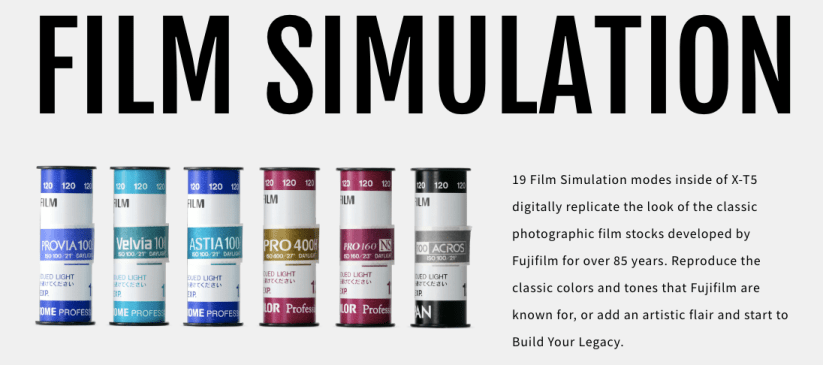
Interestingly, as a side note, if you look closely at the promotional statement by Fujifilm about film simulations on the X-T5, you’ll see this statement: “Reproduce the classic colors and tones that Fujifilm are known for, or add an artistic flair and start to Build Your Legacy.” First, I could be wrong, but I’m pretty sure it should be “is” and not “are”—after all, Fujifilm is known for reproducing classic colors and tones; for “are” to be correct, you’d need a conjunction, such as, “Reproduce the classic colors and tones that Fujifilm and Fuji X Weekly are known for….” Maybe they initially penciled that “and Fuji X Weekly” part in there, and erased it at the last minute, forgetting to change the “are” to “is” by accident. Second, Build Your Legacy seems to be Fujifilm’s new catchphrase for Film Simulation Recipes. It’s been a Fujifilm trademark for a few years, but I hadn’t seen it used in conjunction with film simulations. I wonder if Fujifilm has something up their sleeves that they’ll announce later. Perhaps it is even related to their upcoming app? I’m not sure, but it is definitely something to keep an eye on.
I had big plans for this project for these days, but life had other plans. Specifically, Covid. I know what you’re thinking: didn’t you just have the flu a few weeks ago? Yes, I did. Now I have Covid. Well, I’m almost recovered now, but I was very sick during the days that I captured these pictures, and I was limited to what I could capture in and around the house. Most of these photographs were taken in the backyard.
If you’re not sure what this short-term project is, the concept is simple: I’m photographing only with my Fujifilm X-T1 from the announcement day of the Fujifilm X-T5 (November 2) until the release date (November 17). Why? First, even though the Fujifilm X-T1 is eight-years-old (and approaching nine), it is still such a great little camera. It took three years for Fujifilm to bring this model to the market because they wanted to get it right, and it was one of their most important cameras ever released. The Fujifilm X-T1 was one of the first, if not the first, Fujifilm cameras that widely appealed to professional photographers. It was Fujifilm’s most successful model at the time—outselling all the previous cameras—and launched the extremely successful X-T line. The X-T5 is the latest iteration. This project will give me a better understanding of how the X-T5 has evolved from the original model. It also allows me to demonstrate that previous models, including the original X-T1, are still really good.
Hopefully, now that I’m not nearly so sick and my quarantine period has ended, I can do some of the photography that I was intending to do. I want to really see what the X-T1 is capable of, and with some luck I’ll be able to do that before this project comes to a close in the coming days. Once my X-T5 arrives in the mail, the X-T1 will be going back on the shelf, at least for a little while. I don’t expect the new camera to be wildly better than the first iteration, but soon enough I’ll know for sure just how much improved it is. And, of course, I’ll write all about it, so stay tuned!
Tiny Purple Blossoms – Buckeye, AZ – Fujifilm X-T1 – “Classic Kodak Chrome” – Day 5
In my article, Did I Buy the Fujifilm X-T5? Should You?, I mentioned that I began a new short-term photography project: photographing only with my Fujifilm X-T1 from the announcement of the Fujifilm X-T5, which was November 2, until the release date, which will be November 17. I’m not using any other camera during this 16 day period, only the X-T1.
Why am I doing this? First, even though the Fujifilm X-T1 is eight-years-old (and approaching nine), it is still such a great little camera. It took three years for Fujifilm to bring this model to the market because they wanted to get it right, and it was one of their most important cameras ever released. The Fujifilm X-T1 was one of the first, if not the first, Fujifilm cameras that widely appealed to professional photographers. It was Fujifilm’s most successful model at the time—outselling all the previous cameras—and launched the extremely successful X-T line. The X-T5 is the latest iteration. This project will give me a better understanding of how the X-T5 has evolved from the original model.
More importantly than any of that, the Fujifilm X-T1 was a good camera on the day it was released, and is still a good camera in 2022. There’s no reason that it cannot be used today. The image quality is excellent. The camera is pretty quick overall (look at the sports pictures!). It has one advantage over all other X-T cameras: 16mp. The files are smaller, which means I can capture more pictures on an SD card, it takes less time to transfer the pictures from the camera to my phone, the pictures take up less space on my phone, the pictures upload more quickly to my cloud storage, the pictures use less cloud data, and the pictures download from cloud storage more quickly. Less is more sometimes. I’ve really appreciated this quickness lately. The Fujifilm X-T1 is a camera that I’ve thoroughly enjoyed shooting with over the last week, and I think I’ll be a little sad when I put it back on the shelf after my X-T5 arrives in the mail.
Day 1
Birdcage on a Wall – Buckeye, AZ – Fujifilm X-T1 – “Classic Kodak Chrome” – Day 1
A Pink Rose in the Garden – Buckeye, AZ – Fujifilm X-T1 – “Classic Kodak Chrome”
Let’s be clear: the Fujifilm X100V has skyrocketed in price because Fujifilm cannot make enough copies due to the global parts shortage. But, when you combine that shortage with an increased demand, you get ridiculously inflated prices. Supply and demand. But what caused the demand to increase?
A few people shared with me a recent Petapixel article entitled Used Fujifilm X100 Series Camera Prices Are Surging Thanks to TikTok. This article is based off of a Fujiaddict article entitled TikTokers Drive Up Fujifilm X100 Prices Across The Lineup. Both are interesting reads and basically say the same thing: social media influencers, particularly those on TikTok (by the way, you can find me on TikTok…), are causing an increased interest in (and demand for) the X100—from the original to the latest version—by raving about the camera. It should be noted that the X100-series is a gateway into the Fujifilm world for a lot of people—it’s easier to dip your toes with a fixed-lens than to dive into a whole interchangeable-lens system. Many people have told me that an X100-series camera was their first Fujifilm, sometimes their very first camera, period.
There are quotes in the article describing what’s great about the X100V, including “zero editing” and “digital camera that mimics film” and “shoot photos that need no editing.” That made me wonder if these social media influencers are using Film Simulation Recipes. Makes sense, right? I mean, it kind of sounds like they do, and the photographs seem to confirm it, but I’m not really sure. I reached out to a couple of those mentioned in the article, but have yet to receive a response, which is not surprising because I’m sure they’re absolutely inundated with messages—I get a ton, and I’m nowhere near as popular as they are. I saw in the comments on one of the videos that it was just default Classic Chrome and not a recipe. Oh, well. Then I searched #fujifilmx100v on both TikTok and Instagram (follow me on Instagram, if you don’t already), and I found a bunch of similar videos and posts by others that do, in fact, mention specifically using Film Simulation Recipes. I think it’s quite plausible—perhaps probable—that the recipes are a significant factor in the rise in popularity of the X100V and other X100-series cameras, and maybe Fujifilm in general. So while I’m not directly responsible, it appears that I might be indirectly responsible for the rise in cost of the X100V, at least partially and to a small extent. If you’re trying to purchase an X100-series camera and you’re finding it overpriced, I’m sorry. I didn’t mean for that to happen, and I apologize for my part in it.
Putting the humor aside, I am incredibly honored that so many are using my Film Simulation Recipes and that they’re helping lots of people achieve the looks they’re after without fussing with editing—from those just getting started with their first “real” camera to recognizable names doing pro work, and all sorts of people in-between. You’re having more fun, potentially increasing your productivity, and spending more time doing what’s important to you, because you’re spending less time in front of a computer. That’s all so wonderful! It’s unreal to me that I’m having such a large impact on photography, something that I never imagined would ever happen. I’m incredibly grateful and appreciative to all of you for visiting this website and trying the recipes and being a part of this great community. Thank you!
And, I suppose, that makes you accomplices in the rise in cost of the X100, too….
Edit: The moment that I published this, I received a message from Edward Lee Films (who is mentioned in the articles), and he does in fact have the Fuji X Weekly App on his phone and uses Film Simulation Recipes. Check him out on Instagram and TikTok!
Just yesterday Fujifilm announced the brand-new X-T5, and I’ve been inundated with questions of whether I’ve preordered it or not. Before I give my answer to that, I want to share my opinion (and it’s just an opinion) on who should buy the X-T5 and why, and who should pass on it. I’m sure many of you are considering purchasing it and are on the fence, so hopefully this helps you.
I think it’s important to have some perspective. New cameras come out all of the time, and each time there’s a lot of hype, which causes FOMO (fear of missing out) and GAS (gear acquisition syndrome), neither of which are good things. I’ve often said that it’s better to invest in experiences than gear—what kind of epic journey could you embark on with $1,700?—and the gear you already have is more than good enough. “Better” gear will never make you a better photographer, but using your gear more often will, especially if you can make an honest evaluation of your photographs and really consider what lessons they have to offer—each exposure, whether failed or successful, is a learning opportunity if you are open to it. It’s always a good idea to take the new-camera hype with a large grain of salt by keeping a healthy perspective.
The Fujifilm X-T5 looks like and seems like a very wonderful camera. Fujifilm listened to those who complained about the X-T4, and made the X-T5 more like the X-T3. That’s good, unless you like the X-T4 more than the X-T3 (there are some who do), then you might not appreciate the X-T5; otherwise, you’re likely to consider the X-T5 to be a nice improvement. Are those nice improvements enough that you should consider purchasing it?
If you print your pictures poster-sized, the X-T5 is for you, because it has all that extra resolution. If you crop extensively, the X-T5 is for you, because—you know—40mp and all. If you find the autofocus on your current model to be insufficient, then the X-T5 is for you, because they improved that. Need to shoot 6K video? The X-T5 is for you. Need IBIS? The X-T5 has it. If your camera is too big and you’d prefer something smaller, depending on the camera you have and how small you want to go, the X-T5 might be for you. Just got to have Nostalgic Negative and “improved” Auto White Balance? Well, the X-T5 has it. None of those things apply to you? Then I would suggest passing on the X-T5.
A lot of times when a new camera is released, it takes two steps forward and one step backwards. I think this is so some future iteration of it can add it back in and call it a new feature or improvement. For the X-T5 it is the optional vertical battery grip, which isn’t an option for the new camera. For most people this is no big deal, but for some this is a dealbreaker, so it is worth pointing out. I have a feeling that once the X-T5 is released, we’re going to start getting reports of overheating issues, so keep that in mind, too.
Hummingbird Feeder Along a Wall – Buckeye, AZ – Fujifilm X-T1 – “Classic Kodak Chrome” – I captured this picture today
I started a new short-term project: I’m photographing exclusively with my Fujifilm X-T1 from the announcement date of the X-T5 (yesterday) until the release date (the 17th). The X-T1 started the X-T line and is such an important camera in Fujifilm’s X-series heritage. It’s eight-years-old now (almost nine), so it can’t be any good, right? Well, no surprise to me, it’s still a highly capable camera worthy of use in 2022. In fact, the X-T1 has one advantage over all other X-T cameras, including the X-T5: the file sizes are smaller. That means I can capture more pictures on an SD card, it takes less time to transfer the pictures from the camera to my phone, the pictures take up less space on my phone, the pictures upload more quickly to my cloud storage, the pictures use less cloud data, and the pictures download from cloud storage more quickly. Less is more sometimes. Even though the X-T5 is capable of saving in HEIF, which saves space, the files will still be significantly bigger than those from the X-T1. Certainly, though, the pictures from the X-T1 aren’t good enough for printing, though, right? Nonsense! Some of my favorite pictures that I’ve ever printed were captured on a Fujifilm X-E1, which is even older than the X-T1.
Now I’ll answer the opening question: did I preorder the Fujifilm X-T5? Yes, I did. The silver one. Why? One reason, and one reason alone: Nostalgic Negative. I don’t think this new film simulation is going to be my favorite. I don’t think I’ll like it as much as Classic Negative, Classic Chrome, Eterna, or Acros. But I really want to try it and see what Film Simulation Recipes I can create with it. I think it will be fun to do that. Which brings me to another point: if some new gear will bring you joy, even if it isn’t meeting any other need, then it might be worth it. Maybe. It could be short term joy, and later you’re asking yourself why you didn’t use the money to visit a National Park or something instead, so you better be sure that you’ll really enjoy it for some time to come. The X-T5 doesn’t meet any other need for me. I don’t need the extra resolution, and, in fact, I’m not looking forward to that aspect of it. I don’t need the improved autofocus, as I find the autofocus of the X-T1 to be good enough for me, and the X-H1, X-T30, X100V, and X-E4 that I own are even better. I don’t shoot video (my wife does on her X-T4), and I have no need for 6K. I don’t consider IBIS to be important for any of my photography, but if for some reason I do need it (such as a long telephoto lens in dim light), I use my X-H1, which has IBIS. I have a lot of smaller camera bodies already, so I don’t need another—in fact, I suspect that bigger and heavier lenses will balance better on the X-T3 and (especially) X-T4 than the X-T5. The new and improved Auto White Balance is intriguing, and I’m curious how that affects recipes, but that’s definitely not a selling point for me. The only thing about the X-T5 that makes me want to buy it is Nostalgic Negative, which I’m really uncertain if that’s a good reason to spend so much money (my brain says no, my heart says yes), but I really look forward to using Nostalgic Negative and experimenting with it—I’m quite excited for that!
Should you buy the X-T5? That’s a question only you can answer. I can offer my best advice, but you should take it with a grain of salt, because everyone’s wants and needs are different. I can offer my perspective, but I would recommend getting advice from others, and go with whichever one makes the most sense to you.
This post contains affiliate links, and if you make a purchase using my links I’ll be compensated a small amount for it.
Preorder your Fujifilm X-T5 in black: AmazonB&H Preorder your Fujifilm X-T5 in silver: AmazonB&H
What makes this camera special? Who should buy it?
To understand the X-T5, one has to go back in time a few years. The X-H1 was Fujifilm’s original flagship, but due to poor timing on its release and an overly aggressive initial MSRP, it didn’t sell well. Fujifilm thought this camera was going to be a huge hit, but instead it flopped… at least until it was heavily discounted. Those who own an X-H1 love the camera, and regard it as one of Fujifilm’s best, a true workhorse. The X-T3, which was announced just months after the X-H1 was released, more or less killed the X-H1, just because it was the first X-Trans IV camera while the X-H1 was the last X-Trans III model. The X-T3 would become Fujifilm’s top selling camera of all time, and was only recently discontinued. The X-T4 came out when the X-T3 was just over a year old, and Fujifilm sold them both at the same time because the X-T4 wasn’t really the X-T3’s successor, but instead was another attempt at a flagship model, kind of a cross between the X-H1 and X-T3 (but with compromises that both X-T and X-H users weren’t thrilled about). Now that Fujifilm has released the X-H2 and X-H2s cameras, there isn’t a “need” for the X-T4, and it’s being discontinued. That brings us to the X-T5, which is the successor to both the X-T3 and X-T4, but is more like the X-T3 than the X-T4, yet sharing a legacy with both models. Make sense?
What makes the X-T5 special is that it walks back some of the unwanted “improvements” of the X-T4—yet improves upon the appreciated features of the X-T4—while in a package more similar to the X-T3, and with the new sensor and processor of the X-H2. So is it better than the X-T3? In many regards yes, in some regards it is a wash (not better or worse), and in a couple of regards no. Is it better than the X-T4? This depends on your definition of better, because the X-T4 was actually a more premium model, but with curious design choices that some don’t appreciate—if that’s you, then, yes, the X-T5 is better, but if you really like the X-T4, the X-T5 might be seen as a step backwards in some ways. I will say this: my wife has an X-T4 that she really loves, but she would prefer the screen of the X-T3/X-T5, so that makes it potentially a better camera for her. I say “potentially” because the screen is just one factor. If the X-T4 handles heat better—say, if the X-T5 has overheating issues when recording video—then that wouldn’t work out well, because she uses it more for for video than stills. “Better” is a subjective term, anyway, that’s perceived much differently depending on the person and how they use their gear. What’s “better” for one person might not be “better” for another—at all depends on your point-of-view.
But isn’t X-Trans V better than X-Trans IV? X-Trans IV was such an outdated sensor and overall technology, while X-Trans V is the pinnacle of APS-C camera technology advancements—doesn’t that mean it’s unquestionably better? That’s tough to say. I’m reminded of when Syndrome, in the movie The Incredibles, describes his new-and-improved superhero-destroying robot. “It’s bigger, it’s badder, ladies and gentleman,” Syndrome announces, “and it’s too much for Mr. Incredible!” Similarly, there’s no doubt that the X-T5 is metaphorically “bigger and badder” than the X-T3 and X-T4 (physically, it’s smaller than the X-T4), but perhaps “it’s too much for” most photographers. While some have decried the X-T3 and X-T4 as disappointments or not “good enough” for some reason, for the vast majority of photographers, both of those models are well above and beyond anything that they actually need. And, of course, with more megapixels come additional challenges—sometimes less is more. The point of this paragraph is that, yes, the technology of X-Trans V is surely an improvement, but, at a point of diminishing returns, do you really need those improvements? Some of you do, many of you don’t—and for those who don’t, the improvements of the X-T5 are really paper improvements and not something that will likely affect your photography in any practical way.
What I just stated is important because some of you right now are trying to decide if you should upgrade, and everyone’s telling you that you should. There’s a whole lot of hype—some FOMO and GAS even—and you’re not sure what to do. I will give you my advice as someone who has never touched or seen in-person an X-T5. Take it for what it’s worth, which is probably not a lot.
If you have an X-T2 and have been thinking of upgrading for awhile, but the X-T3 was too similar to the X-T2 (not enough of an upgrade), and the X-T4 had that darn flippy screen you didn’t like, then you’ll likely really appreciate the X-T5. If you have the money and desire, just do it and get it—I feel like this is the group that the X-T5 makes the most sense for. Those with an X-T3? I have a hard time with this one, because it might be a big difference for you, or it might be pretty much the same thing that you already have, depending on how you use the camera. Those who shoot JPEGs will likely find it significantly different with the new film simulations and JPEG options (although it doesn’t appear to be a whole lot different than the X-T4 in this regard). If you print your pictures poster-sized, those extra megapixels will come in handy. If you somehow find the autofocus lacking, that’s been improved. Use it for video? There’s some improvements there, too. Need IBIS? It has it. But if those things don’t matter that much to you, the X-T5 isn’t all that much different than the X-T3, and won’t necessarily be an improvement for you. So my suggestion to those considering upgrading from the X-T3 to the X-T5 is to think long and hard about how you use your camera and where you find it lacking, if you find it lacking at all. Those with an X-T4, the X-T5 is only an upgrade for you if you hate the flippy screen, if you somehow find the autofocus lacking, print posters, or need a slightly smaller body (apparently the X-T5 is just larger than an X-T1); otherwise, the X-T5 isn’t really an upgrade for you, and I don’t recommend getting the new camera. Still using an X-T1? Buy a used X-T2 or X-T3—there’s about to be a whole bunch of them. So to summarize, the X-T5 makes the most sense as an upgrade for those who currently have an X-T2; it’s 50-50 for those with an X-T3, depending on how you use your camera; many of those with an X-T4 will likely not trade in for the new model, although some will, obviously.
We’ve talked about upgrading from a like-model, but what about those who have some other camera? If you’ve been using an X-T20 or X-T30 and wanting a more premium model, the X-T5 might be just that for you. I don’t think it should be underestimated how many will be moving up from one of those models to an X-T5, or perhaps a used X-T3 or X-T4. I suspect that a used X-T3 will be pretty easily found for $700-$800 in the coming months—they’re still exceptional cameras, and that will be very tempting for those who don’t have $1,700 to drop on an X-T5. For those with an X-H1, I think the X-T4 is just as much (if not more so) of an “upgrade” as the X-T5 (for those who don’t consider the X-H2 and X-H2s to be the “real” successors), and obviously neither are really upgrades, so I don’t see the X-T5 as particularly appealing to the X-H1 owners, although I’m sure some will take the bait. I do believe that those who own an X100V as their only Fujifilm camera (and that’s a significant group… it really is a gateway into the Fujifilm system) will take a long look at the X-T5, as they should, and some will buy.
You might think, reading all of this, that I’m not especially excited for this camera, but you couldn’t be more wrong. I believe that Fujifilm is trying to do the right thing with the X-T5. Fujifilm walked back a lot of the changes that they made to the line with the X-T4, because those changes weren’t appreciated by the majority of X-T users. They did what they should have done (and what I previously suggested that they should do) and make the X-T5 more like the X-T3 and less like the X-T4. Bravo! I think the X-T5 is an important camera for Fujifilm, and a lot hinges on its success. I truly hope it’s a smashing success for Fujifilm, and I think it will be. With that said, I don’t work for Fujifilm, and I want to give good advice—honest advice—to my community, and the best advice I have is this: you shouldn’t upgrade with every new model release, experiences are more valuable than gear, and new gear will not make you a better photographer. On the flip side, if you have the money, and the X-T5 will help your photography in some way or make it more fun, then it definitely might be worth the expense. Only you can decide that for yourself. Trust your gut, and either go for it or pass, and feel good about that decision, whatever it is.
This post contains affiliate links, and if you make a purchase using my links I’ll be compensated a small amount for it.
Preorder your Fujifilm X-T5 in black: AmazonB&H Preorder your Fujifilm X-T5 in silver: AmazonB&H
I’ve had a lot of people tell me lately that they’re frustrated the Fujifilm camera they want to purchase is out of stock, and has been for some time. Unfortunately, Fujifilm (like a lot of companies) has been plagued by global supply chain issues and parts shortages. On top of that, I believe that Fujifilm is ready to fully move onto X-Trans V, which means that X-Trans IV models will get harder and harder to find. So I thought I’d look at what is out there in stock on Amazon, and share what I find.
I was not surprised to see the Fujifilm X100V and Fujifilm X-E4 out-of-stock. Those two cameras haven’t even had a chance to hit the shelves, because they’re already sold the moment the shipment arrives at the store. Fujifilm could have sold a lot more copies of these two models if they had been able to manufacture more, and maybe they’re in the process of doing just that, or maybe they’re retooling for the next iteration—who knows? Whatever the case, a lot of people want an X100V and/or X-E4, and they can’t get one, unfortunately, and maybe buying used (and likely at an inflated price) is their only option.
For all the news that the X-H2S and X-H2 have had more demand than can be filled… they’re apparently in stock, and you can get one (or both) before Thanksgiving. The X-T3 and X-T4 are both in stock, but the X-T5 is apparently coming before Christmas (so watch for that). There are plenty of X-Pro3’s available. Supposedly there’s only one X-S10. Surprisingly, there are several X-T20 and X-E3 bodies, apparently. Shockingly, I found one (supposedly) brand-new X-M1, two refurbished X-T1’s, and one (supposedly) new-but-not-warrantied X100T, if you are interested in an older model.
I think it’s really easy to get caught up in the hype of advancing camera technology. It’s natural to think that we need the latest and greatest new gear. But lately I’ve been thinking that we should not forget just how awesome our current cameras are. Whatever camera gear you have, it’s pretty freakin’ amazing!
I found it interesting that Rob Morgan prefers the X100F over the X100V. He said, “…although the technical specs of the X100V are ‘better’ it lost the mojo of the earlier models.” In other words, he likes the five-year-old model more than the two-year-old one. What about gear that’s even older than that? Can it still be any good?
The Fujifilm X-Pro1 is ten years old now. So is the X-E1. If you are using decade-old camera gear, you are certainly behind the curve, right? Everyone else’s pictures are so much greater than yours, right? Those cameras aren’t capable of capturing worthwhile images, right? Of course, the answer is no to all three questions—your gear is not obsolete, your pictures aren’t inherently inferior, and, yes, your gear is plenty capable as long as you are. Photography has been around for 196 years, but only cameras released in the last 12 months are worth owning, some would say—those cameras that evolved after only 186 years aren’t nearly as good as those that have had the full 196 years to be released. That’s nothing but pure nonsense!
The X-Pro1, the X-E1, and every single other Fujifilm X camera is a capable photographic tool. Is the X-T4 better? Maybe. Is the X-H2 better? Maybe. Is the X-T1 better? There are some who think so. Is the X-H1 better? Many X-H1 owners think so. Does any of it matter? No. What matters is how you use your gear, not what gear you use.
One of my favorite pictures (that has hung on my wall for years) is this image captured on a Fujifilm X-E1 with a 50 year old lens.
The fact is that the X-Pro1 and X-E1 are just as capable today as they were in the year that they were released. Actually, that’s wrong. With Fujifilm’s firmware updates (that they used to be known for), the cameras are better today than they were in 2012. A lot of positive things were said about the cameras back then. A lot of wonderful pictures were captured with them back then. 10 years later and it all still applies, and the cameras can still capture amazing pictures today.
I thought it would be a worthwhile exercise to reread the old X-Pro1 reviews, and quote the positive things that were said about it back then. I think this is a good perspective to have, especially if you’re feeling a little camera envy. The X-Pro1 was a highly desirable model when it was released. I remember drooling over it in the pages of a photography magazine, but I couldn’t afford it back then. I’m very happy to own it now, because it’s still a solid camera, and still worth drooling over, even at the decade mark.
“It’s not just a retro look that distinguishes the Fujifilm X-Pro1, but its cutting-edge hybrid optical viewfinder and emphasis on quality prime lenses. Excellent image quality with very clean detail is the extra surprise inside.” —Imaging Resource, 04/18/2012
“The Fujifilm X-Pro1 does almost everything right: it’s a beautiful (if enormous) camera, it takes great pictures and video, and once you take the time to learn its controls and systems it’s as capable a shooter as I’ve tested.” —The Verge, 05/22/2012
“The X-Pro1 is certainly right up there with the best APS-C sensor cameras on the market, and some full-frame models too.” —Photography Blog, 03/15/2012
“The camera’s images are exceptional, delivering on the claims that it can match up to existing full-frame sensor’s abilities.” —What Digital Camera, 03/09/2012
“The image quality is stunning, with excellent, and I really mean excellent pixel level detail, with excellent colour reproduction, great dynamic range, excellent high ISO noise results and excellent JPEG output straight from the camera.” —ePhotoZine, 03/12/2012
“This is a high ISO street shooters dream. Yes, I said STREET SHOOTERS DREAM.” —Steve Huff, 04/04/2012
“This camera is a wave-breaker. May the other companies take note!” —Digital Photography School, 03/30/2012
“With the X-Pro1 Fujifilm has built on the platform provided by the X100, and is beginning to look like a very serious contender at the high end of the camera market.” —Digital Photography Review, 06/28/2012
Whatever camera you have, don’t worry about it being “good enough” or “new enough” or anything else. What you do with the gear you have is much more important than the gear you have—the limitation is only oneself. Do the best you can with what you have, and in time you’ll surprise even yourself at what you create. Your camera—whatever it is—is awesome, and we shouldn’t so easily forget that.
Rob Morgan is an internationally touring bass guitar player. He’s a super talented musician that’s often in-demand. He’s a creative director for live shows and world tours. Maybe you’ve even seen him play before in an arena, dive bar, or coffee shop—he’s even performed on The Today Show. Rob’s out on tour right now, so maybe you can catch him live if he’s coming to a city near you.
Aside from the music and podcast, Rob is also a photographer. It started out as a hobby—simply another creative outlet—but has turned into something much more. His photographs have been printed in media globally and he’s regularly commissioned to photograph musicians. He often uses a Fujifilm camera loaded with a Film Simulation Recipe.
Curious yet? I hope so! Keep reading to learn much more about Rob and his photography.
Grand Tetons from Snake River overlook – Photo by Rob Morgan with Fujifilm X100F
FXW: Hi, Rob! You play bass guitar—how did you get started with that? Why the bass?
Rob Morgan: There’s a common trope in music: a band needs a bassist, so they convince a guitar player to pick it up. Me, I’ve always been in love with the electric bass. The moment I got one for Christmas when I was 14, it was game over. I knew that was it for me, and there’s never been a Plan B.
Pre-Show drinks in the Greenroom with Joel Bowers – Photo by Rob Morgan with Fujifilm X100F
FXW: What are the biggest music projects that you’ve been involved with? What are your most memorable musical moments? And what are you currently doing?
Rob Morgan: I mean, if we’re talking about memorable musical moments… it’s always the weird ones that stick out, no? A drummer (mistakingly) trusting a fart fifteen seconds before going on stage and playing in front of thousands in Beijing, China—our guitar player and I laughed during the entire set, knowing he was going to need a new drum seat after this show.
But opening for Foo Fighters at Fuji Rock Music Festival in Japan a few years back while playing bass with the band Owl City was definitely up there. Getting to have a private moment with Dave Grohl and telling him how his band’s documentary Back and Forth was one of the reasons I didn’t quit music years before while in a dry spell… that felt like a full circle moment.
As for right now, I’m currently sitting on a bus as we drive through Washington on tour with Caitlyn Smith.
Backstage with Caitlyn Smith – Photo by Rob Morgan with Fujifilm X100F
FXW: Let’s switch gears. How did you get started in photography?
Rob Morgan: Growing up, there were these photography kits for kids—it came with a film camera and instructional book—that my mom got me back in the day, but I didn’t really start diving in deep until a few years ago. I was halfway through an Asia tour when I found myself wandering around Tokyo with my friend, guitar tech and stage manager Alex Perkins, who always had a Fuji X camera on him. On a tour that big, you don’t have access to your instruments outside of shows, and through him I realized one of the things I love most about photography: at any given moment, you can enter into the creative process.
Michael Shynes on stage – Photo by Rob Morgan with Fujifilm X100F
FXW: Tell me about your cameras. Why Fujifilm? What do you shoot with now?
Rob Morgan: You can absolutely get a killer synth sound on a laptop, but there’s something about the tactile feeling of twisting a knob to change a sound on an analog synth that I love. While on that tour, I picked up a Fujifilm X100 for the same reasons. The fact that you changed the aperture and shutter speed via actual knobs (instead of touching a screen) reminded me of the cameras I grew up with, and the X100 series is still the closest digital version of a film camera I’ve found—its small size and vintage profile also play a large part in my love for it.
Artists and musicians (uncomfortably) can sense a large DSLR being pulled out instantly. This thing feels far less invasive and my propensity for zone-focusing and manually dialing in the exposure in advance means I can be extremely fast.
Through the years, I kept advancing through the line, moving to an X100S, X100T, X100F, X100V, and back again to my current camera, an X100F. The reason for going backwards is a pretty unpopular opinion: although the technical specs of the X100V are “better” it lost the mojo of the earlier models. The feel of the metal, the tilting screen, and even the shape all seem clunky to me, and I found myself reaching for my camera less often.
I love the X100F’s 35mm equivalent prime lens, but I also travel with the TCL and WCL adapters. I feel like I see the world in 35mm, but If I’m taking portraits of an artist, I throw on the 50mm TCL. If I’m bringing my camera in close quarters, on stage, or in the tour bus, I like the 28mm focal length (that the WCL allows me to capture) while in the middle of it all.
Pre-show shots with Caitlyn Smith – Photo by Rob Morgan with Fujifilm X100F
FXW: What Film Simulation Recipes do you use and why?
Rob Morgan: Whether it’s Daniel Kramer’s photographs of Bob Dylan, the authentic moments backstage captured by Danny Clinch or the iconic photographs of Anton Corbijn… as I started paying attention to the images that moved me, I realized the majority of them were shot on Kodak Tri-X 400 film (often pushed to 3200). As I said, I treat my X100F like one of my film cameras, and, thanks to your “Pushed Tri-X” recipe, I’m able to take it a step further and make it feel like I’ve loaded the camera with a roll of that film. It’s seriously been a game-changer for me! Shooting JPEG+RAW also allows me to not question it and focus on light and composition knowing that if it calls for something else later, I have the option in my back pocket. Sometimes, I’ll switch over to your HP5 recipe to change it up, but 99% of the time I stick with Tri-X.
Danny Burke photoshoot for Klergy – Photo by Rob Morgan with Fujifilm X100F
FXW: How does being color blind affect your photography?
Rob Morgan: It’s tough to say. I’ve always had a propensity for the timelessness of black & white photography despite being red-green color blind. Ted Grant said, “When you photograph people in color, you photograph their clothes. But when you photograph people in black and white, you photograph their souls!” I love that, and I think I’d still be shooting the way I do even if I wasn’t color blind, but it’s definitely cemented my style. Now that I shoot portraits of artists, record labels will often ask for color options, too, so I’ll shoot RAW and use a wallet-sized grey card to adjust the white balance in Lightroom. But normally, they’re bringing me in to shoot because they want my gritty B&W style.
Andrew McMahon and daughter – Photo by Rob Morgan with Fujifilm X100F
FXW: Tell me about your behind-the-scenes photography. What do you try and convey through these pictures?
Rob Morgan: I’m fully aware of how incredibly fortunate I am to get to travel the world playing music. But, once you do anything on a regular basis, it’s easy to start taking the small moments for granted: whiskey cheers in the greenroom before walking on stage, a candid moment on the tour bus, the band goofing off during soundcheck…. Like anyone else diving into photography, I started taking photos of the world around me. As I started sharing them online, and people connected with them, I realized how rare of a vantage point I have. I’m no Linda McCartney, and I’m not married to one of The Beatles, but the candidness and behind-the-scenes trust seen in her photography have always been something that inspires my work. I’m glad artists and fans connect with the photos I’ve taken, but at the end of the day, it’s purely selfish—I want to remember all the tiny details of this wild ride.
Waiting pre-show– Photo by Rob Morgan with Fujifilm X100F
FXW: Tell me more about your interest in street & documentary photography.
Rob Morgan: I adore the documentary photography of Dorothea Lange, and she’s often quoted as saying, “The camera is an instrument that teaches people how to see without a camera.” That’s everything to me. Whether I’m on tour with an artist or traveling Europe with my wife, Sarah—as long as I stick to my rule of NO ‘CHIMPING’ (looking at a photo you just took), photography helps me to see the moment and my surroundings more clearly. The street photography approach of “F/8 and be there” (setting your aperture to f/8 and hyper-focal zone-focusing) has been massively impactful to my approach, whether backstage or wandering a new city. It’s taught me to anticipate a moment and has given me the speed to capture it, especially if I have a bass in my left hand. See a moment, grab the camera, snap the shutter, put it down, and get back to rocking out.
Frankfurt, Germany – Photo by Rob Morgan with Fujifilm X100F
FXW: Thank you so much, Rob, for carving out some time while on tour to do this interview!
You might have noticed that, while seemingly everyone else was eager to share the news of Fujifilm’s latest camera—the X-H2—and give their opinions and praise, I have been quiet about it. Not that I’ve been quietabout the X-H2 (and X-H2s), but I haven’t said a word about it since it was announced last Thursday. I wasn’t planning to say anything about it today, either, but I’ve received a lot of messages asking for my opinion if they should preorder this camera or not. I’m not really sure what I can add to this conversation that’s unique, but I will try. Also, I’m feeling lighthearted, and I hope that somehow comes across in this article—if the words seem serious, I don’t mean them that way at all. Sometimes critical nonverbal queues aren’t conveyed in written text, so keep that in your mind as you read further down. With that said, let’s dive into this!
I definitely don’t like to state that anyone should or shouldn’t buy any specific camera model. That’s a personal decision, and I cannot know if something is “right” for you—only you can determine that. I can offer my two cents, which might not be worth even two pennies, but it’s not for me to decide what you should do. Because so many have asked, I’m going to offer my advice; however, take it with a grain of salt, and if you are really unsure, seek all sorts of opinions and decide which one resonates with you the most.
A lot of people seem to be surprised that Fujifilm didn’t send me an X-H2 to try. While Fujifilm has loaned me a few cameras to try out for a time (namely, an X-T200, X-Pro3, and GFX-50S), I’m definitely not on their short list to send new gear to. I’m not an X-Photographer or Fujifilm Creator or anything like that, and I have no official or formal connection with the company—I’m just a guy who shoots with Fujifilm cameras, creates Film Simulation Recipes, and shares my opinions and experiences on this blog. I think Fujifilm appreciates that I help to bring them a lot of sales, and that I help to foster excitement among their customers, but I also use competitor names (such as “Kodak”) and I’m not afraid to speak critically of them, so they’re not always happy about this website (I know this because they told me so during one of the handful of times that I’ve spoken with someone within the company). Funny (and completely true) story: Ken Rockwell (after he tried The Rockwell recipe) was kind enough to attempt to get Fujifilm to put me on their press list, but apparently his (unofficial) endorsement wasn’t enough because I’m not on that list (I hear about new gear the same way that you do). And don’t even get Fujifilm started on Fujirumors …within Fujifilm, you don’t talk about Bruno and you don’t talk about that rumor website—ever. I do think that Fujifilm should do more to meet the community where they’re at, and not be so standoffish to it just because they didn’t create the community and have no control over it. I don’t think they fully realize the unique position they’re in, and they don’t really know what to do with it. To capitalize on it, they need to embrace it.
A lot of people also seem to be surprised that I didn’t order an X-H2 to make Film Simulation Recipes on. I do hope to make X-Trans V recipes. It’s my understanding from the reports I’ve received that the X-Trans IV recipes (for the X-Pro3 and newer cameras) are 100% compatible with X-Trans V cameras, and the rendering is essentially identical to X-Trans IV. What the X-H2 does have that X-Trans IV cameras don’t is Nostalgic Negative, and I do hope to someday try that new film simulation. The reasons why I didn’t order an X-H2 (or X-H2s) are 1) it’s not in my budget, 2) I don’t think I’d like the shooting experience (big bulky body with PASM), 3) I don’t have any need for 8K, and 4) I find my current gear to be sufficiently quick already with more than enough resolution. It’s just not a camera for me; however, that doesn’t mean it isn’t for you.
I’ve received messages from people who ordered the X-H2s, and some told me that they really love the new camera and it’s the best camera they’ve ever used, and others have told me that they hated it and it is the worst Fujifilm user experience they’ve ever encountered, so they returned it. How can one camera have such strong yet completely opposite reactions? I went down a couple of rabbit holes, and I think I found some commonalities that might help you determine if the X-H2 is a camera you’ll love or hate. Below I have two checklists: one for buying the X-H2 and one against buying the X-H2. Check as many that apply to you in each checklist, and whichever side has the most, that’s the direction to lean. You still have to make a decision yourself on what’s right for you, but if you are stuck, maybe this will help a little.
You SHOULD buy an X-H2 if…
☐ You don’t mind, or maybe even prefer, PASM. ☐ You don’t care if your gear is bulky. ☐ Your first Fujifilm camera was an X-S10. ☐ Your only Fujifilm camera is GFX. ☐ You own a full-frame camera by Canon, Sony, or Nikon. ☐ Your primary photo/video subjects constantly move quickly. ☐ You like to have the latest and greatest technology and gear. ☐ You have a bunch of money saved up and are eager to spend it. ☐ You own a professional production company and want to phase out your Sony gear for Fujifilm.
You should NOT buy an X-H2 if…
☐ You like the tactile classic controls that Fujifilm is known for. ☐ You don’t like bulky gear. ☐ You don’t own an X-S10 or Bayer model. ☐ You don’t own a GFX camera, or if you do it is a GFX50R. ☐ You sold all of your Canikony gear awhile ago. ☐ Your primary photo/video subjects don’t constantly move quickly. ☐ You don’t mind waiting for tech to go on sale or to buy things used sometimes. ☐ You prefer to spend money on experiences rather than gear. ☐ You are simply a photographer.
Definitely take those checklists with a grain of salt. I know that not every statement applies to everyone, or even everyone equally. But, generally speaking, if one side has a lot more boxes marked, then it probably resonates with you, and perhaps provides some clarity if you are not sure what to do. It matters not to me if you do or don’t order the camera; if you do, I have included an affiliate link below, which, if you use, helps me out a little.
In other news, according to Fujirumors, the X-T4, X-E4, and X-T30 II cameras are apparently being discontinued. If you’ve been wanting to buy one, and if you can find it in stock, it might be a good time to put that order in. It also means that the X-T5 and probably X-T50 (I’m making the wild guess now that Fujifilm will skip the X-T40 name, for marketing reasons, and go straight for 50) aren’t that far out—I think X-T5 before the end of the year, and X-T50 first quarter of 2023. I don’t believe an X-E5 is in the works; if it does come, it will more likely be in 2025, closer to the end of the X-Trans V lifecycle, or perhaps never. I think an X-S20 will come shortly after the X-T50, probably less than a year from now. I don’t have any inside information, these are simply guesses.
This post contains affiliate links, and if you make a purchase using my links I’ll be compensated a small amount for it.
Fujifilm needs to drop whatever they’re currently doing, and make an X80. This should be priority number one!
Not that I think they’re going to do this—I really don’t think they will—but they absolutely should. They should do it right, and they should do it right now.
Fujifilm introduced the X70 in January 2016 and discontinued it in December of that same year. You might think that the camera was a flop, but it wasn’t. Unfortunately, to Fujifilm’s surprise, shortly after the camera launched, Sony suddenly discontinued the 16-megapixel APS-C sensor that the X70 used, and Fujifilm had no choice but to fully move on to X-Trans III as quickly as possible. The X70 was a casualty of that situation. No successor was ever made, supposedly because heat dispersion was an issue with the X-Trans III sensors. Even though the camera is six years old now, people love their X70 camera—you don’t see very many for sale, and when you do it’s usually for a similar price to, or even higher than, the original MSRP.
Even though the camera is an old model, photographers are still enjoying their X70. Omar Gonzalez said that he loves the X70, and it’s his favorite fun pocketable camera. Reggie Ballesteros called it his favorite pocket cam. Samuel Streetlife called it an amazing camera for street photography and it’s sad that Fuji didn’t continue this line. People love the X70 because it is basically a smaller and more wide-angle X100T, but without a viewfinder; the viewfinder is a make-or-break for some, but other people don’t mind its absence at all.
So what would an X80 look like? What features should it have?
Fujifilm should try, as best as practical, to keep it the same size and shape as the X70. It should have the same 18.5mm (28mm full-frame-equivalent) lens. The rear screen can stay the same. I’m sure that Fujifilm would replace the d-pad with a joystick… I’d like to see both, but it will be a joystick and not a d-pad (and not both). Fujifilm should include the shutter/ISO knob of the X100V. Swap the command switch thing for a command wheel. Otherwise, don’t change a thing. The X70 is a cult classic because Fujifilm did so much “right” with it. Don’t overcomplicate it; don’t “fix” what’s already good.
The electronic viewfinder will be the controversy. The X70 doesn’t have one, and I personally don’t think it’s a requirement for the X80, but some people will have a strong opinion that, in 2022 (or 2023), it is a requirement. Perhaps Fujifilm should consider a pop-up viewfinder (right underneath where the X70 says “X70”) similar to the Sony RX100 III, or (my preferred option) a shoe-mount viewfinder that’s an optional accessory.
Obviously on the inside it needs to have a new sensor and processor. X-Trans IV? X-Trans V? Something else? Heat dispersion is obviously the biggest obstacle. The Fujifilm X100V can run hot, and it has a larger body, so it’s possible that the X-Trans IV sensor, despite being “cooler” than X-Trans III, is still too hot. Is the 26mp stacked X-Trans V sensor cooler? I know it’s quicker, but instead of quickness, can it be utilized for its coolness? How about the 40mp non-stacked? I personally would prefer it to not have a Bayer sensor, but if it did, it needs to have Acros and Classic Negative and Clarity and all that, which hasn’t been included on any Bayer model. I don’t know what sensor it would need to be or what Fujifilm needs to do to make it work, but I’m sure it’s possible, and they should do what it takes to figure it out.
How much would an X80 cost? The X70 had an MSRP of only $700, which seems like a steal of a deal! I think the X80 could have an MSRP of around $1,000 and people would buy it. Go much higher than that and people will start expecting more premium features (like weather sealing), but even at $1,200 I’d preorder it. Look, a Fujifilm X-E4 with the 18mm pancake, which is still noticeably larger than the X70 yet the closest you can get to it with Fujifilm’s current lineup, will run you $1,450, so it shouldn’t seem unreasonable to pay significantly more for the X80 than the X70. Heck, some people will pay a grand for a used X70!
If Fujifilm made an X80, that would be epic. It’s my number two “wow” camera that Fujifilm should make. However, I believe that Fujifilm believes that the market for such a camera came-and-went, and current camera buyers aren’t as interested in such a model; however, the feedback that I have received suggests that there would be a heck-of-a-lot of excitement for an X80 if Fujifilm ever did make one. I hope they do.
It’s your turn! What features should a Fujifilm X80 have? Which sensor? Would you buy one if they made one? Let me know your thoughts in the comments! While I think most likely Fujifilm will never read this, there is a chance that they might—if they do, make sure your voice has been heard.
“We are working on WOW product development.” —Jun Watanabe, Product Planning Group Manager, Imaging Solutions Division, Fujifilm
Fujirumors reported on an article by Digital Camera Life that translated and summarized a video by Map Camera, which featured an interview with Fujifilm Product Planning Manager Jun Watanabe. In addition to the quote above, Jun also said, “I would like to continue working to create ‘WOW’ products with the development team, including me, so that we can meet everyone’s expectations and say, ‘I definitely want to buy this.'”
Before we go any further, I must point out that this seems a little like the “Telephone Game” where one person whispers something into someone’s ear, and that person whispers what they heard into the next person’s ear, and so on, until the last person speaks what they heard, which doesn’t much resemble what the first person whispered. Now add to that a translation of a translation, and we get these quotes by Jun Watanabe, which may or may not be what he actually said. However, for the purpose of this article, we’ll assume that Fujifilm is indeed currently working on products that will make people say “wow”—or at least products that the Product Planning Group thinks will make people say that—and they want to “meet everyone’s expectations” somehow.
There’s a lot to digest, of course. Sometime in the 1400’s, monk and poet John Lydgate stated, “You can please some of the people all of the time, you can please all of the people some of the time, but you can’t please all of the people all of the time.” No one product will “meet everyone’s expectations” but perhaps he simply means that between all of the projects that they’re working on, once they all come out, that there will be a “wow product” for everyone.
Coastal Blooms – San Simeon, CA – Fujifilm X-E4 – “Pacific Blues” recipe
I’m in a unique position here at Fuji X Weekly, because I hear from a lot of Fujifilm photographers—granted, mostly those who shoot with Film Simulation Recipes, which is certainly not everyone with a Fujifilm camera, but a large number nonetheless. I have a pretty good pulse on a large segment of Fujifilm’s customers. I know what would make a lot of their customers say, “I definitely want to buy this!” But Fujifilm has never asked me. I have a lot of valuable feedback that I would be more than happy to give to them, if they’re ever interested.
I think the top two things that would make the Fujifilm photographers in this audience say “wow” are 1) a recommitment to Kaizen updates, and 2) more JPEG options (film simulations and such). For example, the Classic Negative film simulation has more of a wow factor for many of the tens of thousands of people shooting with recipes than the autofocus speed of the X-H2s, and giving that film simulation to the X-T3—the all-time top selling model—via a firmware update is a no-brainer for making your customers happy. I assume, however, that the Product Planning Group is not involved with those things—it’s different departments altogether—so Jun and his gang might completely agree, but it wouldn’t make any difference.
What I thought I’d do with this article, on the off-chance that someone from Fujifilm reads it (maybe even Mr. Watanabe himself), is provide some ideas for “wow” products that Fujifilm photographers would want to buy. These are things that would make people take notice. I don’t think becoming more like another brand is a good way to make people say “wow” (except, perhaps, sarcastically). These are ideas for products that would set Fujifilm apart from the crowd, and not blend in. Ordered from least exciting to most (in my opinion anyway), here’s my list of the 10 “WOW” products that Fujifilm should be making right now!
10. Minimalist Model
Maybe just have this little screen and remove the big one.
The Fujifilm X-E4 is already a “minimalist” camera that people either love or hate, and in some ways Fujifilm wen’t too far, removing too many dials and switches and such. But, what if Fujifilm went even further?
Here’s my idea: no rear screen—just a hybrid viewfinder (maybe like the one in the X-Pro2?). Maybe include the little “box tab” screen of the X-Pro3? No video mode. Incorporate the dual shutter/ISO knob of the X100V. Add back the M/C/S switch. Maybe include a C1-C7 knob (or switch of some kind)? Otherwise, clean and simple. Small and lightweight. This wouldn’t be the X-E5, but a new model altogether, made for the experience of shooting with it.
I’m sure this would not sell like hotcakes, and a lot of people wouldn’t like it, but it would certainly grab headlines. Every camera reviewer would want to get their hands on one, just to try it. A lot of people would want to try it. I would want to try it, and most likely own it. Crazy? Yes. Great? Probably, depending on the design choices—it will be a tough balancing act, though, and making it “just right” won’t be easy.
9. 135mm Lens
135mm focal-length.
Fujifilm has a 90mm prime and a (really large and expensive) 200mm prime, but nothing in-between. I found a vintage Vivitar 135mm lens that I just love using, and it made me wonder why doesn’t Fujifilm have a 135mm prime? They should.
This isn’t something to get carried away with. Should it have OIS (stabilization)? It could, but it definitely doesn’t have to. Should it have a wide maximum aperture? F/2.8 is plenty wide enough. Should it be weather-sealed? Probably, I think that’s more-or-less expected nowadays. This shouldn’t be a $6,000 lens or even a $1,200 lens, but sub-$1,000—maybe around $800-$900.
8. Another Pancake Lens
The 27mm pancake helps make this setup super small and lightweight.
One obvious advantage of APS-C over full-frame is size and weight. A big draw to Fujifilm cameras, from those who in the past shot Canon or Sony or Nikon, is the smaller package. It can be such a pain to lug around big and heavy gear, and after doing that for awhile it’s refreshing to have something less intrusive around your neck. Not only are the cameras smaller and lighter, but the lenses can be, too.
Fujifilm has a number of small and lightweight primes, but only two pancakes: the 18mm f/2 and 27mm f/2.8. The 18mm is long overdue for an update (keep the optics, give it a faster and quieter motor). The 27mm, which was recently updated (but is hard to find because it sells out even before hitting the store shelves), is my personal favorite lens. Why not add another pancake option?
I think there are three potential focal-lengths for the new pancake, but I’m not certain which would be best. My personal top-choice is something longer than the 27mm, perhaps a 40mm f/2.8. This short-telephoto would be good for portraits and walk-around photography. Another option would be something wider than the 18mm, perhaps 14mm (or 15mm) f/3.5. The third option would be something in-between 18mm and 27mm, like maybe 23mm f/2.8. I don’t know which one should be made, but I know that one of them should, because size and weight are a big draw to the system, and having a serious series of pancake lenses would do a lot to emphasis that advantage.
7. GFX100R
This is shape that the GFX100R should have.
I don’t own a GFX camera, but if I did, it would definitely be a rangefinder-styled model. So far, the GFX 50R is the only rangefinder-styled camera in the GFX lineup, and it’s old—almost four years old now. It’s the cheapest GFX model—you can pick one up for $2,850 right now—but maybe it hasn’t sold well, I don’t know (perhaps that’s why it’s the only one). If it has sold at least somewhat well, I think it makes a lot of sense to offer a 100-megapixel updated model with the same sensor as the GFX100S. That for sure would make people say wow!
6. ISOCELL
I captured this picture in 2012 using a Samsung NX200.
This isn’t so much a product as it is a technology. Samsung partnered with Fujifilm to develop the ISOCELL technology that is used in a number of cellphone cameras now. If Fujifilm used a Samsung-made ISOCELL sensor with “Tetra” pixel-binning for X-Trans, that would grab headlines. Imagine a 112-megapixel X-Trans VI sensor that produced 28-megapixel images for high-ISO or extended dynamic range, and otherwise delivered medium-format-like high-resolution pictures. People would take notice!
5. Infrared Camera
Straight-out-of-camera infrared picture on non-converted Fujifilm X-E4.
A number of people want to do IR photography, but the conversion process is invasive and expensive. The only camera-line that makes infrared photography easy is the Sigma SD models, which include a removable IR filter—take the filter off and shoot IR photography, put it back on and shoot normal. I don’t know if that’s particularly practical for Fujifilm, but they could make an already-IR camera model. In fact, Fujifilm did this with the X-T1; however, it was only available for medical purposes, and not sold to the general public.
I don’t think an IR model would need to be the X-T4 (or future X-T5), but something more affordable, like the X-T30 II or future X-T40. Obviously not everyone would go out and buy one, but I think there’d be enough interest to make it worthwhile for Fujifilm to produce. It would certainly be a wow-camera for some photographers.
4. Digital XPan
XPan aspect ratio captured with the RitchieCam App on my iPhone.
The XPan cameras were a joint venture between Fujifilm and Hasselblad, beginning in 1998, that used 35mm film to capture panoramic pictures in the 65×24 aspect ratio. While XPan cameras weren’t huge commercial successes, they gained a cult-following—so much so that Fujifilm has included the XPan aspect ratio as an option on the latest GFX models.
My idea is not for a 65×24 crop, but for a camera with a 65×24-shaped sensor. This would require a special-built sensor, which might be both difficult and expensive to procure. I think it would need to be in an X-Pro-like body, and probably should have a fixed-lens… maybe 30mm f/2.8? If it were interchangeable-lens, perhaps it would require two or three special lenses to use the full sensor (for the XPan ratio), or use any other X-mount lens and the camera automatically produces a 3:2 aspect ratio image. To me, the fixed-lens option makes the most sense.
I don’t think a digital XPan camera is especially practical, but it would be a huge headliner. Without a doubt it would make people’s jaws drop, and maybe even their wallets open.
3. X200 (Full-Frame X100)
Imagine this bigger….
I do not see Fujifilm jumping into the full-frame market. It’s crowded, and between X and GFX, Fujifilm can already basically indirectly compete well against it. Still, a lot of people have asked Fujifilm to produce a full-frame line; however, that’s like starting over from scratch, since most of their current X lenses won’t cover the sensor, and the GFX lenses are large and expensive compared to many full-frame options. It would be a huge financial risk that probably wouldn’t pay off. With that said, I do think there’s one full-frame camera that Fujifilm could produce that would be much less risky: the X200, a full-frame version of the X100-series.
It would obviously be bigger, heavier, and more expensive than the X100V. I think the focal-length of the lens should be different, too, so that it is not just the sensor size that separates the X100 line from the X200. Perhaps 50mm? Maybe 30mm? 35mm could be perfect, so it might not be a good idea to mess with it. There should be something more to differentiate the APS-C version from the full-frame, and Fujifilm would have to figure that out.
If Fujifilm did produce this camera, it would for certain have a big wow-factor, and I have zero doubts that people would line up to buy it.
2. X80
Imagine this smaller….
The Fujifilm X70 was doomed from the start. It was announced just three months before the first X-Trans III camera, right when Sony announced that they were not going to produce anymore 16-megapixel APS-C sensors. Fujifilm used their last X-Trans II sensors in this camera (plus the X-E2S), and when supplies ran out, so did this camera. When people asked when they were going to release a successor, Fujifilm stated that the X-Trans III sensor was “too hot” to place inside the tiny X70 body. The closest thing to a successor was the XF10, an inexpensive Bayer model with a PASM dial. But the X70 is much beloved by those who own them—to this day they can be tough to find, and they’re not cheap (don’t expect to find a bargain just because it’s old).
If Fujifilm were to release a real successor to the X70 (which would likely be called X80), it would no doubt be a hit. Smaller, lighter, and more-wide-angle than the X100 series, with the latest technology and JPEG options, would make people look. And buy! I’m confident that this would be a top-seller.
My top recommendation to Fujifilm for a “WOW” product is a monochrome-only camera based on either the X100 or X-Pro line, and called “Acros Edition.” It would basically be Fujifilm’s version of the Leica’s black-and-white-only cameras, like the M Monochrom, M10 Monochrome, and Q2 Monochrom.
What advantages do monochrome-only cameras have over color sensors? For one, all of the pixels are used for luminosity information (not just half, or in the case of X-Trans, 55%), which means more apparent resolution (more detailed image), less digital noise, improved high-ISO performance, and increased dynamic range. You can use color filters with it just like with black-and-white film. And it’s fun and cool. I’d be first in line to buy one, and I’m sure many reading this would be right beside me, as this would be the wow camera of all wow cameras.
I don’t know if any of these 10 product ideas are currently being considered by Fujifilm or not. Their idea of what would make people say “wow” and mine might be two completely different things. Fujifilm’s idea of what might make people say, “I definitely want to buy this,” could be 180º from mine. If Fujifilm should happen to read this, I want to make sure that my ideas were stated, because maybe—just maybe—this could impact future designs in some way. Probably not; however, it’s still fun to dream.
Now it’s your turn! Which of these 10 ideas would you be most excited for? What products would make you go “wow” that I didn’t include in this list? Let me know in the comments!
One of my favorite X-Trans I Film Simulation Recipes is Color Negative Film, which has a white balance shift inspired by my Fujicolor 100 Industrial recipe. This recipe, which was a Patron Early-Access Recipe on the Fuji X Weekly App but is now available to everyone, is an adaptation of the X-Trans I recipe for X-Trans II. It doesn’t mimic any specific film, but just has a more generic film aesthetic. It’s not an exact match to the X-Trans I recipe, but it’s pretty close.
This “Color Negative Film” recipe is a great allrounder for daylight situations. My Fujifilm X-T1 was boxed away for over two months as I moved, and when I unboxed it last week this recipe is the one that I programmed and used first. It’s a recipe that I know many of you will love, too. If you have an X-Trans II camera, give this one a try!
No Swimming – Layton, UT – Fujifilm X-T1 – “Color Negative Film”
Provia Dynamic Range: DR400 Highlight: +2 (Hard) Shadow: +2 (Hard) Color: -2 (Low) Sharpness: -1 (Medium-Soft) Noise Reduction: -2 (Low) White Balance: 3200K, +8 Red & -8 Blue ISO: Auto up to ISO 3200 Exposure Compensation: 0 to +2/3 (typically)
Example photographs, all camera-made JPEGs captured using this “Color Negative Film” film simulation recipe on my Fujifilm X-T1:
Sunlit Leaves – Layton, UT – Fujifilm X-T1
Green Leaves – Farmington, UT – Fujifilm X-T1 – Photo by Jon Roesch
Early Autumn – Farmington, UT – Fujifilm X-T1
Forest Trail – Farmington, UT – Fujifilm X-T1
One Dead Leaf – Farmington, UT – Fujifilm X-T1
Backlit Autumn Leaves – Farmington, UT – Fujifilm X-T1
Autumn Flare – Farmington, UT – Fujifilm X-T1
Changing Leaves in the Woods – Farmington, UT – Fujifilm X-T1
Yellow Shrub – Farmington, UT – Fujifilm X-T1
Trail to the Trees – Layton, UT – Fujifilm X-T1
Water Logged – Farmington, UT – Fujifilm X-T1 – Photo by Jon Roesch
Little Purple Blooms – Farmington, UT – Fujifilm X-T1
Reeds of Summer – Farmington, UT – Fujifilm X-T1
Magenta Blossoms – Buckeye, AZ – Fujifilm X-T1
Trumpet Flower – Buckeye, AZ – Fujifilm X-T1
Pride of Barbados – Buckeye, AZ – Fujifilm X-T1
Jon by a Wall – Buckeye, AZ – Fujifilm X-T1
Find this Film Simulation Recipe and over 200 more on the Fuji X Weekly App!
Help Fuji X Weekly
Nobody pays me to write the content found on fujixweekly.com. There’s a real cost to operating and maintaining this site, not to mention all the time that I pour into it. If you appreciated this article, please consider making a one-time gift contribution. Thank you!