Why New Cameras Might Seem Boring

PetaPixel published an article entitled If You Think ‘Cameras Have Gotten Boring’ You’re Looking at Photography All Wrong, and I’m not so much interested in talking about that article in particular as I am of the idea of why new cameras might seem boring. There are probably a thousand different ways to look at it, and they’re likely all legitimate—I’m not suggesting that my explanation is better, it’s simply my thoughts and opinions. You might agree or disagree, and that’s perfectly ok. So, why do new cameras seem boring to some people?

I read a book last year, entitled David and Goliath: Underdogs, Misfits, and the Art of Battling Giants by Malcolm Gladwell, that was quite fascinating. I’m not a mathematician by any stretch, and I’m certainly not a statistician. For those who haven’t read the book, Malcolm talks a lot about the inverted-U curve (that is to say, an upside-down U). There’s a common pattern found everywhere (that’s often ignored) where something goes up a little, then up steeply before it begins to flattens out as it nears the peak, followed by a slow decline, then a steep decline. Can you picture the upside-down U?

Above: A short excerpt from Malcolm Gladwell’s David and Goliath from Amazon’s website. Seriously, read the book if you haven’t yet done so.

Let’s take a topic like autofocus, which a lot of people talk about in the Fujifilm world, but much less so outside of that. Photographers who use Sony cameras, for example, don’t discuss AF, except to occasionally remind everyone else just how good it is. In the PetaPixel article, the author states, “Sony managed to… improve processing for better autofocus….” Do Sony photographers care? If their AF is already super-duper awesome amazing, does it matter that it just got a hair better? I’m sure that 99%+ of Sony users wouldn’t be able to distinguish a difference, and only a tiny fraction of a percent of users would note that it makes a real, practical difference to their photography. While the improved processing for better autofocus may have been a substantial technical feat, for most people who use the gear, it’s inclusion or exclusion doesn’t matter in the least.

The reason why it doesn’t matter is that autofocus on Sony cameras (and some other brands) is near the peak of the inverted-U curve. Each improvement has less-and-less-and-less of a practical benefit to the users, who already find it more than good enough for each and every situation. In some circumstances, AF was prioritized to the detriment of image quality. If autofocus is already amazingly incredible beyond what you even need, any improvements will seem boring. They’re more gee-whiz than anything else. It’s like the famous line from The Incredibles, spoken by the villain: “And when everyone’s super, no one will be.”

Captured using a Fujifilm X-M1

With Fujifilm, there is some room for improvement. Fujifilm’s AF isn’t trash like some have hyperbolically said, but it isn’t peak like Sony’s. Fujifilm’s AF is more than good enough for most photographers; however, it is occasionally less than ideal for some situations. If Fujifilm “managed to improve processing for better autofocus” just like Sony did, it would not be perceived as boring because Fujifilm is not at the peak of the inverted-U. The improvements would make a real, practical difference to a larger percentage of the users. But, with each improvement, they inch closer to the peak, and eventually they’ll reach it (a bet some will still complain, though).

I think digital photography technology is near the peak of inverted-U curves in most categories. This means it’s an amazing time to be a photographer. We should have a deep appreciation for just how fortunate we are to have access to the gear we have. At the same time, camera advancements are easy to take for granted. An improvement that a team of experts worked tirelessly on for years might seem ho-hum, because the usefulness of it is minor for a small percentage of people, and is otherwise unnoticeable. That’s just the way it is at the peak.

Camera-made JPEG from Sony A7 IV

New cameras aren’t boring because they’re boring; they’re boring because they’re so good they do everything we need them to and more. They’re so good that our expectations have become incredibly high, making it more difficult to wow us. And, when you’re at the peak of an inverted-U, it’s easy to step a little beyond it. Take a step forward, and you take a step down. For instance, Sony’s new Dual Gain Output technology increases the dynamic range at low ISO when using the mechanical shutter, but can give a lower dynamic range when using the electronic shutter than cameras without this technology—a step forward, but also a small step down.

I’m not picking on Sony, they were just the primary subject of the PetaPixel article. Actually, I’m pointing out that they’ve managed to get to the peak of inverted-U curves almost across the board, which is an amazing feat. It puts them in a tough position where advancements seem boring to their customers. Some areas where they’re not at or near the peak of the curve are JPEG output, color science, and stylish camera body design. If they make improvements in those areas, they’re less likely to be perceived as boring. For Fujifilm, they’re near the peak in those areas, but not in some others. In my opinion, camera manufacturers should self-identify where they are on various inverted-U curves, and put more efforts where they’re not at or near the peak, and less effort where they’ve already achieved greatness.

Is the X Half the Worst Fujifilm-Related Product of 2025?

Fujirumors recently conducted a survey of the “best” and “worst” Fujifilm-related gear released in 2025. This included Fujifilm cameras—specifically, the X-E5, X-T30 III, X half, GFX100RF, and GFX Eterna 55—as well as lenses, including third-party lenses. Instax was in the list, too. The survey had two questions: which was the best, and which was the worst. The insinuation in the body of the article was that whatever product was chosen as the “worst” would be considered a flop.

No surprise to me, the Fujifilm X-E5 was ranked as the “best” Fujifilm-related product of 2025, receiving nearly 40% of the votes. It’s an excellent camera that’s been pretty well received. A strong argument can be made that the GFX100RF or Eterna 55 are technically the best, but the majority of those voting are likely not in the GFX system. The X-T30 III will probably end up selling more copies than any of the other cameras, which doesn’t necessarily make it the “best” only the best selling due to having the best value. It’s all subjective.

Above: Various pictures captured with the Fujifilm X half

The Fujifilm X half far and away received the most votes for “worst” Fujifilm-related product, receiving 50% of the responses. I’m not surprised because the survey was on Fujirumors, and the X half is largely not intended for the market that audience generally is. Just like I’d be shocked if the Instax Mini LiPlay won best product on that site, while it wouldn’t be shocking at all if it did so on an Instax-centric website.

The primary customers of the X half are not those in X-series; it’s those with an Instax camera, those who shoot film on a retro point-and-shoot, those who like digicams, and those who have an interest in photography but have no interest in using a mirrorless or DSLR model. They want film-like results without fuss. I would bet that two-thirds of those who have bought an X half don’t own and have never owned an X-series camera, aside from their new X half. If we were to revisit this in a couple of years, I would wager that the X half was the gateway into the X-series for thousands of people, which is exactly what the purpose of that camera is. Someone buys the X half today, next year they buy an X-T30 III or X100VI or something like that.

Above: Various pictures captured with the Fujifilm X half

The question, of course, is this: does that make the X half the worst Fujifilm-related product of 2025? If it’s successful at bringing in new customers, particularly an often overlook subset of potential customers, isn’t that good? I don’t know exactly how well the X half is or isn’t selling, especially since those statistics are hard to come by. Apparently, it was the number one selling camera in Japan over the summer, significantly outselling the second most popular. After talking with a few different camera stores, it seems to be doing well, but the camera is not nearly as hot as the X100VI or even the X-E5. I hear that it’s more popular in Asian markets than in Europe or America, so maybe that explains it.

I can tell you this: I have an X half, and it was my most-used camera on an RV roadtrip up the Atlantic coast over the summer. It’s fun for casual snapshots, and was perfect for documenting our journey. My wife and I both use it, and sometimes we fight over it. With that said, it will never replace my X-T5 or X-E5 or X100VI or any other model. It’s not that type of camera. It’s going to give you the “worst” image quality of any current X-series model, but in the best way possible. So maybe it is the worst Fujifilm-related product, but that’s what makes it great. And it’s definitely not a flop, it’s just intended for a different group of people than the usual suspects, which certainly can be a great way to expand market share.

This post contains affiliate links, and if you make a purchase using my links I’ll be compensated a small amount for it.

Fujifilm X half in black:
AmazonB&HNuzira
Fujifilm X half in silver:
AmazonB&HNuzira
Fujifilm X half in charcoal:
AmazonB&H

Hidden Gems: Underrated Fujifilm Cameras for SOOC Photography

Fujifilm is renown in the photography world for blending modern technology with vintage styling, delivering an experience similar to classic film cameras with colors inspired by analog looks. While newer models often steal the spotlight, some older Fujifilm cameras remain hidden gems—overlooked, yet still highly capable. These cameras seem to pair especially well with my Film Simulation Recipes for straight-out-of-camera photos that don’t require editing. If you’re looking for a capable, budget-friendly camera that embraces the magic of Fujifilm’s film simulations, consider these four hidden treasures.

Fujifilm X-T1: The Classic Workhorse

Released in 2014, the Fujifilm X-T1 was a game-changer for the X-series. It introduced the rugged, SLR-style design with dedicated dials that many Fujifilm photographers love. With a 16mp X-Trans II sensor, the X-T1 may not have all the latest film simulations and JPEG options, or stats that impress compared to the latest models, but don’t let that fool you—it still produces fantastic images in 2025.

This was one of the first cameras with Classic Chrome, which is the long-time most popular film simulation for those who use Recipes. Kodachrome II, Kodachrome 64, Classic Kodak Chrome, and Kodacolor are a few of the Classic Chrome Recipes that work beautifully on the X-T1, producing a vintage film-like aesthetic straight-out-of-camera. The Fujifilm X-T1 is an excellent introduction to the Fujifilm experience without breaking the bank, and it’s easy to recommend as someone’s first interchangeable-lens model to learn photography on.

Fujifilm X-T1 & Kodak Portra 160 Recipe
Fujifilm X-T1 & Ektachrome 100SW Recipe

Fujifilm X-Pro2: The Soul of Film Photography

The Fujifilm X-Pro2 is a dream camera for photographers who love the rangefinder experience. Introduced in 2016, it was the first Fujifilm camera with the 24mp X-Trans III sensor and the first to feature Acros, one of my favorite film simulations. This camera was a notable step forward in emulating film-like results thanks to added JPEG options like faux grain. Of the three X-Pro iterations, the X-Pro2 is my personal favorite.

This camera is a fantastic choice for those who want an analog-like shooting experience. With its optical/electronic hybrid viewfinder and vintage aesthetics, it feels like using an old film camera. Recipes like Vintage Kodachrome, Kodachrome II, Kodak Gold 200, and Acros Push Process (to name a few) look great on the X-Pro2. This camera is especially great for manual vintage lenses, which makes the experience even more retro.

Fujifilm X-Pro2 & Kodachrome II Recipe
Fujifilm X-Pro2 & Provia Slide Recipe
Fujifilm X-Pro2 & Acros Recipe

Fujifilm X-T20: The Compact Powerhouse

When I met Omar Gonzalez on a Manhattan rooftop last year, he seemingly wasn’t carrying a camera. So I asked him if he brought one with him, and, if so, which one? He smiled, and pulled out of his sweater pocket a Fujifilm X-T20. He then told me that the X-T20 is his everyday casual camera for just walking around with. That should speak volumes. He also mentioned that the C1-C7 Custom Setting Presets were filled with Fuji X Weekly Recipes.

With the same X-Trans III sensor as the X-Pro2 and X-T2, the Fujifilm X-T20 offers exceptional image quality in a more compact, lightweight body—ideal for street photographers, travelers, and creatives on the go. Despite its size, the X-T20 retains the essential dials that make Fujifilm cameras so enjoyable to use. Recipes like Provia Slide, Everyday Astia, Agfa Optima, and Agfa Scala produce stunning yet nostalgic images on this camera. The X-T20 is an excellent choice for photographers who want a mix of convenience, quality, and affordability.

Fujifilm X-T20 & Kodachrome II Recipe
Fujifilm X-T20 & Velvia Recipe
Fujifilm X-T20 & Fujicolor Pro 400H Recipe

Fujifilm X30: The Forgotten Compact

The Fujifilm X30 might just be the most underrated Fujifilm camera. This fixed-lens compact camera from 2014 features a 2/3-inch 12mp X-Trans II sensor and a 28-112mm (full-frame-equivalent) f/2.0-2.8 lens that has a lot of character. It’s small size is ideal for everyday carry, yet it is quite versatile thanks to the zoom lens.

The pictures from this camera are amazing, with a ton of character—I especially love the lens flare. The photos are instant memories, and that’s the selling point of the X30, as the spec sheet is not especially impressive, and the camera seems a bit outdated in 2025. Recipes like Pro FilmLomography Color 100CineStill 800T, and Monochrome Red are excellent options. The X30 is an everyday-carry camera—just grab it while heading out the door on ordinary outings.

Fujifilm X30 & Kodachrome 64 Recipe
Fujifilm X30 & Pro Film Recipe
Fujifilm X30 & CineStill 800T Recipe

Conclusion

While the latest Fujifilm cameras have more features and film simulations, these four underrated models remain exceptional tools for photographers who appreciate the magic of film simulations and Recipes. Each one offers a unique experience: the rugged reliability of the X-T1, the rangefinder soul of the X-Pro2, the compact power of the X-T20, and the travel-friendly versatility of the X30.

When paired with the right Film Simulation Recipes, these cameras prove that you don’t need the newest gear to get great results. If you’re looking for a Fujifilm camera that delivers timeless images and an engaging shooting experience, don’t overlook these hidden gems. You might just discover your new favorite camera.

Find these Film Simulation Recipes in the Fuji X Weekly App! Consider becoming a Patron subscriber to unlock the best App experience and to support Fuji X Weekly.

Your Gift Guide for Affordable Fujifilm Gear

It’s the holiday season, and Christmas is right around the corner. Maybe you want to give a gift to your photographer friend or family member something that they will absolutely love. Perhaps your spouse, child, grandchild, or niece/nephew is interested in following in your footsteps, and are hoping to find their first “real” camera under the tree. If you are shopping for a fellow photographer or budding photographer, I’ve got some gift ideas for you!

For my 40th birthday, my wife got me a Fujifilm X100V, which was such an incredible gift! For her 40th birthday, I gave her a Fujifilm X-T4. While those were certainly wonderful presents, they were very unusual for us, as we don’t typically spend anywhere near that much for birthdays and Christmas, and probably a lot of you reading this don’t either. There are tons of great more affordable options and it’s easy to get overwhelmed, so for this article I’m going to narrow the premise, which hopefully will provide some of you with a little better clarity.

First off, I’m assuming that you don’t have a small fortune to spend, and so you don’t mind buying used gear, which is more affordable, and perhaps a bit more practical as a gift. MPB, the sponsor of this article (where all my suggested gift ideas can be purchased from), is the largest global platform where you can buy, sell, or trade used photo and video gear—each piece checked by hand before being MPB Approved. If you’re thinking about upgrading or gifting gear this holiday season, embracing used is a great way to keep costs down without compromising on quality. Secondly, this website is Fujifilm-centric, so all of my suggestions will be related to that brand of gear.

Let’s jump right in!

Fujifilm X-T1 — Best learning camera

For someone who wants their first “real” camera to learn photography on, the Fujifilm X-T1 is my top recommendation. First, it has manual tactile controls to learn the principles of photography with (such as the exposure triangle). Second, while it is “old” for digital technology (released in 2014, a full decade ago), it is still very capable. This was Fujifilm’s flagship model when it was introduced, and 10 years later it holds up pretty well. Interestingly, in 2021, Antonio Faccilongo won the World Press Photo Story of the Year with a photograph captured with this model. Third, the X-T1 is quite affordable, and can be purchased for less than $500. You will need a lens to go with it, and my top recommendation is the Fujinon 35mm f/2, which can be had for less than $300 used. Depending on the exact copies you pick, you can get a camera and lens combo for under $800, and even under $700 if you don’t mind a few scuffs.

Fujifilm X-S10 — Affordable hybrid for videography

While many cameras are great for photography, some don’t excel at both stills and video. My top recommendation for an affordable hybrid—a camera that’s good for both stills and video—is the Fujifilm X-S10, which has in-body-image-stabilization (IBIS), an important feature for videography. If you are buying for someone who has shown an interest in creating TikTok or YouTube videos, you’ll want to strongly consider the X-S10. It can be had for under $900, which makes it the most expensive camera in this list; however, I think it pairs well with the Fujinon 15-45mm f/3.5-5.6, which is one of the more affordable lenses at about $150.

Fujifilm X-A2 – Most affordable camera

I get asked somewhat frequently what is the cheapest way to get into Fujifilm, usually from those wanting to buy a camera for their child or grandchild. Is it possible to do so under $500? Well, it is possible, but just barely. The Fujifilm X-A2 can be had for under $350, and the Fujinon 15-45mm f/3.5-5.6 is about $150, which brings you in right around $500. The X-A line was Fujifilm’s most budget-friendly series. The X-A2 was released in 2015 and is approaching 10 years old; however, it is still surprisingly capable, with similar technical stats as the Fujifilm X-T1.

Fujifilm X30 — Fun for the one who has everything

For the photographer who has it all, the Fujifilm X30 is a fun little camera! There’s a pretty good chance that the photographer you are shopping for doesn’t have this model. It’s older, and doesn’t have particularly impressive stats, but what it lacks technically it more than makes up for in pure joy. Nobody is going to make a career out of this camera, but for fun snapshots that have a ton of character, the X30 is one to take a close look at. It’s not necessarily cheap at around $700, but at least you don’t have to buy a lens for it, since it is a fixed-lens camera.

Fujinon WCL-X100 II & TCL-X100 II — Conversion lenses for X100-series cameras

If the photographer you are buying for already owns a Fujifilm X100-series camera, like the X100VI, X100V, and X100F, a great addition are the two conversion lenses: WCL-X100 II and TCL-X100 II. These two lenses add versatility to any X100-series camera, and are especially great for travel photography. They’re not terribly expensive, either: the WCL-X100 II is about $200, while the TCL-X100 II is about $230. Choose one, or choose both. If it’s just one, I would give first consideration to the WCL-X100 II.

If you are searching for a holiday gift for the photographer or budding photographer in your life, I hope that this list provided you with some clarity. I always enjoy receiving camera-related clothes and coffee mugs and things like that as gifts, but if you really want to give a camera or lens, those do cost a lot of money, and I think that this list has some excellent suggestions; however, feel free to browse MPB’s current inventory, as you just never know what you might find.

See also:
Fujifilm X-Pro2 — The camera that got away (again)
Fujifilm X-T50 + Fujinon 23mm F/2 = Interchangeable-Lens Fujifilm X100VI??
Leica Q2 from the perspective of a Fujifilm photographer
Fujifilm X30 — Fujifilm’s Forgotten Retro Compact Zoom
Close Up with the Fujinon XF 30mm F/2.8 R LM WR Macro
Traveling Light with the Fujifilm X100VI + WCL-X100 II & TCL-X100 II Conversion Lenses

The Current Fujifilm X-Series Cameras

Not everyone is aware of which cameras are currently available in the Fujifilm X-series lineup, or who each one might be for. I did this last year, and thought it would be good to update it for 2024. These are my opinions, and not everyone is likely to agree with them, but I hope that some of you will find this helpful.

If you are looking for the too-long-didn’t-read version, it’s simply this: the X-H2/X-H2s is the premium flagship, the X-T5 is the top-notch retro-styled option, the X-T50 is nearly as good as the X-T5 but with a few notable differences, the X100VI is impossible to get, the X-S20 is the smaller sibling of the X-H line, the X-T30 II is the oldest option but is the best value for stills, and the X-M5 is the newest camera and is pretty good for a base-level model. Oh, and there’s a bonus at the end.

Fujifilm X-H2 / X-H2s

The X-H2 and X-H2s are Fujifilm’s flagship X-series models. These are top-of-the-line hybrid cameras with the greatest features. The X-H2s has a stacked 26mp X-Trans V sensor for maximum speed—think sports and wildlife—while the X-H2 has a high-resolution 40mp X-Trans V sensor. I’ve met a number of talented and successful photographers and videographers who use these models for their professional work, and they speak quite highly of them.

Fujifilm intended the X-H2 and X-H2s to compete against the Canikony brands. Fujifilm wanted those unhappy with their Canon, Nikon, or Sony models—particularly the lower-to-mid-tier full-frame bodies (the GFX line competes more against higher-end full-frame)—to take a close look at these cameras. It seems to be a successful strategy; my rough guestimate from my own experiences within the community is that more than half of those who purchased an X-H2/X-H2s did so as their first Fujifilm model.

If you are coming from another brand and want the easiest transition and also the top-of-the-line model, the X-H2/X-H2s is my best recommendation. For a pro (or aspiring pro) photographer or videographer, this definitely should be strongly considered. Personally, I don’t like the PASM dial philosophy, and so these models are not for me. For those who appreciate Fujifilm’s traditional tactile controls and vintage styling, the X-H2 and X-H2s might not be for you, either; however, no camera is for everyone, and just because this camera “isn’t for me” doesn’t mean that it shouldn’t exist, because there definitely is a need for it, and some people really love this line.

Fujifilm X-H2:
AmazonB&HMoment, WEX, Nuzira
Fujifilm X-H2s:
AmazonB&HMoment, WEX, Nuzira

Fujifilm X-T5

The Fujifilm X-T5 is nearly as capable as the Fujifilm X-H2, but smaller, lighter, and cheaper, and with traditional tactile controls and vintage styling. This camera is no video slouch, but it is a bit more stills-orientated than the flagship line. It has the 40mp X-Trans V sensor, and competes well against some full-frame models. If you want the full Fujifilm experience, this is my top recommended camera. I know some who use the X-T5 for both professional stills and video work, so it is more than capable for whatever it is you need to capture.

From what I can tell, the majority of people who own an X-T5 have previously owned other Fujifilm models. It’s not typically one’s introduction to the X-series. I purchased the X-T5 immediately after it was released, and I have no regrets—it’s a great camera! If you have an older Fujifilm model that you’d like to upgrade from—or a lower-tier body that you want to step-up from—the X-T5 is one to strongly consider.

Fujifilm X-T5 in black:
AmazonB&HMomentWexNuzira
Fujifilm X-T5 in silver:
AmazonB&HMomentWexNuzira

Fujifilm X-T50

The Fujifilm X-T50 is the X-T5’s little brother—the technical specs are pretty much identical, and it is essentially equally as capable. The X-T50 is smaller, lighter, and cheaper. It is not weather-sealed (although I’ve taken it out in the rain a few times with no issues), has only one SD-Card slot, and a lower-quality EVF. Also, instead of an ISO Dial (something that the X-T00 series has never had, but the X-T0 series does have), the X-T50 has a Film Dial, which I personally like, but not everyone does.

Between the X-T5 and X-T50, I think if you are new to Fujifilm, I would steer you towards the X-T50; however, if you’ve been in the system awhile, the X-T5 is better and not all that much more expensive. Since the X-T50 is smaller and more lightweight, it might be the better option for travel or walk-around photography. You cannot go wrong with either, but the X-T5 is the more premium option of the two, if you are simply after the best. I like both models, and appreciate them for different reasons.

Fujifilm X-T50 in black:
AmazonB&HMomentWexNuzira
Fujifilm X-T50 in silver:
AmazonB&HMomentWexNuzira
Fujifilm X-T50 in charcoal:
AmazonB&HMomentWex

Fujifilm X100VI

This is the camera that everyone wants but few can get. The X100VI is by far the most pre-ordered camera in the history of photography, with unprecedented demand. Some who ordered one on the first day that it was available for purchase are still waiting. If you want to buy one, you’ll have to get in a really long line. I was quick to get my preorder in, but I still had to wait a little while; those who weren’t quite as fast have been waiting a lot longer, unfortunately.

The Fujifilm X100VI is my desert-island camera. If I could only ever have one model for the rest of my life, it would be this one. I almost always have it with me. I love the 23mm f/2 fixed lens, the leaf shutter, built-in ND filter, hybrid EVF/OVF, etc., etc.. This camera is extremely difficult to get right now, but hopefully it will be a little easier in 2025. Fujifilm has been manufacturing them at about 4 times the rate that they did the X100V, and eventually they’ll get caught up.

Fujifilm X100VI in black:
AmazonB&HMomentWexNuzira
Fujifilm X100VI in silver:
AmazonB&HMomentWexNuzira

Fujifilm X-S20

The X-S20 is the little brother of the X-H line. It has a 26mp X-Trans IV sensor paired with the X-Trans V processor. While it is a very capable stills camera, it is more video-centric, and is especially appealing for video content creators. I talked with several professional videographers who own both this and an X-H model, and they like using this camera over the flagship model for more casual work, such as social media videos and shorter-length YouTube videos. A couple even told me that the X-S20 is their top favorite Fujifilm X-series model.

This is another Fujifilm camera that has PASM and is intended to attract Canikony brand photographers. It competes well against Canikony brand APS-C and even some low-tier full frame offerings. From my experience, the majority of people who purchased it did so as their first Fujifilm model. It’s a great option for someone just getting into the system—especially if they’re more interested in video than stills—or as a smaller and lighter companion to their X-H2/X-H2s.

Fujifilm X-S20:
AmazonB&HMoment, WEX, Nuzira

Fujifilm X-T30 II

The Fujifilm X-T30 II is the oldest X-series camera that Fujifilm is currently selling. It is quickly approaching the three-years-old mark, but it was an extremely minor refresh (mostly, just a firmware update) over the nearly identical X-T30, which was released in 2019. It uses the same X-Trans IV sensor as the X-S20, but with the X-Trans IV processor (not X-Trans V).

While the X-T30 II is quite similar to the X-T50, Fujifilm has stated that the X-T50 is not its successor. Aside from the newer sensor and processor, as well as a Film Dial instead of a Drive Dial, the X-T50 has IBIS, is marginally larger and heavier, and is significantly more expensive. While I have seen some amazing video work created with an X-T30 II, the camera is definitely more stills-centric. If you’re not especially interested in video, and simply want the best value camera that will do well for photography, the X-T30 II is my top recommendation, and is an excellent introduction to Fujifilm or a good upgrade from an older model. If video is important, or if you just want the more premium option, the X-T50 is a great alternative.

Fujifilm X-T30 II in black:
AmazonB&HMomentWexNuzira
Fujifilm X-T30 II in silver:
AmazonB&HMomentWexNuzira

Fujifilm X-M5

The X-M5 is the newest camera from Fujifilm. It is both their smallest and most affordable model, and is very well equipped for its price point. One notable feature that its missing is an EVF. Like the X-S20, it has a 26mp X-Trans IV sensor paired with the X-Trans V processor. I think it could be an excellent first camera for someone, a solid upgrade from an old X-A model, or a good travel option due to its diminutive size.

For stills photography, if you can spend a little more, the X-T30 II is a step up despite being much older. For video, the X-M5 is better than the X-T30 II, but not quite as good as the X-S20 or X-T50; however, those cameras are a lot more money.

Fujifilm X-M5 in black:
B&HMomentWexNuzira
Fujifilm X-M5 in silver:
B&HMomentWexNuzira

Fujifilm X-T4 ES

This is kind of a bonus. The Fujifilm X-T4 ES (Extended Spectrum) infrared camera is a unique model that’s not necessarily easy to get. It’s an “ordinary” X-T4, but without the IR filter that is normally over the sensor, which means it is sensitive to the invisible light spectrum—both IR and UV (a.k.a. “full spectrum”). As far as I’m aware, you can only buy it from B&H right now, and only as a special item, which means that you either have to call them or go in-person to their store. I’ve been having a blast with it, the X-T4 ES is so much fun!

This post contains affiliate links, and if you make a purchase using my links I’ll be compensated a small amount for it.

ISO 51200 — Why?!? — Or, is it actually useful?

Fujifilm X-T50 – ISO 51200 – Nostalgic Negative

Today’s digital cameras are exceptionally good at high ISO. For those unaware, ISO can be understood as a measurement of the sensitivity of a digital sensor or film emulsion to light. The more sensitive, the more grainy or noisy, which degrades the image quality. My question is: why do our Fujifilm X-series models even have ISO 51200? Who would ever use it?

I remember way back in the film days that ISO 400 was considered to be “high ISO”—that’s what the “H” stands for in Fujicolor PRO 400H, actually. ISO 800 was largely used only if you really had to (or for the novice that didn’t know any better—Kodak made a lot of sales of ISO 800 and ISO 1000 film back in the day marketed specifically to the uninformed). ISO 1600 was basically for emergency situations. ISO 3200—the upper limit—was for the truly brave. The higher ISOs were more acceptable (and more widely used) for B&W than color, where the grittiness could be used artistically. Still, the rule of thumb back then was to always use the lowest ISO that you thought you could get away with.

Nowadays, with modern gear, I use ISO 800 without even batting an eye. ISO 1600 is more like how ISO 400 was back them—perfectly usable, but the high-ISO limit for some. ISO 3200 on my Fujifilm cameras is actually much more usable than ISO 800 film ever was—ISO 6400 is probably a closer parallel to ISO 800 film, yet cleaner.

Fujifilm X-T30 – ISO 25600 – Ilford HP5 Plus 400 Push Process Recipe

For color photography, ISO 6400 is often my upper limit, but sometimes I’ll use ISO 12800, like with the GAF 500 Recipe. For B&W, ISO 12800 is often my upper limit; however, there are times when I’ve used ISO 25600 or (more rarely) ISO 51200, like with the Ilford HP5 Plus 400 Push-Process Recipe. I feel like ISO 25600 is probably the closest equivalent on Fujifilm X cameras to ISO 3200 with film.

The fact that I use ISO 6400 and sometimes ISO 12800 (particularly for B&W) without being too concerned about the quality is mind blowing. Even going back just 15 years… I remember accidentally shooting at ISO 1600 on my first DSLR, and the pictures were essentially ruined by it. ISO 800 was pretty much the upper limit for that camera before the image quality degraded too much. Some people probably don’t realize just how good their Fujifilm cameras are at high ISO photography.

Several people have told me that they avoid Film Simulation Recipes that use DR400 because the Dynamic Range settings are ISO-dependent, and DR400 requires a higher ISO than they are comfortable using. Everyone has their own tastes and preferences, but I would encourage anyone who is afraid to try higher ISOs to just give it a try and see what you discover. Don’t be afraid to bump it up a little.

Fujifilm X-T5 – ISO 25600 — Ilford HP5 Plus 400 Push Process Recipe

On Fujifilm models that don’t have a dedicated ISO Dial, I will use the front Command Dial to adjust the ISO. The unfortunate aspect of this is that I occasionally bump the Command Dial, which changes the ISO—most often, to ISO 51200, which is the camera’s maximum ISO. I usually catch it right away, but sometimes it’s not until after a few exposures.

Whenever this happens, I wonder why Fujifilm even has ISO 51200. Why not top it out at ISO 25600? While ISO 25600 isn’t especially useful for color photography, it can be good for gritty B&W. ISO 51200 is marginal even for gritty B&W, and is pretty much unusable for color. And who needs ISO 51200 anyway? Certainly the situations are extremely rare where ISO 12800 is too low, let alone ISO 25600.

Fujifilm X-T50 – ISO 51200 – Nostalgic Negative

Just recently, though, I had a change of heart. Actually, I had an epiphany: ISO 51200 on Fujifilm is a lot like Kodak Kodacolor VR 1000 film. When Kodak released that emulsion in the early 1980’s, it was the highest ISO color film available. However, the pictures were quite grainy and textured, and the film was shunned by most “serious” photographers at the time (and discontinued after just four years). Nowadays, there are actually some people who search out the film (which has long since expired), and shoot it for its aesthetic. Instead, they could simply use ISO 51200 on a Fujifilm camera and get similar results. You won’t want to print very large, but for web use or small prints, it’s surprisingly fine.

Below are some pictures that I captured recently using ISO 51200 on a Fujifilm X-T50. It began as an accident, but then I did it on purpose. The “Recipe” is a modification of an upcoming Film Simulation Recipe that I’ve been working on. Most of the pictures below are the Nostalgic Neg. film simulation, and one is Eterna. Those two film sims seem to be the best for ultra high ISO color photography.

Fujifilm X-T50 – ISO 51200 – Nostalgic Negative
Fujifilm X-T50 – ISO 51200 – Eterna

This post contains affiliate links, and if you make a purchase using my links I’ll be compensated a small amount for it.

Fujifilm X-T50 in black:
AmazonB&HMomentWexNuzira
Fujifilm X-T50 in silver:
AmazonB&HMomentWexNuzira
Fujifilm X-T50 in charcoal:
AmazonB&HMomentWex

Let’s talk Fujifilm AF

Captured with a Fujifilm X-M1 camera & Fujinon 90mm f/2 lens

There have been a lot of vocal complaints recently about Fujifilm’s autofocus. I cannot tell you how many times I’ve seen people online call it “garbage” or “bad” or some other negative term. Every once in awhile a person will comment on Fuji X Weekly with a similar sentiment; however, it’s vocalized a lot less here than elsewhere, it seems. This is a controversy that I’ve tried to steer clear of—people have strong opinions about this topic, and I believe that my take is not going to be well received by those with the strong opinions. But I feel someone needs to say something, so I will.

First, let’s begin with this important perspective: no camera is perfect. Each and every model, no matter the manufacturer, has advantages and disadvantages. No Sony, Canon, Nikon, Fujifilm, etc., etc., will ever be perfect, because each and every person has different wants and needs. Someone will desire a camera that’s especially compact, while someone else will want one with a large grip. The first person would likely greatly dislike a Canon EOS R1, and the second person would likely greatly dislike a Nikon Zfc; however, the first person might like the Zfc and the second person might like the R1. The first person might like a Ricoh GR III significantly more than the Zfc, and the second person might like a Fujifilm GFX100 II a little more than the R1. For the first person, the GR III might be the most perfect camera currently available, while for the second person, the GFX100 II might be. Now realize that there are 10,000 or more various takes on what is or isn’t the “best” camera, and those opinions are likely fluid and evolving.

Fujifilm X-T30 Fujichrome Sensia 100

Second, let’s not forget that photography has been around for a very long time. It didn’t begin two, five, or ten years ago. People have been capturing amazing photographs for well over 100 years. If you were to grab a Fujifilm X-T5, jump into a DeLorean, and travel back in time just 20 years, you’d blow away the photographers of that time with what would seem like to them impossible camera technology. Yet the photographs captured today are no more impressive than than they were then. Camera gear has advanced tremendously over the last two decades, but the great photographs from today are no more great than they were 30, 40, 50, etc., etc., years ago.

If you disagree with the complaints, a common rebuttal that people will make regarding this topic is that “you must only photograph things that don’t move.” Interestingly, if you Google search photos of the Olympic games from the ’60’s or ’70’s, you can find some really amazing sports images captured well before autofocus was even invented. You can do the same with wildlife photography. They did this on equipment that was far less advanced and sophisticated than what exists today. If they could do it with the gear they had, why can’t you with the gear that you have? (Hint: it’s not the gear, and never has been).

Fujifilm X-T1 — Kodak Portra 160

Third, Fujifilm’s autofocus should not be expected to have the same level of performance as pretty much any other camera maker. Both Canon and Nikon’s first autofocus SLRs were released in 1986. Konica made the very first autofocus camera back in the 1970’s, and Minolta made the first “good” autofocus camera in 1985 (Sony cameras trace their heritage to both Konica and Minolta). Fujifilm has been making autofocus cameras for a much shorter time; Fujifilm also has had less R&D money to spend in-general than the Canikony brands. Anyone who expects that Fujifilm’s autofocus would be at the same level as those brands (who had a big head start and more money to spend) hasn’t put much thought into this. Even so, Fujifilm isn’t all that far behind Sony and Canon, and is arguably on par with Nikon. I have a Canon EOS 5DS R, Sony A7 IV, and Nikon Zfc (and have owned other cameras from those brands in the past), and I haven’t personally noticed any difference in autofocus performance between any of those cameras in my photography.

Fujifilm’s autofocus is very good—fantastic, actually. However, Sony and Canon (and arguably Nikon) have a bit more fantastic autofocus system than Fujifilm (as you’d expect). I really don’t understand the complaints about Fujifilm’s autofocus. It is like complaining that a Corvette isn’t a Maserati, and calling the Corvette garbage because it isn’t more like a Maserati. If you want a Maserati, buy a Maserati! Otherwise, appreciate that you have a Corvette.

Fujifilm X-T5 — Fujicolor Reala 100

The fact is that autofocus is a crutch, and I don’t mean that in a bad way. A lot of tech is a crutch, which can make things easier for you—they can oftentimes be quite helpful. I almost always use crutches of some sort in my photography, and I suspect that most other people do as well. But like any crutch, you don’t need it, or, at the least, you can learn how to make it work for you. Someone told me a long time ago that either you control your camera or your camera controls you. That has to be much more true today than when it was told to me. Whatever subject that you are photographing, people have been capturing amazing pictures in that genre for longer than you’ve been alive and with gear much less advanced and “capable” than yours. If they could do it, so can you. Your gear is only a liability if you allow it be—if it is a liability to you, you have the power to not allow it (control your camera vs it controlling you). The gear has never been the issue, but it’s a lot easier to blame the gear than to look inward. It’s important to remember that whatever you are photographing, there are people in that same genre using Fujifilm gear with much success. The gear isn’t a problem for them, so why is it for you?

Which brings us to your choice. If you own a Fujifilm camera and are dissatisfied with the autofocus, you have three options: 1) figure out how to make it work for you (you absolutely have the power to do this), 2) find a different camera that has better autofocus (a more sophisticated crutch), or 3) do neither, and just complain about it and be miserable. I can’t think of any other options, so those are your choices.

Fujifilm X-T30 — Velvia v2

The complaints about Fujifilm’s autofocus have really only been over the last couple of years. Yes, there have been discussions about it since the original X100 back in 2011; however, I’ve seen a sharp increase in the complaints over just the last couple of years, and especially over the last year. I believe what accounts for this is people coming to Fujifilm from Canikony brands (especially Canon and Sony), and being dissatisfied with the autofocus of Fujifilm compared to the cameras that they previously had (my question is: why did they leave their previous brand if it was so good??). Fujifilm’s autofocus is not quite as advanced as Sony’s or Canon’s, but that should be expected (as was already outlined), and it doesn’t mean that Fujifilm’s is garbage or bad, only that the photographer needs to rely just a bit more on their own personal skills to compensate for the slightly diminished crutch.

It is true that I’m neither a sports nor wildlife photographer—I’ve dabbled in both at times, but those are not my main photographic interests by any stretch. I do have kids, and have captured a ton of successful pictures of them, as well as many other moving subjects. I don’t personally have any issues with Fujifilm’s autofocus—not even on the older models, which have far less sophisticated autofocus capabilities than the latest fifth-generation cameras. With that said, your photographic wants and needs might be different than mine, which brings us right back to the start: no camera is perfect, and each has advantages and disadvantages. If you don’t feel that a certain one is “right” for you, you have a lot of options. If you feel like the camera is controlling you (and not the other way around), I wholeheartedly believe that you have it within you to take control of your photography.

Fujifilm X-T50 — The “Digital Film” Camera — But who is it for?

The brand-new Fujifilm X-T50 was just announced! It’s both surprising and intriguing. This might be Fujifilm’s most contentious model since the X-Pro3, but it shouldn’t be controversial at all. What exactly is the X-T50? Is it the right camera for you? I’ll try to answer those questions in this article.

The double-digit X-T line has traditionally been Fujifilm’s mid-level, enthusiast-grade, interchangeable-lens, SLR-styled models (that’s a mouthful!). It’s the little brother of the single-digit X-T cameras, like the X-T2 and X-T3. With the discontinuation of the low-end triple-digit X-T series, the double-digit X-T cameras have become Fujifilm’s de facto entry-level option. The Fujifilm X-T30 II, which was released in November of 2021, is the current base model, although it’s neither cheap in quality or price—it’s still a mid-tier APS-C camera.

The X-T50 is not the successor to the X-T30 II, but a whole new (yet highly similar) line. Fujifilm plans to sell the X-T30 II alongside the X-T50, similarly to what they did with the X-T3 and X-T4 a few years back. This also means that there is a potential future successor to the X-T30 II, perhaps called the X-T30 III or X-T40; I don’t know that for sure, but I think it is a fair assumption. The main thing for you to know is that the X-T50 is not a replacement for any previous model, but a whole new camera.

There are some key things that set the X-T50 apart from the X-T30 II. First is the 40mp X-Trans V sensor, the same sensor found in the X-H2, X-T5, and X100VI; the X-T30 II has the 26mp X-Trans IV sensor. Second, like the other 40mp cameras, the X-T50 has IBIS; the X-T30 II doesn’t. Perhaps the biggest difference—and the one that is most contentious—is the Film Dial. The X-T30 II has a Drive Dial on top, but in its place on the X-T50 is a brand new knob for switching between the film simulations (Drive is a button on the X-T50, like on the X100VI and X-E4). Aside from that, the X-T50 is a tad bigger than the X-T30 II, has a more rounded design, and costs quite a bit more ($1,400 for the body-only). The X-T50 is more premium than the X-T30 II, but, unsurprisingly, it’s not at the same level as the X-T5. I’d call it an upper-mid-tier model, higher than the X-T30 II but lower than the X-T5.

The Film Dial is a brilliant move by Fujifilm. I know that some may not “get it” and that’s ok; not every camera is for every person. Film simulations are such an intrinsic part of the Fujifilm experience for many users. Placing it on top of the camera in a position of importance makes film simulations a more immersive experience, one that invites exploration. The Film Dial alone will sell the X-T50; 40mp, IBIS, 6K video, etc., are merely bonuses. By simply taking an already existing and loved feature, and moving it from an Fn button or Menu position to the top plate, Fujifilm reinvented the functionality of their camera.

It’s not that the X-T50 does something that the X-T5 (or any other Fujifilm camera) doesn’t, it’s only how it is presented to the photographer. You can use the exact same Film Simulation Recipes on the X-T50 that you can on the X-T5, X100VI, and X-H2, and the analog-like output is identical between each of those models. What is unique about the X-T50 is that a turn of the Film Dial will instantly change the film-like aesthetic. That experience differentiates this cameras from all the others—not just other Fujifilm models, but from every brand. The Film Dial makes the X-T50 a “digital film” camera.

I don’t want to get too deeply into what the Film Dial is and how to get the most out of it, because I have a whole article that explains it in detail (click here). What’s important to know is that the knob only changes the film simulation and nothing else. On the dial, there are eight (out of the 20) hard-set film sims (Provia, Velvia, Astia, Classic Chrome, Reala Ace, Classic Negative, Nostalgic Neg., and Acros), plus three customizable positions for your favorites that were left out. The “C” position simply disables the Film Dial.

If Fujifilm had asked for my input, I would have suggested a couple of changes. First, a C1-C7 Dial (or, better yet, a C1-C11 Dial, since there are 12 positions) would have been most ideal for those who use Film Simulation Recipes. That would’ve been less contentious, and I think a lot of current Fujifilm users would be excited for that; however, I understand why Fujifilm didn’t choose that route: a Film Dial is more inviting and less intimidating to the uninitiated. My advice to Fujifilm is to release an X-T55, which would be the exact same camera, but with a C1-C7 (or C1-C11) Dial in lieu of the Film Dial. Second, since they didn’t do that, I think it would have been really cool if each film simulation on the Film Dial could be customized into a Recipe. If Highlight, Shadow, Color, Dynamic Range, Grain, etc., etc., etc., could be custom set to each film sim on the Film Dial, that would be awesome. While Fujifilm could make that change with a Kaizen firmware update (and I very much hope they do), it would be surprising if they did. But, no worries, because I’ve figured out a good strategy for how to use the Film Dial as-is, and it’s highly enjoyable.

There are probably a number of people who are concerned that the X-T50 uses the “old” NP-W126 battery, and not the new NP-W235. I took this camera with me on multiple trips, and shot with it literally all day several times, and only once did I actually have to use a spare battery. So as long as you have two NP-W126 batteries, you should be good-to-go. Perhaps a second spare is a good idea if you record a lot of video footage.

So who is the Fujifilm X-T50 for? Is it worth buying? Should a different camera be considered instead? There are a few groups that the X-T50 makes a lot of sense for, and a couple of groups that I think it could potentially be a good option for.

First, the Fujifilm X-T50 is great for those who shoot film, but want to get into digital photography. With film prices so high right now, there are a number of analog photographers who are seriously considering their first digital camera. Or perhaps they haven’t picked up a digital camera in a long time because they didn’t appreciate the experience of it, and are searching for something that is more reminiscent of film photography. I can relate to this, personally. I have no doubts that it will be highly appealing to this group of people—after all, the X-T50 is Fujifilm’s “digital film” camera.

Next up are those who succumbed to the Fujifilm X100VI hype but cannot secure a camera due to the unprecedented demand. Specifically, I’m talking about those who are not current Fujifilm users—those who have a different brand of camera or perhaps no “real” camera at all currently. They will see the X-T50 as an alternative that they have a better chance at actually getting their hands on. Since most of the specs are exactly the same, it won’t take much to convince someone in this group to buy it instead of the X100VI. Obviously, there are some significant differences between the two models, but there are enough similarities that the X100VI’s demand (and Fujifilm’s inability to fulfill it) will notably fuel X-T50 sales. The X100VI’s hype is real, and, in my opinion, well deserved; the X-T50 is not an X100VI, but certainly close enough for many people.

Fujifilm X-T50 + Fujinon 23mm f/2 + PRO Negative 160C Recipe

Third, the X-T50 will be appealing to video content creators who desire streamlined color grading. The Film Dial works in video mode, and film simulations can reduce or even eliminate some editing steps. This is an underrated and underutilized aspect of Fujifilm cameras that I think will be employed more on the X-T50 simply because of the Film Dial.

Then there are Fujifilm X-T5 owners who want a smaller and lighter option—but with an identical output—to be a companion camera. Some might appreciate the divergent shooting experience, while others might not. I think, for this group, the X-T50 is contentions, and either you’re intrigued by it or put off, and your opinion has likely already been made.

Fujifilm X-T50 + Fujinon 23mm f/2 + Reala Ace Recipe

The last group are those who have an older double-digit X-T camera, or perhaps even a triple-digit model, and are eager to upgrade to something brand-new. The X-T5 is a little too big, heavy, and/or expensive for you, while the X-T30 II doesn’t have the latest two film simulations or features like 6K video and IBIS. If you appreciate the Film Dial, the X-T50 could be perfect; otherwise, this might not be the double-digital X-T camera that you were wishing for.

I really like the Fujifilm X-T50, personally. It’s fun, and offers a divergent experience from the other retro-inspired models. But, no camera is perfect, and none are for everyone. Each person has their own preferences. I think the X-T50 will, generally speaking, appeal more to non-Fujifilm photographers than current Fujifilm owners. On one hand, that’s really good. The X-T50 will be a lot of people’s gateway into Fujifilm. On the other hand, there are plenty of people who will complain that Fujifilm should have designed it another way. I do wish that the new knob had been implemented just a little differently, but I completely understand why they did it. Just because this camera might be more well-received by those buying their first Fujifilm model, doesn’t mean that current Fujifilm enthusiasts can’t or won’t like it, too, because I think many will (I enjoyed it); however, there are some who definitely won’t.

Fujifilm X-T50 + Fujinon 23mm f/2 + PRO Negative 160C Recipe

The Fujifilm X-T50 is brilliant, as it blurs the line a little between digital and analog, and gives users a unique photography experience. I have no doubts that the Fujifilm X-T50 will be a huge success, and the new Film Dial will be a big reason for it.

This post contains affiliate links, and if you make a purchase using my links I’ll be compensated a small amount for it.

Fujifilm X-T50 in black:
AmazonB&HMomentWex, Nuzira
Fujifilm X-T50 in silver:
AmazonB&HMomentWex, Nuzira
Fujifilm X-T50 in charcoal:
AmazonB&HMomentWex

Example pictures, all camera-made JPEGs using various Film Simulation Recipes on a Fujifilm X-T50:

Fujifilm X-T50 + Fujinon 90mm f/2 + 1970’s Summer Recipe
Fujifilm X-T50 + Fujinon 35mm f/2 + PRO Negative 160C Recipe
Fujifilm X-T50 + Fujinon 90mm f/2 + Reala Ace Recipe
Fujifilm X-T50 + Fujinon 90mm f/2 + Velvia Recipe
Fujifilm X-T50 + Fujinon 23mm f/2 + Velvia Recipe
Fujifilm X-T50 + Fujinon 23mm f/2 + Kodak Portra 400 v2 Recipe
Fujifilm X-T50 + Fujinon 23mm f/2 + Reala Ace Recipe
Fujifilm X-T50 + Fujinon 23mm f/2 + 1970’s Summer Recipe
Fujifilm X-T50 + Fujinon 23mm f/2 + Kodak Tri-X 400 Recipe
Fujifilm X-T50 + Fujinon 23mm f/2 + Pacific Blues Recipe
Fujifilm X-T50 + Fujinon 23mm f/2 + PRO Negative 160C Recipe
Fujifilm X-T50 + Fujinon 90mm f/2 + Velvia Recipe
Fujifilm X-T50 + Fujinon 23mm f/2 + Kodak Tri-X 400 Recipe
Fujifilm X-T50 + Fujinon 23mm f/2 + Pacific Blues Recipe
Fujifilm X-T50 + Fujinon 23mm f/2 + PRO Negative 160C Recipe

See also:
How To Add Film Simulation Recipes To Your Fujifilm Camera
The Essential 7 Film Simulation Recipes to Program Into Your Fujifilm Camera First

Find these Film Simulation Recipes and over 300 more on the Fuji X Weekly App! Consider becoming a Patron subscriber to unlock the best App experience and to support Fuji X Weekly.

XPan III — The Digital Panoramic Camera That Should Exist

Hasselblad XPan III mockup — Photo by Tony Andersen

Tony Andersen loves XPan cameras. He is from Finland, and has admired Hasselblad for a long time. Tony has the original Hasselblad XPan film camera, and the idea of a digital version excites him. So much so, in fact, that he made a pretty cool mockup of what it could look like—using a Fujifilm X-Pro1. Let’s talk about what makes XPan special, discuss some considerations for a digital model, plus look at Tony’s mockup. We’ll conclude with some current options for XPan photography.

For those that don’t know, XPan cameras were a joint venture between Hasselblad and Fujifilm in the late-1990’s through the mid-2000’s, right at the pinnacle of film. XPan models were interchangeable-lens rangefinder cameras that used approximately two frames of 35mm film to capture panoramic pictures in a 65:24 aspect ratio. These cameras were quite niche and only sold moderately well when they were new, but today they are highly desirable among landscape photographers who still shoot film, and interest in XPan has been seemingly growing recently. Hasselblad and Fujifilm made two models; Hasselblad called theirs XPan and XPan II, while Fujifilm named theirs TX-1 and TX-2. Interestingly, Fujifilm’s X-Pro, X-E, and (especially) X100 series cameras all share some design elements with XPan, and, in a way, can trace their lineage to those models.

The original Hasselblad XPan camera — Photo by Tony Andersen

While it is certainly possible to crop any photograph to the 65:24 aspect ratio, the problem is that you are tossing approximately half of the resolution in the trash. The XPan cameras didn’t utilize a narrow section of 35mm film to create a panorama, but instead used nearly two frame’s worth of real estate. This allowed photographers to achieve high-quality, detail-rich images in a wide format, yet in a camera that was still relatively compact. If one wanted just a regular 3:2 frame, the XPan cameras were capable of that, too. To digitally recreate this, one would need to have a wide sensor with a good deal of resolution. Ideally, a digital XPan camera should have around 50-megapixels (or more), and produce a minimum of 24mp when cropped to 3:2.

Tony’s mockup of a digital XPan camera began with a used X-Pro1. He chose the camera because it has a similar look to XPan, and has essential features: solid build-quality, hybrid-viewfinder, manual retro controls. It has the original X-Trans I sensor, which Tony appreciates. Plus, “it has a nice shutter click sound, which makes the analogue experience better.”

Fujifilm X-Pro1 — Photo by Ritchie Roesch
XPan crop — Fujifilm X-Pro1 — Color Negative Film — Photo by Ritchie Roesch

“I used an angle grinder to remove the edge of the lens side viewfinder frame,” he told me, “so that I could continue to make a seemingly wider viewfinder out of it. Then I measured the original XPan and used filler and plastics to model a wider version of the X-Pro1. I didn’t even know I could do sculpturing. I wanted a camera that looks and feels like the XPan. I’ve been working on the X-Pro1 for over a year.”

“I was able to replicate the XPan color with three different layers of spray paint,” Tony continued. “I made from wood a new grip for the X-Pro1 and put leather around it. I found that the original grip on the XPan was uncomfortable and too small.”

Modified X-Pro1 with a coat of spray paint — Photo by Tony Andersen
Modified X-Pro1 on the workbench — Photo by Tony Andersen

Tony used a Fujinon 16mm f/2.8 lens to replicate a Hasselblad 45mm f/4 XPan lens (both have a full-frame-equivalent 24mm focal length). He used a 3D-printer to create a lens hood that disguises the Fujifilm lens to more closely resemble the Hasselblad. He also has an adapter to use the XPan lenses on the X-Pro1. There were only three lenses made for XPan cameras: 30mm f/5.6, 45mm f/4, and 90mm f/4. An 11mm lens for the X-Pro1 would be necessary to replicate the 30mm, but there is no such lens: you can choose either 10mm or 12mm. For the 90mm, the Fujinon 33mm f/1.4 would be the best bet.

Just recently, Tony added a film advance lever from an old Kiev 6C camera to his X-Pro1. The lever is only for looks, and doesn’t actually do anything; however, Tony envisions that if a digital XPan camera were ever manufactured, a film advance lever could be included, and could serve any number of functions. It could be utilized to cock the shutter like on the Epson R-D1, or it could be a programmable lever that activates various features, such as flash, or built-in ND filter, or something like that.

Hasselblad XPan (left) and faux Hasselblad XPan III (right) — Photo by Tony Andersen
XPan Crop — Fujifilm X-Pro1 — Photo by Tony Andersen

While Tony’s “XPan III” has a 16mp Trans I CMOS sensor, he believes that most ideally such a camera should have a 50mp XPan-shaped CCD sensor. The reason why he would prefer a CCD sensor over CMOS is because CCD sensors inherently behave more like film, and can produce images that appear more similar to analog. Theoretically it is possible to program such a sensor to produce “digital film emulsions” where the aesthetic is partially created at the hardware level, and not just from the camera’s firmware or software on a computer. There are advantages and disadvantages to both CCD and CMOS; however, the camera industry has committed to advancing CMOS technology and has put very little into CCD development. It would be intriguing to explore CCD, but almost certainly any digital XPan camera manufactured today would have a CMOS sensor.

To simulate what CCD XPan photographs might look like, Tony captured some images with his Phase One P65+ (which as a 60mp CCD sensor), cropped them to the 65:24 aspect ratio, and edited the files in Lightroom to resemble Velvia 50 and Kodak Panatomic-X film scans. He believes that it should be possible to achieve similar results straight-out-of-camera from a digital XPan III camera.

XPan crop — “Fujifilm Velvia ISO 50” — Phase One P65+ — Photo by Tony Andersen
XPan crop — “Kodak Panatomic-X ISO 32” — Phase One P65+ — Photo by Tony Andersen

Tony hopes that his X-Pro1 project will bring an increased awareness and interest to XPan cameras, both the film models and especially a potential digital version. “Maybe even catch the eye of Fujifilm or Hasselblad.”

“Fujifilm might be the most logical choice for a digital XPan,” Tony stated, “as it would be better placed in their product line. The GFX 50R could be a nice base to build the new camera on. The GFXPan camera could use the current sensor—the 102mp—modify it to 44x17mm by removing the upper and lower rows to achieve a 65×24 aspect ratio. Then redevelop the firmware to use only this aspect in the viewfinder, maybe redesign the optic for 2.7:1 wide like the XPan.”

XPan crop — Fujifilm X-T5 — CineStill 400D v1 — Photo by Ritchie Roesch
XPan crop — Fujifilm X-T5 — Fujicolor Reala 100 — Photo by Ritchie Roesch

It was with Fujifilm’s partnership that the XPan film cameras were made, and it was with a Fujifilm X-Pro1 that Tony made an XPan III mockup. I find the idea of Fujifilm creating a digital XPan camera—called TX-3 or GFXPan—highly intriguing. It could be with a slightly stretched sensor inside an X-Pro body (similar to Tony’s mockup). Much more likely, it would be something in the GFX realm; however, it would need to have the retro controls and styling like the GFX 50R, and not be a PASM model like most GFX cameras. Obviously, either way, it would be a niche product, but it seems like there is enough interest—and a growing interest—that such a camera would sell well enough to be profitable. It would certainly make headlines! People would be talking about Fujifilm, which would be good for Fujifilm.

For some unknown reason, Fujifilm X-series cameras inexplicably don’t have the XPan aspect ratio as an in-camera option (GFX cameras do, though). I would strongly encourage Fujifilm to include the 65:24 aspect ratio on their X-series cameras with the 40mp X-Trans V sensor. It would be simple for them to do, and it seems like an obvious no-brainer. It would be amazingly cool if they ever produced a digital XPan, but at the very least Fujifilm should offer the XPan aspect ratio as an option in the X-series. Yes, you can do it with post-editing software, but I much prefer to do things in-camera whenever possible.

XPan Ratio — iPhone 14 Pro — RitchieCam App — Slide Film Filter — Photo by Ritchie Roesch

I don’t know if a digital XPan III will ever come to fruition, but there are currently a few cameras to consider if you are looking for an alternative. Fujifilm GFX models have the XPan aspect ratio as an in-camera option, and they also have plenty of resolution and film-like results; however, only the GFX 50R has the retro-styling and controls similar to the film cameras, which means that the GFX 50R is your best bet. Most Fujifilm X-series cameras have the retro design and controls plus film simulations and Film Simulation Recipes; the X-T5 and X-H2 have enough resolution, but you have to crop to XPan post-capture. The Panasonic S1R has sufficient resolution and the XPan aspect ratio as an in-camera option, but it doesn’t deliver the retro experience or film-like straight-out-of-camera results. My RitchieCam iPhone App also has the XPan aspect ratio; when used with the 48mp 1x camera on the iPhone 14/15 Pro/Pro Max, it has enough resolution, and is an in-your-pocket option that produces film-inspired results straight-out-of-camera. None of these are fully ideal. Hopefully someday Fujifilm and/or Hasselblad will release an XPan III camera with a 65:24 sensor shape. As it stands now, these are your best alternatives to a camera that does not yet—and may never—exist, but should.

I want to give Tony Andersen a big “thank you” for sharing his XPan III mockup and photographs. Hopefully Tony’s enthusiasm for the XPan format will some day result in an XPan III type camera from one of the camera manufacturers. It definitely deserves to happen someday, and Fujifilm seems like the perfect camera maker to do it.

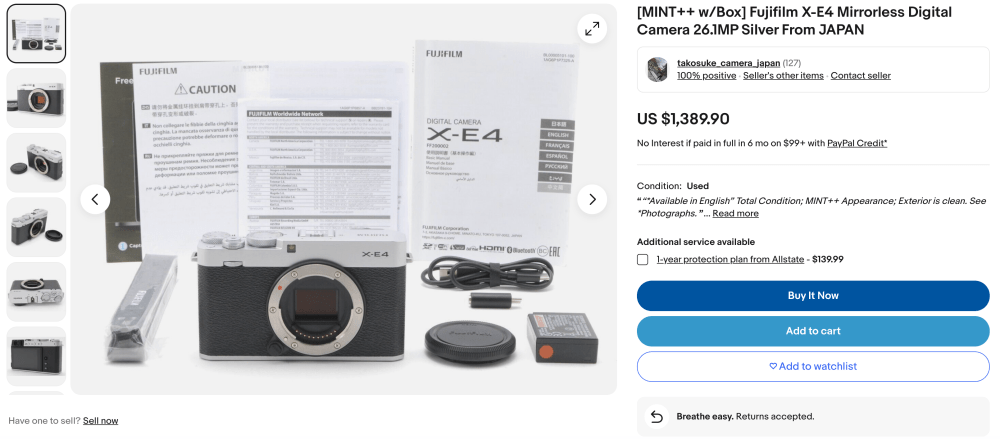
The Fujifilm X-E4 is INSANELY expensive right now!!

The cost of a second-hand Fujifilm X-E4 is completely out of hand!

Before we get to that, let’s rewind this all a bit. Fujifilm released the X-E4 in late-February 2021. I preordered my copy, which arrived in early March. The X-E4 was the fifth in the X-E line, which began in 2012 with the X-E1, Fujifilm’s second interchangeable-lens X-series model (the X-Pro1 was the first). The X-E2 came out only one year later, and the nearly identical X-E2s was released three years after that. The X-E3 was released in 2017, and rumors floated around that it might be the last X-E camera.

The X-E line is much beloved by those who own them. It’s a combination of beautiful rangefinder styling, diminutive size, simplicity, and affordability, while producing images that are equally as good as the bigger and more expensive models. But sales have always been so-so. The X-E3, in particular, was a slow-mover, and it was possible to buy a brand-new copy for less than MSRP as recently as last year. Two years ago the X-E3 was on sale for $560. This is to say that the X-E line is niche, even within Fujifilm, which is itself sort of a niche brand; however, it’s a much loved series by many who have had the pleasure to use them. The X-E1 was my gateway into Fujifilm; today the X-E4 is my second-favorite camera, only behind the X100V.

Two Caballeros – Culleoka, TX – Fujifilm X-E4 & Fujinon 27mm f/2.8 – Kodachrome 64

With the X-E3 not moving particularly quickly, Fujifilm seriously considered discontinuing the X-E line. But with the discontinuation of the low-budget X-A and X-T000 cameras, plus a vocal outcry from their customers, I believe Fujifilm had a change of heart, so the X-E4, with its minimalistic design, was born. However, between the global parts shortage and the expected so-so sales, Fujifilm didn’t produce as many copies as other cameras. My guess is that they were concerned that unsold boxes of the X-E4 would be sitting around for years like with the X-E3 (and, to an extent, the X-E2s before that, and the X-E2 before that, and the X-E1 before that), so Fujifilm made the decision to discontinue the X-E4, and divert manufacturing resources to other cameras, like the X100V, X-T5, and X-S20.

What Fujifilm did not anticipate is that the sudden success of the X100V—thanks to social media and Film Simulation Recipes (to a degree)—would spill over to the X-E4. Since it became so hard to get a copy of the X100V, and new orders were being placed faster than Fujifilm could manufacture the camera—with backorder lists six months long—people began to look for alternatives. The X-E4, especially paired with the 27mm pancake, was a top alternative suggested for those who wanted an X100V but couldn’t get one. The X-E4, which was already hit-or-miss to find, was now sold out everywhere, and Fujifilm couldn’t manufacture new copies nearly fast enough.

Even though the X-E4 was suddenly super successful, Fujifilm inexplicably discontinued it back in March of this year, just two years after it was initially released. I believe that Fujifilm had already decided to discontinue it, and cease manufacturing at a certain point—not secure the necessary parts to make more copies—and they followed through with their plan despite the increased demand. In my opinion, this was a big mistake. Apparently, Fujifilm may have also planned to quietly discontinue the X-E line with the X-E4. My hope is that they change their minds and create an X-E5, but I’m not holding my breath, because it probably won’t happen. Maybe articles like this will convince them otherwise.

Working – Salt Lake City, UT – Fujifilm X-E4 & Fujinon 27mm f/2.8 – Kodak Vision3 250D

Since the X-E4 was discontinued while demand was high, the prices of used copies has skyrocketed, as reported by Fujirumors. I began this article prior to Patrick publishing his, but got busy with other things before finishing it, then I saw his post on the subject. I questioned if it was even worth publishing, but, after thinking about it, I decided to finish this article. I believe that I have a divergent-enough take on this topic that it’s worthwhile to publish anyway.

Used copies of the X-E4 are being listed for sale for 50% to 100% more (and sometimes higher!) than the camera cost when brand new. Crazy! It’s simple supply and demand. There’s a lot of demand, and Fujifilm didn’t manufacture nearly enough supply. So now, if you want an X-E4 you’re going to pay through the teeth. Even the X-E3 is selling for more than it was, although it still seems pretty affordable—if you can’t find an X-E4, buy an X-E3 instead. I love my X-E4, but I wouldn’t recommend buying one for these prices. What it really shows is that Fujifilm should make an X-E5, or start manufacturing more X-E4 bodies. It’s a wasted opportunity.

Below are some screenshot examples I found of the insanely inflated X-E4 prices. If you are trying to buy one, I sincerely wish you the best of luck finding one for a reasonable cost.

See also: The Current Fujifilm X-Series Lineup

Is the X-E Line Done? Fujifilm seems to think so….

“If we decided to stop entry-level products such as X-T200 or X-E4,” Franck Bernard, Fujifilm France Photo Division Director, stated in a recent Phototrend interview, “it is because it is not a promising market. Today, competitors are also deciding to abandon certain more accessible product lines.”

Wow. This seems to be confirmation that the X-E line is done. The X-T200 was discontinued back in 2020, and with that the X-T000 line was abandoned. The Fujifilm X-E4 was discontinued back in March. This appears to be an indication that, in 2023, the X-E series has succumbed to the same fate that the X-T000 line did three years ago.

Of course, in other interviews, Fujifilm has kind of tiptoed around this topic and even hinted that the X-E line hasn’t been axed. They never expressly communicated one way or the other with certainty, but now they have. Sort of. They used fuzzy language—“if we decided”—and Mr. Bernard isn’t a corporate manager (he’s regional), so perhaps he didn’t have the authority to state what he said and it might not be exactly what HQ wanted made public. In other words, this might not be the official position of Fujifilm.

I think that his comment is factual and simultaneously must be taken with a large grain of salt. He’s likely saying something that’s largely understood within the company, but also something that Fujifilm doesn’t want to outright state, because they want to reserve the right to change their mind in a quickly shifting market and with dynamic corporate directives. They don’t want to officially kill off the X-E line, only to discover that they should have made an X-E5; instead, if they quietly cancel it, then it’s a bit easier to bring back at a later date if market conditions allow.

Pacific Poppies – Montaña de Oro SP, CA – Fujifilm X-E4 – Pacific Blues Recipe

Franck Bernard goes on to provide a little context to his comment: “I believe that Fujifilm has made the industrial choice for more than 5 years now to turn to high-end products and we will not return to entry-level products.”

I’ve heard this said a few times from Fujifilm managers. They believe the future of the brand is not with low-end models, or even with what we once thought of as the mid-range bodies, but with the higher-tier cameras. The X-H line, the X-T0 line, the X100 series, X-S00 line (which was made slightly more higher-end with the X-S20), and X-Pro, along with GFX. That’s where Fujifilm wants to focus their efforts. That’s where Fujifilm sees the future of their digital camera brand. The X-E series just doesn’t fit in, no matter how in-demand the X-E4 was at the time of its discontinuance. Camera brands don’t axe a line that has a lot of demand and a waitlist to buy—unless it was simply impossible to secure the necessary parts to manufacture more, or the higher-ups shifted priorities to other things. I think the latter explains the X-E4’s sudden and inexplicable discontinuation. Fujifilm doesn’t want to offer models in the X-E class. It’s beneath them now. Or, perhaps, for whatever reason, they believe the market is about to dry up for it, despite the demand (which, by the way, still exists more than six months after its discontinuation).

“Logically,” Mr. Bernard continued, “there should be a successor to the X-T30. We would like to maintain older, affordable products that correspond to a certain purchasing power. But we have no visibility on future ranges.” This is a bit after he stated that, “…our flagship product remains the X-T5, the standard model of the range. Comes behind the X-T30 II, and then follows the X-S10/X-S20.”

I think he was saying that, in France, the X-T5 is Fujifilm’s top selling model, followed by the X-T30 II, then the X-S00 series. Because of the demand for the X-T30 II, there should logically be a successor. Fujifilm France wants to be able to offer products that those with a more limited budget can afford. But, Fujifilm Japan has not provided them with a timeline when such a camera will come, if at all. That’s my interpretation, but I don’t know if that’s what he really meant. It’s a bit confusing.

As best as I can tell from all of this, the X-E line is done (but Fujifilm wants to reserve the right to change their minds) and an X-T30 II successor is desired by certain people within Fujifilm (and they believe logically it should happen) but HQ hasn’t provided any information to them on when or if that will happen. This is because—beginning five years ago—Fujifilm began to shift away from lower-end gear and towards higher-end products. This is all a part of the long-term plan, more or less.

Evening Charge – Santa Rosa, NM – Fujifilm X-E4 – Kodak Portra 400 v2 Recipe

Will an X-T40 (perhaps it will be called X-T30 III or X-T50) happen? It sounds like eventually it will happen, but not necessarily soon. Don’t be surprised if it is given new features (IBIS? 40mp?) and a higher price tag. Will an X-E5 happen? Probably not. If a lot of people speak up and state that they’d buy one, maybe. But still probably not. There’s been a large vocal desire for an X80, but that hasn’t happened, nor will it—technically, though, it is still possible, just highly unlikely. I think that’s the unfortunate state of the X-E line.

In a seemingly-unrelated-but-at-closer-look-completely-related article, PetaPixel says that young people are finding digital cameras to be more difficult to use and more time-consuming than cellphone cameras (imagine that!). While it’s easy to dismiss this, I think there are a few points worth considering. First, it’s great that Fujifilm introduced the X App, which is better than their rather mediocre (being kind) Cam Remote App, but the new app is years late and not compatible with older models. If Fujifilm wants to sell cameras to younger folks (which, presumably, generally have a tighter budget and aren’t buying flagship models), having an intuitive and reliable way to transfer the images is a necessity. Unfortunately, Fujifilm has fantastically failed at this, which undoubtedly affects sales of lower-end models. Think about this: film simulations (and especially Film Simulation Recipes) are highly desirable among those who want great results without fuss and without spending a lot of time achieving it. But getting those pictures off the camera can be a pain.

What Fujifilm (and the other camera makers) should have done is create a way to upload directly from the camera to Instagram, X, Facebook, Flickr, text, email, cloud, etc.. Maybe have an Android-like operating system with apps. As it is now, the step in-between that’s time-consuming, frustrating, and unintuitive is one reason why the cellphone is constantly eating away the bottom end of the camera market. Instead of innovating, camera makers just throw their hands up and say “Oh, well.” They blame the cellphone, but really they just concede the fight without trying all that hard to compete with it. Oh, and why did Fujifilm abandon the concept of connecting the camera directly with their Instax printers? That’s another missed opportunity, in a similar vein.

So if Fujifilm were to release an X-E5, but with a whole new way to get the pictures off of the camera and shared wherever the photographer wishes—something that’s easy, fast, and intuitive—I have zero doubts that it would sell well. Yes, there’s the X App, which is a step in the right direction, but ideally there would be no need for an app. It should be a one-step process from the camera itself. As the PetaPixel article illustrates, the hassle of using a digital camera—hassles that don’t need to exist but do, and hassles that aren’t found on the cellphone—is notable enough to go viral. Don’t doubt that the opposite is also viral-worthy. For example, the reason why the X100V suddenly became popular is because it went viral on social media, and a big reason why it went viral is because it could produce analog-looking pictures that didn’t require editing (yes, Recipes!). It produced wonderful results easily, and that caught the attention of so many that the camera is historically long-backordered. Now imagine if those results could be more quickly and intuitively available for sharing. Yes, that’s notable enough to go viral.

The Current Fujifilm X-Series Lineup

According to Fujirumors, there will not be another X-series camera announced in 2023. Apparently, whatever camera was thought to be coming is not… at least not until sometime after New Years. The next Fujifilm camera to be released will, then, be the X100V successor, which will likely be announced in late-January or early-February.

The name most thrown around for the X100V successor is X100R, where “R” stands for Roku, which is six in Japan; however, I’d be surprised if Fujifilm did this just because Roku is such a recognizable brand name. Can you imagine the fun, though, that someone like Omar Gonzalez or Kai Wong could have with this? I can already see the gags about the X100Roku… plug it into your TV for streaming made easy! Catch the latest videos from your favorite YouTubers right on the X100Roku! I don’t know what Fujifilm will name it, but I propose X100Z, which makes the most sense to me.

Other than a new lens, not much is known about the X100V successor. I think it will have the 40mp X-Trans V sensor. Nothing else has leaked, as far as I’ve seen. We’ll just have to wait and see.

A lot of Fujifilm models have been discontinued, and we’re now in the last quarter of 2023, so I thought I would take this opportunity to briefly discuss what the X-series lineup currently looks like.

Fujifilm X100V

This, of course, is the one model that everyone wants but nobody can get. It’s the most in-demand camera that Fujifilm has ever made. With a backorder list that’s months-long, new orders are being placed for the X100V faster than Fujifilm can manufacture new copies. Hopefully, the X100Z (or whatever Fujifilm will call it) will help alleviate this issue, but it might just exacerbate it. I wonder if those who have been on backorder lists for months will be made first in line for the new model, or if they’ll have to jump into a whole new line? Fujifilm will have to be careful with how they handle the transition. The X100V is currently the only rangefinder-style model being offered by Fujifilm. Oh, and good luck finding one!

Fujifilm X-T5

The latest in the often-celebrated X-T line is the X-T5, which is truly a photographer’s camera. It is one of four fifth-generation X-series models, and one of only two with the 40mp X-Trans V sensor. It’s also the only SLR-styled camera with the traditional tactile controls being offered by Fujifilm at this time.

Fujifilm X-H2 / X-H2s

These two cameras are Fujifilm’s flagship models designed to competitively contend with some full-frame offerings by Canikony brands. They’re the most expensive in the lineup, offering the best-of-the-best features, but in a body dissimilar from most that Fujifilm has previously released for X cameras. They’re largely intended to bring photographers into the Fujifilm fold from other brands, and not necessarily satisfy the desires of those who have been with the brand for many years. The X-H2 is the 40mp high-resolution version, while the X-H2s is the 26mp performance option.

Fujifilm X-S20

The X-S20 is the more budget-friendly and compact version of the X-H2/X-H2s. It’s like their little brother. It’s also more intended to bring in folks from Canikony brands than to sell to long-time Fujifilm users. Despite having the old sensor, it’s Fujifilm’s newest X-series model.

Fujifilm X-S10

The X-S10 is the predecessor to the X-S20. Even though the new iteration has been out for several months, Fujifilm hasn’t discontinued the X-S10. I’m not sure if it’s because they still have a lot of copies sitting around, or if it’s just selling so well that they’ll keep it around awhile longer. Fujifilm did something similar with the X-T3—continued to manufacture it well after the X-T4 was released—because it was still doing well for them. The X-S10 is Fujifilm’s cheapest offering, and currently the best value in my opinion.

That’s it! That’s the full X-series lineup currently. It looks a lot different than it used to—boy, have times changed!

Cameras that have been discontinued that still might see a successor are the X-T30 II, X-E4, and X-Pro3. My guess is that an X-Pro4 will be announced in late-spring or early-summer, and will be the first to follow the upcoming X100-series model. I’m not certain if we’ll get an X-T40 (maybe they’ll call it X-T30 III or X-T50), but it would make a lot of sense to offer it, as that line has always done well for Fujifilm, and a budget-friendly camera with the traditional tactile controls is curiously and sadly missing. If Fujifilm does eventually make an X-E5, if past releases are any indication, it will be sometime in late-2024 or even in 2025, I think, just before X-Trans VI; however, the X-E4 had a lot of demand and a long backorder list before being suddenly discontinued, so it would make a lot of sense to release an X-E5 before then. I’m not convinced that Fujifilm will offer both an X-T00 and X-E model simultaneously, and it’s possible that one of those two lines is gone for good. We’ll see.

My guess is that we’ll see three X-series cameras in 2024. The first will be the X100Z, then the X-Pro4, then either the X-T40 or X-E5 later in the year. The X100V successor is the only one that’s for certain, the rest is speculation.

This post contains affiliate links, and if you make a purchase using my links I’ll be compensated a small amount for it.

Fujifilm X100VAmazon   B&H  Moment
Fujifilm X-T5:  Amazon  B&H  Moment
Fujifilm X-H2:  Amazon  B&H  Moment
Fujifilm X-H2S:  Amazon  B&H  Moment
Fujifilm X-S20:  Amazon  B&H  Moment
Fujifilm X-S10:  Amazon  B&H  Moment

Creative Collective 055: Serendipity of Accidental Noise

Dark Cloud Over The Dark Mountain – South Weber, UT – Fujifilm X-T30 – Ilford HP5 Plus 400 Push Process Recipe – ISO 25600

Most people don’t use ultra-high ISOs like 25600 on their Fujifilm cameras. But maybe it’s underutilized? Perhaps it’s not appreciated nearly as much as it should be. While I have utilized ISO 25600 and higher on purpose in the past, a couple of recent accidental uses of this ultra-high ISO has made me pause and reconsider if I should be using it more often than I do.

So let’s take a look at some ultra-high ISOs!

Report: Fujifilm will Announce a “Very Small” Digital Camera THIS Month!

According to Fujirumors, there is a brand-new rumor that Fujifilm will announce a “very small” digital camera within the next couple of weeks, sometime before the end of the month. No other details were provided, so our imagination can run wild with what exactly it is.

While this is certainly exciting news, I think it’s important to keep our expectations in check. There’s no X Summit to go along with this announcement, which means that it’s not a camera that Fujifilm deems as a significant model. Fujifilm typically makes a big fuss when they reveal a new camera, but they don’t always; however, those cameras tend to be low-end budget models. There wasn’t an X Summit back when the XF10 was announced, for example.

What, then, will this camera be? Nobody yet knows, but my guess is a low-end model, most likely a Bayer camera. I thought Fujifilm was done making these, but maybe they believe there’s a market after all?

The upcoming model might be an X-A8. The X-A series was a popular line—especially in Asian countries—for many years, but the X-A7 had disappointing sales numbers, and was abruptly discontinued not long after release. The X-A7 and X-T200 were basically competing against each other, and it might have been a case of Fujifilm offering two models that were too similar. Both lines had been axed, but maybe Fujifilm feels there’s enough demand that they can resurrect one; since the X-A line was smaller than the X-T000 series, I could see it qualifying as a “very small” model.

Another possibility is something that probably nobody is thinking of: pocket digicam zoom. Something like the XF1 and XQ2 would be intriguing, but it could also be more along the lines of the FinePix T400, since there has been renewed interest in those types of cameras. Perhaps it’s a successor to the XP140 waterproof camera? That’s actually the most likely option, as unexciting as it might be.

Of course it could be an XF20, a followup to the XF10. The XF10 had mediocre sales, but with the Ricoh GR III being almost as in-demand as the X100V, Fujifilm might possibly see an opportunity. Strike while the iron’s hot, as they say—and the iron for that type of camera is certainly hot right now. Even better would be an X80, the long-hoped-for successor to the X70. I think an X80 would get an X Summit, so I’m less hopeful for that, but you never know. A lot of people wish for that camera, so I will keep my fingers crossed.

Could “very small” be in reference to an X-E5? Probably not, unless they shrunk it a bunch. Also, they’d announce it at an X Summit, I’m certain. It could be an Instax Mini EVO 2, which would technically be a digital camera, and is quite tiny in the world of Instax. Don’t be surprised if it’s this. I’ll certainly be disappointed, as it wouldn’t fit my personal definition of “very small” or “digital camera.”

Most likely, the new camera will be a FinePix XP150 (or whatever they’ll call it). If so, it’s not something I have any interest in buying. I think an XF20 or X-A8 are small possibilities, but I would be shocked, since Fujifilm has seemingly moved beyond releasing those types of cameras. Even less likely are are an X40 or XQ3, since Fujifilm hasn’t made 2/3″ sensor models in a long time. An X80 would be most ideal, and a camera that a lot of people would celebrate—I would be at the front of the line to buy it—but I don’t think Fujifilm would announce it without fanfare, so I highly doubt that is it.

Since there’s not going to be much fanfare, it’s not going to be a camera that you’ll probably get excited for. Because we don’t know what it will be—only that it’s coming, whatever it is—our imaginations can run wild, and the possibilities, no matter how unlikely, give us some excitement. Just keep your expectations low, or else you’ll probably be disappointed.

New: Reala Ace Film Simulation

Now that the X Summit is over and the GFX100 II has been officially announced, we have a little bit better idea of what exactly Fujifilm’s new film simulation is. First, the name is not Reala like was previously rumored, but Reala Ace. Not a huge difference, but different nonetheless.

Fujifilm has sometimes named certain film stocks differently in Japan than the rest of the world, and several film stocks were only made available in Japan. Fujicolor Reala Ace 100 was a color negative film sold only in Japan. Some speculated that it was the exact same thing as Fujicolor Superia Reala 100 (initially, Superia wasn’t in the emulsion name, but was added later) just sold under a slightly different name, while others said that Fujicolor Reala Ace 100 was a unique film similar to the Reala sold worldwide except fine-tuned for Japanese skin tones. For whatever reason, Fujifilm went with the name Reala Ace for their new film sim.

Prior to today’s announcement, I had speculated that “…the new film simulation will [not] be an accurate replication of Reala film, since Classic Negative is so close already; instead, I think Fujifilm is simply going to use the brand name for a film sim that has a neutral and natural rendering (true-to-life or real-like, yet leaning towards soft tonality and muted colors).” I also said, “I’m crossing my fingers that the Reala film simulation will be a tweak of Classic Negative that will more closely mimic Reala emulsions.”

I was half right and half wrong, but I’m quite happy to be half wrong. I was right that the film sim would lean towards soft tonality and have a true-to-life rendering. I was wrong that it wouldn’t look like Reala film or Classic Negative, because it does. You could call the new film sim Classic Negative v2, but Fujifilm named it Reala Ace.

Leaving the Water – Laguna Beach, CA – Fujifilm X-T5 – Fujicolor Reala 100 Recipe

How accurate is the Reala Ace film simulation to Reala film? It definitely has the right vibe, from the small number of samples I’ve found online. It isn’t all that dissimilar to my Fujicolor Reala 100 Film Simulation Recipe, either—in fact, I think just a few small adjustments to my Recipe brings the results closer to the new film simulation. Of course, I have no idea if those Reala Ace examples are unedited, and what parameter adjustments the photographer might have done, or if they’re all factory defaults.

Fujifilm has a graph demonstrating how the different film simulations fit on a tonality and saturation scale. It should be taken with a grain of salt. For example, there’s no way that Nostalgic Neg. is the second most vibrant film sim, because it’s not. PRO Neg. Hi has a little more saturation than PRO Neg. Std, yet they’re the same on the chart. Still, we can extrapolate that Reala Ace has softer tonality yet a tad higher vibrancy than Classic Negative.

Even though Reala Ace is essentially Classic Negative, I’m quite thrilled that this new film sim has an obvious analog aesthetic. Classic Negative is one of my favorite film simulations, and I’m sure Reala Ace will be, too, once I get a chance to use it someday in the future. My guess is that the upcoming Fujifilm X100Z (or whatever Fujifilm calls it… maybe they’ll name it X100Ace?) will be the first X-series camera to get Reala Ace. I won’t buy the GFX100 II (it’s way outside of my budget), so it might be awhile before I get to try it. From what I can tell, the new film sim will be found right below Classic Chrome and right above PRO Neg. Hi in the camera’s film simulation list.

Interestingly enough, there seems to be a lot of interest in this new film sim, but not necessarily by folks who will buy the GFX camera. The ones most excited seem to be those who anticipate that it will trickle to the X-series. Most of those who have reviewed the camera (who received a pre-production model from Fujifilm) barely mentioned it, and mainly as a passing thought. One did talk a little more about it (and right at the beginning), but otherwise the enthusiasm for Reala Ace seems to be much stronger from the X crowd than the GFX, despite it only found (for now) on GFX. This makes a lot of sense to me because most of those who shoot GFX cameras don’t use Film Simulation Recipes (yet there are some); however, many who have X-Trans cameras do use Recipes. Fujifilm should introduce new film sims on X-series models where they can better capitalize on that excitement, and not on GFX where it’s unimportant (generally speaking) to those buyers, essentially wasting the opportunity (hey, maybe Fujifilm should consult with me??!!).

I modified the Fujicolor Reala 100 Film Simulation Recipe on my Fujifilm X-T5, reprocessing in-camera some recent pictures on the SD Card, to more closely resemble the Reala Ace film simulation. You can find the Reala Recipe on this website (here) and on the Fuji X Weekly App. The modifications I made to the Fujicolor Reala 100 Recipe are: White Balance Shift set to 0 Red & +1 Blue (using Daylight WB… I also tried Auto White Balance with that same shift), Color Chrome FX Blue Strong, Color +1, Highlight -1.5, Sharpness 0, and Clarity -2. There are only a small number of examples of the new film sim, and it’s impossible to know if they’re 100% default Reala Ace or if they have been modified or edited in some way, but I think I’m in the ballpark with these settings. It’s pretty close. Below are some examples.

Faux Reala Ace on my X-T5

This post contains affiliate links, and if you make a purchase using my links I’ll be compensated a small amount for it.

Fujifilm X-T5 in black:  Amazon  B&H  Moment
Fujifilm X-T5 in silver:  Amazon  B&H  Moment
Fujifilm GFX100 II:  B&H

What could a Fujifilm Digital XPan Camera look like and should they make it?

In my Will there be a new Fujifilm X camera announced in September? article I mentioned that Fujifilm should include an XPan 65:24 aspect ratio as an option on the X-Pro4, whenever that camera comes out. GFX models already have this, but Fuji hasn’t given the XPan ratio to any X-series cameras. The X-Pro4 seems like a logical place to start, especially if it is given the 40-megapixel sensor, which has plenty of resolution to support the crop. But, should Fujifilm make a “real” XPan camera, and what would that look like?

XPan was a collaboration between Fujifilm and Hasselblad in the late-1990’s and early-2000’s. XPan cameras were 35mm interchangeable-lens rangefinders that produced panoramic pictures across two film frames—the pictures were twice as wide as normal 35mm images. The cameras were also capable of capturing regular 35mm frames, should the photographer not wish to create panoramic pictures. Two XPan cameras were made; Hasselblad called them XPan and XPan II while Fujifilm named them TX-1 and TX-2. The X100-series models have a striking resemblance to XPan cameras.

XPan crop — Fujifilm X-T5 — CineStill 400D v1 Recipe

I don’t think it would be all that difficult for Fujifilm to make a true XPan camera. It would require two APS-C sensors placed side-by-side, or—probably more preferably—one chip cut to the same size as two. The lens would be the big issue, since X-Series lenses wouldn’t offer enough coverage. Either Fujifilm would make it a fixed-lens camera (like the X100V, but with a different lens that has coverage), or they’d need lenses that would cover the wide frame. If they decided on the interchangeable-lens concept, GF-mount lenses from the GFX series would have enough coverage, so it would make sense to use them. In other words, the XPan camera would technically be GFX, but in an X-series body and with an X-Trans sensor.

Even though the TX-1 and TX-2 looked more similar to the X100V, I think using an X-Pro body would be a good option to build it on. Call it the TX-Pro4 or X-Pan1 or something like that. The hybrid viewfinder would need to be modified to accommodate the wider frame, but otherwise the camera wouldn’t need a whole lot of changes.

XPan crop — Fujifilm X-T5 — Kodak Ektachrome E100VS v1 Recipe

There are three different sensors that Fujifilm is currently using in the X-Trans V generation of cameras: 40-megapixel (X-H2, X-T5), 26-megapixel stacked (X-H2s), and 26-megapixel X-Trans IV (X-S20). Which would they put into the XPan camera?

If they chose the 40-megapixel option, which would actually be 80-megapixel, that would be the most marketable, since megapixels sell. On the 100-megapixel GFX cameras, the XPan aspect ratio reduces the resolution to 50mp, while the 50-megapixel models reduces the resolution to 25mp; 80mp would be much more than either! The disadvantage would be the processing power required and heat dispersion necessary, which would be a huge challenge for Fujifilm, so I don’t think this is a likely option.

XPan crop — Fujifilm X-T5 — Fujicolor Superia 100 Recipe

The other two are both 26-megapixel sensors, which would equal 52mp on an XPan model. This would be the same resolution as using the XPan aspect ratio on the 100mp GFX cameras. The new stacked sensor is great for speed but is much more expensive, while the older X-Trans IV sensor is still good yet affordable. Of the two, the stacked sensor is the most intriguing; however, it would likely raise the price of the camera by around $800-$1,000 over using the X-Trans IV option. As the X-S20 demonstrates, pairing the X-Trans IV sensor with the X-Trans V processor is a viable option, and probably what Fujifilm should choose.

Basically, I’m suggesting that Fujifilm modify the (eventual) upcoming X-Pro4 with two 26mp X-Trans IV sensors (instead of the presumably 40mp X-Trans V sensor that the regular X-Pro4 will have), utilizing X-Processor 5. This would give the camera 52mp of resolution when shooting the XPan aspect ratio, or 26mp when shooting in 3:2. The XPan camera would have over 2.5-times more resolution than shooting a 40mp sensor cropped to the XPan aspect ratio.

XPan crop — Fujifilm X-T5 — Classic Slide Recipe

Who would buy this camera? Wouldn’t it be super niche? It would indeed be niche, but it would also be a “wow” product that a lot of people would talk about. Where I think it would get a lot of unexpected attention is with cinematographers, since some of the ultra-wide aspect ratios (think Ultra Panavision) could be shot in 4K, 6K, and possibly even 8K. Also, it would provide a bridge between the X-series and GFX, since those with GFX models could use their existing lenses on this camera, and those not in the GFX system could eventually jump in after buying a couple lenses for their XPan model.

Will Fujifilm make this camera? Probably not. I’d be pretty shocked. Should they? I think so. I believe it would sell well enough that it would be worthwhile for Fujifilm. I’d definitely buy one! Would you?

Will there be a new Fujifilm X camera announced in September?

Fujifilm will be announcing some new gear on September 12; Fujirumors is reporting that it will be GFX cameras and lenses, including a GFX100 successor (which, apparently, wasn’t the GFX100S), GF 55mm f1.7, GF 30mm f/5.6 tilt-shift, and GF 110mm f/5.6 tilt-shift. A rumor has floated for awhile now that two X-series cameras would be released in 2023. The first was the X-S20. What will the second be? And will it be announced in September?

We know that the X100V replacement won’t come until next year, so which one will be next? There’s been a lot of speculation that it could be the X-Pro4 because it’s long overdue; however, if it is, something would have likely already leaked about it, so I’m marking it as unlikely. How about an X80? Fujifilm absolutely should release this camera, but I think that ship has sailed in their minds, and it’s not even on the list of potential future models. X-A8 or X-T300? Those lines have been discontinued, so no. It’s much too soon for an X-H3 or X-T6 or X-S30. What does that leave? The X-E5 or X-T40 (which they might call X-T50). Let me give a few quick reasons why I think it will and won’t be each of those models.

Evening Charge – Santa Rosa, NM – Fujifilm X-E4Kodak Portra 400 v2

It will be the X-E5 because the X-E4 was a hot commodity just before being surprisingly discontinued (presumably so that manufacturing efforts could be diverted to the X100V). It was backordered everywhere and even sometimes selling for more than MSRP. There’s still quite a demand for it, but so very little supply. It was strange that Fujifilm axed an in-demand model, but if they were preparing to release a successor, it makes a lot more sense.

It won’t be the X-E5 because Fujifilm will probably only offer one base-level camera going forward (due to shifting markets), and between the X-T00 and X-E lines, it’s more likely the X-E that’s not renewed. Besides that, historically, the X-E line comes at the very end of a sensor generation, not towards the beginning or middle.

Wearing Grandpa’s Hat – South Weber, UT – Fujifilm X-T30 – Kodacolor

It will be the X-T40 (or X-T50) because this line is long overdue for an update. The X-T30 was released over four years ago. The X-T30 II was an extremely minor upgrade, mostly just a firmware update that should have been given to the X-T30. Both the X-T30 and X-T30 II have been discontinued, so it makes sense that a new version is about to come out. Besides, the X-T00 line has been a good seller for Fujifilm, and the current lineup is in desperate need for a camera of its class.

It won’t be the X-T40 because the X-T30 II was released only two years ago. While it sold well, it wasn’t as in-demand or trendy as the X-E4. Aside from that, Fujifilm is clearly focusing more on higher-end models, and not entry-level.

Tunnel Silhouette – Farmington, UT – Fujifilm GFX-50S – Classic Negative Industrial

What’s my opinion? I think, if an X-series camera is announced on September 12, it will be the X-T40. I don’t think the X-T40 will likely be a major upgrade, so including it on the same day as the GFX150 (or whatever the new GFX camera will be called) makes sense. Just as likely, no X-series models will be announced on September 12; perhaps the next camera will be the X-Pro4 in November (that’s just speculation, I have zero inside information).

The X-T40 will probably be the exact same thing as the X-T30 II, except with the X-Processor 5, which brings improved autofocus and video specs, along with the Nostalgic Neg. film simulation. I suspect that it will have the same X-Trans IV sensor and the same NP-W126S battery, and be 95% the same camera. I don’t think it will be revolutionary; however, it will be Fujifilm’s sub-$1,000 option, which I think is still important to offer. Don’t be surprised, if Fujifilm does decide to eventually release an X-E5, that the X-T00 and X-E lines aren’t available at the same time. In other words, they might manufacture the X-T40 for a year or two (depending on how it sells), and then discontinue it as they prepare to release the X-E5. Once that’s been on the market for a year or so, it’ll get discontinued in time for the next X-T00. I think Fujifilm sees these two models as competing against themselves to some degree. I wouldn’t be surprised at all if one of these two lines was simply (and quietly) discontinued.

Indoor Blooms – Salt Lake City, UT – Fujifilm X-Pro3Fujicolor Superia 800

In my opinion, I think Fujifilm has been secretly working on the X-Pro4, and I wouldn’t be shocked if it was released in November (like the X-T5 was last year). I think it would make a ton of sense. They’ll probably readdressed the rear screen somehow. I do believe it will have the 40mp sensor, and don’t be surprised if it is the first X-series camera with the XPan aspect ratio as an option. This would be a smart move, I think, and it would fall within Fujifilm’s shift towards focusing more on higher-end cameras and less on lower-end.

What do you think? Will an X-series camera be announced on September 12? Which model will it be? What do you hope for? Let me know in the comments!

Pro Film — Fujifilm X70 (X-Trans II) Film Simulation Recipe

Sunny Afternoon Blooms – Buckeye, AZ – Fujifilm X70 – Pro Film Recipe

For this Film Simulation Recipe, I was attempting to accomplish two different things: create a Recipe that uses Underwater White Balance and produce results with an analog-like color negative film aesthetic. To the second point, this Recipe does produce that in generic terms. It’s not intended to mimic any specific film emulsion, although there might be some unintended resemblance to Fujicolor Pro 160C, or—to a lesser extent—Kodak Portra 160VC.

The reason I chose the Underwater White Balance type is because I’ve yet to use it with any X-Trans II Recipe; since your camera will remember one White Balance Shift per White Balance type, this can be another option to consider for your C1-C7. If each of the seven Film Simulation Recipes programmed into your Custom Presets has a different White Balance type, you won’t have to worry about changing the WB Shift when switching between your C1-C7 Custom Preset.

Red Bicycle – Buckeye, AZ – Fujifilm X70 – Pro Film Recipe – Photo by Jon Roesch

This “Pro Film” Recipe is compatible with all Fujifilm X-Trans II cameras (except the XQ1 and XQ2, which don’t have the PRO Neg. Hi film simulation). You can use this Recipe on the X-Pro1 and X-E1 (as well as many of the Bayer models), although the results will be slightly different.

PRO Neg. Hi
Dynamic Range: DR200
Highlight: -1 (Medium-Soft)
Shadow: -2 (Soft)
Color: +2 (High)
Sharpness: -1 (Medium-Soft)
Noise Reduction: -2 (Low)
White Balance: Underwater, 0 Red & -2 Blue

ISO: Auto, up to ISO 3200
Exposure Compensation: -1/3 to +1/3 (typically)

Example photographs, all camera-made JPEGs using this “Pro Film” Film Simulation Recipe on a Fujifilm X70:

No Turning Back – Phoenix, AZ – Fujifilm X70
Yellow Truck – Buckeye, AZ – Fujifilm X70 – Photo by Jon Roesch
Sunset Ford – Buckeye, AZ – Fujifilm X70 – Photo by Jon Roesch
Red Car – Buckeye, AZ – Fujifilm X70
Van Accessible – Phoenix, AZ – Fujifilm X70
Walkway Bicycle – Buckeye, AZ – Fujifilm X70 – Photo by Jon Roesch
Window in the Wall – Buckeye, AZ – Fujifilm X70 – Photo by Jon Roesch
Locked Up Bike – Buckeye, AZ – Fujifilm X70 – Photo by Jon Roesch
Enjoy – Phoenix, AZ – Fujifilm X70
Corner Table – Phoenix, AZ – Fujifilm X70
Clouds over Rooftop – Buckeye, AZ – Fujifilm X70
Sunlight Behind Pavilion – Buckeye, AZ – Fujifilm X70 – Photo by Joy Roesch
School – Buckeye, AZ – Fujifilm X70
Backlit Tree & Wall – Buckeye, AZ – Fujifilm X70 – Photo by Jon Roesch
Electric Wall – Buckeye, AZ – Fujifilm X70
Backyard Jo – Buckeye, AZ – Fujifilm X70
Backlit Water Fountain – Buckeye, AZ – Fujifilm X70 – Photo by Jon Roesch
Green Field – Buckeye, AZ – Fujifilm X70 – Photo by Jon Roesch
Park View – Buckeye, AZ – Fujifilm X70 – Photo by Joshua Roesch
Photographing the Photographer – Buckeye, AZ – Fujifilm X70 – Photo by Joshua Roesch
Arizona Green – Buckeye, AZ – Fujifilm X70 – Photo by Joy Roesch
Early Morning Bougainvillea – Buckeye, AZ – Fujifilm X70

Find this Film Simulation Recipe and nearly 300 more on the Fuji X Weekly App! Consider becoming a Patron subscriber to unlock the best App experience and to support Fuji X Weekly.

Creative Collective 052: FXW Zine — Issue 21 — August 2023

The August issue of FXW Zine is out now! Creative Collective subscribers can download it today. Not a Creative Collective subscriber? Join to gain access to this issue plus all pervious issues of FXW Zine and the many bonus articles. 

Issue 21 takes a look at five budget-friendly Fujifilm cameras that are fairly inexpensive on the used market. If you are considering adding another camera but don’t have a lot to spend, or if you are looking for a good-yet-cheap first Fujifilm model—maybe for your kid or a friend—then the August issue is for you!

Fujifilm X100-? — What Should Fujifilm Name the Upcoming Model?

Fujifilm will be announcing the upcoming X100V replacement in early 2024, according to Fujirumors. What will be different on the new model is unknown, but most likely it will be nearly the same, and will probably be a little more expensive. It will be interesting to see what exactly Fujifilm changes and what they keep the same. Will it have a 26 or 40 megapixel sensor? XPan aspect ratio? IBIS? NP-W235 battery? Anything is a possibility right now, but historically the X100-series doesn’t change a whole lot with each new iteration.

I hope that Fujifilm—and it would be really smart for them to do this—introduces a brand-new film simulation with this model. Yes, it will have Eterna Bleach Bypass and Nostalgic Neg., but it should have one more fresh film sim. I have no idea if that’s in the plans or not, but it should be.

Probably the least important aspect of any new camera—from a usability perspective—is the name; however, from a marketing perspective, the name is fairly important. If the camera is called something awkward or uninspiring, it might mean fewer sales, while if it is called something catchy and cool, it could increase camera sales. Fujifilm likely has a shortlist of potential names written on a board in Japan right now, and they’re trying to decide which one to pick.

Fans of Fujifilm are—just for fun—also contemplating the new name. I correctly picked the name of the X100V well before it was announced, and I’m hoping to go 2-0 with the upcoming version. It’s not important in the scheme of things, but I do enjoy guessing. Others have taken a stab at it, too. Let’s discuss some of the potential options.

My best guess is that Fujifilm will name the new model X100Z. Why Z? First, it sounds cool (think Nissan 350Z). Second, “Z” (Zeta) is the sixth letter in the Greek alphabet, and this will be the sixth iteration of the camera. Third, Fujifilm used Z in some of their film emulsion names, such as Fujicolor Pro 800Z (if they did introduce a new film simulation, it could be based on Pro 800Z and called PRO Neg. Z). It makes a lot of sense to me, and seems to check a lot of boxes that I imagine Fujifilm has for any potential name.

In the original X100 naming system, S stood for Second, T for Third, and F for Fourth. Once number five came around, the naming system no longer worked, so Fujifilm jumped to Roman Numerals for the current model. V not only means Five, but there’s also a V in the word. Some people think that Fujifilm will continue with Roman Numerals, and the next version will be X100VI. This is likely high on Fujifilm’s list of possibilities, but it just seems so Sony, and not so much Fujifilm; however, Fujifilm has been trying to be more like Sony lately, so maybe they’ll go this route. I personally would be surprised if Fujifilm uses another Roman Numeral until the tenth model, which will surely be called X100X, but I have no doubts that this option is on their list.

Another possibility—and this one seems to be the most popular among Fuji fans—is R, because that’s the sixth letter in the Japanese alphabet. The letter is pronounced Roku, which you might recognize as a well-established brand name for streaming television. If Fujifilm went this route, surely there will be plenty of jokes (for example, watch your favorite YouTuber right on your camera…). I could see Omar Gonzalez or Kai Wong having a field day with this! I would think that Fujifilm would avoid this option simply for the name association, but they could say that R stands for Rangefinder or Resolution (if they choose the 40mp sensor), but of course we’ll all know what it really means: plug the X100Roku into your TV for streaming made easy!

Some have speculated that Fujifilm will start over, going with X200 (followed by X200S, X200T, etc.). I don’t think this option makes much sense. I imagine that a full-frame X100 model would be called X200, but I don’t see Fujifilm completely renaming an established and popular line. If they were to go this route, the X200 would have to be significantly different than the X100V to justify such a dramatic name change, and I don’t see that happening.

If Fujifilm keeps everything pretty much the same and only makes minor modifications to the new model, I could see X100Vs (like the X-E2s, or if they use the stacked sensor of the X-H2s) or X100V II (like the X-T30 II) as the name. I think a lot of people will be disappointed that the new camera is pretty much the exact same thing as the (at the time of the new announcement) four-year-old X100V; however, if it ain’t broke, don’t fix it, right? So if not much changes, X100Vs and X100V II are both possibilities, but I imagine that enough will be different that Fujifilm won’t choose these options.

Another one I’ve seen floated around is X100H, where H stands for Hex, which means Six in Latin. It also means curse in English, so I’d be really surprised if Fujifilm made a bewitched model. I think this one will be avoided like the plague!

Of course, the one I’d really like to see is the X100-Acros, a monochrome-only version. I think there would be a lot of buzz surrounding that, and would be a “wow” camera. I hope that Fujifilm is at least considering such a version—I’d be first in line to buy it!

Now it’s your turn: what do you think Fujifilm will name the sixth edition of the X100-series? Let me know in the comments!