Is Fujifilm Purposefully Causing Shortages to Manipulate the Market?

The short answer is no. The longer answer is below.

There’s a controversy that’s been brewing for awhile, but has really gained steam over the last couple of weeks, that suggests Fujifilm is purposefully crafting market shortages of products so as to create hype (or, really, FOMO), in an attempt to ensure that their products are constantly in high demand. The roots of this controversy are in the constant shortages of Fujifilm’s products. At one time, you could walk into most camera stores on any given day and buy the camera or lens that you wanted; however, over the last few years, that hasn’t always been the case. Then, just recently, Fujifilm seemed to confirm it.

Manhattan from Pulaski Bridge – New York City, NY – Fujifilm X-T50 – PRO Negative 160C

“The most important point is how much brand strength to create and how to maintain it,” said Teiichi Goto, Fujifilm President and CEO, in response to a question about their inventory situation and plan. “Therefore, it would be quite unfortunate to manufacture too much and lower the price. What Fujifilm has been trying to do for a long time is finally coming true now. We intend to drive the entire imaging business, including Instax, while concentrating on building brand strength and not reducing the value of the properties purchased by our customers.” When asked if the current inventory situation is normal, Mr. Goto replied, “Yes.”

A lot of people responded to this with something to the effect of: “This proves it! Fujifilm is purposefully creating camera shortages to manipulate the market.” But I think they misunderstand it. I wasn’t planning to write this article, but, since I’ve had several people ask me to comment on the controversy, I thought I’d type out my opinion.

I’m completely convinced that if Fujifilm could produce the precise number of gear (cameras, lenses, etc.) for the current demand, so that everyone who wanted to purchase something could do so without waiting, they would. But that’s nearly impossible to correctly estimate. When PetaPixel asked for clarification if they consider insufficient supply to be part of a marketing strategy, Fujifilm responded, “No. Our marketing strategy is to showcase the innovation behind our lineup of digital cameras and lenses to provide creators with a variety of options so they can choose the right tools for their craft.”

Sign on the Roof – Gila Bend, AZ – Fujifilm X100VI – Classic Color

It takes many months for a camera to be manufactured and end up at a camera store. Fujifilm has to secure the parts, get them assembled, and shipped across the world. They are guessing in December what the demand might be in July. And there are limited resources for manufacturing. How many parts can a supplier produce at any given time? How many cameras can an assembly line put together each day? The whole process is much more complex than I think many people assume. Fujifilm not only has to anticipate future demand, but they have to figure out how to meet that within the constrains of many and various limitations.

Demand isn’t steady, but constantly fluctuating. It can spike unexpectedly, and fall off a cliff unexpectedly. If the demand for a certain camera suddenly ceases, Fujifilm needs to anticipate that months and months in advance, or they’ll continue to manufacture tens of thousands of copies of a product that few are buying.

Let’s look at the Fujifilm X100V. It was released in early 2020, and, for about two-and-a-half years, Fujifilm was more-or-less manufacturing the number of copies it needed in order to meet the demand for that camera. Then, suddenly, demand spiked, due to several viral TikTok videos. Fujifilm did not ramp up production (or, if they did, it wasn’t nearly enough) of the X100V, likely because they assumed the hype would quickly dissipate, especially since the camera was approaching three-years-old at the time; however, they guessed wrong.

Sentinel & Merced – Yosemite NP, CA – Fujifilm X100V – Vintage Color

For the X100VI, Fujifilm assumed that doubling the production of the X100V would be enough to meet the anticipated demand for it. Fortunately or unfortunately, depending on your perspective, the demand for the X100VI was historic and unprecedented. There were more preorders for the X100VI in China alone than there were X100V’s manufactured in total. Fujifilm has said that they will be increasing production of the X100VI, but I’m not certain to what extent exactly (I’ve heard that it could be 30,000 units per month by sometime in the summer, but I have no idea what the precise numbers are right now).

This is uncharted territory for not just Fujifilm, but for any camera maker. Fujifilm has to try to meet steep current demand while being hyper alert for any changes in future demand. If, for example, they are actually making 30K cameras per month, and suddenly the floor drops and nobody wants one, and they’ve already set in motion the manufacturing of 150K cameras, that could be enough to bankrupt the company (at least the camera division).

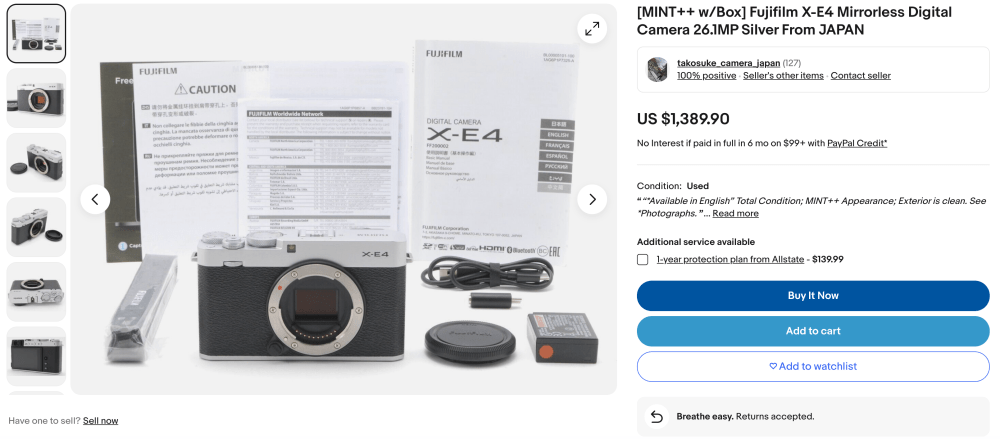
Another example is the Fujifilm X-E3 and X-E4 cameras. Fujifilm anticipated that demand for the X-E3 would be greater than it actually was, and made too many copies. Fujifilm had to discount the X-E3, and sometimes significantly, to clear the warehouse. You could still find brand-new (and discounted) X-E3 bodies 18 months after it had been officially discontinued. Fujifilm used the sales figures of the X-E3 to estimate the demand for the X-E4; however, the X-E4 was much more in-demand than the X-E3 was (largely because it was viewed as a top alternative to the impossible-to-find X100V in the aftermath of the viral videos). Fujifilm did not secure enough parts to manufacture nearly enough copies to meet the demand of the X-E4, and likely assumed (incorrectly) that the spike in demand would be short-lived. If you look at eBay, X-E4’s are listed for double the price of X-E3’s, and much higher than the MSRP when they were brand-new.

Low Sun over Tetons – Grand Teton NP, WY – Fujifilm X-E4 – Ferrania Solaris FG 400

I bring that up for a specific reason. While consumers prefer over-manufacturing (especially since it usually means one can find bargains, and you can readily buy what you want), producers prefer under-manufacturing. Most ideal is precise-manufacturing, but that is really difficult to achieve; between over and under, every company—including Fujifilm—would much prefer to err on the side of making too few of something than too much. And, if you want the gear that you spent a lot of money on to retain its value, you, too, will prefer them to err on the side of caution.

Toyota created the Toyota Production System in the aftermath of WWII. This system invented what is now referred to as Lean Manufacturing (or Lean Business Philosophy or Lean Strategy Process). Many books have been written on this topic—I have a few on my library shelf, although I’ve only actually read one. To understand Fujifilm’s approach to manufacturing and inventory means understanding the Lean approach, which is used worldwide, especially in Japan. This Harvard Business Review article gives a very brief synopsis of what the Lean strategy is, just to give you an idea; even better, I’m sure your local bookstore has a few books on this topic.

The conclusion is that Fujifilm (along with all manufacturers) is in the tough position of trying to accurately gauge demand for each product they offer, and attempt to produce just the right amount; if they are going to err on one side or the other, they much prefer to err by producing too few copies than too many. Making too many of something reduces its value, while making just the right amount or too few does not. They have to guess what the demand will be many months from now, not just what the current demand is. The current demand might be an indication of future demand, but it also might not. Fujifilm would love to make and sell 50,000 copies of something, but just because they make 50,000 copies of something doesn’t mean that they will actually sell them all. A much better position for Fujifilm is to make 30,00 copies of something, and sell them all. That’s not manipulating the market, but simply good business strategy that provides some stability in a turbulent market.

My Fujifilm X-E5 Wish List

The Fujifilm X-E4 is one of my absolute favorite Fujifilm cameras. There was a lot of demand for it, then, inexplicably, Fujifilm discontinued the X-E4 while there was still a fairly lengthy backorder list. According to Fujirumors, Fujifilm is working on the X-E5 right now, possibly to be released sometime in 2025. There’s a reasonable chance that Fujifilm will read this, so I thought I’d take the opportunity to express my wish-list for the camera.

The Fujifilm X-E1 was my gateway into the Fujifilm system. The camera, which was released in 2012 and was Fujifilm’s second interchangeable-lens X-series camera (only preceded by the X-Pro1), was praised for its beautiful retro rangefinder design (nicknamed “Sexy One”), but also criticized for its sluggish performance (some of which was rectified in firmware updates). The X-E1 was fairly quickly replaced by the X-E2, and a minor updated version called the X-E2s was released at the end of the X-Trans II lifecycle (beginning the pattern of X-E cameras released near the end of a sensor generation). While the X-E series has a history of somewhat slow sales, the cameras tend to be much beloved by those who own them. The X-E4 did not experience sluggish sales (in fact, Fujifilm was unable to meet the strong demand); however, it was discontinued anyway, presumably because Fujifilm did not secure enough parts to produce more.

I love the Fujifilm X-E4 because it is small and lightweight, which makes it more pleasant to carry around as an everyday camera. When traveling, there’s limited space for gear in the bag, and tough choices must be made; the X-E4 takes up less room than other bodies, so it’s more likely to be chosen over larger and heavier cameras. In fact, the X-E4 and X100V (and now X100VI) have been my go-to travel cameras since 2021. I also appreciate its clean minimalistic design of the camera.

Pacific Poppies – Montaña de Oro SP, CA – Fujifilm X-E4 – Pacific Blues Recipe

Fujifilm could simply engrave “X-E5” on the new camera and include the X-Processor 5, but keep everything else completely identical to the X-E4, and it would sell. If it ain’t broke, don’t fix it. People wanted the X-E4 but simply couldn’t get it. An X-E5 that is just an X-E4 with the new processor and the new film simulations would do quite well, I’m certain of it. The less Fujifilm changes, the better.

With that said, there are some things that would make the X-E5 even better than the X-E4. I do feel the minimalistic approach was perhaps a bit too minimalistic. The five key changes that I would make if I were one of the designers are: 1) bring back the M/C/S switch, 2) add an ISO Ring around the Shutter Knob like the X100 and X-Pro series have, 3) add back the rear command dial, 4) improve the EVF resolution, and 5) add a small grip to the front like the X-E3 has.

These might be unpopular opinions, but I would use the “old” 26mp X-Trans IV sensor in combination with the X-Trans V processor (like the X-S20); IBIS is unnecessary, and should be avoided for weight and cost reasons; the camera doesn’t need to be weather-sealed. Keep the X-E5 as similar to the X-E4 as possible, just refine it a little with a handful of small improvements.

Fujifilm X-E4 + Fujinon 27mm f/2.8 + Kodak Vision3 250D Recipe

There’s a massive opportunity that I believe Fujifilm has largely ignored. One of the biggest advantages of APS-C over full-frame is size/weight. There are tradeoffs with anything, and APS-C seems to strike a near perfect balance of size/weight, performance, image quality, and value. While full-frame cameras have been shrinking lately, APS-C has not; instead, the APS-C advantage has been shrinking. This is easily rectified, though, and the X-E5 is one step towards that, but it needs to be kept small, light, and affordable. The other key piece that’s missing are pancake lenses.

Yes, there’s the exceptional Fujinon XF 27mm f/2.8 R WR; however, it’s not often readily available for purchase. Likely, you have to add yourself to a backorder list and wait awhile. There’s also the sort-of pancake (Japanese pancake?) Fujinon XF 18mm f/2 R, but it is old, overpriced, and in desperate need of an update. Otherwise, there aren’t many options—at least not natively; however, there are some 3rd-party pancake lenses that have recently appeared, which is good. Fujifilm needs to add a few more pancakes to the Fujinon lineup, and not be satisfied with just two.

I think a total of five pancake lenses would do the trick. The 27mm f/2.8 already exists, but simply needs to be made available. The 18mm f/2 also already exists, although I would strongly encourage Fujifilm to update it. The three lenses that, in my opinion, Fujifilm should add to the pancake lens lineup are 15mm f/3.5, 23mm f/2.8, and 40mm f/2.8. That gives a good variety, and all five would together make for a fantastic kit.

Fujifilm X-E4 + Fujinon 18mm f/2 + Fujicolor Superia 800 Recipe

Since Fujifilm already has two 23mm lenses—the 23mm f/2 and 23mm f/1.4—they might consider something else that they don’t have, perhaps 20mm or 25mm, but definitely something in-between 18mm and 27mm. Instead of 40mm, a longer focal-length could alternatively be chosen, such as 45mm f/3.5 or 55mm f/4. The point is to have something wider than 18mm, something more telephoto than 27mm, and an option in-between the 18mm and 27mm.

A small and lightweight camera—such as the X-E5—combined with a handful of small lenses would make an ideal kit for travel and walk-around photography. It would clearly illustrate a significant advantage of APS-C over full-frame—imagine a camera and five-lens kit that could all fit into a small camera bag! I have no doubt that it would be successful, but it would require that Fujifilm clearly articulate why a small camera with small lenses should be desirable.

I don’t know if the “right” people at Fujifilm will read this, or, if they do, if they’ll listen. But, just in case, I wanted to make sure to get my opinions out there. Now it’s your turn! What would you like to see in a Fujifilm X-E5? What pancake lenses do you think that Fujifilm should make? Let me know in the comments!

Leica Q2 from the perspective of a Fujifilm photographer

Leica Q2

Leica is the camera brand that everyone desires, but few can afford. Premium is the word that best describes Leica. Crème de la crème, or perhaps Beste der Besten. If you can afford a Leica you buy a Leica, because every real photographer wants a Leica. It’s a status symbol, and it shows that you’ve arrived.

All of that is hyperbole, of course; however, there’s a good chance you’ve heard the sentiment before. An alternative yet similar statement is that Fujifilm is the poor man’s Leica. You only own a Fujifilm camera because you cannot afford a Leica model; if you could, you’d own a Leica instead.

I’ve wanted to try a Leica for some time now. The cameras are beautiful, there’s no question about it. But is it beauty over brawn? Are Leica cameras actually so good that the cost is justifiable? Would I—a long-time Fujifilm photographer—like a Leica enough to purchase one? Are Fujifilm cameras just cheap Leica knockoffs for those who cannot afford the real deal? Those are questions that I wanted to answer.

MPB is the sponsor of this article. They loaned me a Leica Q2 to try out for a couple of weeks. For those who don’t know, MPB is an online platform where you can buy, sell, or trade used photo and video gear. “At MPB, there’s something for everyone who wants to try something new, hone their skills, or pursue their passion—and it won’t cost the earth.” If you’re in the market for used camera gear, be sure to check out their platform—you can learn more about MPB here. Thank you, MPB, for making this article possible!

Leica Q2

For those who don’t know, the Leica Q2 is a premium compact fixed-lens 47mp full-frame camera. It is simultaneously somewhat similar to the Fujifilm X100VI, Fujifilm X-E4, and Fujifilm X70, yet significantly divergent from all of those models in several aspects. It has a 28mm f/1.7 lens that is fast and sharp. The camera was released in 2019, and discontinued last year when it was succeeded by the Q3. The original MSRP of the Q2 was $5,800; the current used price is roughly $4,500 to $3,800, depending on the condition. The specific Leica Q2 that I picked from the MPB platform was exactly as described: the camera functioned like it was brand-new; the body had only extremely minor signs of wear, which I was well aware of due to the gear-specific ‘cosmetic condition’ rating (“Excellent” in this case) displayed on the platform.

Something that I was unexpectedly impressed with was the Leica box. I know this sounds strange, but Leica is head and shoulders above the other brands when it comes to packaging. I’d pay a little more to have my Fujifilm cameras come in functional boxes similar to what the Q2 came in. Sometimes the little things can be big things.

I didn’t know a whole lot about the Leica Q2 before this project. I was quite surprised by just how minimalistic the Q2 is. In this regard it is more like the Fujifilm X-E4, which is Fujifilm’s most minimalistic model in recent years, but even more so. There are not very many buttons and controls on the body. For a camera that begs to be used fully manually, it is incomprehensibly missing an ISO dial; however, it is possible to use the unmarked knob on the top plate as an ISO dial by programming the button on top of it to activate ISO. That’s not ideal, but it is certainly better than digging through the menu. On one hand I do like the clean approach, but on the other hand I found it to be a bit too minimalistic for my liking.

There’s no doubt that the Leica Q2 is a beautifully designed camera that is solidly built. While the body is just a tad larger than the Fujifilm X100VI, the lens is significantly larger, and the whole thing is definitely heavier. It’s easy to understand why it would be compared to the X100VI, but the Q2 is a little more similar to the X-E4 (just with a fixed lens instead of interchangeable, and more ruggedly built). The Q2’s 28mm lens is roughly equivalent to 18mm on Fujifilm X cameras, so that’s where a comparison to the long-discontinued X70 comes in. Probably the closest lens in the Fujifilm lineup to that of the Q2 is the Fujinon 18mm f/1.4. Overall, I think the Leica Q2 is dissimilar enough to any Fujifilm model that it’s really apples-to-oranges, yet similar enough that the correlations are understandable.

The Leica Q2 is best when used with a RAW workflow. It’s ok for straight-out-of-camera photography, but definitely much more limited in that regard than Fujifilm. The JPEG image quality is good-but-not-great. There are five profiles—three color and two B&W—which can only be customized to a small extent. For color, Standard is somewhat reminiscent of the Provia film simulation, Vivid can be made to fairly closely resemble factory-default Velvia, and Natural is like a cross between Eterna and PRO Neg. Std. I didn’t care much for Standard, and opted for Vivid the most, and Natural a distant second. For B&W, the two profiles are quite similar to each other, and are much more reminiscent of Monochrome than Acros (on Fujifilm). The High Contrast option has stronger shadows, but is otherwise similar to the standard B&W profile; it can be hard to tell the two apart sometimes. Since I stopped editing RAW files years ago, I only used the camera-made JPEGs.

Two notable issues for using the camera for JPEG photography is that it quite obviously struggles with color banding, such as with clear blue sky, and there is some pronounced distortion from the wide-angle lens that the camera doesn’t fix for you. In some situations, simply adding faux grain might be enough to cover up the banding, but other times that won’t likely be enough. For the distortion, either you have to be ok with it, or you have to adjust it in-post, and, if you are doing that, you might as well just shoot RAW.

It was definitely fun to try out the Leica Q2. I can understand why people desire it, since the camera has a lovely retro design and a minimalism philosophy, two things that I personally appreciate. I think you have to know going into it that RAW editing is more-or-less essential. I’d love to see Fujifilm create a camera that could be more of an apples-to-apples comparison to the Q2, so that you could have a similar experience but paired with Fujifilm’s wonderful JPEG output; currently, no such camera exists.

The Leica Q2 is both beauty and brawn, but not nearly as much JPEG brawn as I had hoped for. I do find the price to be very difficult to justify; however, if it’s a camera that you really want—and you buy it used—it can probably be a worthwhile expenditure. I don’t intend to purchase one, personally, particularly since the JPEG output isn’t nearly as good as Fujifilm’s. While there are certainly some similarities between Leica and Fujifilm cameras, there are plenty of differences that produce notably divergent experiences. If the Leica Q2 experience is what you are after, you’ll just have to get the Q2.

Example photographs, all camera-made JPEGs captured with a Leica Q2:

Vivid
Vivid
Vivid
Vivid
Vivid
Vivid
Vivid
Vivid
Vivid
Vivid
Black & White High Contrast
Natural
Vivid
Vivid
Natural
Vivid
Vivid
Vivid
Natural
Natural
Standard
Vivid
Natural
Black & White
Black & White High Contrast

Previously in this series:
Fujifilm X-Pro2 — The camera that got away (again)
Fujifilm X-T50 + Fujinon 23mm F/2 = Interchangeable-Lens Fujifilm X100VI??

Up next: Fujifilm X30 — Fujifilm’s Forgotten Retro Compact Zoom

Thoughts on the Panasonic Lumix S9

Panasonic just announced a new camera: Lumix S9. I’ve never touched or seen the Panasonic Lumix S9 in person. I’ve only seen reviews of it, such as the Chris Niccolls writeup on PetaPixel. I have a few quick thoughts that I want to share with you, before returning to the regularly scheduled programming.

Many years ago I used to own a Panasonic camera, but only briefly, because I didn’t care for it. It was one of their low-budget models, so maybe if I had something higher-end I would have liked it better. I’m sure I would think much differently about the S9; however, I don’t have much of a personal interest in the brand. If they ceased making cameras, I probably wouldn’t even notice. The S9 only crossed my radar because I might be the reason that it exists.

I captured this on a Panasonic in 2016

The Lumix S9 is specifically intended to appeal to those waiting for a Fujifilm X100VI, but are on a really long waitlist. There’s a vague retro rangefinder styling that might from a distance look similar to the Fujifilm X-E4. It has a 24mp full-frame sensor. More interestingly, it has LUTs, a LUT button, and a LUT app. Panasonic intended this camera for those who want straight-out-of-camera film-like results. We’ll get to that in just a moment.

There are some serious design issues that make the camera a compromise. I think they wanted it to be in a certain size and price point to appeal to potential Fujifilm customers, but they had to strip it down in order to do so. There’s no viewfinder—optical or electronic—which means you’ll have to compose everything on the LCD. That’s ok sometimes—Ricoh GR cameras are that way—but it’s definitely not ideal. There’s no grip—not even a small one—which is ok if the lens is small and lightweight, but not for most of the lenses available for the camera. You won’t find a joystick. Most severely, the S9 doesn’t have a mechanical shutter, so it isn’t a good option for artificial light or quickly moving objects. I don’t like the PASM mode dial, and wish it had retro controls.

The Fujifilm X-A3 was the X-A5’s predecessor, but quite similar overall

Like I said, I have not seen or touched the S9 in person, but it seems like a full-frame version of the Fujifilm X-A5; however, it has IBIS, while the X-A5 doesn’t. Still, there are enough similarities that, in my opinion, the X-A5 is the model people should be focusing their comparisons towards, and not the X100VI. Between the X-A5 and the S9, the S9 wins, but you can buy the old Fujifilm for less than $500, while the S9 will cost you $1,500.

Now back to the LUTs, perhaps the defining feature of the Lumix S9. Those who edit videos are probably quite familiar with LUTs; however, it’s not nearly as well-known or well-understood in the still photography world (and it’s not the same as a film simulation, either). LUTs are presets that overlay (preferably flat) videos or images. Let’s say you captured a photograph using the Eterna film simulation with Highlight, Shadow, and Color all set to -4, then later added a filter to that JPEG to add in contrast and color—that’s what a LUT does. The S9 has the ability to store and apply LUTs to both videos and still photographs in-camera.

Best Burger Shack – Tannersville, NY – Fujifilm X-T50 – Pacific Blues Recipe

This isn’t a new feature for Panasonic, but what is new is that the LUTs can now be added to the camera wirelessly via an app (Fujifilm should do this with Recipes). There’s a library of LUTs available on the app, plus you can create your own. A button on the camera activates the on-camera LUT library. This is a bold move by Panasonic, one that takes direct aim at Fujifilm, and is intended to lure potential (or maybe even current) Fujifilm customers. They want a Recipe-like movement for their own brand.

There are a few reasons why, in my opinion, it won’t catch on. First, the S9 is too stripped down to be taken seriously. Sure, people will buy it, but it won’t be a trendy camera. Second, “LUT” is far less imaginative and romantic than “film simulation”—aside from that, Panasonic doesn’t have the vast experience manufacturing analog emulsions like Fujifilm does. Third, creating your own Film Simulation Recipe is far less complicated (but can still be complicated) than creating your own LUT. Fourth, there are more Recipes available for Fujifilm cameras than there are LUTs available for Panasonic.

Yellow Cab – New York City, NY – Fujifilm X100VI – Vintage Vibes Recipe

With all of that said, I think it’s great that Panasonic is trying this out. More and more, photographers are relying on camera-made JPEGs, and are editing less and less. I think that’s wonderful! The stigma of “you must shoot RAW; only amateurs use JPEGs” is rightfully melting away. I think it’s only a matter of time before camera companies team up with RNI, Alien Skin, VSCO, etc., and offer film-like presets in-camera. Fujifilm has a film heritage that allowed them to build it from the ground up and achieve convincing results. They’re pioneers and leaders in all this, and now it’s catching on.

However—and I had a conversation with someone about this today—would film simulations be the big deal that they are today if not for Fuji X Weekly and Film Simulation Recipes? Would the Panasonic Lumix S9 exist without this community? Probably not. That’s an incredible honor! It goes to show that there’s something to all this—a rising tide that is affecting all of photography, and not just those with X-series models. It will definitely be interesting to see what happens in the next few years: with Fujifilm, Panansonic, and all the other brands who are sure to try their own take on film simulations and Recipes.

Free Fuji X Weekly Photowalk in Scottsdale

Join me on a free Fujifilm-centric photowalk on Sunday, May 5th, in Old Town Scottsdale, Arizona, at 5:30 PM. Explore the blending of modern cosmopolitan with off-beat western heritage through pictures. There will be the potential for street/urban, architecture, automobile, and landscape photography. It will be an opportunity to meet fellow Fujifilm photographers, and to chat about Fujifilm gear, film simulations, and Film Simulation Recipes.

Mark your calendars now! More details coming soon, so stay tuned.

My Fujifilm Camera Recommendations

Fujifilm X100VI

Recently, a lot of people have asked me which Fujifilm cameras do I recommend. Should they buy an X100VI? X-T5? X-H2? X-S20? You get the idea. This is an impossible question for me to answer because it is personal; what I might like in a camera you might dislike, as each person’s needs, experiences, and priorities are different. Still, I’ll try to give some thoughtful answers.

To make this even more challenging, some Fujifilm cameras are difficult to get. As the saying goes, a bird in the hand is worth two in the bush. Should you patiently wait for the Fujifilm X100VI? Or should you get an X-T30 II or X-T5 instead? I cannot tell you what you should or shouldn’t do, I can only offer my opinions, which should be taken with a grain of salt.

I learned photography during the film era, and used full-manual cameras for many years. Because of this, PASM mode-dial cameras never made sense to me and were always an awkward experience. Fujifilm’s retro designs and tactile controls are like home to me. For this reason, I’m not personally a big fan of the Fujifilm’s models that trade those for mode dials, such as the X-S10, X-S20, X-H2, and X-H2s. This is not to say that those are bad cameras (because they’re not), only that they’re not for me—you might, in fact, love them very much.

This article is specifically about new cameras, and not models that have been discontinued and are now only available used. I might make a part two that covers used models; there are so many to choose from, that’s a different beast altogether. For the sake of simplicity, I’m just talking about what is currently available brand-new.

Now, let’s get to it!

This post contains affiliate links, and if you make a purchase using my links I’ll be compensated a small amount for it.

Best Overall: Fujifilm X-T5

Whether you are a photographer, videographer, or both, the Fujifilm X-T5 is the top allrounder. It’s Fujifilm’s most premium model with retro tactile controls. It has a 40mp X-Trans V sensor, IBIS, weather-sealing, dual-card slots—just excellent specs. There’s so much to love about this camera, but no camera is perfect; however, this is in my opinion the closest to perfect among the current interchangeable-lens options. I’ve been using mine for about a year-and-a-half now, and still really enjoying it.

Fujifilm X-T5 in black:
AmazonB&HMomentWexNuzira
Fujifilm X-T5 in silver:
AmazonB&HMomentWexNuzira

Best Budget: Fujifilm X-T30 II

The Fujifilm X-T30 II is currently Fujifilm’s most entry-level model, but don’t be fooled: this camera is highly capable. It has a 26mp X-Trans IV sensor, which is my personal favorite Fujifilm sensor generation. It’s not as feature rich as other models—it doesn’t have IBIS, weather-sealing, or dual-card slots—but it is more than good enough for most people, especially if you plan to use it more for still photography than video. The X-T30 II can sometimes be difficult to find—it was purportedly discontinued at one point, but new copies seem to appear now and then. If you have less than $1,000 to spend, the X-T30 II is definitely your best bet.

Fujifilm X-T30 II in black:
AmazonB&HMomentWexNuzira
Fujifilm X-T30 II in silver:
AmazonB&HMomentWexNuzira

Most Fun: Fujifilm X100VI

The Fujifilm X100VI is the camera that everyone wants but few can actually get. It’s the wildly successful successor to the X100V, which was also hard to find after it became a social-media sensation two-and-a-half years after it was initially released. The X100VI has a 40mp X-Trans V sensor, IBIS, and is (for the most part) weather-sealed. It has great stats; most importantly, it’s a lot of fun to use. The fixed lens, leaf shutter, built-in ND filter, and relatively compact size make it a joy to use. My wife gifted me an X100V for my birthday four years ago; just three weeks ago my X100VI arrived in the mail—these are my desert island cameras, and if I could only have one for the rest of my life, I’d be quite happy with either one of them. If you can get one, in my opinion it’s worth doing so; however, they’re definitely not for everyone, so only you can determine if you’ll appreciate it or not. Aside from that, the X100VI is not easy to get, and you might have to wait awhile for one to become available.

Fujifilm X100VI in black:
AmazonB&HMomentWexNuzira
Fujifilm X100VI in silver:
AmazonB&HMomentWexNuzira

Fujifilm X100VI craze is HUGE — “Biggest launch we’ve ever seen”

It’s been a whirlwind ever since Fujifilm announced the X100VI, the much-anticipated successor to the much-desired-but-hard-to-find X100V. According to Fujirumors, the X100VI has had the most preorders of any other Fujifilm camera ever. According to Sonyalpharumors, the new Fujifilm camera has 50 times more preorders than the Sony A7cII and Sony A7cR combined. Amateur Photographer states that the Fujifilm X100VI breaks all records as sales are off the charts.” There are a couple of quotes within that article that are worth sharing:

“This is the most successful launch we’ve ever had,” a Fujifilm manager in the U.K. stated. “I’ve never seen anything like it.”

“The response has been unprecedented,” said Wex (the largest camera chain in the U.K.). “We have seen a huge surge in initial demand and are now on course to break all records for Wex.”

I decided to do my own sleuthing. I contacted several big camera stores, as well as a couple small local stores, and asked them about X100VI preorders. One of the big stores told me that they didn’t want to talk specifics, but that demand has been extremely high; there will be a delay in fulfilling all of the preorders, but they don’t know how long that delay will be—could be weeks, could be months.

Another big store was much more open. “We’ve never seen anything like this,” they told me. “Probably 10 to 12 times the next biggest launch we’ve ever seen.” One store’s waitlist is currently a little over two-years long (yes, two years already!), but they’re hoping that Fujifilm will increase delivery of units to them, so they can cut that time down from years to months. They also told me that Fujifilm will be shipping cameras to them on a weekly basis. If you’re not in the first batch, if you’re high on the list, you might only have to wait another week or two to receive yours.

Gated Camera Store – Phoenix, AZ – Fujifilm X100V – Fujicolor 100 Gold

The local stores are in a similar boat. While their waitlists have far fewer people on them, they also expect to receive far fewer copies of the camera, so it could be months before they are able to fulfill the current preorders.

“We are seeing the pent up demand from the previous model transform into strong commitment from existing customers, as well as huge levels of excitement and intrigued from new,” Wex explained in the Amateur Photographer article. In that same piece, Park Cameras gave this advice: “The sooner you get your preorder in, the sooner you’ll get your camera.”

If you weren’t super quick to preorder, you’ll likely have some wait before your’s arrives, and possibly a long wait; however, in time all of the preorders will be fulfilled. You might need to be extra patient. Just know that everyone—the camera stores and Fujifilm—are working extra hard to make sure you get it as quickly as possible. If you have yet to preorder but you’d like to, the quicker that you do so the faster the camera will be in your hands; however, be prepared that you might not get it for many months.

Where should you buy yours from? Personally, I’ve purchased gear from local stores, Amazon, B&H, Adorama, Moment, and I’m sure others. Of all of those, Moment is my personal favorite. They’re a pretty cool company, and they’re fans of Fuji X Weekly.

See also:
The Connection Between Fuji X Weekly & the New Fujifilm X100VI
Why Shooting JPEGs Is So Popular (& 10 Fujifilm Simulation Recipes!)

This post contains affiliate links, and if you make a purchase using my links I’ll be compensated a small amount for it.

Fujifilm X100VI in black: AmazonB&HMomentWex
Fujifilm X100VI in silver: AmazonB&HMomentWex

New: Kodak Retina retro-style digital mirrorless camera!!

Introducing the brand-new Kodak Retina digital mirrorless camera! Inside this retro-styled body is a 40-megapixel APS-C BSI CMOS sensor. It has eight built-in presets that mimic classic Kodak film stocks. The pictures from the Kodak Retina look great straight-out-of-camera, no editing needed! This new camera is bold yet beautiful; classic yet modern; digital yet analog.

I was given a pre-production copy of the Kodak Retina camera to try out, and used that as an excuse to visit the majestic Grand Canyon in northern Arizona! I recorded the experience, which I just published to my YouTube channel. The video is my review of the new camera, plus an epic adventure by train to one of the natural wonders of the world. I’ve included it below—you don’t want to miss this one!

The Kodak Retina

Top view of the Kodak Retina

Below are example pictures that I captured on this trip using the eight built-in presets included in the Kodak Retina:

Kodachrome 64

Kodak Retina + Kodachrome 64

Portra 160

Kodak Retina + Portra 160

Portra 400

Kodak Retina + Portra 400

Gold 200

Kodak Retina + Gold 200

Ultramax 400

Kodak Retina + Ultramax 400

Ektachrome E100VS

Kodak Retina + Ektachrome E100VS

Vision3 250D

Kodak Retina + Vision3 250D

Tri-X 400

Kodak Retina + Tri-X 400

At this point, I’m sure you’re already aware that there’s no such thing as a Kodak Retina digital camera. Kodak made Retina film cameras from the 1930’s up to 1970. While Kodak pretty much invented the digital camera, and were an important early innovator of the technology, they never made an interchangeable lens APS-C model. They did produce some full-frame DSLRs in the very early 2000’s, and made an APS-C back for a Nikon SLR in the late 1990’s, and even sold a Micro-Four-Thirds interchangeable-lens mirrorless in 2014 (manufactured by JK Imagining under the Kodak brand name); however, nothing remotely like my faux digital Retina was ever produced by Kodak. This was all just for fun—sorry if I got your hopes up.

The camera is actually a Fujifilm X-T5. That might have been obvious to you. I put some silver tape over the Fujifilm logo, and added a Kodak decal. If you look closely, you can tell that I did that. The lens is a TTArtisan 27mm f/2.8 in their limited edition yellow/orange color scheme, which is very Kodak-like; the lens is actually what inspired me to do this project. The camera strap is something I’ve owned for years now, and a red soft-shutter-release completed the look.

The pictures that I captured with this camera/lens combo are straight-out-of-camera JPEGs using eight of my Film Simulation Recipes:

I chose those particular Recipes because they mimic popular Kodak emulsions, which seemed appropriate since the X-T5 was disguised as a Kodak camera. You can find them—and over 300 more—in the Fuji X Weekly App, available for Android and Apple. Consider becoming a Patron subscriber to unlock the best App experience and to support Fuji X Weekly.

My thoughts with this camera were: what if, 15 years ago, Kodak had pivoted, and began making retro-styled mirrorless cameras with built-in film emulation presets? How much different would the industry look like today if they had? While Kodak didn’t pivot, Fujifilm did. Instead of a digital Retina, we have the X-T5. You don’t need Kodak to make this camera, because it already exists. The X-T5 (or any other Fujifilm model), combined with my Film Simulation Recipes, will do what I proposed a digital Kodak Retina would do. Fujifilm is doing what Kodak should have done but didn’t.

Now it’s your turn! What do you think of this project? How much different would the camera industry look today if a digital Kodak Retina actually existed? Let me know your thoughts in the comments!

This post contains affiliate links, and if you make a purchase using my links I’ll be compensated a small amount for it.

Fujifilm X-T5 in black:  Amazon  B&H  Moment
Fujifilm X-T5 in silver:  Amazon  B&H  Moment
TTArtisan 27mm f/2.8 in black: Amazon
TTArtsian 27mm f/2.8 in yellow/orange: Amazon

See also:
My Experience Obtaining a Permit to Film in a National Park
The History & Poetry of Kodachrome

I’m a Fujifilm Fanboy (…but my opinions should still be valid)

I enrolled in Photography 101 in college 12 years before Fujifilm introduced the original X100. I say this because I’m often accused of being a Fujifilm fanboy, which is meant to be a put-down to insinuate that my opinions are too biased to be trusted. But should I be so easily dismissed just because I really like Fujifilm cameras?

First, I am a proud Fujifilm fanboy, but that should not automatically invalidate my opinions; instead, it should only point towards my perspective. My photography journey began with full-manual film cameras by Canon and Pentax. Two years prior to the release of the X100, I first dabbled in digital photography. I owned cameras by Pentax, Samsung (remember when they made APS-C mirrorless cameras?), Sigma, Nikon, and Sony. Then, in 2016, I purchased a four-year-old Fujifilm X-E1, and my world changed. I found what I had been looking for ever since first trying digital. In an instant I became a Fujifilm fanboy, and my appreciation of Fujifilm brand cameras has only grown stronger since.

Shot on a Ricoh GR III

But, that doesn’t mean I’m not interested in other brands. I have two Ricoh GR cameras, for example. I also own a Nikon Zfc, although I rarely use it. I tried out a Canon EOS 5DS R a couple of years ago. More recently, I had the opportunity to use a Sony A7 IV fairly extensively. I have nothing against Canikony brands, but the more I use them, the more I’m convinced that they’re not for me.

Vocalizing my displeasure with brands that don’t have “film” in the name, and simultaneously stating why I love one particular brand, has caused some to suggest that my opinions are invalid. To be clear: my opinions are nothing more than my opinions, and they stem from my perspective. I was a long-time film photographer who exclusively used full-manual cameras for over a decade, was constantly frustrated with the digital models I used until I found Fujifilm, and I discovered along the way that I dislike editing RAW files—I much prefer camera-made JPEGs, as long as the camera can make those look good. That’s my perspective, and it is something that you may or may not relate to. If you cannot relate to it, then take my opinions with a grain of salt because they’re likely to be different from yours; however, that doesn’t mean that they’re invalid opinions.

Shot on a Nikon Zfc

I got heavily criticized when I stated that Nikon’s venture into retro-styled cameras fell short. Nikon didn’t have the courage to do what they should have done, and made compromises instead. From my perspective that much is clear, but I understand that if your perspective is different from mine you might have divergent conclusions, which is great—the world would be a boring place if we all thought exactly alike. For someone like me, the Fujifilm X-T5 beats the Nikon Zf, no question about it; for someone else, the Zf might be declared the winner for one reason or another. With cameras like the Zf and Zfc, I think Nikon has the potential to be great in my eyes, but those models have some significant shortcomings that need to be overcome first.

I was pretty unimpressed by the Canon EOS 5DS R when I used it. Perhaps that’s because I’m spoiled by the advantages of mirrorless, and using a DSLR was like stepping back in time (and not in a good way). While the camera-made JPEGs had nice colors, they were prone to banding and issues like that, the dynamic range and high-ISO performance was kind of disappointing, and the adjustment options were somewhat limiting. Maybe I’d like the newest models better, but not much about the 5DS R made me curious to try.

Shot on a Canon EOS 5DS R

Not a lot of people know that I used a Sony A7 IV camera somewhat extensively earlier this year. A number of friends and family members suggested that I should try it, plus all sorts of people complained to me that Fujifilm should be more like Sony (and, sadly, Fujifilm seems to be trying…). The opportunity presented itself, so I gave it an honest go. I even thought that if all went well, I might make Sony Recipes. But it didn’t go well. Using Sony cameras—or, at least the A7 IV—is such an uninspiring experience. Yeah, it will get the job done, but nothing about it is exciting to me. Technically great—yes; however, not in a form that makes me want to pick up the camera and shoot. Overall, the JPEG colors were disappointing, except for the “FL” (a.k.a. Film Look) creative look (their version of a film simulation), which actually is pretty darn good. I did like the ability to fade the blacks, and I did think that clipped highlights fall off nicely (as far as digital cameras go), but I did not like the proneness to banding. Sony’s JPEGs just aren’t at the same level as Fujifilm’s, but they definitely have some potential if Sony keeps working at it; however, the camera itself is boring.

But, but, but… autofocus! Fujifilm’s is awful, and Canikony is great! That’s what people say, but I don’t have any issues with Fujifilm’s autofocus, nor did I find any of the Canikony’s I used to be notably superior. Perhaps this is because I started photography with manual focus, and even though autofocus existed, it wasn’t very good back then. It’s improved by leaps and bounds over the years, and is quite reliable nowadays from every brand, including Fujifilm. If you take issue with this, ask yourself this question: why were photographers and cinematographers back then with inferior gear able to do so much more than you today with superior equipment? The answer, of course, is that the problem is not the gear, and has never been. But, you know, it’s easier to blame the gear than to learn new skills that don’t require the gear to be super amazingly great in order to get your desired results. And that’s how I would summarize this point: Fujifilm’s autofocus is amazingly great, and Canikony’s is, perhaps, super amazingly great. Those who put it down are ignoring the fact that it is still amazingly great.

Shot on a Sony A7 IV

This article concludes similarly to how it began: I love Fujifilm cameras! The X100V is my favorite, followed by the X-E4, then the X-T5, which I’ve been shooting with for a year now. Those three cameras are the ones that, by far, I use the most. I also enjoy shooting with my Ricoh GR III. And I use my iPhone often for casual shooting. That’s what works for me, which very well might be different from what works for you, and that’s perfectly ok. All of us have different experiences that give is divergent perspectives. If your perspective is similar to mine, you likely will appreciate my opinions, but if not, you probably will disagree. I’m a Fujifilm fanboy—perhaps one of the biggest that there is—but I’m not strictly a Fujifilm photographer, as I have a long history using all sorts of different brands, including the ones that I criticize sometimes. Heck, I’m even critical of Fujifilm occasionally—including in this very article—but Fujifilm is, by far, my favorite camera brand of them all.

This post contains affiliate links, and if you make a purchase using my links I’ll be compensated a small amount for it.

Fujifilm X100V in black:  Amazon   B&H  Moment
Fujifilm X100V in silver: Amazon   B&H  Moment
Fujifilm X-T5 in black:  Amazon  B&H  Moment
Fujifilm X-T5 in silver:  Amazon  B&H  Moment
Fujifilm X-E4 in black:  Amazon   B&H  Moment
Fujifilm X-E4 in silver:  Amazon   B&H  Moment
Ricoh GR III:  Amazon  B&H  Moment
Ricoh GR IIIx:  Amazon  B&H  Moment
Nikon Zfc:  Amazon   B&H
Nikon Zf:  Amazon   B&H
Sony A7 IV:  Amazon  B&H

Some Current Camera Deals for Christmas

With Christmas just 10 days away, you might be looking for some last-minute camera deals as a gift to yourself or a photographer (or budding photographer) in your family. This website is all about Fujifilm, and for the most part there haven’t been a lot of Fujifilm deals. There hasn’t been a lot for me to recommend to you. You can always pay full price for gear, but you don’t need me to point that out—the service that I’d rather offer is showing where you can save some money. So let’s get into that.

This post contains affiliate links, and if you make a purchase using my links I’ll be compensated a small amount for it.

Fujifilm GFX100S — $1,600 off — AmazonB&H

Fujifilm X-H2s with MKX 18-55mm — $1,200 off — B&H

Fujifilm X-H2s with MKX 50-135mm — $1,200 off — B&H

Fujifilm GFX50S II — $1,000 off — AmazonB&H

Fujifilm X-H2s with 150-600mm — $600 off — Amazon

GF 110mm — $550 off — AmazonB&H

Fujinon 200mm — $500 off — AmazonB&H

GF 32-64mm — $450 off — AmazonB&H

GF 45-100mm — $450 off — AmazonB&H

GF 80mm — $450 off — AmazonB&H

GF 100-200mm — $400 off — AmazonB&H

Fujinon 150-600mm — $400 off — AmazonB&H

Fujinon 100-400mm — $400 off — AmazonB&H

Fujinon 50mm — $300 off — AmazonB&H

Fujinon 8-16mm — $200 off — AmazonB&H

Fujinon 18-120mm — $200 off — AmazonB&H

Fujifilm X-H2s — $200 off — AmazonB&H

Fujifilm X-H2 — $150 off — AmazonB&H

Fujinon 50-140mm — $150 off — AmazonB&H

Fujifilm X-S10 — $100 off — AmazonB&HMoment

Fujinon 16-55mm — $100 off — AmazonB&H

Fujinon 16mm — $100 off — AmazonB&H

Fujinon 56mm — $100 off — AmazonB&H

Fujinon 80mm — $100 off — AmazonB&H

Fujinon 90mm — $100 off — AmazonB&H

It’s a really good time to get into GFX if you’ve been thinking about it, as that’s where the best discounts are. The 50mm f/1 lens is $300 off, and that’s the most intriguing bargain to me, personally. The 90mm f/2 is one of my favorite lenses; while the discount is only $100, it is on sale, and it’s an easy one for me to recommend. If you’ve thought about doing some serious cinematography with Fujifilm, the X-H2s bundled with the cinema lenses are significantly discounted. Otherwise, the deals are pretty pedestrian right now.

New Ricoh GR III / GR IIIx Recipes!

Ricoh GR III + Vibrant Nostalgia Recipe

For those of you with a Ricoh GR III or GR IIIx camera, I just published a new collection of Recipes over at Ritchie’s Ricoh Recipes, called The Analog Collection. There are six new Recipes, so if you have a GR III or GR IIIx, be sure to check it out now! Also, be sure to download the Ricoh Recipes App if you haven’t yet done so.

Since this is a Fujifilm blog, I don’t want to take up too much of your time with this, so if you are interested in learning more, simply click here. For the rest of you, I hope that you enjoy viewing the handful of example pictures in this short article.

Ricoh GR III + Positive Film Recipe
Ricoh GR III + Reggie’s Color Negative Recipe
Ricoh GR III + EktaColor Recipe
Ricoh GR III + Vibrant Nostalgia Recipe
Ricoh GR III + B&W Film Recipe
Ricoh GR III + Kodak Summer Recipe

This post contains affiliate links, and if you make a purchase using my links I’ll be compensated a small amount for it.

Ricoh GR III  Amazon  B&H  Moment
Ricoh GR IIIx  Amazon  B&H  Moment

My Fujifilm X-E5 Wish List

What should a Fujifilm X-E5 look like? What features would I like it to have?

I’m not convinced that Fujifilm will ever make an X-E5, as they’ve indicated that they might not, but if they do, it’s likely that they will begin working on it soon, at least preliminarily. If Fujifilm does make an X-E5, I think spring 2025 is a likely timeframe for its release. Just to be clear, I have zero inside information, and can only speculate. Just in case Fujifilm does begin to work on an X-E5 soon, I thought it would be worthwhile to tell them what I’d like it to be like. Of course, there’s a pretty good chance that they’ll never read this—I don’t believe that Fuji X Weekly is on their list of websites to regularly visit—so this might be for nothing. Optimistically, let’s assume that Fujifilm will read this article, and maybe they’ll even take my ideas into consideration.

Before I get into it, I want to argue why Fujifilm should make an X-E5. I understand why they don’t want to: Fujifilm believes that the market segment that the X-E line is in is shrinking, and will soon be dried up. Fujifilm made a decision to pivot, focusing more on higher-end gear, and less on lower-end gear. While the X-E line has never been considered an “entry-level” product by users, as the tier below it disappeared, it became the default entry-level camera for Fujifilm, since it is the cheapest model. Historically, the X-E line has had somewhat sluggish sales, and often comes out at the tail end of a sensor generation. The X-E3, for example, could still be purchased brand-new at a discount just two years ago; however, the X-E4 sold surprisingly well during its short time, especially towards the end.

Pacific Poppies – Montaña de Oro SP, CA – Fujifilm X-E4 – Pacific Blues Recipe

Inexplicably, Fujifilm discontinued the X-E4 while demand was high—so high, it exceeding Fujifilm’s ability to manufacture them, which caused a backorder list that was months long. Because Fujifilm discontinued the X-E4 while demand was high but supply was low, used models are now selling for ridiculous prices. I’m sure Fujifilm had a good reason for axing the camera—GxAce would say that it was a casualty of the global chip shortage of the early ’20’s—but it left a pretty significant market void. I’m surprised that Fujifilm let it slip through their fingers, but I’m sure it was simply a case of limited resources, and making more X-E4 bodies was less of a priority than other things.

The reason why Fujifilm should make an X-E5 and not let the X-E line die is because there is market demand for it right now. Three years ago, you could buy an X-T30, X-E3, X-T200, or X-A7. If you had a smaller budget or wanted a compact body for travel, you had those four options. Now, there’s only two: the often-out-of-stock X-T30 II or the X-S10. The X-S series is kind of in a different category with a divergent design from most of Fujifilm’s past models; while Fujifilm has marketed the X-S20 as their ideal travel camera, it is a bit on the heavy side for that, plus is more expensive, and not really in the entry-level price range. Currently, for those wanting something under $1,000, or something that’s especially compact and lightweight, you don’t have much to choose from. This is by design, and mainly because the bottom-end market isn’t as big as it was five years ago.

If Fujifilm made an X-E5, there would be demand for it, but (as they say) time is of the essence. The longer Fujifilm dillydallies, the less excitement their might be. You have to strike while the iron is hot, and the iron is hot right now. Will it still be hot two years from now? I have no idea. The safer move would be to simply un-retire the X-E4 and manufacture more copies of it. I don’t think that will happen, so let’s focus on the X-E5.

Working – Salt Lake City, UT – Fujifilm X-E4 – Kodak Vision3 250D Recipe

My ideal X-E camera wouldn’t be all that much different from the X-E4. I love my Fujifilm X-E4, but I know not everyone was excited about it. Some say that it was a step backwards from the X-E3 because Fujifilm went minimalistic with it—a little too minimalistic. For the X-E5, a few simply changes and improvements would make it better. Some people will say that it must have IBIS, but that would make it bigger, heavier, and more expensive. Fujifilm would have to carefully consider if it would be worthwhile to do that. If they added IBIS plus weather-sealing, they could increase the cost and make the line more mid-tier. That’s one option, but that’s not what I would suggest, personally. I would only make a handful of changes to the X-E4, and engrave a 5 on the front instead of a 4. Here are my X-E5 suggestions:

  • Reinstate the M/C/S switch.
  • Put an ISO ring around the Shutter knob like the X100V has.
  • Reinstate a rear command dial.
  • Make the rear screen three-way-tilting like the X-T5.
  • Improve the OVF, perhaps a little bigger and higher resolution.
  • Use the current sensor with the new X-Trans V processor like the X-S20.
  • Add a small grip to the front similar to the X100V.
  • Consider using rounded strap eyelets instead of rectangular.

That’s it! Super simple. There’s no need to reinvent the wheel. That would be a really nice refresh that I think a lot of people would appreciate. That would keep the cost low and the camera small and lightweight.

Reflection of a Broken Door – Litchfield Park, AZ – Fujifilm X-E4 – Fujicolor 100 Gold Recipe

It would be really smart for Fujifilm to update the 18mm f/2 lens, which is long-overdue for a refresh, and introduce a new pancake option: perhaps a 23mm f/2.8 or 40mm f/2.8. They could offer a few different bundle options: the upcoming 16-50mm f/2.8-4.8, the updated 18mm f/2, a new pancake (whatever they decide to go with), the 27mm f/2.8, or all three pancake lenses. The X-E line just begs to be used with pancake lenses, which really illustrates the benefit of APS-C, but sadly Fujifilm only has two. I bet that three pancake lenses bundled with the X-E5 would be a popular option, especially if a few influencers were to demonstrate just how great that would be for a travel photography kit.

Which brings me to the marketing angle. What makes Fujifilm cameras great? What is the essence of shooting with the X series? Hint: it’s what makes the X100V so popular. In my opinion, Fujifilm has done a rather poor job of expressing this and particularly communicating why it should be desirable (maybe they don’t understand it themselves?). Largely, it has come from outside sources—TikTokers, Instagramers, YouTubers… heck, I’ll take a little credit for it myself—who have done Fujifilm’s marketing job for them. The X-E5 (as I suggest the camera should be) would be the quintessence of many aspects of this: cool-yet-functional vintage styling, great implementation of exposure-triangle controls, small and lightweight, and of course out-of-camera JPEGs that look great. Fujifilm needs to focus on that. They need to communicate why the X-E5 fulfills (in many ways) the essence of shooting with the X series, and why that essence is desirable for photographers. Yes, social media influencers and bloggers will do some of that for Fujifilm, and that’s great organic promotion, but Fujifilm themselves needs to do a much better job than they have in the past. If done right, the X-E5 could be a smashing success in spite of shrinking market segments.

Will Fujifilm make an X-E5? Maybe, maybe not. I’d lean towards no if I had to pick one over the other. Should they? Absolutely yes! It would be a real shame for Fujifilm to kill the line when there is so much demand for it. I love the X-E series—the X-E1 was my introduction to Fujifilm—and it deserves to continue. I hope that it does.

The Fujifilm X-E4 is INSANELY expensive right now!!

The cost of a second-hand Fujifilm X-E4 is completely out of hand!

Before we get to that, let’s rewind this all a bit. Fujifilm released the X-E4 in late-February 2021. I preordered my copy, which arrived in early March. The X-E4 was the fifth in the X-E line, which began in 2012 with the X-E1, Fujifilm’s second interchangeable-lens X-series model (the X-Pro1 was the first). The X-E2 came out only one year later, and the nearly identical X-E2s was released three years after that. The X-E3 was released in 2017, and rumors floated around that it might be the last X-E camera.

The X-E line is much beloved by those who own them. It’s a combination of beautiful rangefinder styling, diminutive size, simplicity, and affordability, while producing images that are equally as good as the bigger and more expensive models. But sales have always been so-so. The X-E3, in particular, was a slow-mover, and it was possible to buy a brand-new copy for less than MSRP as recently as last year. Two years ago the X-E3 was on sale for $560. This is to say that the X-E line is niche, even within Fujifilm, which is itself sort of a niche brand; however, it’s a much loved series by many who have had the pleasure to use them. The X-E1 was my gateway into Fujifilm; today the X-E4 is my second-favorite camera, only behind the X100V.

Two Caballeros – Culleoka, TX – Fujifilm X-E4 & Fujinon 27mm f/2.8 – Kodachrome 64

With the X-E3 not moving particularly quickly, Fujifilm seriously considered discontinuing the X-E line. But with the discontinuation of the low-budget X-A and X-T000 cameras, plus a vocal outcry from their customers, I believe Fujifilm had a change of heart, so the X-E4, with its minimalistic design, was born. However, between the global parts shortage and the expected so-so sales, Fujifilm didn’t produce as many copies as other cameras. My guess is that they were concerned that unsold boxes of the X-E4 would be sitting around for years like with the X-E3 (and, to an extent, the X-E2s before that, and the X-E2 before that, and the X-E1 before that), so Fujifilm made the decision to discontinue the X-E4, and divert manufacturing resources to other cameras, like the X100V, X-T5, and X-S20.

What Fujifilm did not anticipate is that the sudden success of the X100V—thanks to social media and Film Simulation Recipes (to a degree)—would spill over to the X-E4. Since it became so hard to get a copy of the X100V, and new orders were being placed faster than Fujifilm could manufacture the camera—with backorder lists six months long—people began to look for alternatives. The X-E4, especially paired with the 27mm pancake, was a top alternative suggested for those who wanted an X100V but couldn’t get one. The X-E4, which was already hit-or-miss to find, was now sold out everywhere, and Fujifilm couldn’t manufacture new copies nearly fast enough.

Even though the X-E4 was suddenly super successful, Fujifilm inexplicably discontinued it back in March of this year, just two years after it was initially released. I believe that Fujifilm had already decided to discontinue it, and cease manufacturing at a certain point—not secure the necessary parts to make more copies—and they followed through with their plan despite the increased demand. In my opinion, this was a big mistake. Apparently, Fujifilm may have also planned to quietly discontinue the X-E line with the X-E4. My hope is that they change their minds and create an X-E5, but I’m not holding my breath, because it probably won’t happen. Maybe articles like this will convince them otherwise.

Working – Salt Lake City, UT – Fujifilm X-E4 & Fujinon 27mm f/2.8 – Kodak Vision3 250D

Since the X-E4 was discontinued while demand was high, the prices of used copies has skyrocketed, as reported by Fujirumors. I began this article prior to Patrick publishing his, but got busy with other things before finishing it, then I saw his post on the subject. I questioned if it was even worth publishing, but, after thinking about it, I decided to finish this article. I believe that I have a divergent-enough take on this topic that it’s worthwhile to publish anyway.

Used copies of the X-E4 are being listed for sale for 50% to 100% more (and sometimes higher!) than the camera cost when brand new. Crazy! It’s simple supply and demand. There’s a lot of demand, and Fujifilm didn’t manufacture nearly enough supply. So now, if you want an X-E4 you’re going to pay through the teeth. Even the X-E3 is selling for more than it was, although it still seems pretty affordable—if you can’t find an X-E4, buy an X-E3 instead. I love my X-E4, but I wouldn’t recommend buying one for these prices. What it really shows is that Fujifilm should make an X-E5, or start manufacturing more X-E4 bodies. It’s a wasted opportunity.

Below are some screenshot examples I found of the insanely inflated X-E4 prices. If you are trying to buy one, I sincerely wish you the best of luck finding one for a reasonable cost.

See also: The Current Fujifilm X-Series Lineup

Where Nikon Went Wrong with the Zf

I have to admit that the announcement of the Nikon Zf has given me G.A.S. (Gear Acquisition Syndrome). The camera looks stunning! And it seems to be nicely equipped, spec-wise.

There are some who will say that the 24mp sensor is unimpressive—and, yes, it’s not—but it’s all that most will ever need. Some cars have a powerful turbocharged V8, but do you really need it? It might be a whole lot of fun on occasion, but not likely a necessity, unless you’re towing something heavy or maybe on a raceway. That fuel-efficient V4 is a lot more practical, and probably plenty for your purposes. Similarly, the 24mp sensor in the Zf is more than enough resolution, unless you plan to crop deeply or print posters. On Fujifilm, I actually prefer the 26mp X-Trans IV sensor to the 40mp high-resolution X-Trans V sensor, just because more resolution is more cumbersome and can create storage issues, and I simply don’t need that much resolution. I think, for most people and purposes, the 20mp to 30mp range is ideal, and 24mp to 26mp seems like a sweet spot. More than that is overkill for the majority of photographers.

The problem, though, with the Zf is fundamental: there’s no aperture ring on Nikkor Z lenses. Because the lenses don’t have an aperture ring, Nikon was forced to include PASM. Just like the Zfc, the Zf has a shooting mode (a.k.a. PASM) switch, which enables and disables the knobs on top of the camera. For example, if the switch is set to A, the shutter knob doesn’t do anything, and is there only for looks. Of course it makes sense that it does this, but if designed correctly, the step of moving the switch to the correct position in order to activate the knob so that the shutter speed can be adjusted is unnecessary. Also, it’s unintuitive. No aperture control on the lens means that it can’t be set when the camera is powered off. Oftentimes, when I am photographing a scene, as soon as I see what it is that I’m going to capture, I have an idea what I want the aperture to be, and I’ll set it even before I power on the camera. Can’t do that on the Zf or Zfc. Just like the Zfc, the Zf makes the most sense when used in Manual mode, and especially when paired with a third-party lens with an aperture ring.

If you want the full Fujifilm experience, you’d better get a Fujifilm, as the Zf won’t deliver that. The Zfc couldn’t match it, and the Zf won’t be able to, either. That doesn’t mean the Zf isn’t an excellent camera, because I’m certain that it is very good, maybe one of Nikon’s best ever (I’m saying this having never used it personally). I would certainly love one myself, just because I’m a sucker for beautifully designed digital cameras that look and handle retro-like. I think the Fujifilm X-T5 and Nikon Zf will be compared very closely by reviewers and YouTubers, and, in my opinion, the X-T5 wins for several reasons, including size, weight, price, JPEG output/Film Simulation Recipes, and user experience (no PASM); however, the Zf will have strengths that beat Fujifilm, so it depends on what’s most important to the user as to which one wins, as I think they’re very comparable. If you’re in the Fujifilm system, you’re not likely to jump ship for the Zf, but if you’re in the Nikon system, the Zf will be quite tempting, and maybe it will convince you to stay with Nikon instead of switching over to Fujifilm, if you were considering that.

I want the Nikon Zf, but $2,000 could fund a nice weekend getaway somewhere. I think experiences matter much more than gear, and oftentimes it’s better to invest in using what you have in an epic way than to buy something new and miss out on the adventure. G.A.S. is an unfortunate problem, especially when combined with F.O.M.O. (fear of missing out); however, the best way to overcome it is to accept that what you have is plenty good enough—simply use it to the best of your ability whenever the opportunities come, and see what happens.

This post contains affiliate links, and if you make a purchase using my links I’ll be compensated a small amount for it.

Fujifilm X-T5 in black:  Amazon  B&H  Moment
Fujifilm X-T5 in silver:  Amazon  B&H  Moment
Nikon Zf:  Amazon   B&H
Nikon Zfc:  Amazon   B&H

Report: Fujifilm will Announce a “Very Small” Digital Camera THIS Month!

According to Fujirumors, there is a brand-new rumor that Fujifilm will announce a “very small” digital camera within the next couple of weeks, sometime before the end of the month. No other details were provided, so our imagination can run wild with what exactly it is.

While this is certainly exciting news, I think it’s important to keep our expectations in check. There’s no X Summit to go along with this announcement, which means that it’s not a camera that Fujifilm deems as a significant model. Fujifilm typically makes a big fuss when they reveal a new camera, but they don’t always; however, those cameras tend to be low-end budget models. There wasn’t an X Summit back when the XF10 was announced, for example.

What, then, will this camera be? Nobody yet knows, but my guess is a low-end model, most likely a Bayer camera. I thought Fujifilm was done making these, but maybe they believe there’s a market after all?

The upcoming model might be an X-A8. The X-A series was a popular line—especially in Asian countries—for many years, but the X-A7 had disappointing sales numbers, and was abruptly discontinued not long after release. The X-A7 and X-T200 were basically competing against each other, and it might have been a case of Fujifilm offering two models that were too similar. Both lines had been axed, but maybe Fujifilm feels there’s enough demand that they can resurrect one; since the X-A line was smaller than the X-T000 series, I could see it qualifying as a “very small” model.

Another possibility is something that probably nobody is thinking of: pocket digicam zoom. Something like the XF1 and XQ2 would be intriguing, but it could also be more along the lines of the FinePix T400, since there has been renewed interest in those types of cameras. Perhaps it’s a successor to the XP140 waterproof camera? That’s actually the most likely option, as unexciting as it might be.

Of course it could be an XF20, a followup to the XF10. The XF10 had mediocre sales, but with the Ricoh GR III being almost as in-demand as the X100V, Fujifilm might possibly see an opportunity. Strike while the iron’s hot, as they say—and the iron for that type of camera is certainly hot right now. Even better would be an X80, the long-hoped-for successor to the X70. I think an X80 would get an X Summit, so I’m less hopeful for that, but you never know. A lot of people wish for that camera, so I will keep my fingers crossed.

Could “very small” be in reference to an X-E5? Probably not, unless they shrunk it a bunch. Also, they’d announce it at an X Summit, I’m certain. It could be an Instax Mini EVO 2, which would technically be a digital camera, and is quite tiny in the world of Instax. Don’t be surprised if it’s this. I’ll certainly be disappointed, as it wouldn’t fit my personal definition of “very small” or “digital camera.”

Most likely, the new camera will be a FinePix XP150 (or whatever they’ll call it). If so, it’s not something I have any interest in buying. I think an XF20 or X-A8 are small possibilities, but I would be shocked, since Fujifilm has seemingly moved beyond releasing those types of cameras. Even less likely are are an X40 or XQ3, since Fujifilm hasn’t made 2/3″ sensor models in a long time. An X80 would be most ideal, and a camera that a lot of people would celebrate—I would be at the front of the line to buy it—but I don’t think Fujifilm would announce it without fanfare, so I highly doubt that is it.

Since there’s not going to be much fanfare, it’s not going to be a camera that you’ll probably get excited for. Because we don’t know what it will be—only that it’s coming, whatever it is—our imaginations can run wild, and the possibilities, no matter how unlikely, give us some excitement. Just keep your expectations low, or else you’ll probably be disappointed.

What could a Fujifilm Digital XPan Camera look like and should they make it?

In my Will there be a new Fujifilm X camera announced in September? article I mentioned that Fujifilm should include an XPan 65:24 aspect ratio as an option on the X-Pro4, whenever that camera comes out. GFX models already have this, but Fuji hasn’t given the XPan ratio to any X-series cameras. The X-Pro4 seems like a logical place to start, especially if it is given the 40-megapixel sensor, which has plenty of resolution to support the crop. But, should Fujifilm make a “real” XPan camera, and what would that look like?

XPan was a collaboration between Fujifilm and Hasselblad in the late-1990’s and early-2000’s. XPan cameras were 35mm interchangeable-lens rangefinders that produced panoramic pictures across two film frames—the pictures were twice as wide as normal 35mm images. The cameras were also capable of capturing regular 35mm frames, should the photographer not wish to create panoramic pictures. Two XPan cameras were made; Hasselblad called them XPan and XPan II while Fujifilm named them TX-1 and TX-2. The X100-series models have a striking resemblance to XPan cameras.

XPan crop — Fujifilm X-T5 — CineStill 400D v1 Recipe

I don’t think it would be all that difficult for Fujifilm to make a true XPan camera. It would require two APS-C sensors placed side-by-side, or—probably more preferably—one chip cut to the same size as two. The lens would be the big issue, since X-Series lenses wouldn’t offer enough coverage. Either Fujifilm would make it a fixed-lens camera (like the X100V, but with a different lens that has coverage), or they’d need lenses that would cover the wide frame. If they decided on the interchangeable-lens concept, GF-mount lenses from the GFX series would have enough coverage, so it would make sense to use them. In other words, the XPan camera would technically be GFX, but in an X-series body and with an X-Trans sensor.

Even though the TX-1 and TX-2 looked more similar to the X100V, I think using an X-Pro body would be a good option to build it on. Call it the TX-Pro4 or X-Pan1 or something like that. The hybrid viewfinder would need to be modified to accommodate the wider frame, but otherwise the camera wouldn’t need a whole lot of changes.

XPan crop — Fujifilm X-T5 — Kodak Ektachrome E100VS v1 Recipe

There are three different sensors that Fujifilm is currently using in the X-Trans V generation of cameras: 40-megapixel (X-H2, X-T5), 26-megapixel stacked (X-H2s), and 26-megapixel X-Trans IV (X-S20). Which would they put into the XPan camera?

If they chose the 40-megapixel option, which would actually be 80-megapixel, that would be the most marketable, since megapixels sell. On the 100-megapixel GFX cameras, the XPan aspect ratio reduces the resolution to 50mp, while the 50-megapixel models reduces the resolution to 25mp; 80mp would be much more than either! The disadvantage would be the processing power required and heat dispersion necessary, which would be a huge challenge for Fujifilm, so I don’t think this is a likely option.

XPan crop — Fujifilm X-T5 — Fujicolor Superia 100 Recipe

The other two are both 26-megapixel sensors, which would equal 52mp on an XPan model. This would be the same resolution as using the XPan aspect ratio on the 100mp GFX cameras. The new stacked sensor is great for speed but is much more expensive, while the older X-Trans IV sensor is still good yet affordable. Of the two, the stacked sensor is the most intriguing; however, it would likely raise the price of the camera by around $800-$1,000 over using the X-Trans IV option. As the X-S20 demonstrates, pairing the X-Trans IV sensor with the X-Trans V processor is a viable option, and probably what Fujifilm should choose.

Basically, I’m suggesting that Fujifilm modify the (eventual) upcoming X-Pro4 with two 26mp X-Trans IV sensors (instead of the presumably 40mp X-Trans V sensor that the regular X-Pro4 will have), utilizing X-Processor 5. This would give the camera 52mp of resolution when shooting the XPan aspect ratio, or 26mp when shooting in 3:2. The XPan camera would have over 2.5-times more resolution than shooting a 40mp sensor cropped to the XPan aspect ratio.

XPan crop — Fujifilm X-T5 — Classic Slide Recipe

Who would buy this camera? Wouldn’t it be super niche? It would indeed be niche, but it would also be a “wow” product that a lot of people would talk about. Where I think it would get a lot of unexpected attention is with cinematographers, since some of the ultra-wide aspect ratios (think Ultra Panavision) could be shot in 4K, 6K, and possibly even 8K. Also, it would provide a bridge between the X-series and GFX, since those with GFX models could use their existing lenses on this camera, and those not in the GFX system could eventually jump in after buying a couple lenses for their XPan model.

Will Fujifilm make this camera? Probably not. I’d be pretty shocked. Should they? I think so. I believe it would sell well enough that it would be worthwhile for Fujifilm. I’d definitely buy one! Would you?

Will there be a new Fujifilm X camera announced in September?

Fujifilm will be announcing some new gear on September 12; Fujirumors is reporting that it will be GFX cameras and lenses, including a GFX100 successor (which, apparently, wasn’t the GFX100S), GF 55mm f1.7, GF 30mm f/5.6 tilt-shift, and GF 110mm f/5.6 tilt-shift. A rumor has floated for awhile now that two X-series cameras would be released in 2023. The first was the X-S20. What will the second be? And will it be announced in September?

We know that the X100V replacement won’t come until next year, so which one will be next? There’s been a lot of speculation that it could be the X-Pro4 because it’s long overdue; however, if it is, something would have likely already leaked about it, so I’m marking it as unlikely. How about an X80? Fujifilm absolutely should release this camera, but I think that ship has sailed in their minds, and it’s not even on the list of potential future models. X-A8 or X-T300? Those lines have been discontinued, so no. It’s much too soon for an X-H3 or X-T6 or X-S30. What does that leave? The X-E5 or X-T40 (which they might call X-T50). Let me give a few quick reasons why I think it will and won’t be each of those models.

Evening Charge – Santa Rosa, NM – Fujifilm X-E4Kodak Portra 400 v2

It will be the X-E5 because the X-E4 was a hot commodity just before being surprisingly discontinued (presumably so that manufacturing efforts could be diverted to the X100V). It was backordered everywhere and even sometimes selling for more than MSRP. There’s still quite a demand for it, but so very little supply. It was strange that Fujifilm axed an in-demand model, but if they were preparing to release a successor, it makes a lot more sense.

It won’t be the X-E5 because Fujifilm will probably only offer one base-level camera going forward (due to shifting markets), and between the X-T00 and X-E lines, it’s more likely the X-E that’s not renewed. Besides that, historically, the X-E line comes at the very end of a sensor generation, not towards the beginning or middle.

Wearing Grandpa’s Hat – South Weber, UT – Fujifilm X-T30 – Kodacolor

It will be the X-T40 (or X-T50) because this line is long overdue for an update. The X-T30 was released over four years ago. The X-T30 II was an extremely minor upgrade, mostly just a firmware update that should have been given to the X-T30. Both the X-T30 and X-T30 II have been discontinued, so it makes sense that a new version is about to come out. Besides, the X-T00 line has been a good seller for Fujifilm, and the current lineup is in desperate need for a camera of its class.

It won’t be the X-T40 because the X-T30 II was released only two years ago. While it sold well, it wasn’t as in-demand or trendy as the X-E4. Aside from that, Fujifilm is clearly focusing more on higher-end models, and not entry-level.

Tunnel Silhouette – Farmington, UT – Fujifilm GFX-50S – Classic Negative Industrial

What’s my opinion? I think, if an X-series camera is announced on September 12, it will be the X-T40. I don’t think the X-T40 will likely be a major upgrade, so including it on the same day as the GFX150 (or whatever the new GFX camera will be called) makes sense. Just as likely, no X-series models will be announced on September 12; perhaps the next camera will be the X-Pro4 in November (that’s just speculation, I have zero inside information).

The X-T40 will probably be the exact same thing as the X-T30 II, except with the X-Processor 5, which brings improved autofocus and video specs, along with the Nostalgic Neg. film simulation. I suspect that it will have the same X-Trans IV sensor and the same NP-W126S battery, and be 95% the same camera. I don’t think it will be revolutionary; however, it will be Fujifilm’s sub-$1,000 option, which I think is still important to offer. Don’t be surprised, if Fujifilm does decide to eventually release an X-E5, that the X-T00 and X-E lines aren’t available at the same time. In other words, they might manufacture the X-T40 for a year or two (depending on how it sells), and then discontinue it as they prepare to release the X-E5. Once that’s been on the market for a year or so, it’ll get discontinued in time for the next X-T00. I think Fujifilm sees these two models as competing against themselves to some degree. I wouldn’t be surprised at all if one of these two lines was simply (and quietly) discontinued.

Indoor Blooms – Salt Lake City, UT – Fujifilm X-Pro3Fujicolor Superia 800

In my opinion, I think Fujifilm has been secretly working on the X-Pro4, and I wouldn’t be shocked if it was released in November (like the X-T5 was last year). I think it would make a ton of sense. They’ll probably readdressed the rear screen somehow. I do believe it will have the 40mp sensor, and don’t be surprised if it is the first X-series camera with the XPan aspect ratio as an option. This would be a smart move, I think, and it would fall within Fujifilm’s shift towards focusing more on higher-end cameras and less on lower-end.

What do you think? Will an X-series camera be announced on September 12? Which model will it be? What do you hope for? Let me know in the comments!

Fujifilm X100-? — What Should Fujifilm Name the Upcoming Model?

Fujifilm will be announcing the upcoming X100V replacement in early 2024, according to Fujirumors. What will be different on the new model is unknown, but most likely it will be nearly the same, and will probably be a little more expensive. It will be interesting to see what exactly Fujifilm changes and what they keep the same. Will it have a 26 or 40 megapixel sensor? XPan aspect ratio? IBIS? NP-W235 battery? Anything is a possibility right now, but historically the X100-series doesn’t change a whole lot with each new iteration.

I hope that Fujifilm—and it would be really smart for them to do this—introduces a brand-new film simulation with this model. Yes, it will have Eterna Bleach Bypass and Nostalgic Neg., but it should have one more fresh film sim. I have no idea if that’s in the plans or not, but it should be.

Probably the least important aspect of any new camera—from a usability perspective—is the name; however, from a marketing perspective, the name is fairly important. If the camera is called something awkward or uninspiring, it might mean fewer sales, while if it is called something catchy and cool, it could increase camera sales. Fujifilm likely has a shortlist of potential names written on a board in Japan right now, and they’re trying to decide which one to pick.

Fans of Fujifilm are—just for fun—also contemplating the new name. I correctly picked the name of the X100V well before it was announced, and I’m hoping to go 2-0 with the upcoming version. It’s not important in the scheme of things, but I do enjoy guessing. Others have taken a stab at it, too. Let’s discuss some of the potential options.

My best guess is that Fujifilm will name the new model X100Z. Why Z? First, it sounds cool (think Nissan 350Z). Second, “Z” (Zeta) is the sixth letter in the Greek alphabet, and this will be the sixth iteration of the camera. Third, Fujifilm used Z in some of their film emulsion names, such as Fujicolor Pro 800Z (if they did introduce a new film simulation, it could be based on Pro 800Z and called PRO Neg. Z). It makes a lot of sense to me, and seems to check a lot of boxes that I imagine Fujifilm has for any potential name.

In the original X100 naming system, S stood for Second, T for Third, and F for Fourth. Once number five came around, the naming system no longer worked, so Fujifilm jumped to Roman Numerals for the current model. V not only means Five, but there’s also a V in the word. Some people think that Fujifilm will continue with Roman Numerals, and the next version will be X100VI. This is likely high on Fujifilm’s list of possibilities, but it just seems so Sony, and not so much Fujifilm; however, Fujifilm has been trying to be more like Sony lately, so maybe they’ll go this route. I personally would be surprised if Fujifilm uses another Roman Numeral until the tenth model, which will surely be called X100X, but I have no doubts that this option is on their list.

Another possibility—and this one seems to be the most popular among Fuji fans—is R, because that’s the sixth letter in the Japanese alphabet. The letter is pronounced Roku, which you might recognize as a well-established brand name for streaming television. If Fujifilm went this route, surely there will be plenty of jokes (for example, watch your favorite YouTuber right on your camera…). I could see Omar Gonzalez or Kai Wong having a field day with this! I would think that Fujifilm would avoid this option simply for the name association, but they could say that R stands for Rangefinder or Resolution (if they choose the 40mp sensor), but of course we’ll all know what it really means: plug the X100Roku into your TV for streaming made easy!

Some have speculated that Fujifilm will start over, going with X200 (followed by X200S, X200T, etc.). I don’t think this option makes much sense. I imagine that a full-frame X100 model would be called X200, but I don’t see Fujifilm completely renaming an established and popular line. If they were to go this route, the X200 would have to be significantly different than the X100V to justify such a dramatic name change, and I don’t see that happening.

If Fujifilm keeps everything pretty much the same and only makes minor modifications to the new model, I could see X100Vs (like the X-E2s, or if they use the stacked sensor of the X-H2s) or X100V II (like the X-T30 II) as the name. I think a lot of people will be disappointed that the new camera is pretty much the exact same thing as the (at the time of the new announcement) four-year-old X100V; however, if it ain’t broke, don’t fix it, right? So if not much changes, X100Vs and X100V II are both possibilities, but I imagine that enough will be different that Fujifilm won’t choose these options.

Another one I’ve seen floated around is X100H, where H stands for Hex, which means Six in Latin. It also means curse in English, so I’d be really surprised if Fujifilm made a bewitched model. I think this one will be avoided like the plague!

Of course, the one I’d really like to see is the X100-Acros, a monochrome-only version. I think there would be a lot of buzz surrounding that, and would be a “wow” camera. I hope that Fujifilm is at least considering such a version—I’d be first in line to buy it!

Now it’s your turn: what do you think Fujifilm will name the sixth edition of the X100-series? Let me know in the comments!

Pushed CineStill 800T — Fujifilm X-T5 (X-Trans V) Film Simulation Recipe

July Bougainvillea – Buckeye, AZ – Fujifilm X-T5 – Pushed CineStill 800T

CineStill 800T is a Kodak Tungsten-balanced motion picture film (specifically, Vision3 500T) that has had the Remjet layer removed so that it can be processed in C41 chemistry. It’s intended for use in indoor artificial light and at night (but could be used anytime with the appropriate color correction filter). Awhile back I found some examples of CineStill 800T that had been shot during the day in overcast conditions and had been push-processed. I liked the picture aesthetics, so I set out to recreate it.

While this Film Simulation Recipe is intended for daytime photography (particularly on overcast days), it does really well at night, too. For the after-dark pictures in this article, I used a 5% CineBloom diffusion filter, but a 10% or 20% might have been more appropriate for replicating the emulsion. I do recommend the use of a diffusion filter for nighttime photography when shooting with this Recipe.

Mellow Mushroom – Tempe, AZ – Fujifilm X-T5 – Pushed CineStill 800T

This Pushed CineStill 800T Recipe isn’t new, but simply a modification of the X-Trans IV version for use on X-Trans V cameras. Because X-Trans V renders blue more deeply on some film simulations, a tweak to Color Chrome FX Blue—selecting Weak instead of Strong—was necessary for my Fujifilm X-T5. This Film Simulation Recipe isn’t for everyone or every situation, but some of you will really appreciate it for certain pictures.

Film Simulation: Eterna Bleach Bypass
Grain Effect: Strong, Large
Color Chrome Effect: Strong
Color Chrome FX Blue: Weak
White Balance: 7700K, -9 Red & +5 Blue
Dynamic Range: DR400
Highlight: -0.5
Shadow: +1.5
Color: +3
Sharpness: 0

High ISO NR: -4
Clarity: -3
ISO: Auto, up to ISO 6400
Exposure Compensation: -1/3 to +2/3 (typically)

Example photographs, all camera-made JPEGs captured using this Pushed CineStill 800T Film Simulation Recipe on my Fujifilm X-T5:

Flower Stems in Colored Water – Buckeye, AZ – Fujifilm X-T5
Playing Video Games – Buckeye, AZ – Fujifilm X-T5
Yellow Flowers on a Dreary Day – Buckeye, AZ – Fujifilm X-T5
Birdcage Wall – Buckeye, AZ – Fujifilm X-T5
Empty Cage – Buckeye, AZ – Fujifilm X-T5
Green Tree on a Blue Day – Buckeye, AZ – Fujifilm X-T5
Suburban Grey – Buckeye, AZ – Fujifilm X-T5
Street Train – Tempe, AZ – Fujifilm X-T5
Hand Signal – Tempe, AZ – Fujifilm X-T5
Spin – Tempe, AZ – Fujifilm X-T5
Ice – Tempe, AZ – Fujifilm X-T5
Hair Chairs – Tempe, AZ – Fujifilm X-T5
Mellow Mushroom Pizza – Tempe, AZ – Fujifilm X-T5

This post contains affiliate links, and if you make a purchase using my links I’ll be compensated a small amount for it.

Fujifilm X-T5 in black:  Amazon  B&H  Moment
Fujifilm X-T5 in silver:  Amazon  B&H  Moment

Find this Film Simulation Recipe and nearly 300 more on the Fuji X Weekly App! Consider becoming a Patron subscriber to unlock the best App experience and to support Fuji X Weekly.

Why the Fujifilm X-T5 is Not my Favorite Camera (…and the X100V is)

Someone asked me for advice: should they sell their Fujifilm X100V (plus the wide and tele conversion lenses) and buy an X-T5 (plus some f/2 Fujinon lenses), or just keep the X100V? They really like the X100V, and it works well for their photography, but they think the X-T5 might be better. I was going to answer this question personally, but I can’t find the email or DM (sorry); instead, I will answer the question publicly, and hope they find it. Maybe it will also be helpful to some of you considering a similar scenario.

Because there is so much demand for and so little supply of the X100V, they’re selling for an inflated price right now. If a camera like the X-T5 is financially out-of-reach, yet you can get a good amount for your X100V, now the X-T5 is a possibility. But is it worth it?

I have a Fujifilm X100V. It was a birthday gift from my wife over three years ago, and it’s been my favorite camera ever since. Even though my X100V is far from new, it is still such a great camera, and I use it all of the time. I feel like it is the perfect tool 90% of the time, 8% of the time it’s not ideal but can be made to work, and 2% of the time it is just the wrong tool for the job. That’s for my photography. You might find it to be perfect 100% of the time for yours, or only 50%, or something else entirely. Each person is different. My opinion is that, while the X100V is my favorite camera, it is best when you have an interchangeable-lens option for those situations when it is not ideal.

I have a Fujifilm X-T5. I purchased it when it was announced so that I could try the new Nostalgic Neg. film simulation. The X-T5 is such a great camera, too—very wonderful! Fujifilm did an excellent job with this one. But I don’t like it nearly as much as the X100V. If I put the two models next to each other, most of the time I’d grab the X100V and not the X-T5. Let me give you five reasons for this.

Before I do—just real quick—I want to make it clear that this article is not about bashing the Fujifilm X-T5 or any other camera. I’m sure for some of you the X-T5 is your all-time favorite model, and you’ve never been happier. It could be that if you purchased it, you’d find the perfect camera for you. Each person will have their own preferences because we’re all different, and we have some excellent options to choose from. I’m simply speaking about my personal experiences and preferences.

First, the Fujifilm X-T5, while still fairly small and lightweight, is bigger and heavier than my X100V. This matters a lot to me, because the X100V rarely gets in the way, while the X-T5 can and sometimes does. After awhile of carrying around, the X-T5 gets tiring a lot quicker than the X100V. Also, I have a travel kit that I really like, and the X100V fits really well in it, while the X-T5 doesn’t.

Second, the Fujifilm X100V has some features that I find especially useful, such as the built-in fill-flash that works incredibly well (thanks to the leaf shutter and Fujifilm’s programming) and a built-in ND filter. The X-T5 has IBIS, which is also a useful feature, so this isn’t completely lopsided in favor of the X100V, but I use the fill-flash and ND filter fairly frequently, while IBIS is only occasionally useful for me—you might find the opposite to be true for you.

Third, the Fujifilm X-T5 is designed like an SLR, and the viewfinder is in the middle; the X100V is designed like a rangefinder, and the viewfinder is on the corner. When I use the X-T5, my nose gets smooshed against the rear LCD, and often leaves a smudge. With the X100V, my nose sits next to the camera completely unsmooshed (did I just make up a new word?), and the rear LCD remains smudgeless (another made-up word?).

Fourth, the X100V has more manageable file sizes than the X-T5. The 26-megapixel images from the X100V are plenty for me. I’ve printed 2′ x 3′ from straight-out-of-camera JPEGs, and they look great. I don’t print larger than that, so I don’t really need the extra resolution. If I needed to crop deeply I could with the X-T5, but since it’s an interchangeable-lens model, I’d simply change the lens as my first option. The X-T5’s 40-megapixel pictures fill up an SD card and my phone’s storage noticeably quicker. Sometimes more resolution means more problems.

Fifth, the Fujifilm X-T5 is subject to dust on the sensor. Technically, it’s possible to get a dirty sensor on the X100V (and that would be a big problem), but it would take a combination of a crazy scenario (I’m thinking haboob) and mishandling (no filter attached). I’ve never had a single dust spot (knock on wood) on my X100V, but it’s a constant battle with my X-T5 (and my other interchangeable-lens models).

So my recommendation is to keep the Fujifilm X100V, and not sell it to fund the purchase of an X-T5. That’s my advice, but it is up to each person to determine what is most appropriate for their unique situation. What’s best for me may not be what’s best for you.

With that said, I do think it makes a lot of sense to have an interchangeable-lens option to go with the X100V. I have a Fujifilm X-E4 that I especially love, and I use it more often than the X-T5. Yes, you heard that correctly: the X100V is my most used camera, the X-E4 is number two, and the X-T5 is in third place right now. They’re all wonderful options, and you should be happy with any of them. In the specific situation I was asked about, I do believe that cost is a significant consideration, and I’d look into a used Fujifilm X-E3 as a companion to the X100V, since the X-E4 might be too expensive or difficult to find.

This post contains affiliate links, and if you make a purchase using my links I’ll be compensated a small amount for it.

Fujifilm X100V — Amazon   B&H  Moment
Fujifilm X-E4 — Amazon   B&H  Moment
Fujifilm X-T5 —  Amazon  B&H  Moment