I love using vintage lenses because they often have character. Modern lenses are often technically perfect (or close to it), but they usually lack the character that is a hallmark of analog photography—perhaps the precision engineering makes them too good. The imperfections of old glass is what gives them their unique qualities. One of those qualities is sometimes interesting lens flare. Some people love lens flare and some people hate it—if you are one of those who loves it, I discovered a trick that you might appreciate. It is simple (yet can be tricky), and you probably already have what you need to do it.
When should you use which Film Simulation Recipes on your Fujifilm X-Trans III camera? With so many recipes to choose from, it can be difficult to know what recipe you should select in a given situation, and this article is intended to help you with that. If you haven’t read Part 1, it’s important to do so because it explains what exactly we’re doing—the backstory—which is important to understand. There’s a video to watch in that article, too. Take a moment right now to hop on over to Part 1 (click here) before continuing on with this post, if you haven’t viewed it already. Also, check out Part 2 (click here) if you missed that.
Like Part 2, I set out to recommend seven recipes, one for each C1-C7 Custom Preset, that don’t share the same white balance type, because X-Trans III cameras—X-Pro2, X100F, X-E3, X-T2, X-T20 & X-H1—cannot remember a White Balance Shift within the C1-C7 Custom Presets. If two recipes share the same white balance type but not the same shift, then when you switch presets you must remember to adjust the shift, too. That can be inconvenient and frustrating, so my best solution is to program recipes that use different white balance types and/or share the same white balance type and shift. The user experience is much improved, but you might not be able to program all of your favorite recipe at the same time, which is the one downside to doing this. It was a difficult task, but I think I came up with a good set for you.
If you have a Fujifilm X-T3 or X-T30, you can use these recipes, too, by simply setting Color Chrome Effect to Off. Also, if you have a newer X-Trans IV camera (or X-Trans V), you can use these recipes by additionally setting Color Chrome FX Blue to Off, Clarity to 0, and choosing a Grain size (either Small or Large).
For sunrise or sunset photography, this “Improved Velvia” Film Simulation Recipe is one of your best bets! It’s great anytime of the day or night when you need vibrant colors, so it has a lot of versatility, but it is especially nice during “golden hour” when the sun is low to the horizon. This recipe uses the Auto white balance type; if I wasn’t concerned about white balance type, I’d probably still choose this recipe.
Pear Blossom Day – Farmington, UT – Fujifilm X-T30 – “Kodak Gold 200”
“Midday” is simply daylight conditions outside of when the sun is low to the horizon, and for this category I’m recommending Kodak Gold 200. Even though this is a recipe for the X-T3/X-T30, it is fully compatible with X-Trans III cameras. It’s great for sunny conditions—midday or otherwise—and is good for landscapes and portraits. If you have this programmed into your camera, you’re going to use it a lot, perhaps more than any of the others. It uses the Daylight white balance type; if I wasn’t concerned about white balance type, I’d still choose this one, although each in the alternatives list are excellent options, too.
Pink Rose Blossom – Ogden, UT – Fujifilm X-T30 – “Ektachrome E100GX”
If it’s a rainy, overcast day, the Ektachrome E100GX is an excellent Film Simulation Recipe to try. It’s also great for many daylight situations, so it offers good versatility. This recipe uses the Fluorescent 2 white balance type; if I wasn’t concerned about white balance type I would choose Fujicolor Superia 800 instead, but this is a close second-best, and I feel good about recommending it anyway.
Cameras and Coffee – South Weber, UT – Fujifilm X-T30 – “Color Negative”
For natural light indoor photography, I recommend the Color Negative Film Simulation Recipe, which is another one that’s intended for the X-T3/X-T30, but is fully compatible with X-Trans III cameras. It uses the Fluorescent 1 white balance type; if I wasn’t concerned about white balance type I would choose Agfa Optima 200 instead, but this is still a solid option.
For nighttime or indoor artificial light situations, try the Fujicolor NPL 160 Tungsten Film Simulation Recipe. It does especially well for “blue hour” photography at dusk or dawn, when the sun is below the horizon. This recipe uses the Fluorescent 3 white balance type; if I wasn’t concerned about white balance type, I would choose CineStill 800T instead, but this is a good second-best.
Suburban Abstract – Buckeye, AZ – Fujifilm X-H1 – “Xpro”
There aren’t very many options for this category, but the Xpro recipe is an excellent recipe, producing a cross-process aesthetic. It uses the Kelvin white balance type; if I wasn’t concerned about white balance type, I would probably choose the Cross Process recipe instead, but this is quite similar, so you can’t go wrong either way.
Alternatives for “alternative process” photography:
Doll – Bountiful, UT – Fujifilm X-H1 – “Analog Monochrome”
Last but certainly not least is black-and-white, and for that I recommend the Analog Monochrome Film Simulation Recipe. This recipe is really good for most situations. It uses the Incandescent white balance type; if I wasn’t concerned about white balance type, I would be happy with this recipe or any in the alternatives list below, which are all good.
The Nostalgic Negative film simulation hasn’t received the fanfare of Classic Chrome or especially Classic Negative. Not even as much as Acros or Eterna. Maybe about as much as Eterna Bleach Bypass. Maybe. I think it’s because of poor marketing strategies by Fujifilm.
Nostalgic Negative was introduced by Fujifilm about a year-and-a-half ago on the GFX100S. I know that some people use film simulations and shoot straight-out-of-camera on GFX, but it is a much smaller percentage, I think, than the X system. I don’t know the numbers, but (just throwing something out there) if 20% of Fujifilm X owners use Film Simulation Recipes, the number of GFX owners is maybe 5%. So Nostalgic Negative is something that, for the most part, GFX owners don’t even care about. Besides, I’m pretty sure that GFX models sell a lot fewer copies than X series cameras, so the number of people actually using this film simulation on a GFX100S is pretty small. The next camera to get Nostalgic Negative was the GFX 50S II—kind of the same story. The first X camera to get Nostalgic Negative was the X-H2S, followed very quickly by the X-H2. Interestingly, this film simulation isn’t found anywhere in the promotional material for those two cameras. Yes, they have Nostalgic Negative, but it’s clear that Fujifilm didn’t think it would be a selling point for those two models. That makes sense, since these two “flagship” cameras aren’t intended for or marketed to long-time Fujifilm photographers, but for those with other camera systems (Canikony) looking to make a change. I suspect that many of those buying the X-H2S and X-H2 are generally less aware of, and less open to using, film simulations and recipes and such.
That brings us to the Fujifilm X-T5, the first X series camera where Fujifilm is actually promoting the Nostalgic Negative film simulation… barely. It’s mentioned in the promotional material, but without much fanfare, and not stated as a new feature, or with a good explanation of what it’s intended to resemble and what makes it special.
According to Fujifilm, the Nostalgic Negative film simulation is based on “American New Color” photography of the 1970’s. They studied photographs by William Eggleston, Stephen Shore, Joel Sternfeld and Richard Misrach in order to create it. Eggleston and Sternfeld largely shot on Kodachrome—II and X in the early 1970’s, 25 and 64 in the late ’70’s—while Shore shot mostly Kodacolor, and Misrach shot a lot of Vericolor. All of those are Kodak emulsions, but with different aesthetics. These four photographers had different styles and different darkroom processes, and they each had a unique look; the commonality that Fujifilm found was an “overall atmosphere based on amber.” That’s a basic explanation of what Nostalgic Negative is. While not mentioned by Fujifilm, I think this film simulation might be closer to aesthetic of Saul Leiter than the ones Fujifilm stated they studied. Saul Leiter used a whole bunch of different films over the years, including Kodachrome and Anscochrome, but apparently he didn’t mind using generic drug store brands, either. Nostalgic Negative is a divergent approach for Fujifilm, I think, in that it isn’t intended to mimic a certain emulsion (or the “memory color” of a specific film stock), but instead tries to mimic the “memory color” of a certain decade (the 1970’s), or perhaps elicit a nostalgic emotional response.
The Fujifilm X-T5 is the cheapest camera with Nostalgic Negative. It’s the 5th camera to get it, and at $1,700, it’s somehow the cheapest! I don’t think this film simulation will really “catch on” until it’s available on a more affordable body. And this is where I think Fujifilm goofed. If they had introduced Nostalgic Negative on the X-T5, and followed it up with an X-T40, X-S20, X100VI (or whatever it will be called), X-Pro4, and X-E5 in the coming couple of years, it would be a selling point. People would be super-excited about it right now. But because Fujifilm first put it on four models that are expensive and where the users aren’t as eager about film simulations, it lost a lot of its luster. Nobody’s really talking about Nostalgic Negative anymore. While I don’t think I’ll appreciate this film simulation as much as Classic Negative, Classic Chrome, Eterna, or Acros, I do believe it has the potential for some very interesting recipes. I look forward to trying it. Heck, I’m spending $1,700 just for Nostalgic Negative—that’s crazy! Or dumb. It could go either way.
What about you? Are you excited for Nostalgic Negative? How much would you spend for it? If Fujifilm offered it as a paid firmware update for your X-Trans IV camera, would you buy it? Let me know in the comments!
This post contains affiliate links, and if you make a purchase using my links I’ll be compensated a small amount for it.
Preorder your Fujifilm X-T5 in black: AmazonB&H Preorder your Fujifilm X-T5 in silver: AmazonB&H
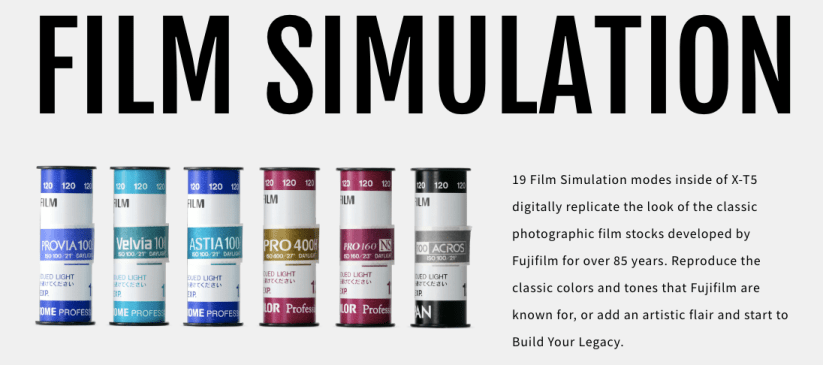
Interestingly, as a side note, if you look closely at the promotional statement by Fujifilm about film simulations on the X-T5, you’ll see this statement: “Reproduce the classic colors and tones that Fujifilm are known for, or add an artistic flair and start to Build Your Legacy.” First, I could be wrong, but I’m pretty sure it should be “is” and not “are”—after all, Fujifilm is known for reproducing classic colors and tones; for “are” to be correct, you’d need a conjunction, such as, “Reproduce the classic colors and tones that Fujifilm and Fuji X Weekly are known for….” Maybe they initially penciled that “and Fuji X Weekly” part in there, and erased it at the last minute, forgetting to change the “are” to “is” by accident. Second, Build Your Legacy seems to be Fujifilm’s new catchphrase for Film Simulation Recipes. It’s been a Fujifilm trademark for a few years, but I hadn’t seen it used in conjunction with film simulations. I wonder if Fujifilm has something up their sleeves that they’ll announce later. Perhaps it is even related to their upcoming app? I’m not sure, but it is definitely something to keep an eye on.
I had big plans for this project for these days, but life had other plans. Specifically, Covid. I know what you’re thinking: didn’t you just have the flu a few weeks ago? Yes, I did. Now I have Covid. Well, I’m almost recovered now, but I was very sick during the days that I captured these pictures, and I was limited to what I could capture in and around the house. Most of these photographs were taken in the backyard.
If you’re not sure what this short-term project is, the concept is simple: I’m photographing only with my Fujifilm X-T1 from the announcement day of the Fujifilm X-T5 (November 2) until the release date (November 17). Why? First, even though the Fujifilm X-T1 is eight-years-old (and approaching nine), it is still such a great little camera. It took three years for Fujifilm to bring this model to the market because they wanted to get it right, and it was one of their most important cameras ever released. The Fujifilm X-T1 was one of the first, if not the first, Fujifilm cameras that widely appealed to professional photographers. It was Fujifilm’s most successful model at the time—outselling all the previous cameras—and launched the extremely successful X-T line. The X-T5 is the latest iteration. This project will give me a better understanding of how the X-T5 has evolved from the original model. It also allows me to demonstrate that previous models, including the original X-T1, are still really good.
Hopefully, now that I’m not nearly so sick and my quarantine period has ended, I can do some of the photography that I was intending to do. I want to really see what the X-T1 is capable of, and with some luck I’ll be able to do that before this project comes to a close in the coming days. Once my X-T5 arrives in the mail, the X-T1 will be going back on the shelf, at least for a little while. I don’t expect the new camera to be wildly better than the first iteration, but soon enough I’ll know for sure just how much improved it is. And, of course, I’ll write all about it, so stay tuned!
Raindrops on a Branch – Farmington, UT – Fujifilm X100V – “Elite Chrome 200“
In my series, Which Film Simulation Recipes, When?, I’m trying to help out those who are unsure what Film Simulation Recipe to use in a given situation (after all, there are more than 250 to choose from). One of those situation is when you’re shooting in overcast conditions on a dreary day. I provide a recipe suggestion, plus five alternatives, to try. This topic was also discussed briefly in the last SOOC broadcast. The problem is that it’s all subjective; what I think might work well on a rainy day, you might disagree with. The aesthetic that I like you might not. Everyone has their own opinions.
What makes a Film Simulation Recipe work well on an overcast day? First, I think it needs to accentuate the mood. To me, that’s most important, although feelings are abstract and variable, so the task of saying “this recipe has the right mood” is difficult. Whether it should be punchy or muted, warm or cool, depends on the mood you want to convey. The recipe also needs to be able to handle the grey sky and not blow it out, while also dealing with low-contrast situations that you’re likely to encounter. It also has to look good at higher ISOs, because if it’s thick overcast, you’re likely dealing with higher ISOs (thankfully, most recipes do well at higher ISOs because of the X-Trans sensor and processing).
Fujifilm X-Photographer Nathalie Boucrypublished an excellent article today tackling this topic that I want to direct you to (click here—I promise that it is worth your time to do so). Obviously she doesn’t look at every recipe or even most recipes, but she does a comparison of a handful of them, and you can decide for yourself which one (or ones), if any, stand out to you as something to try. Since it is subjective, what she likes—or what I like—might be much different than what you like, and that’s perfectly ok—it’s about finding what works for you. Nathalie and I are both trying to take you on a path of discovery, so that you can find the recipes that work for you, and in the process you’re likely to find some that aren’t your style.
Comparison courtesy of Nathalie Boucry.
The best path to discovery involves action. You have to try a recipe in a given situation to figure out if it does well or not, and if you appreciate the results of it. You have to be willing to fail—by fail, I simply mean that you might find a recipe that you don’t like to use in a given situation while attempting to find one that you do like for that situation. In a way, it’s a little like playing the classic board game Clue. Was it Colonel Mustard in the Library with the Candlestick? Maybe. You have to suggest it to find out. Will the Elite Chrome 200 recipe work well for you on a rainy day? Maybe. I can suggest it, but you need to try it for yourself to find out. Nathalie’s article might be particularly helpful to you, because she did the hard work, and one of those recipes that she used might just stand out to you as one to try the next time you are photographing in the rain.
Now it’s your turn! What is your favorite Film Simulation Recipe to use on overcast, dreary, rainy days? Let me know in the comments!
Don’t have the Fuji X Weekly App? Download it today for free! Consider becoming a Patron to unlock the best App experience and to support this website.
I just learned that Chuck Drummond passed away this last Friday at 79-years-old. I met him once, and he was very kind. My deepest sympathies go out to the Drummond family, who I’m sure are still mourning.
This last summer my family and I embarked on an epic roadtrip that took us through Oklahoma. Pawhuska was a little out of the way, but we made sure to detour through it so that we could visit The Mercantile, the restaurant/coffee shop/bakery/gift store owned by Ree Drummond, who is also known as The Pioneer Woman.
For those unfamiliar, Ree Drummond became famous for her cooking blog, where she shared recipes used to feed her family and the hungry ranchmen, which turned into books, television shows, product lines, and The Mercantile, among other things. She lives on a large ranch in rural Oklahoma. Pawhuska was barely on the map before Ree became famous—now it’s still barely on the map, although it certainly has seen a significant resurgence, and it can become quite busy with tourists. Yes, for The Pioneer Woman fans, Pawhuska is a destination.
I’ve written about Pawhuska before, and I don’t want to rehash that; instead, I want to share a serendipitous encounter while in the small town, which I’ll remember for some time to come.
We awoke to steel grey sky and light rain. After getting ourselves put together, my family and I strolled around the small town of Pawhuska, which was almost deserted—the weather seemed to scare people off, or at least keep them indoors. We explored the streets, and I captured photographs with my Fujifilm X100V using the Kodak Tri-X 400 Film Simulation Recipe—black and white seemed especially appropriate for the weather. Eventually we made our way inside The Mercantile for breakfast, something that everyone should experience at least once in their lives—to say that it’s good is as big of an understatement as saying the Grand Canyon is big; both are true, but neither truly describe it.
While waiting for our food, an old man wearing a cowboy hat walked in by himself. He appeared weathered and worn, but in good spirits, with a smile on his face. My wife stated in a whisper just loud enough for our children to hear, “Look, there’s a real cowboy.” A true ranchman. An iconic stature of the American west. He sat at a small table near ours.
My wife knew right away who he was. This was Chuck. Ladd’s dad. Ree’s father-in-law. When the waitress came by, my wife asked if it would be alright to say hi to him. “Oh, sure,” she answered with a wink, “he loves the attention.” So my wife stood up, walked to his table, and introduced herself.
Chuck grinned, and he, too, stood up. He shook my wife’s hand, then he shook mine. He noticed my little girl’s cowboy boots, and made a comment to her about how nice they were and that he liked them. The waitress asked if she could take our picture, so with my wife’s phone she snapped one with Chuck, myself and my wife standing together. It was all very quick. Then we sat back down. Our food came, and we ate. His food came, and he ate alone, although other people also recognized him and he would pause to shake their hands and maybe take a picture. Chuck was a celebrity of sorts.
Our encounter was brief, but memorable. His kindness was obvious. His cheerfulness contagious. We met a genuine cowboy in rural Oklahoma. Just now I showed my daughter the picture I captured of Chuck Drummond (at the top of this article), and asked if she remembered him. “Oh, yeah,” she stated without hesitation, “that man said he liked my boots.” We’ll forever remember this chance encounter on a rainy day in May.
I’d yet to share any of these pictures, which were all captured on that drizzly morning in Pawhuska. I hope that you enjoy them!
Open All Year – Pawhuska, OK – Fujifilm X100V – “Kodak Tri-X 400”
For those who watch the monthly SOOCbroadcast, the current recipe-of-the-month is Fujichrome Sensia 100. We introduced that Film Simulation Recipe in the last episode, and we will finish our discussion of it in the next show, which will be in one week, on Thursday, November 17th. I hope that you’ll join us! Don’t forget to upload your photos captured with the Fujichrome Sensia 100 Film Simulation Recipe (click here) by November 15th to be shown in the next broadcast.
Speaking of the next SOOC broadcast, after we finish our discussion of the Fujichrome Sensia 100 recipe, we’ll introduce the next recipe-of-the-month, which will be Kodak Ektachrome 100SW. It produces warm and vibrant colors, which I find especially well suited for landscape photography. Be sure to set a reminder, so that you don’t miss the episode!
For those who don’t know, SOOC is a monthly live video series, with each episode focused on a different Film Simulation Recipe. It is a collaboration between Tame Your Fujifilm (Fujifilm X-Photographer Nathalie Boucry) and Fuji X Weekly (Ritchie Roesch). SOOC is a fun and educational experience where we not only talk about Fujifilm camera settings, but also answer your questions and give tips and tricks. Basically, we’re trying to help you master your Fujifilm camera, with a focus on simplifying your photographic workflow. It’s also interactive, and your participation makes it great!
Even though I have my own photography projects going on and I’m always working on new Film Simulation Recipes, I also shoot with the recipes that we discuss in each episode (plus the upcoming episode). I have been using both the Fujichrome Sensia 100 and the Kodak Ektachrome 100SW recipes. I don’t just ask you to use the recipes, myself and Nathalie both use them, too—we’re doing it together as a community.
Flag Pole – Buckeye, AZ – Fujifilm X-T30 – “Fujichrome Sensia 100”
If you have a Fujifilm X-Trans III or newer camera, I invite you to program and shoot with the Fujichrome Sensia 100 Film Simulation Recipe, and share with us your results. While you’re at it, load the Kodak Ektachrome 100SW recipe into your camera, too, and have it ready to go for next week.
If you missed the last SOOC broadcast, which really was a good one, you can watch it below. It’s a bit long (we have a little problem called “time management”… 🤣), but I believe you’ll find it worthwhile.
Tiny Purple Blossoms – Buckeye, AZ – Fujifilm X-T1 – “Classic Kodak Chrome” – Day 5
In my article, Did I Buy the Fujifilm X-T5? Should You?, I mentioned that I began a new short-term photography project: photographing only with my Fujifilm X-T1 from the announcement of the Fujifilm X-T5, which was November 2, until the release date, which will be November 17. I’m not using any other camera during this 16 day period, only the X-T1.
Why am I doing this? First, even though the Fujifilm X-T1 is eight-years-old (and approaching nine), it is still such a great little camera. It took three years for Fujifilm to bring this model to the market because they wanted to get it right, and it was one of their most important cameras ever released. The Fujifilm X-T1 was one of the first, if not the first, Fujifilm cameras that widely appealed to professional photographers. It was Fujifilm’s most successful model at the time—outselling all the previous cameras—and launched the extremely successful X-T line. The X-T5 is the latest iteration. This project will give me a better understanding of how the X-T5 has evolved from the original model.
More importantly than any of that, the Fujifilm X-T1 was a good camera on the day it was released, and is still a good camera in 2022. There’s no reason that it cannot be used today. The image quality is excellent. The camera is pretty quick overall (look at the sports pictures!). It has one advantage over all other X-T cameras: 16mp. The files are smaller, which means I can capture more pictures on an SD card, it takes less time to transfer the pictures from the camera to my phone, the pictures take up less space on my phone, the pictures upload more quickly to my cloud storage, the pictures use less cloud data, and the pictures download from cloud storage more quickly. Less is more sometimes. I’ve really appreciated this quickness lately. The Fujifilm X-T1 is a camera that I’ve thoroughly enjoyed shooting with over the last week, and I think I’ll be a little sad when I put it back on the shelf after my X-T5 arrives in the mail.
Day 1
Birdcage on a Wall – Buckeye, AZ – Fujifilm X-T1 – “Classic Kodak Chrome” – Day 1
A Pink Rose in the Garden – Buckeye, AZ – Fujifilm X-T1 – “Classic Kodak Chrome”
Specifically, I set out to create a Film Simulation Recipe that could make a good option for “golden hour” or “midday” daylight photography—potentially a solid choice for C1 or C2 in your camera. I wanted it to have a classic Kodak aesthetic—perhaps a bit nostalgic, like from the 1970’s or 1980’s, maybe somewhat similar to Kodacolor—but not modeled after any specific film. Something classic and warm and clearly Kodak-like. I really like what I came up with, and I think many of you will, too!
Saguaro Green – Buckeye, AZ – Fujifilm X-T30 – “Classic Kodak”
This “Classic Kodak” Film Simulation Recipe is compatible with the X-T3 and X-T30 cameras, and, because it doesn’t use Color Chrome Effect, it’s also compatible with X-Trans III models. To use this recipe on newer X-Trans IV (and X-Trans V) cameras, simply set Color Chrome FX Blue to Off, Clarity to 0, and choose a Grain size (either Small or Large).
Classic Chrome Dynamic Range: DR400 Highlight: -2 Shadow: +1 Color: +4 Noise Reduction: -4 Sharpness: -1 Grain Effect: Strong Color Chrome Effect: Off White Balance: Shade, -1 Red & +2 Blue ISO: Auto up to ISO 6400 Exposure Compensation: +1/3 to +1
Below are all camera-made JPEGs captured using this “Classic Kodak” Film Simulation Recipe on my Fujifilm X-T30:
Clocktower – Buckeye, AZ – Fujifilm X-T30
Center on Main – Buckeye, AZ – Fujifilm X-T30
5 & 6 – Goodyear, AZ – Fujifilm X-T30
Water Fountain – Buckeye, AZ – Fujifilm X-T30
Circle Around the Roofline – Buckeye, AZ – Fujifilm X-T30
Old Doll Head For Sale – Buckeye, AZ – Fujifilm X-T30
Unlit Bulbs and Rainbow – Buckeye, AZ – Fujifilm X-T30
Rainbow Hidden in the Trees – Buckeye, AZ – Fujifilm X-T30
Small Yellow Leaves – Buckeye, AZ – Fujifilm X-T30
Dressed in Pink – Buckeye, AZ – Fujifilm X-T30
Green Garden Leaves – Buckeye, AZ – Fujifilm X-T30
Palm Branches in the Sky – Buckeye, AZ – Fujifilm X-T30
Sonoran Desert Mountains – Buckeye, AZ – Fujifilm X-T30
Nobody pays me to write the content found on fujixweekly.com. There’s a real cost to operating and maintaining this site, not to mention all the time that I pour into it. If you appreciated this article, please consider making a one-time gift contribution. Thank you!
Let’s be clear: the Fujifilm X100V has skyrocketed in price because Fujifilm cannot make enough copies due to the global parts shortage. But, when you combine that shortage with an increased demand, you get ridiculously inflated prices. Supply and demand. But what caused the demand to increase?
A few people shared with me a recent Petapixel article entitled Used Fujifilm X100 Series Camera Prices Are Surging Thanks to TikTok. This article is based off of a Fujiaddict article entitled TikTokers Drive Up Fujifilm X100 Prices Across The Lineup. Both are interesting reads and basically say the same thing: social media influencers, particularly those on TikTok (by the way, you can find me on TikTok…), are causing an increased interest in (and demand for) the X100—from the original to the latest version—by raving about the camera. It should be noted that the X100-series is a gateway into the Fujifilm world for a lot of people—it’s easier to dip your toes with a fixed-lens than to dive into a whole interchangeable-lens system. Many people have told me that an X100-series camera was their first Fujifilm, sometimes their very first camera, period.
There are quotes in the article describing what’s great about the X100V, including “zero editing” and “digital camera that mimics film” and “shoot photos that need no editing.” That made me wonder if these social media influencers are using Film Simulation Recipes. Makes sense, right? I mean, it kind of sounds like they do, and the photographs seem to confirm it, but I’m not really sure. I reached out to a couple of those mentioned in the article, but have yet to receive a response, which is not surprising because I’m sure they’re absolutely inundated with messages—I get a ton, and I’m nowhere near as popular as they are. I saw in the comments on one of the videos that it was just default Classic Chrome and not a recipe. Oh, well. Then I searched #fujifilmx100v on both TikTok and Instagram (follow me on Instagram, if you don’t already), and I found a bunch of similar videos and posts by others that do, in fact, mention specifically using Film Simulation Recipes. I think it’s quite plausible—perhaps probable—that the recipes are a significant factor in the rise in popularity of the X100V and other X100-series cameras, and maybe Fujifilm in general. So while I’m not directly responsible, it appears that I might be indirectly responsible for the rise in cost of the X100V, at least partially and to a small extent. If you’re trying to purchase an X100-series camera and you’re finding it overpriced, I’m sorry. I didn’t mean for that to happen, and I apologize for my part in it.
Putting the humor aside, I am incredibly honored that so many are using my Film Simulation Recipes and that they’re helping lots of people achieve the looks they’re after without fussing with editing—from those just getting started with their first “real” camera to recognizable names doing pro work, and all sorts of people in-between. You’re having more fun, potentially increasing your productivity, and spending more time doing what’s important to you, because you’re spending less time in front of a computer. That’s all so wonderful! It’s unreal to me that I’m having such a large impact on photography, something that I never imagined would ever happen. I’m incredibly grateful and appreciative to all of you for visiting this website and trying the recipes and being a part of this great community. Thank you!
And, I suppose, that makes you accomplices in the rise in cost of the X100, too….
Edit: The moment that I published this, I received a message from Edward Lee Films (who is mentioned in the articles), and he does in fact have the Fuji X Weekly App on his phone and uses Film Simulation Recipes. Check him out on Instagram and TikTok!
Just yesterday Fujifilm announced the brand-new X-T5, and I’ve been inundated with questions of whether I’ve preordered it or not. Before I give my answer to that, I want to share my opinion (and it’s just an opinion) on who should buy the X-T5 and why, and who should pass on it. I’m sure many of you are considering purchasing it and are on the fence, so hopefully this helps you.
I think it’s important to have some perspective. New cameras come out all of the time, and each time there’s a lot of hype, which causes FOMO (fear of missing out) and GAS (gear acquisition syndrome), neither of which are good things. I’ve often said that it’s better to invest in experiences than gear—what kind of epic journey could you embark on with $1,700?—and the gear you already have is more than good enough. “Better” gear will never make you a better photographer, but using your gear more often will, especially if you can make an honest evaluation of your photographs and really consider what lessons they have to offer—each exposure, whether failed or successful, is a learning opportunity if you are open to it. It’s always a good idea to take the new-camera hype with a large grain of salt by keeping a healthy perspective.
The Fujifilm X-T5 looks like and seems like a very wonderful camera. Fujifilm listened to those who complained about the X-T4, and made the X-T5 more like the X-T3. That’s good, unless you like the X-T4 more than the X-T3 (there are some who do), then you might not appreciate the X-T5; otherwise, you’re likely to consider the X-T5 to be a nice improvement. Are those nice improvements enough that you should consider purchasing it?
If you print your pictures poster-sized, the X-T5 is for you, because it has all that extra resolution. If you crop extensively, the X-T5 is for you, because—you know—40mp and all. If you find the autofocus on your current model to be insufficient, then the X-T5 is for you, because they improved that. Need to shoot 6K video? The X-T5 is for you. Need IBIS? The X-T5 has it. If your camera is too big and you’d prefer something smaller, depending on the camera you have and how small you want to go, the X-T5 might be for you. Just got to have Nostalgic Negative and “improved” Auto White Balance? Well, the X-T5 has it. None of those things apply to you? Then I would suggest passing on the X-T5.
A lot of times when a new camera is released, it takes two steps forward and one step backwards. I think this is so some future iteration of it can add it back in and call it a new feature or improvement. For the X-T5 it is the optional vertical battery grip, which isn’t an option for the new camera. For most people this is no big deal, but for some this is a dealbreaker, so it is worth pointing out. I have a feeling that once the X-T5 is released, we’re going to start getting reports of overheating issues, so keep that in mind, too.
Hummingbird Feeder Along a Wall – Buckeye, AZ – Fujifilm X-T1 – “Classic Kodak Chrome” – I captured this picture today
I started a new short-term project: I’m photographing exclusively with my Fujifilm X-T1 from the announcement date of the X-T5 (yesterday) until the release date (the 17th). The X-T1 started the X-T line and is such an important camera in Fujifilm’s X-series heritage. It’s eight-years-old now (almost nine), so it can’t be any good, right? Well, no surprise to me, it’s still a highly capable camera worthy of use in 2022. In fact, the X-T1 has one advantage over all other X-T cameras, including the X-T5: the file sizes are smaller. That means I can capture more pictures on an SD card, it takes less time to transfer the pictures from the camera to my phone, the pictures take up less space on my phone, the pictures upload more quickly to my cloud storage, the pictures use less cloud data, and the pictures download from cloud storage more quickly. Less is more sometimes. Even though the X-T5 is capable of saving in HEIF, which saves space, the files will still be significantly bigger than those from the X-T1. Certainly, though, the pictures from the X-T1 aren’t good enough for printing, though, right? Nonsense! Some of my favorite pictures that I’ve ever printed were captured on a Fujifilm X-E1, which is even older than the X-T1.
Now I’ll answer the opening question: did I preorder the Fujifilm X-T5? Yes, I did. The silver one. Why? One reason, and one reason alone: Nostalgic Negative. I don’t think this new film simulation is going to be my favorite. I don’t think I’ll like it as much as Classic Negative, Classic Chrome, Eterna, or Acros. But I really want to try it and see what Film Simulation Recipes I can create with it. I think it will be fun to do that. Which brings me to another point: if some new gear will bring you joy, even if it isn’t meeting any other need, then it might be worth it. Maybe. It could be short term joy, and later you’re asking yourself why you didn’t use the money to visit a National Park or something instead, so you better be sure that you’ll really enjoy it for some time to come. The X-T5 doesn’t meet any other need for me. I don’t need the extra resolution, and, in fact, I’m not looking forward to that aspect of it. I don’t need the improved autofocus, as I find the autofocus of the X-T1 to be good enough for me, and the X-H1, X-T30, X100V, and X-E4 that I own are even better. I don’t shoot video (my wife does on her X-T4), and I have no need for 6K. I don’t consider IBIS to be important for any of my photography, but if for some reason I do need it (such as a long telephoto lens in dim light), I use my X-H1, which has IBIS. I have a lot of smaller camera bodies already, so I don’t need another—in fact, I suspect that bigger and heavier lenses will balance better on the X-T3 and (especially) X-T4 than the X-T5. The new and improved Auto White Balance is intriguing, and I’m curious how that affects recipes, but that’s definitely not a selling point for me. The only thing about the X-T5 that makes me want to buy it is Nostalgic Negative, which I’m really uncertain if that’s a good reason to spend so much money (my brain says no, my heart says yes), but I really look forward to using Nostalgic Negative and experimenting with it—I’m quite excited for that!
Should you buy the X-T5? That’s a question only you can answer. I can offer my best advice, but you should take it with a grain of salt, because everyone’s wants and needs are different. I can offer my perspective, but I would recommend getting advice from others, and go with whichever one makes the most sense to you.
This post contains affiliate links, and if you make a purchase using my links I’ll be compensated a small amount for it.
Preorder your Fujifilm X-T5 in black: AmazonB&H Preorder your Fujifilm X-T5 in silver: AmazonB&H
When should you use which Film Simulation Recipes on your Fujifilm X-T3 or X-T30 camera? With so many recipes to choose from, it can be difficult to know what recipe you should select in a given situation, and this article is intended to help you with that. If you haven’t read Part 1, it’s important to do so because it explains what exactly we’re doing—the backstory—which is important to understand. There’s a video to watch in that article, too. Take a moment right now to hop on over to Part 1 (click here) before continuing on with this post, if you haven’t viewed it already.
What makes Part 2 more challenging than the first article is that the X-T3 and X-T30 cameras cannot remember a White Balance Shift within the C1-C7 Custom Presets. If two recipes share the same white balance type but not the same shift, then when you switch presets you must remember to adjust the shift, too. That can be inconvenient and frustrating, so my best solution is to program recipes that use different white balance types and/or share the same white balance type and shift. The user experience is much improved, but you might not be able to program all of your favorite recipe at the same time, which is the one downside to doing this. What I set out to do with this article is recommend seven recipes, one for each C1-C7 Custom Preset, that don’t share the same white balance type, or, if they do, share the same shift. It turned out to be a somewhat impossible task, but I think I came up with a good set for you.
Also, if you have a newer X-Trans IV camera (or X-Trans V), you can use these recipes, too, by simply setting Color Chrome FX Blue to Off, Clarity to 0, and choosing a Grain size (either Small or Large). While Part III will cover X-Trans III, some of these recipes are compatible with X-Trans III cameras; the key is to look for whether they call for Color Chrome Effect or not—if not, it’s compatible with X-Trans III. Also, X-Trans III recipes are fully compatible with the X-T3 and X-T30 (just set Color Chrome Effect to Off), but I avoided those recipes for this article because I wanted to save them for Part 3.
Fujichrome Sensia 100 is one of my favorite recipes for sunrise and sunset colors. It does pretty well throughout the entirety of “golden hour” but when the sky is pink and purple and red it does especially well. This recipe is an excellent option for shade, and does pretty well in many situations, including natural light portraits, so it has some good versatility. It uses the Fluorescent 2 (sometimes called Neon 2) white balance type; if I wasn’t concerned about white balance type, I would strongly consider Kodak Portra 400 v2 instead of this one, but I do think Fujichrome Sensia 100 is a solid choice for “golden hour” photography.
This was actually a really touch decision because there are so many great options for “midday”—which simply is daylight outside of “golden hour”—and I had to choose one, so I went with Kodak Vision3 250D. This is such a good (and underutilized) recipe, and does well in a number of situations, including “golden hour” and shade and portraits and (of course) midday. It uses the Fluorescent 1 (sometimes called Neon 1) white balance type; if I wasn’t concerned about white balance type, I could go with Kodachrome 64 or Kodak Portra 160 or Kodak Gold 200 or (of course) Kodak Vision3 250D and be very happy with any of them, they’re all good.
Winter Reeds – Farmington, UT – Fujifilm X-T30 – “Classic Slide”
The Classic Slide recipe is one of my top choices for heavy overcast, rainy, dreary days. It’s also good for shade or midday or even “golden hour” photography—it’s another recipe with some good versatility. It uses the Daylight white balance type; if I wasn’t concerned about white balance type, I’d still choose this one, but Negative Print is a good runner up.
Cinematic Negative is a very versatile recipe, and I like it for all of the situations we’ve talked about above, but I also like it for indoor photography, both natural light and (to an extent) artificial light (although I would consider a “Nighttime” recipe below as a first choice for artificial light). It uses the Incandescent white balance type; if I wasn’t concerned about white balance type, Analog Color would be my top choice for indoor natural light photography, but Cinematic Negative is a close second, so I’d be happy to have it in C4, where it could also be used for a number of other situations.
Wet Glass Bokeh – Salt Lake City, UT – Fujifilm X-T30 – “Jeff Davenport Night”
If it’s between dusk and dawn, especially if there are city lights, Jeff Davenport Night is the recipe to use. Period. It uses a Kelvin white balance type; if I wasn’t concerned about white balance type I’d still use this recipe, no questions asked.
Bloom Purple – South Weber, UT – Fujifilm X-T30 – “Expired Eterna”
The “Alternative Process” category is a fun one. These are recipes you probably wouldn’t use all of the time, only occasionally just for the joy of it. I chose “Expired Eterna” because of the white balance type—Auto—but if I wasn’t concerned about white balance type, I would choose Redscale, Cross Process Film, or Kodak Elite Chrome 200 Color Fade—any of them, they’re all fun. Vintage Color Fade also uses Auto white balance, but I didn’t choose it because it requires double-exposures, which can be tricky, but if you’re up for the challenge, go with that one instead.
Alternatives for “alternative process” photography:
The Obscurity of Light – Farmington, UT – Fujifilm X-T30 – “Dramatic Monochrome”
Last but not least is B&W, and for that I chose Dramatic Monochrome, which is a good recipe that I really like. It uses Auto white balance without a shift; however, the other Auto white balance recipe (Expired Eterna above) does use a shift. How I would handle this is I wouldn’t worry about the shift for this recipe, just use the shift of Expired Eterna, because, while white balance shift does affect black-and-white pictures, it’s not as big of an impact as color images, and it won’t significantly change the aesthetic of Dramatic Monochrome—only subtly—and you’re not likely to notice, so I just wouldn’t worry about it. If I wasn’t concerned about white balance type, I would choose Kodak Tri-X 400 (read the article for that recipe to see how to make it compatible with the X-T3 and X-T30), because it is my favorite Film Simulation Recipe.
Fujifilm just announced a new lens: Fujinon 30mm f/2.8 Macro. This is a “standard” prime lens with a 45mm (equivalent) focal-length. It’s a macro, and its closest focus distance is about 4″ from the sensor, which is great. While the f/2.8 maximum aperture may not sound especially exciting, it’s important to know that impressive maximum apertures aren’t a big deal on macros. The 30mm f/2.8 macro has a linear motor and is weather-sealed. Overall it seems like a high quality Fujinon lens.
I love macro lenses because they’re often very sharp and quite versatile. The one downside is that there’s a lot of range to scroll through when focusing, and because of this they’re not quite as quick as non-macro lenses. In Fujifilm’s lineup, you have two other macro options: the 60mm f/2.4 and 80mm f/2.8. The 60mm is old, slow, and optically inferior, although still a good lens. The 80mm is excellent optically (one of the absolute best, actually), but is bulky and expensive. At $600, this new lens is not overly costly, yet seemingly quite capable and pretty compact. This new 30mm option will be an appealing choice for those interested in macro photography, or those wanting a good walk-around lens with extra versatility.
This post contains affiliate links, and if you make a purchase using my links I’ll be compensated a small amount for it.
In other (but related) news, AstrHori has released a 28mm f/13 Micro Probe lens that has 2x magnification! If you want to get really close, and do some crazy closeup pictures of bugs or flowers, this is a lens to strongly consider. I don’t think you’d put this unusual lens on your camera for street photography or portraits—you might poke someone’s eye out—but for true macro photography, this is one you’ll want to take a good look at. If you are a dedicated macro shooter, this is a lens to get excited for; however, with that said, I’ve never used it and cannot attest to the image quality—I don’t doubt that it’s decent, I just have no firsthand experience. If you only occasionally dabble in macro photography, then the Fujinon 30mm is probably a better choice for you. The good news for macro photographers is that you have two new options. Yea!
The AstrHori 28mm f/13 Micro Probe is available for $739 on Amazon.
What makes this camera special? Who should buy it?
To understand the X-T5, one has to go back in time a few years. The X-H1 was Fujifilm’s original flagship, but due to poor timing on its release and an overly aggressive initial MSRP, it didn’t sell well. Fujifilm thought this camera was going to be a huge hit, but instead it flopped… at least until it was heavily discounted. Those who own an X-H1 love the camera, and regard it as one of Fujifilm’s best, a true workhorse. The X-T3, which was announced just months after the X-H1 was released, more or less killed the X-H1, just because it was the first X-Trans IV camera while the X-H1 was the last X-Trans III model. The X-T3 would become Fujifilm’s top selling camera of all time, and was only recently discontinued. The X-T4 came out when the X-T3 was just over a year old, and Fujifilm sold them both at the same time because the X-T4 wasn’t really the X-T3’s successor, but instead was another attempt at a flagship model, kind of a cross between the X-H1 and X-T3 (but with compromises that both X-T and X-H users weren’t thrilled about). Now that Fujifilm has released the X-H2 and X-H2s cameras, there isn’t a “need” for the X-T4, and it’s being discontinued. That brings us to the X-T5, which is the successor to both the X-T3 and X-T4, but is more like the X-T3 than the X-T4, yet sharing a legacy with both models. Make sense?
What makes the X-T5 special is that it walks back some of the unwanted “improvements” of the X-T4—yet improves upon the appreciated features of the X-T4—while in a package more similar to the X-T3, and with the new sensor and processor of the X-H2. So is it better than the X-T3? In many regards yes, in some regards it is a wash (not better or worse), and in a couple of regards no. Is it better than the X-T4? This depends on your definition of better, because the X-T4 was actually a more premium model, but with curious design choices that some don’t appreciate—if that’s you, then, yes, the X-T5 is better, but if you really like the X-T4, the X-T5 might be seen as a step backwards in some ways. I will say this: my wife has an X-T4 that she really loves, but she would prefer the screen of the X-T3/X-T5, so that makes it potentially a better camera for her. I say “potentially” because the screen is just one factor. If the X-T4 handles heat better—say, if the X-T5 has overheating issues when recording video—then that wouldn’t work out well, because she uses it more for for video than stills. “Better” is a subjective term, anyway, that’s perceived much differently depending on the person and how they use their gear. What’s “better” for one person might not be “better” for another—at all depends on your point-of-view.
But isn’t X-Trans V better than X-Trans IV? X-Trans IV was such an outdated sensor and overall technology, while X-Trans V is the pinnacle of APS-C camera technology advancements—doesn’t that mean it’s unquestionably better? That’s tough to say. I’m reminded of when Syndrome, in the movie The Incredibles, describes his new-and-improved superhero-destroying robot. “It’s bigger, it’s badder, ladies and gentleman,” Syndrome announces, “and it’s too much for Mr. Incredible!” Similarly, there’s no doubt that the X-T5 is metaphorically “bigger and badder” than the X-T3 and X-T4 (physically, it’s smaller than the X-T4), but perhaps “it’s too much for” most photographers. While some have decried the X-T3 and X-T4 as disappointments or not “good enough” for some reason, for the vast majority of photographers, both of those models are well above and beyond anything that they actually need. And, of course, with more megapixels come additional challenges—sometimes less is more. The point of this paragraph is that, yes, the technology of X-Trans V is surely an improvement, but, at a point of diminishing returns, do you really need those improvements? Some of you do, many of you don’t—and for those who don’t, the improvements of the X-T5 are really paper improvements and not something that will likely affect your photography in any practical way.
What I just stated is important because some of you right now are trying to decide if you should upgrade, and everyone’s telling you that you should. There’s a whole lot of hype—some FOMO and GAS even—and you’re not sure what to do. I will give you my advice as someone who has never touched or seen in-person an X-T5. Take it for what it’s worth, which is probably not a lot.
If you have an X-T2 and have been thinking of upgrading for awhile, but the X-T3 was too similar to the X-T2 (not enough of an upgrade), and the X-T4 had that darn flippy screen you didn’t like, then you’ll likely really appreciate the X-T5. If you have the money and desire, just do it and get it—I feel like this is the group that the X-T5 makes the most sense for. Those with an X-T3? I have a hard time with this one, because it might be a big difference for you, or it might be pretty much the same thing that you already have, depending on how you use the camera. Those who shoot JPEGs will likely find it significantly different with the new film simulations and JPEG options (although it doesn’t appear to be a whole lot different than the X-T4 in this regard). If you print your pictures poster-sized, those extra megapixels will come in handy. If you somehow find the autofocus lacking, that’s been improved. Use it for video? There’s some improvements there, too. Need IBIS? It has it. But if those things don’t matter that much to you, the X-T5 isn’t all that much different than the X-T3, and won’t necessarily be an improvement for you. So my suggestion to those considering upgrading from the X-T3 to the X-T5 is to think long and hard about how you use your camera and where you find it lacking, if you find it lacking at all. Those with an X-T4, the X-T5 is only an upgrade for you if you hate the flippy screen, if you somehow find the autofocus lacking, print posters, or need a slightly smaller body (apparently the X-T5 is just larger than an X-T1); otherwise, the X-T5 isn’t really an upgrade for you, and I don’t recommend getting the new camera. Still using an X-T1? Buy a used X-T2 or X-T3—there’s about to be a whole bunch of them. So to summarize, the X-T5 makes the most sense as an upgrade for those who currently have an X-T2; it’s 50-50 for those with an X-T3, depending on how you use your camera; many of those with an X-T4 will likely not trade in for the new model, although some will, obviously.
We’ve talked about upgrading from a like-model, but what about those who have some other camera? If you’ve been using an X-T20 or X-T30 and wanting a more premium model, the X-T5 might be just that for you. I don’t think it should be underestimated how many will be moving up from one of those models to an X-T5, or perhaps a used X-T3 or X-T4. I suspect that a used X-T3 will be pretty easily found for $700-$800 in the coming months—they’re still exceptional cameras, and that will be very tempting for those who don’t have $1,700 to drop on an X-T5. For those with an X-H1, I think the X-T4 is just as much (if not more so) of an “upgrade” as the X-T5 (for those who don’t consider the X-H2 and X-H2s to be the “real” successors), and obviously neither are really upgrades, so I don’t see the X-T5 as particularly appealing to the X-H1 owners, although I’m sure some will take the bait. I do believe that those who own an X100V as their only Fujifilm camera (and that’s a significant group… it really is a gateway into the Fujifilm system) will take a long look at the X-T5, as they should, and some will buy.
You might think, reading all of this, that I’m not especially excited for this camera, but you couldn’t be more wrong. I believe that Fujifilm is trying to do the right thing with the X-T5. Fujifilm walked back a lot of the changes that they made to the line with the X-T4, because those changes weren’t appreciated by the majority of X-T users. They did what they should have done (and what I previously suggested that they should do) and make the X-T5 more like the X-T3 and less like the X-T4. Bravo! I think the X-T5 is an important camera for Fujifilm, and a lot hinges on its success. I truly hope it’s a smashing success for Fujifilm, and I think it will be. With that said, I don’t work for Fujifilm, and I want to give good advice—honest advice—to my community, and the best advice I have is this: you shouldn’t upgrade with every new model release, experiences are more valuable than gear, and new gear will not make you a better photographer. On the flip side, if you have the money, and the X-T5 will help your photography in some way or make it more fun, then it definitely might be worth the expense. Only you can decide that for yourself. Trust your gut, and either go for it or pass, and feel good about that decision, whatever it is.
This post contains affiliate links, and if you make a purchase using my links I’ll be compensated a small amount for it.
Preorder your Fujifilm X-T5 in black: AmazonB&H Preorder your Fujifilm X-T5 in silver: AmazonB&H
The 12th (yes, 12th!) issue of FXW Zine is out, and if you are a Fuji X Weekly Creative Collective subscriber, you can download it now!
What’s in the November issue? The cover story is about embracing blur! Have you noticed the recent blurry picture trend? In this issue we dive into the what, how, and why of it all. There are 22 pictures, including the cover, across 16 page.
If you haven’t joined the Creative Collective, consider subscribing today to get access to bonus articles and the FXW Zine—not just this issue, but the first eleven issues, too!
Airstream – Pismo Beach, CA – Fujifilm X-E4 – “Chrome Slide”
This Film Simulation Recipe is a bit of a mystery to me. I recently found it in my C1-C7 custom presets on my Fujifilm X-E4, simply named Exp. After shooting with it, I quickly remembered that I had created it back in July, and then for some unknown reason stopped using it. In the weeks and months that passed, I somehow completely forgot all about it. Here’s what I do know: while I was traveling over the summer, someone had asked me to create a certain look, which I believe was of a particular photographer and not a specific film stock (although I am not fully certain of that), and so I did, but now I have no idea who asked (because I get many requests) or who the photographer was that I was attempting to mimic. I’m not sure if I was close to successful or not, as I don’t really remember a whole lot of anything about it. I did find on an SD card the pictures that I had captured with the recipe over the summer. I began using it again just recently, and I really appreciate the results—I think many of you might, too. In fact, it could be a new favorite recipe for some of you!
While I don’t believe that this recipe was modeled after any specific film stock, it does remind me a little of Ektachrome. Over the years there have been around 40 different emulsions that Kodak has given the brand name Ektachrome to, not to mention that one film may have had numerous updates and revisions (Ektachorme E100, for example), so it can be tough to know exactly which “Ektachrome” this might most closely resemble. Maybe E100 or E200 or even Elite Chrome? I’m certain that it’s not an exact match to any, but to me it has a general Ektachrome “memory color” (as Fujifilm puts it). Since I’m not sure what it most closely resembles, I’m simply calling it Chrome Slide.
This Film Simulation Recipe is compatible with the Fujifilm X-Pro3, X100V, X-T4, X-S10, X-E4, and X-T30 II cameras. I believe that it is also compatible with X-Trans V models, such as X-H2, X-H2S, and the upcoming X-T5. Those with newer GFX cameras should be able to use it, too, although it will render slightly differently. Unfortunately, it is not compatible with the X-T3 or X-T30.
Classic Negative Dynamic Range: DR400 Highlight: +1 Shadow: +1 Color: +4 Noise Reduction: -4 Sharpness: 0 Clarity: +3 Grain Effect: Weak, Small Color Chrome Effect: Strong Color Chrome Effect Blue: Strong White Balance: Daylight, -3 Red & +1 Blue ISO: Auto, up to ISO 6400 Exposure Compensation: 0 to +2/3 (typically)
Example photographs, all camera-made JPEGs using this “Chrome Slide” Film Simulation Recipe on a Fujifilm X-E4:
Patriotic Boat – Morro Bay, CA – Fujifilm X-E4
Surf Rider – Pismo Beach, CA – Fujifilm X-E4
Elephant Seal Along Rocky Shore – San Simeon, CA – Fujifilm X-E4
Sport Bird – Avila Beach, CA – Fujifilm X-E4
Sunset Storm – Buckeye, AZ – Fujifilm X-E4
Layers & Repeated Shapes – Morro Bay, CA – Fujifilm X-E4
Public Guitarist – Pismo Beach, CA – Fujifilm X-E4
Billiards – Redlands, CA – Fujifilm X-E4
Ice House – Avila Beach, CA – Fujifilm X-E4
Urban Bikes – Pasadena, CA – Fujifilm X-E4
Pine Layers – Pine, AZ – Fujifilm X-E4
Small Flowers Near Tree – Tonto Natural Bridge SP, AZ – Fujifilm X-E4
Hexagon Waterdrops – Pine, AZ – Fujifilm X-E4
October Oak – Pine, AZ – Fujifilm X-E4
Wet Pine – Pine, AZ – Fujifilm X-E4
Singular Rose Bloom – Buckeye, AZ – Fujifilm X-E4
Water Falling Under The Bridge – Tonto Natural Bridge SP, AZ – Fujifilm X-E4
Small Waterfall – Tonto Natural Bridge SP, AZ – Fujifilm X-E4
Nobody pays me to write the content found on fujixweekly.com. There’s a real cost to operating and maintaining this site, not to mention all the time that I pour into it. If you appreciated this article, please consider making a one-time gift contribution. Thank you!
I’ve told you before that the Fujinon 27mm f/2.8 is my favorite lens. I have the new version with the aperture ring and weather-sealing—the old version is optically identical (and the autofocus is identical), but it lacks an aperture ring and weather-sealing and costs just a little more for some reason. While the “Mark II” 27mm f/2.8 is the better option, it can be a little difficult to find. Fujifilm has had a difficult time getting the lens to stores, and stores sell out pretty quickly after they receive them. A number of you have stated your frustration trying to get your hands on one. There is a new alternative, though: the TTArtisan 27mm f/2.8 Autofocus.
I’ve shot before with a different TTArtisan lens—the 35mm f/1.4—on a Nikon Zfc, and was actually impressed by the image quality. It was no Fujinon or Zeiss or anything like that, but it was noticeably superior to the Nikkor 28mm lens that came with that camera. I suspect that this one will be similar: deliver decent image quality, have character, be solidly-built, and cost a lot less. In fact, the MSRP is only $160 (or $150 if you buy direct from Pergear), which is very affordable for an autofocus lens. If you can’t find the Fujinon 27mm, or if you cannot afford the Fujinon lens, this seems like a good alternative to consider.
I believe that the TTArtisan 27mm f/2.8 is a little bigger than the Fujinon 27mm f/2.8, so it isn’t quite as pancake, but more like the Fujinon 18mm f/2 pancake. It has a rear-lens-cap USB connection for firmware updates, which I think is interesting. I’ve never used this lens personally to verify any of this, but maybe someday I will.
I personally wish that TTArtisan would have instead created a different focal length pancake lens—maybe that’s in the plans, who knows?—and I think a 23mm pancake or 50mm pancake or 12mm pancake would be nice options. For reasons that I don’t understand, there aren’t nearly enough good pancake options for Fujifilm cameras. I mean, a selling point of APS-C is the compact size (compared to full-frame), so why not offer more tiny lenses to take advantage of it? I do believe that competition is good, so I’m happy to see this TTArtisan lens as an option for Fujifilm photographers, and I hope they make more lenses that are similar in the future.
This post contains affiliate links, and if you make a purchase using my links I’ll be compensated a small amount for it.
I get asked all of the time when to use which Film Simulation Recipe. With over 250 on the Fuji X Weekly App to choose from, it can be difficult to know when each recipe should be chosen. Besides, you only have C1-C7 Custom Presets on your Fujifilm camera (most of you, anyway). Which seven recipes should you have programed? When should you select them?
The problem with trying to answer this question is that it’s a highly subjective endeavor. While I might like a certain recipe for a particular situation, you might not. There’s not a right or wrong answer, just what works for you and what doesn’t—and I cannot say whether any particular recipe will work for you or not. Only you can answer that for yourself, and you have to try a recipe to know. With that said, I attempt to give good advice. In each SOOC broadcast I recommend a few recipes for various situations. Still, I’ve really struggled with how to be helpful to those asking for direction—that is until I watched a video by Grainydays, a YouTube channel about film photography, in which photographer Jason Kummerfeldt tries to give advice on when to use which film stocks. You can view it below:
Jason has a similar dilemma. Since film choice is such a personal thing, how do you say when to use which? It’s the same thing for Film Simulation Recipes. His solution is simply to demonstrate what he uses and state what he likes, and maybe you’ll like it too; I’m going to do the same thing for recipes. I’ll tell you what my preferences are, and invite you to try them too if you want. If you don’t want, that’s cool. There’s not any one way—and especially no right or wrong way—to do this. Instead, figure out what works for you, and do that. If you’re not sure, perhaps this article will be helpful to you.
I’m going to suggest seven recipes for you to program into your Fujifilm camera, and state when to use each. Since recipes are (for the most part) generationally specific, I’m going to make this a series of articles to cover most Fujifilm models. In this first one we’ll cover “newer” X-Trans IV cameras: X-Pro3, X100V, X-T4, X-S10, X-E4, and X-T30 II. This should also apply to X-Trans V cameras (from the reports I’ve received, X-Trans IV recipes are fully compatible with X-Trans V, although I have not tested this myself to know for certain) and newer GFX models (although the rendering will be slightly different).
Kodak Portra 400 v2 is a recipe that does well at anytime during daylight hours, and as the name suggests it is a good option for portrait photography, but I’m going to recommend it specifically for “golden hour” near sunrise and sunset. This really could be your primary use-all-of-the-time recipe, and that’s why I suggest placing it in C1, but when the sun is low to the horizon, make sure that this is the one you’re shooting with. I personally use this recipe frequently.
Denny’s Days – Beaver, UT – Fujifilm X-E4 – “Kodachrome 64”
Kodachrome 64 is another one that could be your go-to everyday-use recipe, but specifically I want to suggest it for daytime (non-“golden hour”) photography. Obviously it can also be used for when the sun is low to the horizon, too, but I think it is one of the best options for when the sun is not low—from mid-morning to mid-afternoon. This is one of the few recipes that you’ll almost always find programmed into my camera.
Evening Clouds Over Wasatch Mountains – Farmington, UT – Fujifilm X-E4 – “Kodak High Definition Plus 200”
If it’s thick overcast and rainy, the Kodak High Definition Plus 200 recipe is an excellent option. Yes, it’s pretty good in daylight, too (even “golden hour”), but give it a try on drab overcast days—I think you’ll really appreciate just how well it does in that situation.
For natural light indoor photography, my top choice is the Kodak Ultramax 400 recipe. This is another great all-rounder that could be used in pretty much any daytime situation and produce excellent results, but specifically I’m recommending it for natural light indoor pictures. For artificial-light indoor images, use the recipes for nighttime photography below.
11th Street – Astoria, OR – Fujifilm X100V – “Serr’s 500T”
If it’s after dark, my top choice for nighttime or artificial light photography is Serr’s 500T. This is a very blue recipe, so it isn’t a good option for many daytime situations, but from just past sunset to just prior to sunrise, this is the one that I would most recommend, especially if there are warm artificial lights.
For an alternative process recipe—a fun option for unusual results—my top recommendation is Xpro ’62. Use it anytime of the day or night, as it is surprisingly versatile. The results will be different, and perhaps unexpected, yet the experience will be a lot of fun, so give it a try!
Alternatives for “alternative process” photography:
Round Window – Pismo Beach, CA – Fujifilm X100V – “Kodak Tri-X 400”
My all-time favorite recipe is Kodak Tri-X 400, so it should come as no surprise that it is my top recommendation for monochrome photography. It’s not the most popular recipe on Fuji X Weekly, but it is the most popular B&W recipe. Definitely give this one a try if you’ve never done so before.
You have plenty to choose from, because I just suggested to you 42 different Film Simulation Recipes! Of course, there are so many other recipes that I could have listed—just because one didn’t make this list doesn’t mean that it’s not good; however, I do feel that this is a good set—not only the seven suggestions, which I believe are a winning C1-C7 combination, but the alternative options, too. With that said, don’t let an exclusion from this list discourage you from trying a particular recipe, because you never know when one just “clicks” for you, and you find a new favorite. The top picture in this article was captured with a recipe that I didn’t recommend, yet I do really like that recipe and do recommend it, and I even use it myself sometimes, including recently. It’s a good reminder that this is all subjective, and you might not prefer any of my recommendations, but instead have seven that I didn’t mention as your C1-C7 custom presets. So, I guess, the conclusion is to try every recipe until you find the ones you love and fulfill your photographic needs—but, if you’re not sure, maybe start with these 42.
Next up will be recipes for “older” X-Trans IV cameras—the X-T3 and X-T30.
SOOC was live yesterday. If you missed it, you can watch it today—I’ve included the full episode at the bottom of this article. This was one of my favorite SOOC broadcasts so far, and much of the thanks for that goes to you! Everyone who tuned in and participated in some way made it exceptional. Definitely, if you couldn’t watch it live, be sure to take some time to view it now. Also, thank you to everyone who submitted pictures using the Kodak Portra 400 Film Simulation Recipe. The Viewer’s Images slideshow video is above, so be sure to take a look!
For those who don’t know, SOOC is a monthly live video series, with each episode focused on a different Film Simulation Recipe. It is a collaboration between Tame Your Fujifilm (Fujifilm X-Photographer Nathalie Boucry) and Fuji X Weekly (Ritchie Roesch). SOOC is a fun and educational experience where we not only talk about Fujifilm camera settings, but also answer your questions and give tips and tricks. Basically, we’re trying to help you master your Fujifilm camera, with a focus on simplifying your photographic workflow.
The new recipe-of-the-month is Fujichrome Sensia 100. Be sure to shoot with that and upload your pictures (click here) by November 15th to be included in the next broadcast, which will be on November 17th (mark your calendars now!).
I couldn’t take it anymore, so I turned off the advertisements on Fuji X Weekly. They’re gone. You’re welcome. Oh, and I’m sorry that you had to put up with them for so long.
Why did I do this? Why did I even have ads in the first place? To answer the second question first, there’s a real cost to running this website and doing the things I do. The ad revenue (which isn’t much—it’s amazing how little you actually get from ads, much less than many of you likely imagine) helps to pay for it. It basically covered the cost of web hosting and domains and stuff like that—not only for Fuji X Weekly, but Ritchie’s Ricoh Recipes, RitchieCam, RithieRoesch.com, and the Community Recipes page, too. I discontinued the ads for two reasons: the company facilitating the ads cut their payouts in half (which is crazy unfair), and the ads were just soooo annoying anyway—I hated having them. It was time for them to go!
Unfortunately, when you run a website, you sometimes have to do things that you don’t want to because you have your own expenses that must be covered. The ads were helpful in covering those expenses, but not something that I liked having. In fact, in my very first post, I optimistically proclaimed, “I’m not placing advertisements on this website.” That lasted a little while (although, at the time, WordPress placed their own ads on this site because I was utilizing their free plan back then), but as this website grew, so did the expenses of running it. I hoped that someday another revenue stream would eventually be enough that I could turn the ads off. That never really materialized, but lately Amazon affiliate purchases have increased (thank you for using my links for your purchases!), so I’m using that as my excuse: affiliate revenue is now paying for the expenses of keeping this thing up and running. I’m hopeful that the ads are gone for good.
It’s long overdue, and I’m glad that I finally did it: Fuji X Weekly is now free of annoying ads! This should make the experience of this website noticeably better. I’m sorry that you had to put up with them for so long, and I hope you celebrate with me that they’re finally gone. Hallelujah!