Is Fujifilm Purposefully Causing Shortages to Manipulate the Market?

The short answer is no. The longer answer is below.

There’s a controversy that’s been brewing for awhile, but has really gained steam over the last couple of weeks, that suggests Fujifilm is purposefully crafting market shortages of products so as to create hype (or, really, FOMO), in an attempt to ensure that their products are constantly in high demand. The roots of this controversy are in the constant shortages of Fujifilm’s products. At one time, you could walk into most camera stores on any given day and buy the camera or lens that you wanted; however, over the last few years, that hasn’t always been the case. Then, just recently, Fujifilm seemed to confirm it.

Manhattan from Pulaski Bridge – New York City, NY – Fujifilm X-T50 – PRO Negative 160C

“The most important point is how much brand strength to create and how to maintain it,” said Teiichi Goto, Fujifilm President and CEO, in response to a question about their inventory situation and plan. “Therefore, it would be quite unfortunate to manufacture too much and lower the price. What Fujifilm has been trying to do for a long time is finally coming true now. We intend to drive the entire imaging business, including Instax, while concentrating on building brand strength and not reducing the value of the properties purchased by our customers.” When asked if the current inventory situation is normal, Mr. Goto replied, “Yes.”

A lot of people responded to this with something to the effect of: “This proves it! Fujifilm is purposefully creating camera shortages to manipulate the market.” But I think they misunderstand it. I wasn’t planning to write this article, but, since I’ve had several people ask me to comment on the controversy, I thought I’d type out my opinion.

I’m completely convinced that if Fujifilm could produce the precise number of gear (cameras, lenses, etc.) for the current demand, so that everyone who wanted to purchase something could do so without waiting, they would. But that’s nearly impossible to correctly estimate. When PetaPixel asked for clarification if they consider insufficient supply to be part of a marketing strategy, Fujifilm responded, “No. Our marketing strategy is to showcase the innovation behind our lineup of digital cameras and lenses to provide creators with a variety of options so they can choose the right tools for their craft.”

Sign on the Roof – Gila Bend, AZ – Fujifilm X100VI – Classic Color

It takes many months for a camera to be manufactured and end up at a camera store. Fujifilm has to secure the parts, get them assembled, and shipped across the world. They are guessing in December what the demand might be in July. And there are limited resources for manufacturing. How many parts can a supplier produce at any given time? How many cameras can an assembly line put together each day? The whole process is much more complex than I think many people assume. Fujifilm not only has to anticipate future demand, but they have to figure out how to meet that within the constrains of many and various limitations.

Demand isn’t steady, but constantly fluctuating. It can spike unexpectedly, and fall off a cliff unexpectedly. If the demand for a certain camera suddenly ceases, Fujifilm needs to anticipate that months and months in advance, or they’ll continue to manufacture tens of thousands of copies of a product that few are buying.

Let’s look at the Fujifilm X100V. It was released in early 2020, and, for about two-and-a-half years, Fujifilm was more-or-less manufacturing the number of copies it needed in order to meet the demand for that camera. Then, suddenly, demand spiked, due to several viral TikTok videos. Fujifilm did not ramp up production (or, if they did, it wasn’t nearly enough) of the X100V, likely because they assumed the hype would quickly dissipate, especially since the camera was approaching three-years-old at the time; however, they guessed wrong.

Sentinel & Merced – Yosemite NP, CA – Fujifilm X100V – Vintage Color

For the X100VI, Fujifilm assumed that doubling the production of the X100V would be enough to meet the anticipated demand for it. Fortunately or unfortunately, depending on your perspective, the demand for the X100VI was historic and unprecedented. There were more preorders for the X100VI in China alone than there were X100V’s manufactured in total. Fujifilm has said that they will be increasing production of the X100VI, but I’m not certain to what extent exactly (I’ve heard that it could be 30,000 units per month by sometime in the summer, but I have no idea what the precise numbers are right now).

This is uncharted territory for not just Fujifilm, but for any camera maker. Fujifilm has to try to meet steep current demand while being hyper alert for any changes in future demand. If, for example, they are actually making 30K cameras per month, and suddenly the floor drops and nobody wants one, and they’ve already set in motion the manufacturing of 150K cameras, that could be enough to bankrupt the company (at least the camera division).

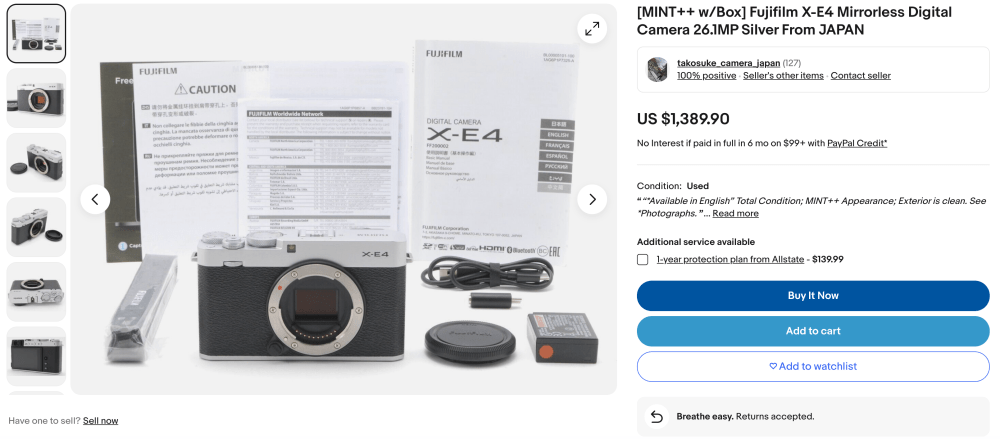
Another example is the Fujifilm X-E3 and X-E4 cameras. Fujifilm anticipated that demand for the X-E3 would be greater than it actually was, and made too many copies. Fujifilm had to discount the X-E3, and sometimes significantly, to clear the warehouse. You could still find brand-new (and discounted) X-E3 bodies 18 months after it had been officially discontinued. Fujifilm used the sales figures of the X-E3 to estimate the demand for the X-E4; however, the X-E4 was much more in-demand than the X-E3 was (largely because it was viewed as a top alternative to the impossible-to-find X100V in the aftermath of the viral videos). Fujifilm did not secure enough parts to manufacture nearly enough copies to meet the demand of the X-E4, and likely assumed (incorrectly) that the spike in demand would be short-lived. If you look at eBay, X-E4’s are listed for double the price of X-E3’s, and much higher than the MSRP when they were brand-new.

Low Sun over Tetons – Grand Teton NP, WY – Fujifilm X-E4 – Ferrania Solaris FG 400

I bring that up for a specific reason. While consumers prefer over-manufacturing (especially since it usually means one can find bargains, and you can readily buy what you want), producers prefer under-manufacturing. Most ideal is precise-manufacturing, but that is really difficult to achieve; between over and under, every company—including Fujifilm—would much prefer to err on the side of making too few of something than too much. And, if you want the gear that you spent a lot of money on to retain its value, you, too, will prefer them to err on the side of caution.

Toyota created the Toyota Production System in the aftermath of WWII. This system invented what is now referred to as Lean Manufacturing (or Lean Business Philosophy or Lean Strategy Process). Many books have been written on this topic—I have a few on my library shelf, although I’ve only actually read one. To understand Fujifilm’s approach to manufacturing and inventory means understanding the Lean approach, which is used worldwide, especially in Japan. This Harvard Business Review article gives a very brief synopsis of what the Lean strategy is, just to give you an idea; even better, I’m sure your local bookstore has a few books on this topic.

The conclusion is that Fujifilm (along with all manufacturers) is in the tough position of trying to accurately gauge demand for each product they offer, and attempt to produce just the right amount; if they are going to err on one side or the other, they much prefer to err by producing too few copies than too many. Making too many of something reduces its value, while making just the right amount or too few does not. They have to guess what the demand will be many months from now, not just what the current demand is. The current demand might be an indication of future demand, but it also might not. Fujifilm would love to make and sell 50,000 copies of something, but just because they make 50,000 copies of something doesn’t mean that they will actually sell them all. A much better position for Fujifilm is to make 30,00 copies of something, and sell them all. That’s not manipulating the market, but simply good business strategy that provides some stability in a turbulent market.

Leica Q2 from the perspective of a Fujifilm photographer

Leica Q2

Leica is the camera brand that everyone desires, but few can afford. Premium is the word that best describes Leica. Crème de la crème, or perhaps Beste der Besten. If you can afford a Leica you buy a Leica, because every real photographer wants a Leica. It’s a status symbol, and it shows that you’ve arrived.

All of that is hyperbole, of course; however, there’s a good chance you’ve heard the sentiment before. An alternative yet similar statement is that Fujifilm is the poor man’s Leica. You only own a Fujifilm camera because you cannot afford a Leica model; if you could, you’d own a Leica instead.

I’ve wanted to try a Leica for some time now. The cameras are beautiful, there’s no question about it. But is it beauty over brawn? Are Leica cameras actually so good that the cost is justifiable? Would I—a long-time Fujifilm photographer—like a Leica enough to purchase one? Are Fujifilm cameras just cheap Leica knockoffs for those who cannot afford the real deal? Those are questions that I wanted to answer.

MPB is the sponsor of this article. They loaned me a Leica Q2 to try out for a couple of weeks. For those who don’t know, MPB is an online platform where you can buy, sell, or trade used photo and video gear. “At MPB, there’s something for everyone who wants to try something new, hone their skills, or pursue their passion—and it won’t cost the earth.” If you’re in the market for used camera gear, be sure to check out their platform—you can learn more about MPB here. Thank you, MPB, for making this article possible!

Leica Q2

For those who don’t know, the Leica Q2 is a premium compact fixed-lens 47mp full-frame camera. It is simultaneously somewhat similar to the Fujifilm X100VI, Fujifilm X-E4, and Fujifilm X70, yet significantly divergent from all of those models in several aspects. It has a 28mm f/1.7 lens that is fast and sharp. The camera was released in 2019, and discontinued last year when it was succeeded by the Q3. The original MSRP of the Q2 was $5,800; the current used price is roughly $4,500 to $3,800, depending on the condition. The specific Leica Q2 that I picked from the MPB platform was exactly as described: the camera functioned like it was brand-new; the body had only extremely minor signs of wear, which I was well aware of due to the gear-specific ‘cosmetic condition’ rating (“Excellent” in this case) displayed on the platform.

Something that I was unexpectedly impressed with was the Leica box. I know this sounds strange, but Leica is head and shoulders above the other brands when it comes to packaging. I’d pay a little more to have my Fujifilm cameras come in functional boxes similar to what the Q2 came in. Sometimes the little things can be big things.

I didn’t know a whole lot about the Leica Q2 before this project. I was quite surprised by just how minimalistic the Q2 is. In this regard it is more like the Fujifilm X-E4, which is Fujifilm’s most minimalistic model in recent years, but even more so. There are not very many buttons and controls on the body. For a camera that begs to be used fully manually, it is incomprehensibly missing an ISO dial; however, it is possible to use the unmarked knob on the top plate as an ISO dial by programming the button on top of it to activate ISO. That’s not ideal, but it is certainly better than digging through the menu. On one hand I do like the clean approach, but on the other hand I found it to be a bit too minimalistic for my liking.

There’s no doubt that the Leica Q2 is a beautifully designed camera that is solidly built. While the body is just a tad larger than the Fujifilm X100VI, the lens is significantly larger, and the whole thing is definitely heavier. It’s easy to understand why it would be compared to the X100VI, but the Q2 is a little more similar to the X-E4 (just with a fixed lens instead of interchangeable, and more ruggedly built). The Q2’s 28mm lens is roughly equivalent to 18mm on Fujifilm X cameras, so that’s where a comparison to the long-discontinued X70 comes in. Probably the closest lens in the Fujifilm lineup to that of the Q2 is the Fujinon 18mm f/1.4. Overall, I think the Leica Q2 is dissimilar enough to any Fujifilm model that it’s really apples-to-oranges, yet similar enough that the correlations are understandable.

The Leica Q2 is best when used with a RAW workflow. It’s ok for straight-out-of-camera photography, but definitely much more limited in that regard than Fujifilm. The JPEG image quality is good-but-not-great. There are five profiles—three color and two B&W—which can only be customized to a small extent. For color, Standard is somewhat reminiscent of the Provia film simulation, Vivid can be made to fairly closely resemble factory-default Velvia, and Natural is like a cross between Eterna and PRO Neg. Std. I didn’t care much for Standard, and opted for Vivid the most, and Natural a distant second. For B&W, the two profiles are quite similar to each other, and are much more reminiscent of Monochrome than Acros (on Fujifilm). The High Contrast option has stronger shadows, but is otherwise similar to the standard B&W profile; it can be hard to tell the two apart sometimes. Since I stopped editing RAW files years ago, I only used the camera-made JPEGs.

Two notable issues for using the camera for JPEG photography is that it quite obviously struggles with color banding, such as with clear blue sky, and there is some pronounced distortion from the wide-angle lens that the camera doesn’t fix for you. In some situations, simply adding faux grain might be enough to cover up the banding, but other times that won’t likely be enough. For the distortion, either you have to be ok with it, or you have to adjust it in-post, and, if you are doing that, you might as well just shoot RAW.

It was definitely fun to try out the Leica Q2. I can understand why people desire it, since the camera has a lovely retro design and a minimalism philosophy, two things that I personally appreciate. I think you have to know going into it that RAW editing is more-or-less essential. I’d love to see Fujifilm create a camera that could be more of an apples-to-apples comparison to the Q2, so that you could have a similar experience but paired with Fujifilm’s wonderful JPEG output; currently, no such camera exists.

The Leica Q2 is both beauty and brawn, but not nearly as much JPEG brawn as I had hoped for. I do find the price to be very difficult to justify; however, if it’s a camera that you really want—and you buy it used—it can probably be a worthwhile expenditure. I don’t intend to purchase one, personally, particularly since the JPEG output isn’t nearly as good as Fujifilm’s. While there are certainly some similarities between Leica and Fujifilm cameras, there are plenty of differences that produce notably divergent experiences. If the Leica Q2 experience is what you are after, you’ll just have to get the Q2.

Example photographs, all camera-made JPEGs captured with a Leica Q2:

Vivid
Vivid
Vivid
Vivid
Vivid
Vivid
Vivid
Vivid
Vivid
Vivid
Black & White High Contrast
Natural
Vivid
Vivid
Natural
Vivid
Vivid
Vivid
Natural
Natural
Standard
Vivid
Natural
Black & White
Black & White High Contrast

Previously in this series:
Fujifilm X-Pro2 — The camera that got away (again)
Fujifilm X-T50 + Fujinon 23mm F/2 = Interchangeable-Lens Fujifilm X100VI??

Up next: Fujifilm X30 — Fujifilm’s Forgotten Retro Compact Zoom

Using my Fujifilm X-T30 for the first time in a long time

The last time that I used my Fujifilm X-T30 was in early December. Yesterday was the first instance I had made any pictures with it in over six months, the longest time in-between use. Once it was my most-used camera; there was a time when I really, really liked the X-T30.

I purchased my Fujifilm X-T30 brand-new in 2019, right when it was announced in February. I used it extensively for about 15 months, until my wife gave me an X100V for my birthday. I still regularly photographed with it for awhile (although not nearly as much as before the X100V), until I purchased a Fujifilm X-E4 in March of 2021. Ever since then, my X-T30 has mostly sat on the shelf collecting dust. Every now-and-then I still capture some images with it. At first it was once every few weeks, then once every couple of months—the time gap has been growing longer and longer. Finally, it surpassed six months.

You might think that it’s time to sell it. If I’m not using the camera, perhaps someone else could. I’m sure there are people contemplating a used X-T30 right now. But I kind of want to hold onto it awhile longer. I have a lot of memories with the camera. In fact, just today my wife was showing me some family pictures from 2019 and early 2020, and in a number of them I have an X-T30 in my hands or around my neck. Maybe I should consider parting ways with it, but I’m not ready to do so just yet.

Especially after yesterday. I dusted the camera off, attached a TTArtisan 27mm f/2.8 lens, loaded it with my Kodacolor Recipe, and captured a bunch of pictures—I’ve included four of those images above. It was so much fun! My kids enjoyed being photographed, too. I’m not a portrait photographer, but I sometimes pretend to be one. The X-T30 is a great little camera, and I particularly appreciate the diminutive size and weight of it. The Kodacolor Recipe is one of my favorites, especially for a 1980’s vibe.

While I’d prefer a Fujifilm X-T30 II or especially a Fujifilm X-T50, the X-T30—the original one from 2019—is still very good. Just because some new camera comes along that’s “better” doesn’t mean that the camera you own and use is somehow not good. The Fujifilm X-T30 is still worth owning and using in 2024, and will be for awhile to come. I definitely need to use it more often than I have recently, and not allow so much time to go by in-between picking it up.

The Camera that Fujifilm Should Make Right Now (but probably won’t)

There’s a digital camera that Fujifilm should absolutely be making right now, and it’s not the X-Pro4, or X-E5, or a full-frame model (although those would be great, too). There’s a specific camera that would fly off the shelves—the X100VI’s historic demand would pale in comparison. What is this camera?

The digital QuickSnap.

The Fujifilm QuickSnap is a disposable 35mm film camera that is beloved for its nostalgic lo-fidelity aesthetic, simplicity, and price. Fujifilm introduced the QuickSnap camera in 1986, with the slogan, “Everybody should enjoy photography with ease.” The QuickSnap was an immediate success, and was immensely popular for a very long time—it was even successful enough to survive the film crash of the 2000’s. People still buy and use QuickSnap cameras; they’re particularly popular for weddings, kids, and lomographers. Many people love the nostalgic experience of one-time-use cameras.

Interestingly, the most sold digital camera right now in Japan is a cheap Kodak digicam. Third and fifth places are also cheap Kodak digicams. Digicams are a dime a dozen (perhaps literally, if you win a collection on an auction site, or rummage through your parents or grandparents house). What’s missing in the photo world is a digital version of the QuickSnap, a film camera that partially inspired the digicam. I have zero doubts that it would be a massive success for Fujifilm, and would probably leave all digicams in the dust.

This is how I envision the digital QuickSnap:

First, it would need a digital sensor that obviously won’t be anywhere close to full-frame, since that would be both ridiculous and expensive. The Fujifilm Mini Evo has a tiny 5mp sensor; it would likely be a mistake to use that one, but they certainly could. I think that a 12mp or 16mp 1/2.3″ would be the most obvious choice, since those can be obtained by Fujifilm rather easily and cheaply. The sensor itself doesn’t matter all that much; however, cost and quality must be balanced extremely carefully. Too poor of image quality will hurt sales, while a too expensive price-tag will also hurt sales.

More important, though, is the picture aesthetic. Fujifilm should program it with their Classic Negative film simulation, including faux grain—something similar to my Fujicolor Superia 800 Recipe. The pictures created by the digital QuickSnap camera should look similar to the pictures that come out of an analog QuickSnap. As much as practical, the pictures need to look alike from the film and digital versions.

Next, it needs to function nearly the same as the analog QuickSnap. It should be super simple: a switch to activate the built-in flash, a wheel to cock the shutter and “advance” to the next frame, a shutter release button, a battery-level indicator, and maybe a one-press picture-transfer to an app. There should not be any LCD or electronic viewfinder to review the pictures.

The very basic optical viewfinder from the film camera should be carried over—the user experience should be as similar to the analog version as possible. Due to the crop factor of the sensor, a new lens will be necessary. The exact sensor size will determine what the lens should be, perhaps something like a 5mm or 6mm f/5.6 plastic lens that’s close to 30mm full-frame equivalent. What is important is that it is focus-free (fixed focus) and produces a similar aesthetic to the film camera.

A critical factor of one-time-use cameras is the film itself; namely, the tolerance for under and over exposure. Since the sensor won’t have this same tolerance, it’s necessary for the digital QuickSnap to have some amount of exposure control. It must have a light meter, as well as some (auto) control over the ISO and shutter speed. For the sake of image quality, the ISO should be capped as low as practical. If Fujifilm could utilize the D-Range Priority technology, I think that would help, too.

The digital QuickSnap should have internal storage that saves only 27 JPEG images. It could count the exposures mechanically exactly like the film camera does, providing an identical experience. Once the 27th picture has been captured, it won’t let you capture anymore until the memory has been cleared, either by wirelessly transferring the images to a mobile app, or via USB. The QuickSnap App should be super simple (and actually work), with an option within the app to auto-connect and transfer once 27 pictures have been recorded, or manually connect and transfer if preferable. The camera should also be able to connect to the Instax app, and transfer (and print) directly from there. The camera should charge via USB, and could also transfer the images using a USB cable. Once the pictures have been removed from the camera, it would then allow the user to capture the next 27 frames.

The QuickSnap App, aside from photo transfers, should have a few simple options, for those who wish to do a little more with their pictures. A retro-styled date stamp. Maybe a few filter overlays that don’t radically change the picture aesthetic (examples: high contrast, low contrast, warm, cool, color boost, reduce color, etc.), and maybe a handful of light-leak affects. The more simple the better. Maybe Fujifilm can even offer a service where 4″ x 6″ prints can be made and mailed out to customers who wish for an even more authentic experience.

While the size and design should still closely resemble the film version, I think the digital QuickSnap must feel a little more sturdy, and not so cheap that it would easily break if dropped. If Fujifilm could offer it for less than $100, that would be most ideal. A camera like that would be a huge hit, thanks to its nostalgic charm, ease of use, straight-out-of-camera aesthetic, and affordability.

You’re welcome, Fujifilm.

Don’t want to wait for a digital QuickSnap, but still want the look? Check out these articles:
Getting a Disposable Camera Look with DispoLens
Getting that ’90’s Film Look with Fujifilm Cameras

For those wondering, the four pictures in this article were captured with a Fujifilm X100VI using the Superia Negative Recipe.

Top 25 Most Popular Film Simulation Recipes in May 2024

Manhattan from Pulaski Bridge – New York City, NY – Fujifilm X-T50 – PRO Negative 160C

I get asked fairly regularly which Film Simulation Recipes are the most popular. For me, this is a fascinating topic, but it’s definitely hard to know definitively. While I get a glimpse on social media, my best gauge is the Fuji X Weekly website statistics; specifically, which Recipe articles are viewed the most. I don’t collect any data on the Fuji X Weekly App, so that’s no help—although, if I did, it would likely offer the most accurate picture; however, it would still be impossible to know which Recipes people programmed into their Fujifilm cameras, or how often they used each. Perhaps a survey would be particularly useful, yet even it has its limitations. While certainly a flawed method, page-view website statics offer the best glimpse at which Film Simulation Recipes are the most popular, so that’s what I’m using for this article. These are simply the Top 25 most-viewed Recipes on the Fuji X Weekly website last month (May 2024).

There was a lot of movement for May, especially in the bottom 80% of this list—the top five Recipes are pretty predictable. Those with Kodak brand names in the title—Kodachrome, Portra, Gold, Tri-X, etc., etc.—are usually the most popular. Classic Chrome is the king of film simulations, as the majority of the most-viewed Recipes are based on that film simulation.

Gate E8 – Phoenix, AZ – Fujifilm X100VI – Kodak Portra 400 v2

Bright Summer has been on a rollercoaster lately, and its jump to number six is quite surprising. A lot of upward and downward movements overall. A couple Recipes that usually rank in the Top 25 didn’t make the cut. There are three Nostalgic Negative Recipes in this list, which is a bit unusual, two Classic Negative Recipes, one each of Eterna, Reala Ace, and Acros; otherwise, all the rest are Classic Chrome.

Without any further delay, below are the most popular Recipes of last month!

Top 25 Most Popular Film Simulation Recipes of May 2024

#1:

A Classic Chrome based Recipe for X-Trans IV cameras that is the long-time most popular Film Simulation Recipe for Fujifilm cameras. This is the king of Recipes!

#2:

A Classic Chrome based Recipe for X-Trans IV cameras that is almost always ranked number two in these types of lists.

#3:

Another popular Classic Chrome based Recipe for X-Trans IV cameras. It climbed one spot.

#4:

A Wes Anderson inspired Recipe based on Classic Chrome for X-Trans IV and X-Trans V cameras. It was ranked #2 for April.

#5:

Reala Ace is the most popular Classic Negative based Recipe. It was ranked in the same position last month.

#6:

Bright Summer—another Classic Chrome based Recipe for X-Trans IV—is sometimes called Preetra 400, because it is modeled after Preet’s aesthetic (Preet himself is the one who gave it that nickname, btw). It doesn’t usually crack the Top 25, but in March it suddenly jumped to #9, for April it fell to #23, and now in May it up all the way to #6!

#7:

This is a recently published Recipe that uses Classic Chrome, and has similarities to Kodak Portra. It’s compatible with both X-Trans IV and X-Trans V. This Recipe moved up one position from April.

#8:

This version of Kodak Portra 400 was commonly the third most popular Film Simulation Recipe on Fuji X Weekly for a long time. It fell one spot compared to last month.

#9:

Pacific Blues used to be the highest-ranked Classic Negative based Recipe, but Reala Ace has left it in the dust. This particular one is compatible with X-Trans IV models, but there is also an X-Trans V version. In April it was ranked #16, so it is definitely on the rise.

#10:

A somewhat recently published Classic Chrome based Recipe for X-Trans IV and X-Trans V cameras. It fell one spot compared to April.

#11:

By far the most popular B&W Recipe, Kodak Tri-X 400 is based on the Acros film simulation, and has compatibility X-Trans III, X-Trans IV, and X-Trans V models. It was ranked #17 last month.

#12:

This is the X-Trans V version of Kodak Portra 400 v2. It rose two spots from April.

#13:

Vintage Kodachrome, which is based on Classic Chrome, is one of the older Film Simulation Recipes on Fuji X Weekly, and is compatible with X-Trans III cameras. It was ranked #11 last month.

#14:

Another Classic Chrome based Recipe, for use on X-Trans III models, plus the X-T3/X-T30. This one rose several spots, as it was ranked #19 in April.

#15:

This is a fairly recently Recipe, and the very first to use the new Reala Ace film simulation. At the moment, it is only compatible with the Fujifilm X100VI and X-T50. In April it ranked #12.

#16:

The very first Film Simulation Recipe on Fuji X Weekly, it is compatible with X-Trans III cameras. It ranked #21 last month.

#17:

This is the X-Trans V version of Kodak Gold 200. It rose three positions from April.

#18:

This is the X-Trans V version of Kodachrome 64. It’s in the same exact spot compared to last month.

#19:

This is a newly published Recipe that uses Nostalgic Negative as the base, which means that it is for X-Trans V cameras. This Recipe is what I used for my two pictures that are found on Fujifilm’s new film simulation page.

#20:

1976 Kodak doesn’t typically crack these lists, but it is a very good Recipe that I’m happy to see being used by more people. The base film simulation is Nostalgic Negative, so it is only compatible with X-Trans V cameras.

#21:

This Recipe is reminiscent of scanned Kodachrome 64 slides, and is compatible with X-Trans IV cameras. Last month it was ranked #15.

#22:

This is a recently published Eterna-based X-Trans V CineStill 800T Recipe; however, it’s simply an adaptation of the X-Trans IV version that has been around awhile. This is the highest ranking Eterna-based Recipe; however, it fell significantly, from #10 in April.

#23:

This is a Recipe that I’m surprised doesn’t rank higher; typically, it’s not even in the Top 25. This version is for X-Trans IV cameras, but there are also versions for X-Trans II, X-Trans III + X-T3/X-T30, and X-Trans V.

#24:

Kodachrome II is an older Recipe made for X-Trans III cameras. It used to often be in the Top 10, but has been falling for awhile. Last month it ranked the same.

#25:

The weather is getting hotter, so it’s not a huge surprise that 1970’s Summer is on the rise. This is a Nostalgic Negative Recipe for X-Trans V cameras.

See also:
How To Add Film Simulation Recipes To Your Fujifilm Camera
The Essential 7 Film Simulation Recipes to Program Into Your Fujifilm Camera First

Find these Film Simulation Recipes and many more on the Fuji X Weekly App!

A Controversy Undone

The Camera Bar – New York City, NY – Fujifilm X-T50 – Pacific Blues Recipe

Panasonic inadvertently created a controversy (actually, two). You’re probably aware of it already, but for those who aren’t, let me briefly explain it to you. Afterwards, I’ll tie it back into Fujifilm and Fuji X Weekly, and by the end it will all make sense why I’m bringing it up on this blog.

It began when Gerald Undone, a popular YouTuber, posted a video lamenting that Panasonic didn’t invite him to the launch event of the Lumix S9, nor did they send him a preproduction model prior to release. Gerald comes across as unnecessarily bothered for the exclusion; however, he goes on to make some extremely valid points that shouldn’t be dismissed. If you haven’t seen the video, I’d rather you watch it and form your own opinions than to read my commentary on it, so I’ll leave it at that.

What is important to note, though, is that—in Gerald’s view—Panasonic punished him for being critical of one of their products (or, really, using the “wrong” word), and they told him they were excluding him from the S9 launch because they were concerned he wouldn’t like the camera. In his opinion, Panasonic’s content-creator inclusion for the event was largely based on who they felt would tow the company’s line, which casts skepticism (fairly or unfairly) across the viewpoints of those who were invited. Again, you can watch the video and form your own opinions, I’m just trying to lay out the controversy for those who are unaware.

Bus Ride with Tom Baumgaertel – New York – Fujifilm X100VI – Kodak Tri-X 400 Recipe

Afterwards, people noticed that the camera reviews by those who attended the launch event and/or who had received a preproduction model of the Lumix S9 were largely very positive despite the technical specs and features being surprisingly mediocre. There was an obvious disconnect between the initial reviews and the perception of those who had read the fine details. Did that prove Gerald right?

Important to the controversy is that the Lumix S9, aside from one important aspect, is probably the least interesting full-frame camera released in the last decade (this is my opinion, it’s ok to disagree). Some reviewers—I’m sure at the recommendation of Panasonic—suggested that the S9 is comparable to the Fujifilm X100VI; basically, the S9 is a full-frame interchangeable-lens X100VI alternative. However, the Fujifilm camera that the S9 is most similar to is the X-A5, and not the X100VI. The X-A5 has some advantages (mechanical shutter, hotshoe, grip, size/weight, price, lenses), and the S9 has some advantages (6K video, IBIS, larger dynamic range, better high-ISO, better autofocus); otherwise, those two models are surprisingly similar.

The “important aspect” of the Lumix S9, which is indeed noteworthy, is the ability to wirelessly transfer LUTs (think overlays or presets) from an app to the camera, and apply those to still pictures for straight-out-of-camera photography. Panasonic is trying to create a community around LUTs similar to the Recipe Community for Fujifilm. Interestingly, Panasonic’s slogan for the S9 is: “Shoot. Edit. Share.” It’s a mixed message, for whatever reason; however, Film Simulation Recipes have become so popular for Fujifilm that other brands are trying to figure out how to incorporate something similar, which should not be overlooked or under-appreciated.

Omar Gonzalez – New York City, NY – Fujifilm X-T50 – Superia Negative Recipe

Going back to the controversy, there have been a large number of people within the photography world who have commented on a perceived disconnect between what the Lumix S9 actually is and the hype that many YouTubers espoused who were flown to Japan for the launch. The solution suggested by some is to ignore the opinions of those who were given early-access to the S9, and especially to those who attended the launch. But is that fair?

I was recently loaned a preproduction Fujifilm X-T50. I wasn’t invited to the X-Summit launch event in Sydney, but I was flown to a secondary event in New York City. The X-T50 has a contentious design choice that I spoke (mostly) positively about. Do you see a parallel? Was I invited because Fujifilm thought I would hype the camera? Were my opinions influenced by Fujifilm’s generosity towards me? Can Fuji X Weekly still be trusted for unbiased opinions (or at least as unbiased as an unashamed fanboy can get)? I really had to ask myself these questions, and give this whole matter a lot of consideration.

When I arrived in New York, one of the first things I was asked by a Fujifilm representative is what I thought of the new Film Dial. I said that I was unsure about it at first, but once I figured out how to get the most out of it, I really liked it. The representative was surprised, because it was assumed that I wouldn’t like it, since it’s not necessarily designed for use with Recipes.

Bryan Minear Getting Soaked – Windham, NY – Fujifilm X-T5 – Kodak Tri-X 400 Recipe

During the trip—and even before—it was stated several times by Fujifilm that what they wanted most was authenticity—those involved shouldn’t be concerned with what they may believe the company wants; Be true to who you are. I was also told that vulnerability is a virtue they appreciate. Looking back, my impression is that they wanted those in attendance to be at ease, and to not feel pressured to think or feel some certain way, or create some certain things. The point seemed to be more about establishing connections between creative people who happen to use Fujifilm products, and much less about the products themselves.

The question is whether or not I was influenced in some way by Fujifilm. I probably would not have picked up an X-T50 had Fujifilm not sent me one; had I not used it, I probably would not have spoken so positively towards it, because I wouldn’t have discovered how to effectively use it. That seems like an obvious one, to me. Maybe more subtly: I met some of the people behind the brand, and gained insights into some inner workings, which adjusted my perception about the company—essentially, some of my preconceived notions about Fujifilm had to be realigned to match reality. That’s a type of influence that I believe is actually positive. Did I come away thinking that if I speak negatively about the brand, I won’t be invited back? I’d be lying if I told you that it didn’t cross my mind, because it did; however, I don’t believe that is true.

This whole controversy has caused me to pause and self-reflect, and evaluate my own motives and actions. I want authenticity and vulnerability to be the gold standard of this website and myself, personally. I hope that I’m a trustworthy voice in the Fujifilm community—both now, and for years to come. I’m highly appreciative that Fujifilm reached out to me, loaned me a camera, and invited me to their event, and I look forward to any other potential opportunities to work with the brand in the future. If I have to leave my ethics at the door to do so, I’m not ok with that. Thankfully, I don’t believe Fujifilm would ask that of me, but it is important to not be complacent of the potential, and to hold onto my personal values tightly at all times.

Fujifilm X-Pro2 — The camera that got away (again)

Back in 2018, I briefly owned a Fujifilm X-Pro2. I loved that camera! It was so much fun, and the perfect compliment to my Fujifilm X100F. To this day it remains my absolute favorite interchangeable-lens model by Fujifilm that I’ve ever purchased. Unfortunately, I had to sell it.

You see, I didn’t have a lot of money back then to spend on (what was at the time) my hobby. I’m sure that many of you can relate. I found a good deal on a used X-Pro2, but I really couldn’t afford it. Using PayPal credit, I was able to hold onto the camera for about six months, but when the interest came due, I had to let it go. I had high hopes that I could find a way to keep it, but it just didn’t work out. The day that I mailed the X-Pro2 off to its new owner was a sad one (although I’m sure it was quite happy for them). I’ve thought about that camera—and the summer of 2018 when I briefly owned it—many times since. I’ve often wondered if I’d like it just as much today as I did then.

Thankfully, the kind folks at MPB, who are fans of Fuji X Weekly and Film Simulation Recipes, provided me with the opportunity to find out. MPB is the sponsor of this article—this is the first ever sponsored post on this website, by the way—and they loaned me a Fujifilm X-Pro2 to try out for two weeks. For those who don’t know, MPB is an online platform where you can buy, sell, or trade used photo and video gear. “At MPB, there’s something for everyone who wants to try something new, hone their skills, or pursue their passion—and it won’t cost the earth.” If you’re in the market for used camera gear, be sure to check out their website—you can learn more about MPB here. Thank you, MPB, for making this article possible!

Fujifilm released the X-Pro2 eight years ago, in 2016. It’s a rangefinder-styled 24mp APS-C mirrorless camera with a hybrid optical/electronic viewfinder. The X-Pro2, which resembles a classic film camera, is rock-solid, and feels like it could last forever, even if you tossed it around a little. In my opinion, the X-Pro series is one of the most beautifully designed camera lines of all time. The X-Pro2 was an instant classic when it was newly released, and will continue to be for many years to come.

I chose the specific Fujifilm X-Pro2 that I wanted to borrow from the MPB website the same as if I were buying it. When the box arrived in the mail, the camera was exactly as the website described. The camera functioned like it was brand-new; the body had a few minor signs of wear, which I was well aware of due to the gear-specific ‘cosmetic condition’ rating displayed on the platform. There were no surprises, and I got precisely what I was expecting to get. Did I mention that the X-Pro2 is a beautiful camera?

When I had the X-Pro2 back in 2018, I brought it along with me on some epic roadtrips. It went with me to the Black Hills in South Dakota. It traveled with me through Colorado and New Mexico, including The Great Sand Dunes and Taos. I have many great memories associated with the X-Pro2. Was how I felt more about those adventures than the camera itself? Or was the camera truly that great?

As I was removing the X-Pro2 from the box, many of those memories came flooding back. It was a great joy to hold it once again. This time, I wouldn’t be able to take it on any roadtrips. Would I feel the same without some travel experiences to go along with the camera? I wondered what I would think about the X-Pro2 all these years later—would it hold up to the test of time?

Back in 2018, I mostly used three lenses with the X-Pro2: Fujinon 60mm f/2.4, Fujinon 16mm f/1.4, and Meike 35mm f/1.7. Of those three, the only one that I still own is the Meike, so I used it extensively during the two weeks that I had the X-Pro2. I also tried a Helios 44-2, Pentax-110 50mm f/2.8, and 7Artisans 35mm f/0.95. Each of those four lenses have unique characteristics and strengths. The X-Pro2 is especially fun to pair with vintage and manual lenses, and I very much enjoyed that approach with it.

I shoot JPEGs, and rarely edit my pictures (aside from some cropping/straightening). I found that this approach works very well for me. The photographs in this article are all camera-made JPEGs that are not post-processed. The Film Simulation Recipes that I used with the camera six years ago were mainly Kodachrome II, Dramatic Classic Chrome, Vintage Agfacolor, Acros, Acros Push Process, and Agfa Scala. A few of those pictures remain personal favorites to this day.

Above: My Fujifilm X-Pro2 photos from 2018.

For this project, the seven Recipes that I programmed into the C1-C7 Custom Presets on the X-Pro2 were Kodachrome II, Kodak Gold 200, Kodacolor, Classic Kodak, Color Negative, Provia Slide, and Acros. The Kodachrome II and Acros Recipes require the same White Balance type but different White Balance Shifts, so I used the Kodachrome II shift with the Acros Recipe; however, towards the end of the project I replaced Kodachrome II with Analog Monochrome, and switched the Acros WB Shift to be correct for that Recipe. You cannot program a WB Shift into the X-Pro2’s C1-C7 presets (like you can with newer Fujifilm models), but if each Recipe uses a different WB type (or share the same WB type and WB Shift), you don’t have to remember to adjust the WB Shift when changing Custom Presets, and you get a better user experience.

When reviewing the pictures after I returned the camera, I discovered that the Film Simulation Recipes I had used the most were Provia Slide, Acros, Kodak Gold 200, Kodachrome II, and Kodacolor (in that order). Provia Slide is a brand-new Recipe that I created on the X-Pro2, and it wouldn’t exist if MPB hadn’t loaned me the camera, and is a very positive side effect of their sponsorship. I’m quite happy with how several of these images turned out, even if I only had the local sights to capture.

Using Film Simulation Recipes on the Fujifilm X-Pro2 provides a film-like shooting experience and output, especially when combined with vintage or manual lenses. It’s an analog approach with the convenience of digital. Since the pictures don’t need to be edited, you can download them straight from the camera using WiFi and immediately share them—or send them off to be printed—right from your phone. That can save you a lot of time and hassle, while making the process more enjoyable and authentic.

Above: My Fujifilm X-Pro2 photos from 2024.

It was once again heartbreaking to mail off the Fujifilm X-Pro2. I very much wanted to keep it. The camera is just as great in 2024 as it was in 2018. I can’t help but think that 20 years from now the X-Pro2 will be sought after for the photographic experience and picture aesthetic that it provides. There aren’t very many digital cameras you can say that about. I feel like in today’s age where new camera models are constantly being released, and photographers just have to have the latest-and-greatest, it’s easy to overlook legendary cameras like the X-Pro2. And I do very much mean that the Fujifilm X-Pro2 is legendary—those who own it already know it, and those who don’t haven’t yet discovered it.

If you want to buy a Fujifilm X-Pro2, MPB has a number of them in stock right now. Or, if you prefer other Fujifilm cameras, they have many to choose from. If you have some gear to sell or trade in, they’ll give you a free (and non-binding) quote.

Will I buy a Fujifilm X-Pro2, this time to keep? I’d love to and I hope to, but I already own way too many cameras, so I’d first need to part ways with at least a couple that I rarely use. The X-Pro2 is extremely tempting. I don’t have an answer one way or the other yet, but the X-Pro2 is one that I certainly wish that I had.

Up next in this series:
Is the Fujifilm X-T50 + Fujinon 23mm f/2 a good alternative to the Fujifilm X100VI?

Fujicolor Natura 1600 — Fujifilm X-T5 (X-Trans V) Film Simulation Recipe

Lantana Blooms – Buckeye, AZ – Fujifilm X-T5 – Fujicolor Natura 1600

Fujifilm produced Fujicolor Natura 1600, a high-ISO color negative film, from 2003 through 2017. It was only sold in Japan, but it became renown worldwide as word got out about this wonderful emulsion. A lot of speculation has surrounded it. Is it simply renamed Fujicolor Superia 1600? Many people think so. Is it slightly modified Superia 1600 for Japanese skin-tones? Some people think so. Is it slightly modified Superia 1600 made specifically for the Fujifilm Natura camera? Perhaps so. I haven’t found any definitive evidence to conclude if Natura 1600 is unmodified Supera 1600 or a slightly modified variant of it; if it isn’t identical, it’s very similar.

I have a Fujicolor Superia 1600 Film Simulation Recipe already, and it’s a Recipe that I personally quite like. One film can have many different aesthetics, depending on a whole host of factors, including (but not limited to) how it was shot, developed, and scanned. In a sense, you could consider this a v2 of the Fujicolor Superia 1600 Recipe; however, it was modeled after examples of Fujicolor Natura 1600 scans that I found online (and not Superia). This Fujiclor Natura 1600 Recipe isn’t new, but simply a modification of the X-Trans IV version for use on X-Trans V cameras. Because X-Trans V renders blue more deeply on some film simulations, a slight change was needed to Color Chrome FX Blue, but otherwise the two versions are identical.

Fiat – Buckeye, AZ – Fujifilm X-T5 – Fujicolor Natura 1600

This Fujicolor Natura 1600 Film Simulation Recipe is intended for fifth-generation X-Trans cameras, which (as of this writing) are the Fujifilm X-H2s, X-H2, X-T5, X-S20, and X100VI. For X-Trans IV, use the X-Trans IV version (click here). For newer GFX cameras, you can use this Recipe, but know that it will render slightly different (try it anyway). Click here if you’re not sure how to program a Film Simulation Recipe into your Fujifilm camera.

Film Simulation: Classic Negative
Dynamic Range: DR400
Grain Effect: Strong, Large
Color Chrome Effect: Strong
Color Chrome FX Blue: Weak
White Balance: 5500K, -1 Red & -2 Blue
Highlight:-1.5
Shadow: +1.5
Color: -2
Sharpness: -2

High ISO NR: -4
Clarity: -4
ISO: Auto, up to ISO 6400
Exposure Compensation: +1/3 to +1 (typically)

Example photographs, all camera-made JPEGs captured using this Fujicolor Natura 1600 Film Simulation Recipe on my Fujifilm X-T5:

Newly Sprouted Bougainvillea Branch – Buckeye, AZ – Fujifilm X-T5
Bougainvillea in the Neighborhood – Buckeye, AZ – Fujifilm X-T5
A Frame, Dormant Tree – Buckeye, AZ – Fujifilm X-T5
Bougainvillea by Twin Windows – Buckeye, AZ – Fujifilm X-T5
Americana Suburbia – Buckeye, AZ – Fujifilm X-T5
Suburban Spanish Architecture – Buckeye, AZ – Fujifilm X-T5
Sunset over Suburban Home – Buckeye, AZ – Fujifilm X-T5
Apartments behind Pond – Goodyear, AZ – Fujifilm X-T5
Tree Reflections – Goodyear, AZ – Fujifilm X-T5
Reflection Abstract – Goodyear, AZ – Fujifilm X-T5
Sunset Light on Jonathan – Buckeye, AZ – Fujifilm X-T5
Parking Garage at Dusk – Goodyear, AZ – Fujifilm X-T5
Parking Garage at Night – Goodyear, AZ – Fujifilm X-T5
Library Shelves – Goodyear, AZ – Fujifilm X-T5
Don’t Look – Goodyear, AZ – Fujifilm X-T5
Dying Blossoms – Goodyear, AZ – Fujifilm X-T5
Pallets & Blocks – Goodyear, AZ – Fujifilm X-T5
Caution Light – Goodyear, AZ – Fujifilm X-T5
Car Light – Buckeye, AZ – Fujifilm X-T5
Rover Mini Headlamps – Buckeye, AZ – Fujifilm X-T5
Mini Wheel – Buckeye, AZ – Fujifilm X-T5
Car Rider – Buckeye, AZ – Fujifilm X-T5

Comparison:

Fujicolor Natura 1600 Film Simulation Recipe

This post contains affiliate links, and if you make a purchase using my links I’ll be compensated a small amount for it.

Fujifilm X-T5 in black: Amazon, B&H, Moment, Wex
Fujifilm X-T5 in silver:  Amazon, B&H, Moment, Wex

Find this Film Simulation Recipe and over 300 more on the Fuji X Weekly App! Consider becoming a Patron subscriber to unlock the best App experience and to support Fuji X Weekly.

Agfa Ultra 100 v2 — Fujifilm X-T5 (X-Trans V) Film Simulation Recipe

Yellow Blossoms Along a Fence – Buckeye, AZ – Fujifilm X-T5 – Agfa Ultra 100 v2

Ultra 100 was a short lived color negative film made by Agfa from 2003 to 2005. After its discontinuation it gained a cult-like following; unsurprisingly, I’ve been asked many times to replicate the aesthetic for Fujifilm cameras. The supply of this emulsion has been getting smaller and smaller, and before long it will likely be completely gone. Nowadays, a digital approximation will be your best bet to achieve an Agfa Ultra 100 look.

Two years ago I published an Agfa Ultra 100 Film Simulation Recipe, using Classic Negative as the base. I said of it, “I’m actually not fully satisfied with this Recipe. I think sometimes it’s pretty spot-on, and I think other times it is significantly off.” Two years later, having just re-reviewed a lot of Agfa Ultra 100 photographs in preparation for this article, I completely agree with that assessment: some of the pictures captured with my Agfa Ultra 100 Recipe look extremely similar to some pictures I found captured with the film stock, while others don’t look especially alike. That shouldn’t be too surprising because one film can produce many different looks based on a host of factors, including how shot, developed, printed and/or scanned.

Vibrant Spring – Buckeye, AZ – Fujifilm X-T5 – Agfa Ultra 100 v2

I recently received an email from a film photographer who has been shooting with Agfa Ultra 100 for many years. He purchased a large supply of the film back in 2007, and has kept it in his freezer ever since. With his supply now running low, he began to look for alternatives, and in the process stumbled upon Fuji X Weekly. Unfortunately, my Agfa Ultra 100 Film Simulation Recipe wasn’t a good match for his pictures, so he reached out to me to see if it would be possible to better replicate his photographs. He sent me some samples, and I noticed right away that it was dissimilar from my Recipe. His pictures had a distinct Nostalgic Neg. vibe, so I thought I could probably recreate the aesthetic using that film simulation.

His Agfa Ultra 100 pictures were captured with Pantax MZ-S 35mm SLR, overexposed slightly to compensate for the film being expired, developed by MPix, and scanned on a Noritsu. No post-processing was done, other than whatever corrections the lab may have made while scanning. The resulting pictures looked different than my Recipe, and also different from most of the photographs captured with the film that I found online. In particular, his photographs were significantly warmer and a tad more vibrant than my original Recipe. After a few days of tweaking, I feel like I got really close to the specific aesthetic of his pictures. He only sent me a handful of images to examine, so it’s based on a small sampling; however, this new Recipe seems like a pretty good match overall.

Maricopa Trail – Buckeye, AZ – Fujifilm X-T5 – Agfa Ultra 100 v2

My new Agfa Ultra 100 v2 Film Simulation Recipe is compatible with fifth-generation X-Trans cameras, which (as of this writing) are the X-H2s, X-H2, X-T5, X-S20, and X100VI cameras. Those with newer GFX cameras that have the Nostalgic Neg. film simulation can use it, too; however, it will render slightly different (try it anyway). While this Recipe is intended for sunny daylight situations, it does surprisingly well in a variety of light scenarios.

Film Simulation: Nostalgic Neg.
Dynamic Range: DR400
Grain Effect: Weak, Large
Color Chrome Effect: Weak
Color Chrome FX Blue: Weak
White Balance: 5800K, -3 Red & -3 Blue
Highlight:+1.5
Shadow: +1
Color: +3
Sharpness: -2

High ISO NR: -4
Clarity: -2
ISO: Auto, up to ISO 6400
Exposure Compensation: 0 to +1 (typically)

Example photographs, all camera-made JPEGs captured using this Agfa Ultra 100 v2 Film Simulation Recipe on my Fujifilm X-T5:

SRT303 – Buckeye, AZ – Fujifilm X-T5
Empty Shell Station – Glendale, AZ – Fujifilm X-T5
Dusk Lamp – Buckeye, AZ – Fujifilm X-T5
Corner House at Dusk – Buckeye, AZ – Fujifilm X-T5
Groceries & Meat – Buckeye, AZ – Fujifilm X-T5
Joshua in Window Light – Buckeye, AZ – Fujifilm X-T5
Fake Orchid – Buckeye, AZ – Fujifilm X-T5
Curtains & Blinds – Buckeye, AZ – Fujifilm X-T5
Bright Buzz People Happen – Goodyear, AZ – Fujifilm X-T5
PARK – Goodyear, AZ – Fujifilm X-T5
Sunset from a Parking Garage – Goodyear, AZ – Fujifilm X-T5
Sunset Reflected in a Pond – Goodyear, AZ – Fujifilm X-T5
Golden Suburbia – Buckeye, AZ – Fujifilm X-T5
Roofline & Lens Flare – Buckeye, AZ – Fujifilm X-T5
Bougainvillea Green – Buckeye, AZ – Fujifilm X-T5
Yellow Desert Flowers – Buckeye, AZ – Fujifilm X-T5
Sharp Spikes – Buckeye, AZ – Fujifilm X-T5
Rad – Buckeye, AZ – Fujifilm X-T5
American – Buckeye, AZ – Fujifilm X-T5
Red Stripe – Buckeye, AZ – Fujifilm X-T5
Repurposed Fire Hydrant – Buckeye, AZ – Fujifilm X-T5
Bell Tower – Buckeye, AZ – Fujifilm X-T5
Do Not – Buckeye, AZ – Fujifilm X-T5
Fish Fan – Buckeye, AZ – Fujifilm X-T5
Girl on the Green Grass – Goodyear, AZ – Fujifilm X-T5
Pavement, Grass & Shadows – Buckeye, AZ – Fujifilm X-T5
Roofscape – Buckeye, AZ – Fujifilm X-T5
Open Window – Buckeye, AZ – Fujifilm X-T5
Broken Home – Buckeye, AZ – Fujifilm X-T5
Home in Ruins – Buckeye, AZ – Fujifilm X-T5
Mitsubishi – Buckeye, AZ – Fujifilm X-T5
Monroe Ave Sidewalk – Buckeye, AZ – Fujifilm X-T5

Comparison:

New Agfa Ultra 100 v2 Film Simulation Recipe

This post contains affiliate links, and if you make a purchase using my links I’ll be compensated a small amount for it.

Fujifilm X-T5 in black:  Amazon  B&H  Moment
Fujifilm X-T5 in silver:  Amazon  B&H  Moment

Find this Film Simulation Recipe and over 300 more on the Fuji X Weekly App! Consider becoming a Patron subscriber to unlock the best App experience and to support Fuji X Weekly.

On being a YouTuber — Plus YOUR videos!

I’m not a YouTuber.

Yes, I have a YouTube channel, but it’s a pretty minor footnote compared to everything else that is Fuji X Weekly. I’m a blogger. I’m an app developer (Sahand Nayebaziz deserves much of that credit, though). You could even make an argument that I’m a social media influencer, although that is a bit of a stretch in my opinion. I do, however, have a YouTube channel, and I do occasionally post videos—a whopping total of three last year. Technically speaking, I’m a YouTuber, but practically speaking, I’m a photography blogger who happens to have a small YouTube channel.

My definition of a YouTuber is someone who is successful at it. They post regularly, have some popularity, and earn a nice side-hustle income or even a full-time income from it. I fail at all three of those points. That doesn’t mean that it won’t ever happen, because it could. If I make a plan and work very hard at it, plus don’t give up, there’s a pretty good chance that I could find success. In time I could be a YouTuber, but right now I’m very far from it.

Making YouTube content is hard. It doesn’t have to be: strap on a GoPro and post the clips. That’s not my style, though. Many hours of recording and editing go into each minute of every video on the Fuji X Weekly YouTube channel. A two minute video might have taken eight hours or more to complete, start to finish. My wife, Amanda, does the vast majority of it. She’s busy raising our four children, and YouTube content is not at the top of her priority list. She very much enjoys doing it, though, and I’m always impressed at her skill and vision. I have a face for radio and a voice for print, yet she somehow manages to make it seem otherwise. It’s easy to understand why putting together quality videos is a near impossible task—hence, just three published in 2023—but Amanda does an amazing job, especially considering all of the challenges. She deserves a lot of credit.

I’m surprised by the success that the Fuji X Weekly YouTube channel has had: over 14,000 subscribers, and three videos that have topped 15,000 views. 14K subscribers puts the channel deep into the Top 10%! Supposedly, only about 9% of all YouTube channels have over 1,000 subscribers, and only about 2% top 10,000 subscribers. I’m only in the Top 2% because of the popularity of this website, and not because I’m prolific on YouTube. The percentage that tops 100K subscribers is about 0.3%, so Omar Gonzales, Serr, Pal2Tech, and many others like them, are in an elite category that not very many reach, and even less surpass. Only 0.03% YouTube channels have a million or more subscribers.

What’s interesting is that the top 0.8% most-watched YouTube videos (which are ones that have at least 100K views) account for about 83% of all views on the entire platform. The inverse of this is that 99.2% of all YouTube videos (ones under 100K views) only account for about 27% of all views. Most of the videos on YouTube don’t get many views—in fact, about 88.5% have less than 1,000 views. Only 8% have more than 1,000 views but less than 10,000 (which is where most of my videos are), and only about 3.5% have more than 10K views. The percentage of videos with 100K or more views is less than 1%.

If you’re not a big channel with 100K or more subscribers, you are playing in the shallow end of the pool. There are some smaller channels that manage to break the mold, and have some success with one or two or a few videos. For most people, they’re stuck with under 1,000 subscribers, and their videos will almost always get less than 1,000 views. I feel very fortunate to have somehow moved into the Top 2% for subscribers, with most of my videos in the Top 8% for views, and a few that climbed into the Top 3.5%. Even so, I’m very small potatoes. The Fuji X Weekly YouTube channel is still much too small for me to be considered a YouTuber. Maybe someday it will get there (although that’s not currently a goal of mine). I like seeing it grow, but I have no expectations that it will ever be in that Top 0.3%, which is where one needs to be in order to eke out a living at it. Those that are getting rich from YouTube—aside from Google—are an extremely tiny fraction of the users—probably about 35,000 people worldwide (there are about 115 million channels on the platform).

So I went on YouTube today, and found some videos from smaller channels that posted about Fujifilm and/or Film Simulation Recipes, and included them below. I hope that in some way this helps them grow their channels. I also hope that you enjoy their content. If this can facilitate you finding someone new to follow on YouTube, then this article was a success. At the very bottom I also included my latest YouTube video, in case you have yet to watch it. Right above it is the latest SOOC Live broadcast.

My latest video:

See also:

New: Kodak Retina retro-style digital mirrorless camera!!
Creating Controversy with my Camera

Fuji X Weekly Surpassed 10,000,000 views in 2023!!

Just today, Fuji X Weekly surpassed the 10,000,000 page view mark for 2023! Amazing! This is an unbelievable milestone.

Specifically, 2.3 million visitors (it’s projected to reach 2.4 million by the end of the year) have viewed over 10 million pages and articles on this website this year. That’s a lot of visitors, and a lot of page views! I broke this down not very long ago, and the number of actual regular readers is nowhere near 2 million. Still, nearly two-and-a-half million visitors viewing over 10 million pages in one year is just incredible, well beyond anything I ever thought possible! I’m stunned by it.

Celebrating the Holiday – Buckeye, AZ – Fujifilm X100VKodak Max 800

Looking at all-time stats—from when this blog began in 2017 through today—over 6.5 million visitors have viewed 29.5 million pages (sometime in January it will surpass the 30 million mark). Over 1/3 of those visitors and page views happened in 2023. Interestingly, visitors increased by about 30% from 2022, while page views increased by 25%, which means each visitor viewed fewer pages in 2023 than 2022. A few different things could cause this, and I’ll have to dig more deeply to see if there’s something that I should be doing better. There’s always room for improvements, and I’m constantly trying to do a little better as I learn new things and gain more experience.

Most people visit this website for Film Simulation Recipes. Those are always the most popular articles. The Kodachrome 64 Film Simulation Recipe is by far the all-time most viewed, with double the views of second place: Vintage Kodachrome (which has been around for twice as long). I write about a variety of topics (mostly related directly to Fujifilm, but sometimes just photography in-general), but (with a few exceptions) those articles that are not about Recipes tend to not get a lot of attention compared to the Recipe posts.

One more note that I want to discuss: I’m back to having ads. After my expenses for running Fuji X Weekly increased earlier this year, I experimented with one ad company, but had an absolutely awful experience with them. It lasted a few months, and then I pulled the plug. I’m just now trying a new company, and so far am having a much better experience; however, I’m concerned about your experience. Please let me know if the ads are detrimental to your use of the website or are causing frustrations. I’m doing my best to keep them minimal, opting for an optimized user experience (within all of the options that the ad company provides). There’s a limit to what they’ll allow me to do (I’ve already had to fight for some things), but if there is something that they do allow that I can do, if it makes the user experience better (or, with regards to ads, less worse), then I’m happy to do that. So I guess I’m asking for your feedback. Please speak up if the ads are causing you problems. I can’t guarantee that I can fix or change it, but if I can I certainly will.

How Popular is Fuji X Weekly?

Millions of people have visited this website in 2023, and the year isn’t even over yet!

I never imagined that Fuji X Weekly would grow so popular—I’m shocked by it, actually. It’s a real honor to be helpful to such a large number of photographers across the world, and I feel like I’m only getting started. It’s amazing to me just how far this thing has come, and I can’t wait to see where it all goes.

I’ve been digging through the Fuji X Weekly website analytics, which I do from time-to-time (but probably not nearly as often as I should), and I discovered a few interesting points. Some of you might find this intriguing, too, while others might not (and I apologize for that). For those who are interested, let’s dive into the stats!

During the month of October two milestones were reached: 1) near the beginning of the month, Fuji X Weekly total page views for 2023 exceeded that of 2022, and 2) by the end of October, Fuji X Weekly surpassed two million unique visitors!

Page views is a pretty straight-forward statistic. Between the homepage, blog page, blog posts, Film Simulation Recipe articles, etc., etc., etc.—across the entirety of the Fuji X Weekly website—all of the various pages have been viewed a total approaching 9,000,000 (last year was just over eight million; this year is on track to top 10 million). That’s an absolutely unbelievable number to me! In 2023, I’m averaging 4.3 page views per visitor, which (from what I can tell) is a good number. I’ve read that 3-4 page views per visitor is average. One person might only ever open one article, while someone else might view seven, and between the two of them they had eight page views, with an average of four. Some websites—such as many e-commerce—have more page views per visitor, while some have less, and some much less. There are several very popular photography websites (I won’t mention them by name, but trust me that they’re highly recognizable) that average less than two page views per visitor.

Surprisingly, the more convoluted statistic is unique visitors. Near the very end of October, Fuji X Weekly surpassed two million unique visitors. Or did it? What constitutes a unique visitor, anyway?

If you visit this website from the same device multiple times, you’ll typically be counted as only one visitor. There are some exceptions, depending on your security settings, how often you delete cookies, if you change internet providers or move to a new home, and things like that—but, by-and-large, if you visit this website (say) 20 times over the year, you are counted as only one unique visitor. However, if you use multiple devices—say, your desktop, laptop, work computer, cellphone, and tablet—you could be counted as five unique visitors. Unless, that is, you are logged into your WordPress account (if you have one) on each of those devices, then you’ll only be counted once and not five times. It’s impossible to know how many unique visitors there actually are, since it’s likely that many people are being counted more than once. I cannot know just how many are being counted more than once, or how many times they’re being counted. For sure, two million different people have not visited Fuji X Weekly so far in 2023, but whatever the real number is, it’s still a heck of a lot.

Captured with a Fujifilm X-T5 using the 1970’s Summer Recipe

Let’s talk bounce rate, which is the number of people who visit a website only once, and view only one page, and never come back (they bounce). The average bounce rate across all websites is about 40.5%, but it varies significantly based on website type. Blogs, for example, are in the highest category, with an average bounce rate of 65%. My bounce rate is 50%, which is really good for the type of website that it is. It means that half of the visitors read only one article and leave, never to return. They probably followed a link from some other website or a social media post, or Fuji X Weekly came up in a Google search, and they either found exactly what they were looking for and had no need for further reading, or (more likely) they weren’t all that interested in what was published, so they left. That accounts for one million visitors (and, in turn, one million page views), which leaves the other million as people who are either repeat visitors, or someone who visited just once but viewed more than one article before leaving. For that second group of one million, they averaged almost eight page views per person.

Of that one million who didn’t bounce right away, it’s impossible to know just how many are repeat visitors, or how many were counted more than once (one individual counted as multiple unique visitors). As best as I can tell from the data I could find, making some assumptions based on averages, I believe that around 500,000-ish people have visited Fuji X Weekly in 2023 more than once, and around 80,000-100,000 are regular readers. Someone who is a “regular reader” isn’t necessarily someone who reads everything that’s published, but perhaps checks in every now and then (probably opening many of the Film Simulation Recipe posts that pertain to their particular camera model, but maybe not a lot of the other content). Those who read the majority of the articles published on this website is a much smaller number, around 4,000 to 5,000 I think. Those who read literally everything—the true diehard fans—is likely less than 500, and maybe as little as 200.

We started with millions—two million, to be exact—which is an impressive number; however, we dwindled that down a whole bunch. First to one million, after subtracting those who quickly bounced; then to 500,000-ish, for those who likely visited more than once this year; next to 80,000-100,000, which is the rough number of those who do (at least somewhat) regularly read this website; then to 4,000-5,000, for those who are enthusiastic, and read much of what’s published; and finally to as little as 200—the truly devoted followers of Fuji X Weekly, who read literally all of the articles. Of those numbers, I’m most happy by the smaller ones. I cannot tell you how thrilled I am by those who visit this website often—you are why I continue to publish content and new Recipes frequently. Thank you! From the bottom of my heart, you really mean a lot.

You might be curious which pages and articles have been viewed the most on Fuji X Weekly so far this year. For the top five, the homepage is obvious the most-viewed, followed by the X-Trans IV Recipe page, then the Film Simulation Recipe page, then the X-Trans III Recipe page, and finally X-Trans V Recipe page. The most-viewed article is How To Add Film Simulation Recipes To Your Fujifilm Camera. The top five Film Simulation Recipe posts (in order from most to least viewed) are Kodachrome 64, Kodak Portra 400 v2, Kodak Portra 400, Vibrant Arizona, and Vintage Kodak. Aside from the one already mentioned, the top five non-Recipe articles (in order from most to least viewed) are A $400 Alternative to the Fujifilm X100V, X-E4, and X70, Report: Fujifilm X100Z to be Released in Early 2024, Which Film Simulation Recipes, When? — Part 1, How to Solve Fujifilm’s Cam Remote App Not Connecting to iPhone, and Let’s talk about the upcoming Fujifilm X100Z. Film Simulation Recipe articles tend to get a lot more views than the non-Recipe posts.

I’m not really sure how to conclude this, but just to say one more time a big “Thank you!” to everyone who visits this website, reads the articles, maybe shares them with others, and perhaps is even a Creative Collective subscriber. I also want to express my great appreciation to those who have downloaded the Fuji X Weekly App (and/or the Ricoh Recipes App and RitchieCam App), and especially to those who have become Patrons. This wouldn’t continue to exist without your support. I really appreciate you!

Creative Collective 058: FXW Zine — Issue 24 — November 2023

The November issue of FXW Zine is out now! Creative Collective subscribers can download it today. Not a Creative Collective subscriber? Join to gain access to this issue plus all pervious issues of FXW Zine and the many bonus articles. 

Issue 24—yes, the 24th issue!—has two articles. The first is about fall foliage photography, with its brilliant displays of color. The second is a brief look back at the previous 23 issues of FXW Zine. There are 34 pictures (including the cover) over 24 pages. Enjoy!

The Fujifilm X-E4 is INSANELY expensive right now!!

The cost of a second-hand Fujifilm X-E4 is completely out of hand!

Before we get to that, let’s rewind this all a bit. Fujifilm released the X-E4 in late-February 2021. I preordered my copy, which arrived in early March. The X-E4 was the fifth in the X-E line, which began in 2012 with the X-E1, Fujifilm’s second interchangeable-lens X-series model (the X-Pro1 was the first). The X-E2 came out only one year later, and the nearly identical X-E2s was released three years after that. The X-E3 was released in 2017, and rumors floated around that it might be the last X-E camera.

The X-E line is much beloved by those who own them. It’s a combination of beautiful rangefinder styling, diminutive size, simplicity, and affordability, while producing images that are equally as good as the bigger and more expensive models. But sales have always been so-so. The X-E3, in particular, was a slow-mover, and it was possible to buy a brand-new copy for less than MSRP as recently as last year. Two years ago the X-E3 was on sale for $560. This is to say that the X-E line is niche, even within Fujifilm, which is itself sort of a niche brand; however, it’s a much loved series by many who have had the pleasure to use them. The X-E1 was my gateway into Fujifilm; today the X-E4 is my second-favorite camera, only behind the X100V.

Two Caballeros – Culleoka, TX – Fujifilm X-E4 & Fujinon 27mm f/2.8 – Kodachrome 64

With the X-E3 not moving particularly quickly, Fujifilm seriously considered discontinuing the X-E line. But with the discontinuation of the low-budget X-A and X-T000 cameras, plus a vocal outcry from their customers, I believe Fujifilm had a change of heart, so the X-E4, with its minimalistic design, was born. However, between the global parts shortage and the expected so-so sales, Fujifilm didn’t produce as many copies as other cameras. My guess is that they were concerned that unsold boxes of the X-E4 would be sitting around for years like with the X-E3 (and, to an extent, the X-E2s before that, and the X-E2 before that, and the X-E1 before that), so Fujifilm made the decision to discontinue the X-E4, and divert manufacturing resources to other cameras, like the X100V, X-T5, and X-S20.

What Fujifilm did not anticipate is that the sudden success of the X100V—thanks to social media and Film Simulation Recipes (to a degree)—would spill over to the X-E4. Since it became so hard to get a copy of the X100V, and new orders were being placed faster than Fujifilm could manufacture the camera—with backorder lists six months long—people began to look for alternatives. The X-E4, especially paired with the 27mm pancake, was a top alternative suggested for those who wanted an X100V but couldn’t get one. The X-E4, which was already hit-or-miss to find, was now sold out everywhere, and Fujifilm couldn’t manufacture new copies nearly fast enough.

Even though the X-E4 was suddenly super successful, Fujifilm inexplicably discontinued it back in March of this year, just two years after it was initially released. I believe that Fujifilm had already decided to discontinue it, and cease manufacturing at a certain point—not secure the necessary parts to make more copies—and they followed through with their plan despite the increased demand. In my opinion, this was a big mistake. Apparently, Fujifilm may have also planned to quietly discontinue the X-E line with the X-E4. My hope is that they change their minds and create an X-E5, but I’m not holding my breath, because it probably won’t happen. Maybe articles like this will convince them otherwise.

Working – Salt Lake City, UT – Fujifilm X-E4 & Fujinon 27mm f/2.8 – Kodak Vision3 250D

Since the X-E4 was discontinued while demand was high, the prices of used copies has skyrocketed, as reported by Fujirumors. I began this article prior to Patrick publishing his, but got busy with other things before finishing it, then I saw his post on the subject. I questioned if it was even worth publishing, but, after thinking about it, I decided to finish this article. I believe that I have a divergent-enough take on this topic that it’s worthwhile to publish anyway.

Used copies of the X-E4 are being listed for sale for 50% to 100% more (and sometimes higher!) than the camera cost when brand new. Crazy! It’s simple supply and demand. There’s a lot of demand, and Fujifilm didn’t manufacture nearly enough supply. So now, if you want an X-E4 you’re going to pay through the teeth. Even the X-E3 is selling for more than it was, although it still seems pretty affordable—if you can’t find an X-E4, buy an X-E3 instead. I love my X-E4, but I wouldn’t recommend buying one for these prices. What it really shows is that Fujifilm should make an X-E5, or start manufacturing more X-E4 bodies. It’s a wasted opportunity.

Below are some screenshot examples I found of the insanely inflated X-E4 prices. If you are trying to buy one, I sincerely wish you the best of luck finding one for a reasonable cost.

See also: The Current Fujifilm X-Series Lineup

The Current Fujifilm X-Series Lineup

According to Fujirumors, there will not be another X-series camera announced in 2023. Apparently, whatever camera was thought to be coming is not… at least not until sometime after New Years. The next Fujifilm camera to be released will, then, be the X100V successor, which will likely be announced in late-January or early-February.

The name most thrown around for the X100V successor is X100R, where “R” stands for Roku, which is six in Japan; however, I’d be surprised if Fujifilm did this just because Roku is such a recognizable brand name. Can you imagine the fun, though, that someone like Omar Gonzalez or Kai Wong could have with this? I can already see the gags about the X100Roku… plug it into your TV for streaming made easy! Catch the latest videos from your favorite YouTubers right on the X100Roku! I don’t know what Fujifilm will name it, but I propose X100Z, which makes the most sense to me.

Other than a new lens, not much is known about the X100V successor. I think it will have the 40mp X-Trans V sensor. Nothing else has leaked, as far as I’ve seen. We’ll just have to wait and see.

A lot of Fujifilm models have been discontinued, and we’re now in the last quarter of 2023, so I thought I would take this opportunity to briefly discuss what the X-series lineup currently looks like.

Fujifilm X100V

This, of course, is the one model that everyone wants but nobody can get. It’s the most in-demand camera that Fujifilm has ever made. With a backorder list that’s months-long, new orders are being placed for the X100V faster than Fujifilm can manufacture new copies. Hopefully, the X100Z (or whatever Fujifilm will call it) will help alleviate this issue, but it might just exacerbate it. I wonder if those who have been on backorder lists for months will be made first in line for the new model, or if they’ll have to jump into a whole new line? Fujifilm will have to be careful with how they handle the transition. The X100V is currently the only rangefinder-style model being offered by Fujifilm. Oh, and good luck finding one!

Fujifilm X-T5

The latest in the often-celebrated X-T line is the X-T5, which is truly a photographer’s camera. It is one of four fifth-generation X-series models, and one of only two with the 40mp X-Trans V sensor. It’s also the only SLR-styled camera with the traditional tactile controls being offered by Fujifilm at this time.

Fujifilm X-H2 / X-H2s

These two cameras are Fujifilm’s flagship models designed to competitively contend with some full-frame offerings by Canikony brands. They’re the most expensive in the lineup, offering the best-of-the-best features, but in a body dissimilar from most that Fujifilm has previously released for X cameras. They’re largely intended to bring photographers into the Fujifilm fold from other brands, and not necessarily satisfy the desires of those who have been with the brand for many years. The X-H2 is the 40mp high-resolution version, while the X-H2s is the 26mp performance option.

Fujifilm X-S20

The X-S20 is the more budget-friendly and compact version of the X-H2/X-H2s. It’s like their little brother. It’s also more intended to bring in folks from Canikony brands than to sell to long-time Fujifilm users. Despite having the old sensor, it’s Fujifilm’s newest X-series model.

Fujifilm X-S10

The X-S10 is the predecessor to the X-S20. Even though the new iteration has been out for several months, Fujifilm hasn’t discontinued the X-S10. I’m not sure if it’s because they still have a lot of copies sitting around, or if it’s just selling so well that they’ll keep it around awhile longer. Fujifilm did something similar with the X-T3—continued to manufacture it well after the X-T4 was released—because it was still doing well for them. The X-S10 is Fujifilm’s cheapest offering, and currently the best value in my opinion.

That’s it! That’s the full X-series lineup currently. It looks a lot different than it used to—boy, have times changed!

Cameras that have been discontinued that still might see a successor are the X-T30 II, X-E4, and X-Pro3. My guess is that an X-Pro4 will be announced in late-spring or early-summer, and will be the first to follow the upcoming X100-series model. I’m not certain if we’ll get an X-T40 (maybe they’ll call it X-T30 III or X-T50), but it would make a lot of sense to offer it, as that line has always done well for Fujifilm, and a budget-friendly camera with the traditional tactile controls is curiously and sadly missing. If Fujifilm does eventually make an X-E5, if past releases are any indication, it will be sometime in late-2024 or even in 2025, I think, just before X-Trans VI; however, the X-E4 had a lot of demand and a long backorder list before being suddenly discontinued, so it would make a lot of sense to release an X-E5 before then. I’m not convinced that Fujifilm will offer both an X-T00 and X-E model simultaneously, and it’s possible that one of those two lines is gone for good. We’ll see.

My guess is that we’ll see three X-series cameras in 2024. The first will be the X100Z, then the X-Pro4, then either the X-T40 or X-E5 later in the year. The X100V successor is the only one that’s for certain, the rest is speculation.

This post contains affiliate links, and if you make a purchase using my links I’ll be compensated a small amount for it.

Fujifilm X100VAmazon   B&H  Moment
Fujifilm X-T5:  Amazon  B&H  Moment
Fujifilm X-H2:  Amazon  B&H  Moment
Fujifilm X-H2S:  Amazon  B&H  Moment
Fujifilm X-S20:  Amazon  B&H  Moment
Fujifilm X-S10:  Amazon  B&H  Moment

The Film Simulation Recipe Wrench

Red Rocks Among Green Trees – Sedona, AZ – Fujifilm X-T5 – Kodak Gold 200 Recipe

Peter McKinnon’s recent YouTube video entitled The Valley really struck me. It was highly relatable, and not just because it was filmed in Arizona and Utah. There were several interesting takeaways, and a lot that could be discussed. For now, I want to focus on one thing in particular: the wrench.

I think it’s important to feel a little uncomfortable sometimes. “The enemy of art is the absence of limitations,” Orson Welles famously stated. Oftentimes restricting ourselves in some way will propel us forward or allow us to achieve what we otherwise could not, as we have to approach the situation differently than we are comfortable doing. That perspective shift is where growth happens. Wrenches are good.

If you haven’t yet seen the video, go ahead and watch it now.

“I mentioned I’ve been shooting for 20 years,” Peter McKinnon states at about the eight-minute mark. “Digital gets a bit—maybe not even digital, it’s not even the way to say it—just photography itself just gets a bit monotonous after two decades. There’s a formula that you can follow, and it works—you’ve got a style and you’re used to it and you’re used to everything. So it’s nice to throw a wrench into that mix, and that wrench—for me—that’s film. Really needing to understand what feels like an entirely new craft in so many ways with so many facets to it—it really puts you on your toes. It takes you out of the comfort zone and forces you to see the world through a new perspective.”

“There’s something that connects you with nature,” he continues. “There’s something that connects you to the landscapes you’re standing in when you’re out there loading a roll of film that you’re going to shoot [but] that you can’t see after. There’s something that just feels like true photography. And that feeling I plan on chasing for as long as I can.”

Initially, I saw this through the eyes of a long-time film photographer. Yeah, there is something about loading the roll of film and not knowing what you’ve got until much later that connects you with the scene. But then I saw it through my eyes when I neared the 20-year mark (there’s something about that date…), which was a handful of years back. I desperately needed a wrench, as I was feeling burnt out and uninspired. That wrench for me was Film Simulation Recipes. Shooting straight-out-of-camera was the limitation that I needed to be propelled forward. It’s what rejuvenated and inspired me (still does!), and what I plan to chase as long as I can. For Peter it’s film, for me it’s JPEG Recipes—which, incidentally, do have some similarities.

Mitchell Mesa – Monument Valley, AZ – Fujifilm X-T1 – Velvia Recipe

Of course, Peter McKinnon still edits his film photographs. He spot-removed the horse poop, for example. He very obviously used masks to brighten up the subjects. Nothing wrong with that, as it’s his art. For me, though, post-editing just sucks the life out of me. It’s just not my thing anymore, after having done it for so long without any enjoyment. Thankfully, using Film Simulation Recipes allows me to not worry about editing, and focus more on capturing.

I also saw Peter’s video through my current eyes. For several months now I have been feeling that I need some new limitation—a brand new wrench—to force myself to see through a new perspective. And this video was the aha moment. I grabbed my Fujifilm X100V, turned off the EVF so that it was just the optical viewfinder (no image preview), and turned off the rear LCD. Then I determined not to review my pictures until later, sometime after I was done photographing. This would emulate to an extent that film experience Peter talked about, and that I kind of miss (now that I don’t shoot much film anymore). Doing this, I load the Film Simulation Recipe that I want to use into the camera (or, choose one of the seven that I already have saved), capture some photographs, and then I don’t know what I have until sometime later. It’s definitely a different approach than what I’ve been doing, but so far so good. I think I’m going to appreciate this new wrench.

I just started doing this. Below are a few of the first handful of exposures captured using this technique. The Recipe is one that’s not yet been published, but is coming soon, so stay tuned for that. I can only do this on my X100V and X-Pro1, and not my other models, since it requires an optical viewfinder. Maybe this will be a good excuse to buy the X-Pro4 whenever Fujifilm decides to release that someday in the future. In the meantime, this is how I will approach photography whenever I’m out with my X100V. I think it’s the wrench I need right now.

Pink Arm – Buckeye, AZ – Fujifilm X100V
Empty Cage – Buckeye, AZ – Fujifilm X100V
Twin Palms & Concrete – Surprise, AZ – Fujifilm X100V

Is Full Frame Actually Better than APS-C?

Gold Coast Blooms – Laguna Beach, CA – Fujifilm X100V – upcoming Film Simulation Recipe

The announcement of the Nikon Zf seems to have rekindled an old adage: full frame is better than APS-C. Some are saying that full frame cameras have the minimum sensor size necessary for serious photography, and APS-C and smaller are for amateurs. But is this actually true? Is full frame superior to APS-C? Can APS-C cameras be just as good or perhaps even better than full frame? Does the size of the sensor actually matter all that much? Why even buy a Fujifilm APS-C camera now that Nikon has the full frame Zf?

At the core is the physical size of the sensor. Full-frame is 50% larger than (most) APS-C. The size of a full frame sensor is the same as a 35mm film frame, while the size of an APS-C sensor is the same as an Advanced Photo System Classic film frame. In the film days, no respectable pro or enthusiast photographer used Advanced Photo System cameras. Why should they in the digital age?

Misty Saguaro – Buckeye, AZ – Fujifilm X-T5 – Pacific Blues Recipe

Back in the early days of digital, when dynamic range and noise control were much more critical than nowadays, full frame had a clear advantage, as one needed to squeeze the absolute most out of their files and full frame allowed that. APS-C was more affordable and smaller, so it was popular with amateurs and enthusiasts on a budget. This is where the stigma originated that APS-C is not for those who are serious, and to an extent it unfortunately remains to this day, despite so many incredibly talented and successful photographers utilizing APS-C models.

Since APS-C sensors are smaller than full frame, there is less physical room for light sensitive sensor elements (pixels). There are two options: smaller pixels or fewer pixels. Smaller pixels will allow for increased resolution, but at the expense of low-light capabilities and dynamic range. Fewer pixels allows for better low-light capabilities and dynamic range, but at the expense of resolution. Resolution is resolution, and 24mp on full frame is the same as 24mp on APS-C, yet the pixels on the APS-C will be smaller than those on the full frame sensor. 61mp on full frame is more resolution than 40mp on APS-C, yet their pixels are similarly sized. It’s easy to see the advantage of full frame! Except that most photographers don’t actually need 40mp of resolution, let alone 61mp. It looks good on paper, and it’s great for pixel-peeping and bragging rights, but in practical use, the majority of photographers don’t actually need more than 20mp, and everything above that is overkill. Yes, there are some who do need more, because they crop deeply or print huge, but most people who say they need that much resolution don’t actually need it. Megapixels sell cameras, though, so camera makers keep pushing higher and higher. My argument is simply that there is plenty of real estate on an APS-C sensor; while the increased room on full-frame sensors does offer advantages, those advantages find themselves on a diminishing returns segment of an inverted U curve.

Shot on a Canon EOS 5DS R

Improved dynamic range and high-ISO are often overstated on full frame. The dynamic range of, say, the APS-C Fujifilm X-T5 and the full frame Canon EOS 5DS R are quite similar, and not much different at all in real world use. There are some APS-C cameras with more dynamic range and some with less dynamic range than the X-T5; likewise, there are some full frame cameras with more dynamic range and some with less dynamic range than the 5DS R. But even if we’re talking about an APS-C camera with less and a full frame with more, in practical use, that difference is fairly insignificant (outside of some extreme circumstances). Same with digital noise. Full frame might be cleaner with less noise—particularly as the ISO climbs—but a camera like the X-T5 has a film-grain-like rendering to the digital noise that is much more tolerable than the noise from the 5DS R. In other words, the more noisy X-T5 might be preferable to the less noisy 5DS R at the same ISO. For the most part, full frame does have the advantage with both dynamic range and high-ISO, but it isn’t nearly as big nowadays as many might think.

Now let’s talk crop factor, which is often given as a reason to choose full frame. Because full frame sensors are 50% larger than APS-C, there is a 1.5x crop factor for APS-C focal lengths. For example, a 50mm lens on an APS-C camera will have the same focal length as a 75mm lens on a full frame camera. If you are trying to reach far, it’s a little easier on APS-C than full frame, and if you are trying to go wide, it’s a little easier on full frame than APS-C; however, there are plenty of long telephoto and ultra-wide lens options for both sensor sizes. Crop factor also affects depth-of-field, as f/2 on APS-C has a larger depth-of-field than an f/2 on full frame. If you want a shallow depth-of-field, it’s a little easier to achieve on full frame than APS-C, but if you want a large depth-of-field, it’s a little easier to achieve on APS-C than full-frame; however, it’s still very much possible to get a small depth-of-field on APS-C and a large depth-of-field on full frame. One often-overlooked advantage of APS-C is that, to achieve that shallow depth-of-field, you’re likely to use a larger aperture, allowing more light to reach the sensor, which means shooting at a lower ISO.

Shot on a Canon EOS 5DS R

Perhaps the biggest advantages that APS-C has over full frame—and likely the main reasons why most choose APS-C instead of full frame—are size and price. APS-C cameras are often smaller and weigh less than full frame. Smaller gear can be preferable, especially when traveling, and it can potentially provide a better user experience. Because the sensor is smaller, the price is often lower, sometimes much lower. Your money often goes further with an APS-C system than full frame.

While APS-C cameras can have some advantages over full frame, and some of the strengths of full frame can be overstated, bigger sensors obviously do allow for more and/or bigger light sensitive sensor elements, which generally speaking is better. My point is not to diminish full frame, because they serve important purposes, and can be preferable; instead, my point is only that the stigma that APS-C is “less than” and isn’t for serious photographers is outdated and inaccurate. Full frame has advantages, and APS-C has advantages, and you might find one more preferable than the other, but they are both very capable sensor sizes. My personal preference is Fujifilm X-Trans APS-C, as it works quite well for my photography. You have to decide for yourself what works best for you. I just hope that the stigma can finally be put to rest, as it’s simply not true.

This post contains affiliate links, and if you make a purchase using my links I’ll be compensated a small amount for it.

Fujifilm X-T5 in black:  Amazon  B&H  Moment
Fujifilm X-T5 in silver:  Amazon  B&H  Moment

Where Nikon Went Wrong with the Zf

I have to admit that the announcement of the Nikon Zf has given me G.A.S. (Gear Acquisition Syndrome). The camera looks stunning! And it seems to be nicely equipped, spec-wise.

There are some who will say that the 24mp sensor is unimpressive—and, yes, it’s not—but it’s all that most will ever need. Some cars have a powerful turbocharged V8, but do you really need it? It might be a whole lot of fun on occasion, but not likely a necessity, unless you’re towing something heavy or maybe on a raceway. That fuel-efficient V4 is a lot more practical, and probably plenty for your purposes. Similarly, the 24mp sensor in the Zf is more than enough resolution, unless you plan to crop deeply or print posters. On Fujifilm, I actually prefer the 26mp X-Trans IV sensor to the 40mp high-resolution X-Trans V sensor, just because more resolution is more cumbersome and can create storage issues, and I simply don’t need that much resolution. I think, for most people and purposes, the 20mp to 30mp range is ideal, and 24mp to 26mp seems like a sweet spot. More than that is overkill for the majority of photographers.

The problem, though, with the Zf is fundamental: there’s no aperture ring on Nikkor Z lenses. Because the lenses don’t have an aperture ring, Nikon was forced to include PASM. Just like the Zfc, the Zf has a shooting mode (a.k.a. PASM) switch, which enables and disables the knobs on top of the camera. For example, if the switch is set to A, the shutter knob doesn’t do anything, and is there only for looks. Of course it makes sense that it does this, but if designed correctly, the step of moving the switch to the correct position in order to activate the knob so that the shutter speed can be adjusted is unnecessary. Also, it’s unintuitive. No aperture control on the lens means that it can’t be set when the camera is powered off. Oftentimes, when I am photographing a scene, as soon as I see what it is that I’m going to capture, I have an idea what I want the aperture to be, and I’ll set it even before I power on the camera. Can’t do that on the Zf or Zfc. Just like the Zfc, the Zf makes the most sense when used in Manual mode, and especially when paired with a third-party lens with an aperture ring.

If you want the full Fujifilm experience, you’d better get a Fujifilm, as the Zf won’t deliver that. The Zfc couldn’t match it, and the Zf won’t be able to, either. That doesn’t mean the Zf isn’t an excellent camera, because I’m certain that it is very good, maybe one of Nikon’s best ever (I’m saying this having never used it personally). I would certainly love one myself, just because I’m a sucker for beautifully designed digital cameras that look and handle retro-like. I think the Fujifilm X-T5 and Nikon Zf will be compared very closely by reviewers and YouTubers, and, in my opinion, the X-T5 wins for several reasons, including size, weight, price, JPEG output/Film Simulation Recipes, and user experience (no PASM); however, the Zf will have strengths that beat Fujifilm, so it depends on what’s most important to the user as to which one wins, as I think they’re very comparable. If you’re in the Fujifilm system, you’re not likely to jump ship for the Zf, but if you’re in the Nikon system, the Zf will be quite tempting, and maybe it will convince you to stay with Nikon instead of switching over to Fujifilm, if you were considering that.

I want the Nikon Zf, but $2,000 could fund a nice weekend getaway somewhere. I think experiences matter much more than gear, and oftentimes it’s better to invest in using what you have in an epic way than to buy something new and miss out on the adventure. G.A.S. is an unfortunate problem, especially when combined with F.O.M.O. (fear of missing out); however, the best way to overcome it is to accept that what you have is plenty good enough—simply use it to the best of your ability whenever the opportunities come, and see what happens.

This post contains affiliate links, and if you make a purchase using my links I’ll be compensated a small amount for it.

Fujifilm X-T5 in black:  Amazon  B&H  Moment
Fujifilm X-T5 in silver:  Amazon  B&H  Moment
Nikon Zf:  Amazon   B&H
Nikon Zfc:  Amazon   B&H

Why the Upcoming Nikon Zf won’t be a “Fujifilm Killer”

Apparently, Nikon is about to announce a new retro-style full-frame camera called the Zf. The phrase “Fujifilm killer” has been floated around as if this camera will strike at the heart of Fujifilm’s market share. Let me give you a few reasons why this won’t be the case.

Before I begin, I want to applaud Nikon for creating a new retro-style camera. I believe the Zfc—their APS-C retro-looking model—has been a commercial success. I own one, although I almost never use it (the last time was on a trip to Sedona in May). Nikon hopes to build on the success of the Zfc with the upcoming Zf. Most camera companies don’t have the guts to create a beautifully designed body, so it’s great to see Nikon do it. I probably won’t buy a Zf personally (Nikon, if you want to send me one, I won’t say no!), but I’m sure it will be a very tempting camera for many.

Supposedly, the Zf will be a 24mp full-frame model with two memory card slots (one SD, one Micro-SD). It will be less plasticky than the Zfc, but it is unknown if it will be weather-sealed. Apparently, it will have IBIS and even pixel-shift. While I’m sure the Zf will generate plenty of excitement, it won’t be a “Fujifilm killer” for a few reasons.

First—and this is Nikon’s mistake—is there aren’t any Nikkor Z-mount lenses with aperture rings. I do believe that some of their lenses can be customized to make the manual-focus ring an (unmarked) aperture ring, but then you don’t have a manual focus ring. That’s not an ideal setup. Because the lenses don’t have aperture rings, Nikon will likely include a PASM dial or switch (like on the Zfc) to toggle on-and-off the knobs on the top plate, which is awkward and seemingly unnecessary. The best solution is to use a third-party lens that has an aperture ring and shoot in manual mode. Nikon should released a series of prime lenses with aperture rings along with the Zf (or, even better, back when they announced the Zfc), but I don’t think that will happen. This oversight means that you’ll have a really hard time replicating the Fujifilm shooting experience; if you want that, you’d better buy a Fujifilm camera instead.

Nikon Zfc + TTArtisan 35mm f/1.4 + Vintage Color Recipe – Sedona, AZ

Another important piece of the puzzle that Nikon lacks are JPEG Recipes. A lot of people buy Fujifilm cameras for Film Simulation Recipes, which can save you a lot of time and frustration while providing a more enjoyable experience. There are some Recipes for Nikon Z cameras (here, here, and here), but nothing like what’s available for Fujifilm. A community has even sprung up out of these Recipes, with photographers that are often extremely kind and welcoming. I don’t think there’s a better community in all of photography!

A number of people have said, “If only Fujifilm made a full-frame camera!” With Fuji, there’s either APS-C or medium-format, but not full-frame. At one time APS-C was for amateurs or hobbyists, while full-frame was for professionals and advanced enthusiasts, but that time has come and gone (yet the stigma doesn’t easily disappear, despite being outdated). Nowadays, there are tons of amazingly talented photographers who shoot with APS-C cameras.

The advantages that a 24mp full-frame sensor provides over Fujifilm’s 26mp or 40mp APS-C sensors are improved high-ISO performance and increased dynamic range, but it should be noted that Fujifilm’s cameras are quite excellent at high-ISO and dynamic range, so it only matters in extreme circumstances—and even then, only a little. People will mention depth-of-field (due to the crop factor), but that’s a bit overstated, as it depends on the lens focal-length and aperture—it’s possible to get a narrow depth-of-field on APS-C similar to full-frame, but not with identical focal-lengths and apertures.

Fujifilm X-T5 + TTArtisan 35mm f/0.95 + 1970’s Summer Recipe – Sedona, AZ

This isn’t to say that APS-C is just as good or better than full-frame. There are some advantages and disadvantages to both sensor sizes, but overall those advantages and disadvantages aren’t huge. In my opinion, the advantages of APS-C (which are size, weight, and cost) outweigh the advantages of full-frame, but each has to determine what makes the most sense to their unique desires and needs. My only point is that full-frame isn’t massively better (if better at all) than APS-C, so just because Nikon offers a similarly-styled model with a full-frame sensor doesn’t mean that Fujifilm should be quaking in their boots.

A fun side-by-side experiment would be the Fujifilm X-T5 with the Fujinon 33mm f/1.4 and the Nikon Zf with the Nikkor 50mm f/1.8. The Fujinon lens is 2/3-stops brighter, while the Nikkor has about 1/3-stop less depth-of-field (f/1.4 on APS-C has a depth-of-filed more similar to f/2 on full-frame, everything else being equivalently equal). Both offer the same field-of-view. While the Zf is full-frame, on paper the X-T5 has several spec-sheet advantages. The X-T5 is smaller, lighter, and cheaper; however, since the Fujinon lens is more expensive, the cost of these two kits will be similar. The “winner” of this experiment would likely depend on the photographer (one might lean Fujifilm while another might lean Nikon), but I bet it would be a very close call.

The yet-to-be-announced Nikon Zf will certainly be an excellent camera, and I think it’s smart for Nikon to make it. I don’t believe it will have any significant impact on Fujifilm sales. In fact, if it does well enough, it could even boost Fujifilm’s sales (similarly to how the X100V’s success has caused a spike in Ricoh GR III sales). Most of those who buy the Zf will likely be those already in the Z system. There might be some disgruntled Sony or Canon shooters who are considering switching brands who could be attracted to Nikon by the Zf. There might even be some Fujifilm X-T3 owners who are peeved that Fujifilm left their camera on an island who take a long look at the Zf. Overall, though, I don’t think the Zf will be a “Fujifilm killer” because—while it might have some lovely retro styling similar to what Fujifilm has become known for—it doesn’t offer the same shooting experience, due to the lack of an aperture ring, the inclusion of a PASM switch or dial, and the small number of JPEG Recipes available for it (plus the community built around that). The Nikon Zf will certainly be a popular model, but so is the Fujifilm X-T5—they both can exist simultaneously, and not step on each other’s toes.

This post contains affiliate links, and if you make a purchase using my links I’ll be compensated a small amount for it.

Fujifilm X-T5 in black:  Amazon  B&H  Moment
Fujifilm X-T5 in silver:  Amazon  B&H  Moment
Nikon Zfc:  Amazon   B&H

The new Film Simulation will be…

On Top of the World – Farmington, UT – Fujifilm X100VFujicolor Reala 100 Recipe

Fujirumors is reporting that the new film simulation that will be announced—along with the GFX100 II camera—on September 12 will be called Reala.

Fujicolor Reala 100 was Fujifilm’s first Superia film, even though initially it did not have Superia in the name. Superia films shared Fuji’s “4th layer technology” and Reala was the first to have it, but Reala was marketed towards “pro” photographers while Superia was marketed towards “consumer” photographers. Eventually Fujifilm added Superia to Reala’s name. There were several different versions of Reala manufactured, including a high-ISO Tungsten one made for motion pictures, but Reala 100 was the most popular. Reala was very similar to Superia, but Superia was intended for “general purpose” photography while Reala was intended for portrait and wedding photography. Colors are rendered a little differently between the two films, especially blue, which is deeper and more saturated on Reala, despite Reala being overall slightly less saturated than Superia 100. Fujifilm discontinued Reala in 2013.

When I read that Reala would be the name of the new film sim, I wondered how Fujifilm would differentiate the rendering of it from Classic Negative, which is closely modeled after Superia emulsions. Would it be a slight tweak with deeper blues and slightly lower vibrancy? After given it some thought, I believe that the Reala film simulation won’t be an accurate facsimile of Reala film, but something else entirely.

Golden Light in Abandoned House – North Salt Lake, UT – Fujifilm X100V – Fujicolor Reala 100 Recipe

Some film sims are meant to be somewhat accurate reproductions of specific emulsions, such as Classic Negative and Acros. Some are meant to be general representations of certain groups of films but not accurate to any specific, such as Classic Chrome (Kodak slide film) and Eterna (motion picture emulsions). Others are just brand names, and aren’t meant to accurately replicate the films they’re named after, such as Provia and Astia; in the case of Astia, Fujifilm says it renders the ideal of the emulsion—what the film would have looked like if they could have done it—but not the actual aesthetic. In the case of Nostalgic Neg., it’s meant to replicate an era of American film, and not any specific stock. Eterna Bleach Bypass emulates a darkroom process.

I have zero inside knowledge, so I can only speculate what the new Reala film simulation will look like. Come September 12th, we’ll have a much better idea. What I think you can expect is a neutral rendering. I believe that it will be low-contrast with accurate-yet-muted colors.

Almost – Farmington, UT – Fujifilm X100V – Fujicolor Reala 100 Recipe

A few weeks ago, a Fujifilm manager stated, “…it’s important for us that we have an image that is very clean. Because of course for editing in post-production, you can do anything, right? As long as the original image is very clean and has the best image quality.” The interviewer responded, “I guess my ideal would be if the camera could even save, say, an ‘undisturbed’ JPEG. It’s kind of funny thinking of a JPEG as some sort of a RAW format.”

That’s what I think the new Reala film sim will be: a very clean, “undisturbed” look as a foundation for editing. Maybe Eterna-like low-contrast toning with PRO Neg. Std-like colors, and maybe even more muted than that. From there, you can manipulate the file however you wish using your software of choice. I know there are people who want that, but probably most of those who read this website regularly will be disappointed if it’s true. I’ll hold out judgement until I see it, but I’m crossing my fingers that the Reala film simulation will be a tweak of Classic Negative that will more closely mimic Reala emulsions. If it does not end up replicating the film, I’m sure I will still be able to make some interesting Film Simulation Recipes with it, no matter how it looks. But… I’m sure it won’t be given to any currently existing cameras, only those models that come after September 12th, so it will likely be awhile before I get a chance to try it.